
lovethailand home >South Travel Attractions >Surat Thani Travel Attractions >Koh Samui >Na Muang > Wat Chedi Laem Sor
TL;DR: Wat Chedi Laem Sor is located at Near the boundary between Ban Thale, Na Mueang Subdistrict, and Ban Thong Krut, Taling Ngam Subdistrict, Ko Samui District, Surat Thani, open Daily, hours 08.00 – 17.00.
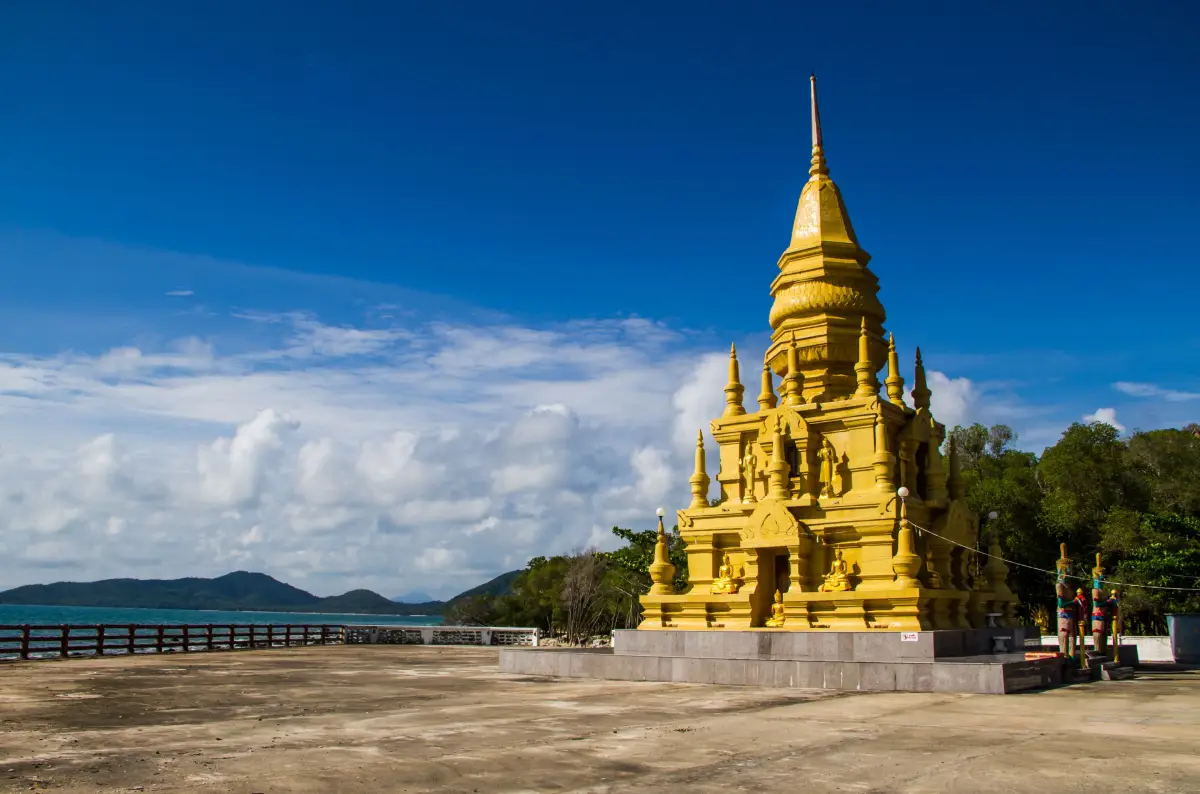
Wat Chedi Laem Sor
Open Days: Daily
Opening Hours: 08.00 – 17.00
Wat Phra Chedi Laem Sor in Surat Thani Province is one of the most distinctive seaside Buddhist sites on Koh Samui. Located in the southern part of the island, near the boundary between Ban Thale in Na Mueang Subdistrict and Ban Thong Krut in Taling Ngam Subdistrict, the temple is best known for its golden seaside pagoda, the relics enshrined within it, its ship-shaped ordination hall, and its connection with Luang Pho Daeng Tisso, a revered monk of Koh Samui.
The temple stands in a calm coastal setting far from the busier tourist zones of Chaweng, Lamai, and Bophut. This location gives Wat Phra Chedi Laem Sor a peaceful character. Visitors come here not only to take photographs of the golden pagoda by the sea, but also to pay respect to the Buddha relics, learn about local Buddhist history, and experience a quieter side of Koh Samui where religion, community memory, and coastal landscape remain closely connected.
Wat Phra Chedi Laem Sor is an old temple that existed before the Sangha Act of 1941. Because it was omitted from earlier surveys, it was officially registered as a temple on 17 February 2011. This background makes the temple historically interesting: its roots in local religious life are older than its official administrative registration. It reflects the way Buddhist places on islands often began from community faith, monastic practice, and local devotion before being formally recorded by modern institutions.
The name Laem Sor is closely tied to the southern coastline of Koh Samui. The area is associated with coastal villages, fishing communities, quiet beaches, and roads leading toward Thong Krut, Phang Ka, and Taling Ngam. Unlike temples located in towns or on busy roads, Wat Phra Chedi Laem Sor sits close to the sea. The sound of waves, the open sky, the line of casuarina trees, and the golden pagoda together create a setting that feels calm, spacious, and deeply local.
The main sacred structure is the golden Laem Sor Pagoda. The pagoda was built by Luang Pho Daeng Tisso, a monk highly respected by the people of Koh Samui and Koh Pha-ngan. Its exterior is covered with golden tiles, and inside it enshrines Buddha relics. For Buddhist visitors, the pagoda is a place of worship and blessing. For cultural travelers, it is an important example of how local faith shaped a seaside landmark that has become one of the most memorable religious sites in southern Koh Samui.
The pagoda’s position by the sea is one of its strongest features. Seen with rocks, waves, and the shoreline behind it, the golden structure looks especially striking in the morning light. Many travelers visit at sunrise or early in the day because the gold surface of the pagoda glows against the blue sea and sky. Late afternoon is also a good time to visit, especially for those who prefer a quieter walk around the temple grounds and softer light for photography.
Another important feature of the temple is the ship-shaped ordination hall. The lower part of the structure functions as a vessel for storing rainwater for temple use, while the upper part enshrines a model of Luang Pho Daeng. This design is meaningful because it reflects the maritime identity of Koh Samui. Boats, sea routes, fishing, and coastal travel have long shaped island life, and the ship-shaped ordination hall connects Buddhist architecture with the everyday world of a seafaring community.
Wat Phra Chedi Laem Sor should be understood as more than a scenic landmark. Its value comes from the combination of Buddhist worship, local memory, craftsmanship, and landscape. Visitors can pay respect to the relic pagoda, learn about Luang Pho Daeng, observe the ship-shaped ordination hall, walk beneath the trees near the beach, and appreciate the atmosphere of a temple that remains grounded in local religious life rather than mass tourism.
The history of Laem Sor Pagoda reaches back further than the present seaside structure. An older pagoda was built on a small hill in southern Koh Samui around 1907 under Phra Khru Wiboon Thammasan, also known as Phet Tisso, a former ecclesiastical leader of Koh Samui. Local craftsmen helped build it using coral-stone blocks instead of ordinary fired bricks, with traditional binding materials made from local natural substances. This construction method shows the resourcefulness of island communities and the strong faith that supported the work.
Local accounts describe the old pagoda as a collective effort by people from across Koh Samui. Large numbers of villagers helped pass construction materials from the lower ground up toward the hilltop site. When the pagoda was completed, Buddha relics that Phra Khru Wiboon Thammasan had received from Sri Lanka were enshrined inside it. From that point, the pagoda became an important sacred monument for the people of Koh Samui.
In 1967, lightning struck the older hilltop pagoda and damaged its upper structure. Luang Pho Daeng Tisso then initiated the construction of a new pagoda on the lower seaside area and moved the Buddha relics into the new structure. This seaside pagoda became the form of Laem Sor Pagoda that most visitors know today. The older pagoda on the hill was later restored by the Fine Arts Department in 2004, adding another important layer to the site’s conservation history.
For this reason, Wat Phra Chedi Laem Sor has a layered history. It is not only a beautiful golden pagoda by the sea, but also part of a longer story involving an earlier hilltop relic pagoda, damage from lightning, the work of Luang Pho Daeng, the relocation of Buddha relics, and later heritage restoration. Understanding this background makes a visit more meaningful because the present pagoda represents continuity rather than a single isolated structure.
Luang Pho Daeng Tisso is central to the identity of the temple. He was born on a Wednesday, the 11th waxing day of the third lunar month, in 1891 at Ban Khao Puk, Koh Samui, Surat Thani Province. His parents were Kaew and On Thongruang. He first ordained at the age of 21 at Wat Samret and later ordained again at the same temple. His life became strongly associated with meditation practice, pilgrimage, monastic discipline, and the development of Buddhist sites across Koh Samui.
Luang Pho Daeng was respected by people on Koh Samui and Koh Pha-ngan as a monk of discipline, compassion, and spiritual practice. Local stories about him remain part of the island’s oral memory, but the deeper meaning of his legacy lies in the way he inspired faith and contributed to religious life. His role in building and developing the Laem Sor seaside pagoda made Wat Phra Chedi Laem Sor a living place of devotion rather than only a monument.
He passed away in 1976 after a passenger boat traveling between Koh Samui and Ban Don sank at sea. This event became part of the collective memory surrounding the temple. Visitors who come to Wat Phra Chedi Laem Sor therefore encounter not only Buddhist architecture but also a story of a revered monk whose life and passing remain deeply remembered by local people.
The temple also expresses the relationship between Buddhism and the sea. Koh Samui has long been shaped by fishing, boats, coastal routes, and island travel. A seaside temple, a golden relic pagoda, and a ship-shaped ordination hall all reflect that cultural world. Wat Phra Chedi Laem Sor is therefore an excellent place to understand how Buddhist faith on Koh Samui developed in harmony with the island’s coastal environment.
Visitors should spend time at the pagoda courtyard, the ship-shaped ordination hall, the Luang Pho Daeng area, the casuarina-lined beach, and the open seaside viewpoint. The site is not large, but it deserves slow observation. Its strength is not in grand scale, but in atmosphere, detail, history, and the way the golden pagoda stands between the temple grounds and the sea.
Photography is popular here, especially around the golden pagoda and the beach. However, visitors should remember that this is an active religious site. Dress respectfully, avoid beachwear inside the temple area, do not climb on religious structures, and avoid posing in ways that are inappropriate near the pagoda. The best photographs are those that preserve the dignity of the place while showing its unique seaside character.
Getting There is easiest by car, motorbike, or hired vehicle. The temple is located in the southern part of Koh Samui near the 4170 road. From the local Durian Garden intersection route, travel about 3 kilometers, turn right onto Road 4170 for about 2 kilometers, then follow the sign and turn left for about 1.5 kilometers to reach Wat Phra Chedi Laem Sor. The final approach leads toward the seaside temple area.
Wat Phra Chedi Laem Sor can be combined with other southern Koh Samui attractions such as Wat Khao Chedi, Thong Krut Beach, Phang Ka, Samui Snake Farm, Na Muang Waterfall, Koh Taen, and Koh Madsum. This route is suitable for travelers who want to explore a quieter part of Koh Samui, with temples, beaches, local food, small communities, and coastal scenery in one trip.
For practical planning, allow around 45 minutes to 1 hour for a basic visit, or longer if you want to take photographs, walk around the beach area, and continue to nearby attractions. Morning is best for cooler weather and sunrise light. Late afternoon is better for a calm atmosphere and softer light. During midday, the open seaside area can be hot, so visitors should bring water, sun protection, and comfortable footwear.
Wat Phra Chedi Laem Sor reveals a side of Koh Samui that beaches and resorts alone cannot show. It is a place where golden Buddhist architecture, relic worship, local monk history, seafaring identity, and quiet coastal scenery meet. For travelers seeking cultural depth on the island, this temple is one of the most worthwhile stops in southern Koh Samui.
| Name | Wat Phra Chedi Laem Sor |
| Location | Near the boundary between Ban Thale, Na Mueang Subdistrict, and Ban Thong Krut, Taling Ngam Subdistrict, Ko Samui District, Surat Thani Province, Thailand |
| Address | Moo 4, Na Mueang Subdistrict, Ko Samui District, Surat Thani 84140, Thailand |
| Coordinates | 9.41174, 99.96904 |
| Highlights | Golden seaside pagoda enshrining Buddha relics, ship-shaped ordination hall, Luang Pho Daeng model, quiet beach setting, and casuarina trees by the shore |
| History | An old temple that existed before the Sangha Act of 1941 and was officially registered as a temple on 17 February 2011 |
| Important Sacred Objects | Laem Sor Pagoda, Buddha relics, ship-shaped ordination hall, model of Luang Pho Daeng Tisso, and the seaside worship courtyard |
| Main Areas / Zones | Seaside Pagoda Courtyard, Ship-Shaped Ordination Hall, Luang Pho Daeng Worship Area, Casuarina Beach Area, Seaside Viewpoint, Parking Area |
| Important Figure | Luang Pho Daeng Tisso, the monk who built the seaside relic pagoda and remains highly respected by the people of Koh Samui and Koh Pha-ngan |
| Current Status | Open for worship, merit-making, relic veneration, and cultural visits by the sea |
| Open Days | Daily |
| Opening Hours | 08.00 – 17.00 |
| Admission Fee | Free Admission |
| Travel Information | Use Road 4170 in southern Koh Samui. From the Durian Garden intersection route, travel about 3 km, turn right onto Road 4170 for about 2 km, then follow the sign and turn left for about 1.5 km to the temple |
| Nearby Tourist Attractions | 1. Laem Sor Beach, about 0 km 2. Wat Khao Chedi, about 1 km 3. Krua Jum Phao / Ban Thong Krut Area, about 2 km 4. Samui Snake Farm, about 3 km 5. Samui Aquarium And Tiger Zoo, about 6 km 6. Na Muang Waterfall, about 6 km |
| Nearby Restaurants | 1. Krua Jum Phao Koh Samui, about 2 km 2. Khanom Jeen Phi Mon, about 3 km 3. Baan Suan Lung Khai, about 8 km, Tel. 098-015-2845, 083-984-5629 4. Krua Chao Baan, about 12 km 5. Lung Jai Gai Yang Som Tam, about 12 km |
| Nearby Accommodations | 1. Samahita Retreat, about 1 km 2. Shanti Samui Resort, about 1 km, Tel. 098-669-8110 3. Stolland Beach Resort Villas, about 1 km, Tel. 095-808-6017 4. Centra by Centara Coconut Beach Resort Samui, about 5 km, Tel. 077-270-670 5. Avani+ Samui Resort, about 8 km, Tel. 077-485-299 |
Frequently Asked Questions (FAQ)
Q: Where is Wat Phra Chedi Laem Sor located?
A: Wat Phra Chedi Laem Sor is located in southern Koh Samui near the boundary between Ban Thale in Na Mueang Subdistrict and Ban Thong Krut in Taling Ngam Subdistrict, Surat Thani Province.
Q: What are the opening days and hours of Wat Phra Chedi Laem Sor?
A: The temple is open daily from 08.00 to 17.00.
Q: Is there an admission fee at Wat Phra Chedi Laem Sor?
A: No. Admission is free.
Q: What is the main highlight of Wat Phra Chedi Laem Sor?
A: The main highlight is the golden seaside pagoda that enshrines Buddha relics, together with the ship-shaped ordination hall and the peaceful coastal setting.
Q: Who was Luang Pho Daeng Tisso?
A: Luang Pho Daeng Tisso was a revered monk of Koh Samui who built the seaside relic pagoda and developed the temple. He passed away in 1976 after a passenger boat accident between Koh Samui and Ban Don.
Q: When is the best time to visit Wat Phra Chedi Laem Sor?
A: Morning is ideal for sunrise light and cooler weather, while late afternoon is good for a quiet walk and softer photography conditions.
Q: How do visitors get to Wat Phra Chedi Laem Sor?
A: Use Road 4170 in southern Koh Samui and follow signs toward Laem Sor. A private car, motorbike, or hired vehicle is the most convenient option.
Q: What nearby places can be visited with Wat Phra Chedi Laem Sor?
A: Nearby places include Wat Khao Chedi, Laem Sor Beach, Thong Krut, Samui Snake Farm, Samui Aquarium and Tiger Zoo, Na Muang Waterfall, Koh Taen, and Koh Madsum.
 Category: ●Places of Worship
 Group: ●Temple
Last Update : 2 MonthAgo
 Last Update : 2 MonthAgo
 Click to Access the Navigation Map GPS
Wat Chedi Laem Sor Map
Recommend

 Art, Culture and Heritage
 Landmarks and Memorials(1)
 Art, Craft Centres, Tradition(8)
 Museums(5)
 Educational Places
 Educational Gardens, Farm(1)
Temple(32)
Educational Gardens, Farm(1)
Temple(32)
 Other Sacred Sites(8)
 Research and Development
 Royal Project(1)
 Suburban Living
 Village, Community(6)
 Local Market(1)
 Nature and Wildlife
 National Parks and Marine Reserves(8)
 Mountain (Doi)(2)
 Dam, Reservoir, Lake(8)
 Waterfalls(34)
 Hot Springs(7)
 Caves(18)
 River, Canal(11)
 Bays and Beaches(30)
 Islands(16)
 Other natural attractions(10)
 Entertainment and Agricultural
 Animal camps and shows(6)
 Farms, Parks and Ecotourism(7)
 Outdoor and Adventure Activities(2)
 Shopping
 Shopping and Night Market(1)
 Travel Articles, Recipes
 Travel Review, Food Review(1)
 Southern Food Menu, Southern Food Recipes(1)


