
lovethailand home >South Travel Attractions >Songkhla Travel Attractions >Singha Nakhon >Sathing Mo > Marrying the Tree Spirit Tradition
TL;DR: Marrying the Tree Spirit Tradition is located at Ban Mamuang Mu, Moo 4, Sathing Mo Subdistrict, Singhanakhon District, Songkhla 90280, Thailand.
Marrying the Tree Spirit Tradition
Ritual Period: From the 6th lunar month to the last day of the 8th lunar month, usually on a Tuesday or Saturday that does not fall on a Buddhist holy day, with the ritual performed from morning until noon
Cultural Area: Moo 4, Ban Mamuang Mu, Sathing Mo Subdistrict, Singhanakhon District, Songkhla Province
The Marrying the Tree Spirit Tradition in Songkhla is one of the most distinctive local belief traditions of Ban Mamuang Mu in Sathing Mo Subdistrict, Singhanakhon District, Songkhla Province. The belief centers on Thuat Mae Muang Thong, also known as Chao Mae Muang Thong, a female tree spirit, guardian spirit, and ancestral figure respected by the local community. This tradition is not marriage in a legal or ordinary social sense. It is a symbolic ritual of respect, vow fulfillment, apology, spiritual protection, and the continuation of a relationship between family lines and a sacred guardian of the village.
The uniqueness of the tradition lies in the way it adopts the structure of a local wedding ceremony and transforms it into a ritual of spiritual obligation. The groom presents a ceremonial khan mak procession, offerings, ritual trays, flowers, candles, betel, sweets, fruit, and other ritual items. A ritual master, locally called Nai Yun, Nai Muen, Nai Mon, or Nai Mherin, prepares and manages the ceremonial trays. A ritual specialist leads the groom in paying respect to the Triple Gem, inviting deities and sacred beings, and informing Thuat Mae Muang Thong of the ritual. The result is a layered ceremony combining Buddhism, Brahmanic elements, ancestor worship, tree-spirit belief, and southern Thai community practice.
The tradition is rooted in Ban Mamuang Mu, Moo 4, Sathing Mo Subdistrict, Singhanakhon District. It is closely connected with Wat Mamuang Mu, an old and important temple in the Singhanakhon area. The temple is associated with several local belief practices, including paying respect to Thuat Mae Muang Thong, worshipping the great tree, marrying Mae Muang Thong, and marrying the tree spirit. Wat Mamuang Mu also preserves local heritage elements such as an old ordination hall, traditional wooden structures, the monument of the grateful buffalo, and stories that connect the temple with the cultural memory of the community.
The legend of Thuat Mae Muang Thong has several versions. One version says that, while alive, the spirit had roots in the area of Wat Mamuang Mu and was the daughter of Ya Chan and Ta Choem, known locally as Pho Chao and Mae Chao. They did not marry, and their house land was later offered for the building of a temple. After death, the woman appeared to villagers and entered their dreams, telling them that she lived at the great mango tree. Villagers began making vows to her when they faced illness, hardship, or trouble, and continued worshipping her after their wishes were fulfilled.
Another version says that Mae Muang Thong was a noble daughter, or the daughter of the ruler of Nakhon Si Thammarat, who was killed and hidden inside the hollow of a great mango tree at the present temple area. Later, her spirit repeatedly revealed miraculous signs, leading villagers to respect her, make offerings, and seek her help. Although the details of the stories differ, their shared core is the belief that Mae Muang Thong is a powerful female spirit associated with a sacred tree and capable of protecting or assisting the community.
The name Thuat Mae Muang Thong carries strong local meaning. In southern Thai belief, the word “thuat” can refer not only to an ancestor by blood, but also to a sacred guardian spirit of a place. The name “Muang Thong” is linked to the great mango tree and to the dream image of a beautiful woman covered with gold ornaments, including bracelets, anklets, necklaces, and hairpins. Her shining appearance, combined with her connection to the mango tree, gave rise to the name Mae Thuat Muang Thong.
Originally, villagers believed that Mae Muang Thong resided in a large hollow mango tree near Wat Mamuang Mu. The trunk was large enough for several people to enter. When the mango tree naturally fell and decayed, only the inner core remained. The villagers moved the remaining core and leaned it against a large Inthanin tree nearby. In 1965, when the temple needed that area for constructing an abbot’s residence, the Inthanin tree was cut down, and a sacred transfer ritual was performed to invite Mae Muang Thong to reside in a Pradu tree at the western corner of the temple.
This transfer of the spirit’s dwelling was a major event in the development of the tradition. It was not merely the movement of a physical object or image. It was the relocation of the community’s sacred center. The ritual was conducted with solemnity, using 12 kinds of offerings prepared by a ritual specialist. After the transfer, villagers moved their ceremonies to the Pradu tree area, which later became associated with the Saturday market area of the community.
In 1968, during a great-tree worship ceremony, Mae Muang Thong was believed to have possessed Nang Hiang, an assistant in the khan mak preparation. Through the medium, the spirit said that she could no longer remain at the Pradu tree because the base of the tree had become part of the market area and was being dirtied by waste. She then instructed devotees to move the worship to a Tabaek tree behind the market, about 30 meters west of the Pradu tree. From that time, the Tabaek tree became an important ritual site and the present place associated with the statue of Mae Muang Thong.
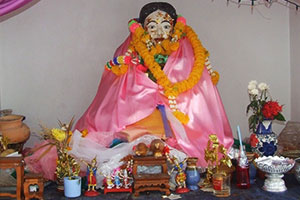
The statue of Mae Muang Thong is central to the present ritual landscape. It gives physical form to a belief that once centered on a tree spirit. The statue was made by Nai Phian Banlangko when he was a monk at Wat Mamuang Mu, after descendants of Mae Muang Thong asked him to make an image of their ancestral guardians. The statue was first placed beneath a temple residence and was later moved to the Tabaek tree. A roof was built to protect it from sun and rain. Today, devotees cover the statue with colored cloth and gold leaf as a sign of faith.
The purpose of the Marrying the Tree Spirit tradition operates on several levels. First, it provides spiritual reassurance for people facing illness, trouble, or uncertainty. Second, it preserves an old belief tradition that has long belonged to the Ban Mamuang Mu community. Third, it encourages local people and younger generations to recognize, study, and continue their cultural heritage. The ceremony is therefore both a ritual of faith and a mechanism of cultural transmission.
The tradition is also connected with becoming a descendant or devotee of Mae Muang Thong. Some family lines believe that once a child or descendant has been entrusted to the spirit, the eldest son or a son reaching ordination age must perform the symbolic marriage before becoming a monk. After the ritual, he may later marry a woman in ordinary life according to normal custom. The ritual does not prevent human marriage. It serves as an act of respect and fulfillment of a spiritual promise between the family and the guardian spirit.
Another form of participation involves vow fulfillment. A person who does not belong to a hereditary devotee line may have once made a vow to Mae Muang Thong during illness, distress, or difficulty. If the wish was fulfilled, the person may return to perform the symbolic marriage as an act of repayment. The ceremony therefore includes both inherited obligation and vow fulfillment. During the ritual, the specialist states whether the groom is performing it as part of ancestral lineage duty or as a vow to be released from spiritual obligation.
The ritual period runs from the 6th lunar month to the final day of the 8th lunar month. The preferred days are Tuesday or Saturday, provided they do not fall on a Buddhist holy day. The ritual is usually performed from morning to noon. These details matter because the ceremony is not arranged only according to convenience. It follows a local ritual calendar and depends on the readiness of the host family, ritual master, ritual specialist, relatives, and the sacred timing recognized by the community.
Preparation begins in the evening before the ritual day. If the ceremony is to be held on Saturday, the khan mak is prepared on Friday evening. The ritual master is responsible for obtaining, arranging, and checking the ceremonial items. The khan mak components can be grouped into three categories: items of worship, items of offering, and auspicious leaves, along with the ceremonial weapon carried by the groom.
The worship items include one tray of flowers and two sets of incense and candles. The offering items include betel and areca nut, a ritual khan mak head fee of 101 baht, and traditional sweets such as khanom phong, khanom la, khanom cho hu or khanom cho ru, red and white sweets, sesame and bean sweets, ya nom, fish-shaped sweets, sweet sticky rice, soft-joint sweets, and fruit such as coconut, sugarcane, banana, orange, and pomelo. These items are not merely objects. They form a ritual language of respect, fertility, readiness, and devotion.
Khanom phong, khanom la, and khanom cho ru are especially important and cannot be omitted. These sweets are also associated with the southern Thai Tenth Lunar Month merit-making tradition. Their presence in the tree-spirit marriage ritual links the ceremony to ancestral remembrance, merit-making, and the symbolic feeding of unseen beings. Food in this ritual is therefore more than nourishment. It is a medium connecting the living, ancestors, and sacred powers.
The khan mak is arranged at the groom’s house. A cloth ceiling is hung above the preparation area to invite deities and ancestral spirits to witness the ceremony. A white cloth is spread beneath the trays. Five silver bowls are prepared for the principal khan mak sets, including the head khan mak, chin khan mak, neck khan mak, and comparable khan mak sets. Auspicious leaves are placed at the bottom of the bowls, including Pradu leaves, Bai Ngoen, Bai Thong, and Bai Thonglang. Betel packets made from banana leaf are then placed inside.
The number of betel packets follows specific ritual rules. The head khan mak contains 13 packets, the chin khan mak contains 11 packets, the neck khan mak contains 7 packets, and two comparable khan mak sets contain 7 packets each. Each packet contains betel leaves with lime and sliced areca nut, with 9 betel leaves in each packet. These numbers reflect ritual order and expertise. The khan mak must be correct not only in appearance, but also in symbolic structure.
In addition to the main khan mak sets, there are also Chian Chao Bao, Chian Rat, and Chian Ngoen. Chian Chao Bao contains betel, tobacco, or in modern practice sometimes cigarettes. Chian Rat contains 112 baht as the ritual master’s teacher fee. Chian Ngoen contains 101 baht as the symbolic bride price, which the ritual specialist later offers to the temple. Once the initial trays are arranged, deities and ancestral spirits are invited. Candles are lit at the household altar, in front of ancestral photographs, and in the prepared khan mak sets.
On the ritual day, the groom dresses formally. He wears a jong kraben, a long-sleeved shirt, leather shoes, white knee-length socks, and a kris tucked at the front side of the waistcloth. This outfit marks him as a ritual groom and also reflects the multi-cultural history of Songkhla and Singhanakhon, where Buddhist, Muslim, Malay, Brahmanic, Chinese, and local spirit traditions have long interacted.
In the past, the khan mak procession involved walking, drums, singing, dancing, and festive movement. Today, walking processions are less common. Often, the procession is performed briefly when leaving the house and again when arriving at the ritual site. Young unmarried women traditionally carry the khan mak. After handing the trays to the ritual master, they sit nearby while the main ritual proceeds. Friends of the groom may continue music and dance at a place where they do not disturb the ceremony.
At the shrine area of Mae Muang Thong, two main ritual roles operate together: the ritual specialist and the ritual master. The ritual master receives and arranges the khan mak, presents the offerings to Mae Muang Thong, and later offers leftover portions to her attendants. The ritual specialist leads the groom and relatives in Buddhist worship, invites deities and sacred beings, and guides the groom through the mat-and-pillow prostration. Their duties are distinct but connected, and they converge during the blessing and purification of the groom.
When the ritual master receives the khan mak from the young women, the trays are placed in the correct order. The wrapping is opened, and candles from the small-candle tray are lit in every khan mak vessel so that Mae Muang Thong may see that the offerings are complete and correct. The ritual master then dips betel leaves in liquor and opened young coconut water and sprinkles the offering items. This marks the formal presentation of the offerings to Mae Muang Thong.
The ritual specialist spreads a new mat, blanket, and white cloth for the groom and places a new pillow in front of him. The groom lights incense and candles before the life-size statue of Mae Muang Thong. The participants chant Namo three times, recite a brief homage to the Triple Gem, and invoke deities, sacred beings, and Mae Muang Thong to witness the ceremony. This sequence shows that the ritual is not separated from Buddhism, but combines Buddhist practice with ancestor and tree-spirit belief.
The mat-and-pillow prostration is a key moment. The ritual specialist prepares four kinds of items: 3 betel leaves, 3 pieces of areca nut, 3 flowers, and 3 one-baht coins. These are divided into three equal groups and placed on the pillow in front of the groom. The groom says “Buddhang Vandami” and sweeps the left group to the side, says “Dhammang Vandami” and sweeps the right group, then says “Sanghang Vandami” and gathers the middle group into his personal tray as auspicious objects. In some versions, only the coins are kept as a lucky charm for livelihood and prosperity.
After this step, the ritual specialist informs Mae Muang Thong why the groom has come. If the ritual is hereditary, he states that the groom is following the lineage practice passed down from the ancestors. If the ritual is vow fulfillment, he states that the groom is performing the ceremony because of a vow and seeks release from obligation. This spoken explanation is important because the ceremony clarifies and settles the relationship between the groom, family, and sacred guardian.
During the offering phase, the ritual master tells the ancestral guardians and Mae Muang Thong that the descendants have come to pay respect. If the ritual is a vow fulfillment, this is stated clearly. The ritual master asks that the obligation be released and that the descendants not be spiritually troubled. Candles are used to inspect the khan mak trays, and the ritual master declares that the offerings have been correctly prepared. Betel leaves are dipped and used to sprinkle the offerings. The main offering to Mae Muang Thong is then complete.
After the main offering, a small portion of every offering item is set aside as “loi den loi chan,” or leftover offerings, for the attendants of Mae Muang Thong known as the holders of the water-gong group. The ritual master places these portions on banana leaves and divides them into four groups: two for the ancestors of Mae Muang Thong and two for her attendants. They are placed at the base of the Tabaek tree with a glass of liquor and one candle. This shows that the ritual acknowledges not only Mae Muang Thong herself, but also her surrounding spiritual retinue.
In some cases, if the ritual master is a medium, relatives may request Mae Muang Thong to possess the medium and bless the descendants. The medium’s trembling signals the arrival of the spirit. Mae Muang Thong then rises through the medium, takes the kris from the tray, inspects the khan mak, and declares that it has been correctly arranged. Drums are then played, and the possessed medium dances with the kris while relatives clap in rhythm. Some descendants join the dance. The scene carries devotion, warmth, and the emotional unity of the family group.
The final phase includes blessing and purification. The ritual specialist, ritual master, parents, and relatives bless the groom and purify him with the flame of a candle. Flowers that have already been offered to Mae Muang Thong are distributed to participants. The blessing chant, usually Chayanto, is recited while flowers are thrown gently toward the groom. As flowers fall onto his clothing, they symbolize blessing, auspiciousness, and acceptance by the family and community.
After the ceremony, the khan mak items are distributed among those who carried the trays and those involved in the ritual. Food is served to participants at the host family’s place. This meal is not only hospitality. It completes the social side of the ritual, thanking helpers and reinforcing relationships among relatives, neighbors, and ritual participants. The tradition is therefore both sacred and social.
From an anthropological perspective, the Marrying the Tree Spirit tradition organizes relationships between people, sacred beings, ancestors, and community. Men about to enter the monkhood pass through a symbolic act of apology, devotion, and blessing before taking on a new religious status. The ritual can therefore be read as a rite of passage from youth into religious and social responsibility.
The tradition also reflects the cultural negotiation of Singhanakhon, an old area where Buddhist, Muslim, Chinese, Malay, Brahmanic, and local spirit traditions have coexisted. Elements such as Buddhist chanting, invocation of deities, ancestral offerings, the kris, wedding procession, traditional sweets, drumming, dancing, and communal meals all point to a complex cultural environment. The ritual should not be reduced to a strange custom. It is a community mechanism for managing belief, obligation, transition, and identity.
For cultural travelers, Wat Mamuang Mu is the most relevant starting point for learning about this tradition because it is directly connected with the legend of Mae Muang Thong. Visitors can observe the old temple setting, learn about the story of the sacred tree spirit, pay respect respectfully at the shrine area, and connect the visit with other heritage sites in Singhanakhon such as Wat Sathit Chonlathan, Wat Lokaram, Wat Salak Pa Kao, old Songkhla city walls, Hua Khao Daeng, Bo Keng, and related cultural sites around Songkhla Lake.
Getting There is possible from Songkhla city by crossing to the Singhanakhon side or by driving across the Tinsulanonda Bridge through Ko Yo and continuing toward Singhanakhon District. From there, travel toward Sathing Mo Subdistrict and Ban Mamuang Mu. The route is suitable for private cars, motorcycles, taxis, or local transport. Visitors interested in the tradition should combine the trip with historical and cultural places in Singhanakhon and Songkhla to understand the temple, village, lake, old routes, and local beliefs as a connected cultural landscape.
Visitor etiquette is important. Dress modestly, keep quiet, do not touch the statue or offerings without permission, do not photograph the ritual in a disrespectful way, and do not disturb participants. This is a living community belief connected with family obligations and local memory. Learning about it should be done with respect toward the community that preserves it.
Today, the Marrying the Tree Spirit tradition remains valuable as cultural heritage of Songkhla. Some forms of the ceremony have changed with time, including shorter processions, the use of cars, and adjustments to some ritual items. However, the core remains: paying respect to Mae Muang Thong, preparing khan mak, fulfilling vows, asking forgiveness, receiving blessings, and maintaining the bond between descendants and the ancestral guardian of Ban Mamuang Mu.
The Marrying the Tree Spirit tradition in Songkhla is much deeper than its unusual name suggests. It brings together sacred female legend, a great tree, ancestral spirits, khan mak offerings, ritual sweets, the kris, procession, spirit possession, blessing, and family-line transmission. It shows that Songkhla and Singhanakhon are not only landscapes of temples, old walls, and the lake, but also landscapes of belief where people, trees, ancestors, temples, and community memory remain closely connected.
| Tradition Name | Marrying the Tree Spirit Tradition in Songkhla / Marriage to Mae Muang Thong / Marriage to the Sacred Tree |
| Category | Southern Thai local belief tradition, vow-fulfillment ritual, ancestral-spirit rite, and symbolic marriage ceremony |
| Cultural Area | Moo 4, Ban Mamuang Mu, Sathing Mo Subdistrict, Singhanakhon District, Songkhla Province |
| Related Site | Wat Mamuang Mu and the shrine area of Thuat Mae Muang Thong in Ban Mamuang Mu |
| Address | Ban Mamuang Mu, Moo 4, Sathing Mo Subdistrict, Singhanakhon District, Songkhla 90280, Thailand |
| Coordinates of Wat Mamuang Mu Area | 7.2363033, 100.5206118 |
| Ritual Period | From the 6th lunar month to the last day of the 8th lunar month |
| Preferred Ritual Days and Time | Tuesday or Saturday, not on a Buddhist holy day, usually from morning until noon |
| Significance | A ritual of respect, vow fulfillment, apology, blessing, and continuation of family-line relationships with Thuat Mae Muang Thong |
| Sacred Figure | Thuat Mae Muang Thong or Chao Mae Muang Thong, respected as a female tree spirit, guardian spirit, and ancestral protector of the community |
| Main Legend | Mae Muang Thong is linked with the great mango tree at Wat Mamuang Mu and is believed to have revealed miraculous signs, leading villagers to worship, make vows, and conduct ritual offerings |
| Main Participants | The ritual groom, especially a male descendant about to be ordained, and those fulfilling vows made to Mae Muang Thong |
| Ritual Leaders | The ritual specialist and ritual master, locally called Nai Yun, Nai Muen, Nai Mon, or Nai Mherin |
| Main Ritual Items | Khan mak trays, flowers, incense, candles, betel, auspicious leaves, khan mak fee, symbolic bride price, khanom phong, khanom la, khanom cho ru, fruit, mat, pillow, white cloth, candles, and the groom’s kris |
| Main Ritual Process | Prepare khan mak at the groom’s house, hold a ceremonial procession to the shrine, receive and inspect the offerings, conduct Buddhist worship, invite deities and Mae Muang Thong, perform mat-and-pillow prostration, present offerings, feed the spirit attendants, bless the groom, and purify him with candle flame |
| Current Status | Recognized as a distinctive local belief tradition and cultural heritage of Ban Mamuang Mu, Singhanakhon District, Songkhla Province |
| Open Days for Wat Mamuang Mu Area | Daily |
| Visiting Hours for Wat Mamuang Mu Area | 08.00 – 17.00 |
| Admission Fee | No admission fee for visiting the temple area; individual ritual performance requires preparation of ritual items and coordination with the local community |
| Caretaker / Related Bodies | Wat Mamuang Mu, Ban Mamuang Mu community, and Singhanakhon Municipality |
| Local Contact Number | Singhanakhon Municipality, Tel. 0-7433-1769 |
| Visitor Etiquette | Dress modestly, keep quiet, respect the shrine, do not touch the statue or offerings without permission, do not disturb rituals, and speak respectfully about local beliefs |
| Nearby Tourist Attractions / Learning Sites | 1. Wat Mamuang Mu, 0 km 2. Wat Lokaram, Sathing Mo, 1 km 3. Wat Salak Pa Kao, Ching Kho, 2 km 4. Wat Sathit Chonlathan, Sathing Mo, 4 km 5. Tinsulanonda Bridge, 6 km 6. Hua Khao Daeng and Old Songkhla City Wall, 7 km 7. Wat Suwan Khiri, 7 km 8. Bo Keng Gateway, 7 km |
| Nearby Restaurants | 1. Singhanakhon Hot Pot, 7 km, Tel. 085-673-4448 2. E&N Coffee Singhanakhon, 7 km, Tel. 099-487-1805 3. Ton Yo Noodle & Pork Bone Soup Singhanakhon, 8 km, Tel. 091-982-5796 4. Bokoei Pa Thaworn Pork Bone Noodles, 8 km, Tel. 084-747-0371, 096-715-0746, 091-764-8959 5. Cher Singhanakhon, 8 km, Tel. 092-263-2805, 082-359-4245 6. Rim Sa Hat Muang Ngam Restaurant, 14 km, Tel. 098-932-8699 |
| Nearby Accommodations | 1. Haad Kaew Resort, 13 km, Tel. 074-331-063 2. Singora Resort, 15 km 3. The Lake House, Ko Yo, 16 km, Tel. 086-965-2382 4. Greenery Hill Resort @ Koyo, 17 km, Tel. 082-889-9941 5. The Singora Hotel, 18 km, Tel. 074-314-555 6. The Luxury Residence Songkhla, 19 km, Tel. 074-321-977 |
Frequently Asked Questions (FAQ)
Q: What is the Marrying the Tree Spirit tradition in Songkhla?
A: It is a local belief tradition of Ban Mamuang Mu in Singhanakhon District, Songkhla Province, in which a symbolic wedding ritual is performed for Thuat Mae Muang Thong, a respected female tree spirit and ancestral guardian.
Q: Who is Thuat Mae Muang Thong?
A: Thuat Mae Muang Thong is a sacred female guardian spirit associated with the great mango tree at Wat Mamuang Mu. Local people respect her as a tree spirit, protective spirit, and ancestral figure.
Q: Where is the ritual associated with?
A: The ritual is associated with Wat Mamuang Mu and the shrine area of Mae Muang Thong at Ban Mamuang Mu, Moo 4, Sathing Mo Subdistrict, Singhanakhon District, Songkhla Province.
Q: When is the ritual performed?
A: The ritual is performed from the 6th lunar month to the last day of the 8th lunar month, usually on Tuesday or Saturday when the day does not fall on a Buddhist holy day, and normally from morning until noon.
Q: Who usually performs the ritual?
A: The ritual is usually performed by male descendants of families that respect Mae Muang Thong, especially men preparing for ordination, as well as people fulfilling vows made to the spirit.
Q: What are the main ritual items?
A: Main items include khan mak trays, flowers, incense, candles, betel, auspicious leaves, ritual money, traditional southern sweets, fruit, mat, pillow, white cloth, candles, and the groom’s kris.
Q: How is the ritual connected with ordination?
A: In some family lines, a male descendant must symbolically marry Mae Muang Thong before entering monkhood as an act of apology, devotion, and blessing.
Q: How should visitors behave at Wat Mamuang Mu?
A: Visitors should dress modestly, keep quiet, respect the shrine, avoid touching the statue or offerings without permission, and refrain from disturbing rituals or speaking disrespectfully about local beliefs.
 Category: ●Art, Culture and Heritage
 Group: ●Art, Craft Centres, Tradition
Last Update : 3 WeekAgo
 Last Update : 3 WeekAgo
Recommend

 Historical Sites and Monuments(2)
 Landmarks and Memorials(7)
 Royal Palace(1)
Art, Craft Centres, Tradition(4)
Royal Palace(1)
Art, Craft Centres, Tradition(4)
 Museums(4)
 Art Gallery(1)
 Educational Places
 Library(1)
 Educational Gardens, Farm(3)
 Places of Worship
 Temple(52)
 Mosque(2)
 Other Sacred Sites(11)
 Suburban Living
 Village, Community(3)
 Local Market(3)
 Floating Market(2)
 Nature and Wildlife
 National Parks and Marine Reserves(5)
 Mountain (Doi)(6)
 Dam, Reservoir, Lake(5)
 Waterfalls(12)
 Caves(4)
 River, Canal(2)
 Bays and Beaches(13)
 Islands(3)
 Other natural attractions(2)
 Entertainment and Agricultural
 Zoos and Aquariums(2)
 Animal camps and shows(1)
 Farms, Parks and Ecotourism(6)
 Travel Articles, Recipes
 Southern Food Menu, Southern Food Recipes(2)


