
lovethailand home >South Travel Attractions >Songkhla Travel Attractions >Rattaphom >Khuha Tai > Khao Khuha
TL;DR: Khao Khuha is located at Khuha Tai Subdistrict, Rattaphum District, Songkhla Province, open Daily, hours Open All Day.

Khao Khuha
Open Days: Daily
Opening Hours: Open All Day
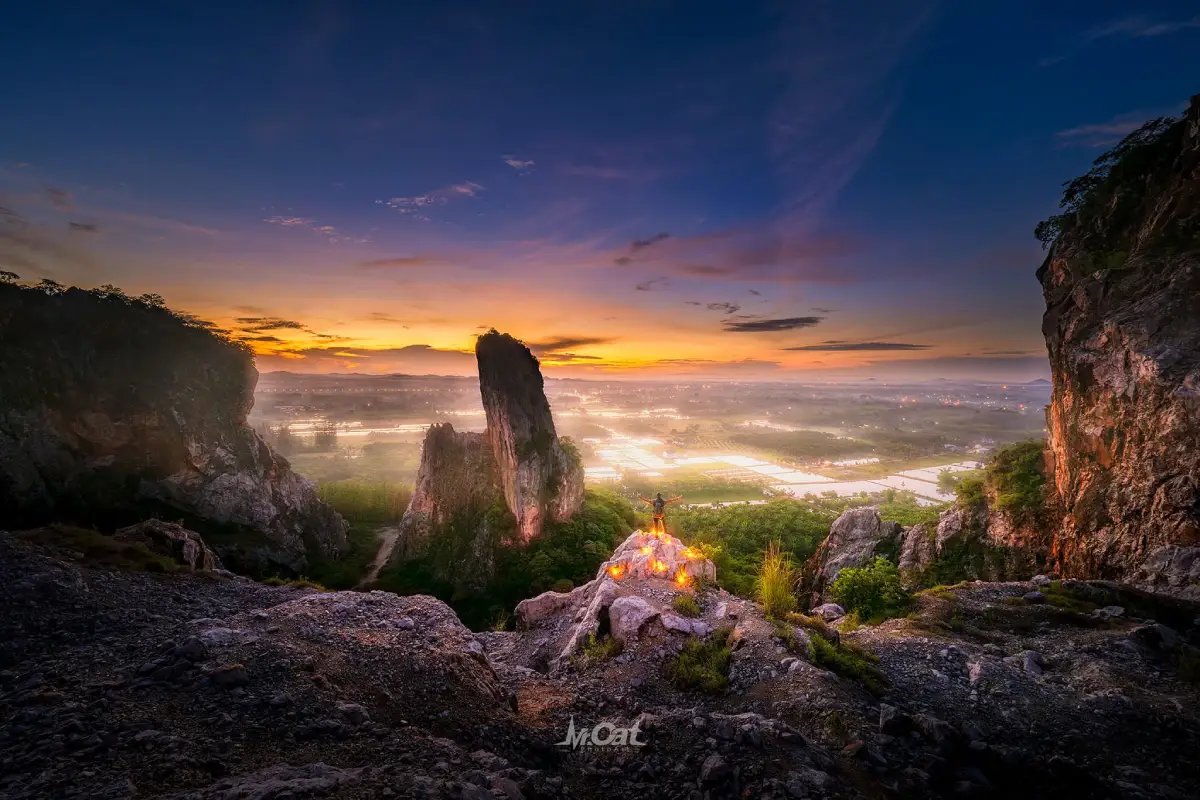
Khao Khuha in Songkhla Province is a striking limestone mountain viewpoint in Khuha Tai Subdistrict, Rattaphum District. Its dramatic landscape was shaped by former quarrying activity, and the site has since become a community nature attraction known for its steep limestone faces, large rocky gorge, pine-lined walking route, surrounding rice fields, panoramic views of Rattaphum, and morning mist. Located within convenient reach of Hat Yai, Khao Khuha is suitable for travelers who want to experience a different side of Songkhla beyond beaches, old-town streets, cafés, and city landmarks.
The visual identity of Khao Khuha comes from both geology and history. The mountain was once used as a limestone quarry, and past blasting changed its natural form into a rugged cliff landscape with layered rock faces, open gaps, and exposed viewpoints. As the quarrying period ended and the local community began to recognize the site’s shared value, Khao Khuha developed into a local nature attraction, an exercise area, and a viewpoint that represents community-based conservation.
Khao Khuha stands in Khuha Tai, an agricultural and foothill area of Rattaphum District. The surrounding landscape includes rice fields, rubber plantations, fruit orchards, small forests, and limestone hills. From the viewpoint, visitors can see how the rural landscape spreads below the mountain. This contrast between rugged limestone cliffs and green agricultural land is one of the reasons Khao Khuha has become one of Songkhla’s most memorable inland viewpoints.
The name Khao Khuha is linked with the older local name Khao Kho Hai. According to local belief, the area around the mountain was once used for grazing cattle and buffalo. Animals were said to disappear repeatedly around the mountain, and local people began calling it Khao Kho Hai, meaning a hill where cattle disappeared. Over time, the pronunciation shifted and the name became Khao Khuha. This story gives the site a local identity beyond its modern role as a viewpoint.
The present importance of Khao Khuha lies in its transformation from a resource-conflict landscape into a place for public use, environmental awareness, and local tourism. The mountain was used for limestone extraction for many years, from small-scale community use to later industrial quarrying. Quarry activity affected the mountain, nearby water sources, dust, noise, and community life. After the concession was not renewed, conservation groups and local residents helped redirect the site toward nature-based tourism and community benefit.
The most recognizable feature of Khao Khuha is the wide gorge between limestone cliffs, with a walking path and pine trees in the middle. Standing inside this rocky corridor gives visitors the feeling of being surrounded by a large mountain passage, even though the hike is relatively short. The cliff walls, open sky, rural fields, and distant hills combine to create a distinctive scene that is highly photogenic and different from most seaside attractions in Songkhla.
The trail begins near the parking area at the foot of the mountain and continues upward through a mix of dirt and rock. The early section is manageable for many visitors, but some parts are steep, loose, or slippery, especially after rain. Proper footwear is important. Sneakers or hiking shoes with good grip are strongly recommended, while sandals or smooth-soled shoes are not suitable for the climb.
Khao Khuha has several viewpoint levels. The first viewpoint is easier to reach and already offers good views of the limestone cliffs and surrounding fields. Higher sections require more effort, and some parts have ropes to help visitors maintain balance. The uppermost areas provide broader views but require greater caution. Visitors should assess their own physical condition and do not need to reach the highest point to enjoy the site.
The best time to visit Khao Khuha is early morning. The weather is cooler, the first light of the day gives the limestone cliffs and fields more depth, and on some mornings mist gathers in the valley and around the lower agricultural areas. Late afternoon is also suitable for views and photography, but visitors should descend before dark because the path is rocky and some sections have limited lighting.
Basic preparation makes the visit safer and more comfortable. Bring sneakers or hiking shoes, drinking water, a hat, sun protection, a fully charged phone, a camera, and a small bag for personal waste. Some upper areas are exposed and have little shade, so visiting late in the morning can feel hotter than expected. Early morning or a mild-weather day gives the best overall experience.
Khao Khuha is suitable for travelers who enjoy viewpoints, unusual landscapes, photography, short hikes, trail running, and community-based nature tourism. It is also meaningful for visitors interested in post-quarry landscape recovery because the site shows how a heavily used natural resource can be reinterpreted as a public and community asset when managed carefully.
Families with young children or elderly travelers should be selective about how far they walk. The lower area and early viewpoint sections are more manageable, while rope-assisted or steep rocky sections should be avoided by visitors with balance problems or limited mobility. Children should be supervised closely, especially on slopes and near exposed rock edges.
Photographers come to Khao Khuha for its varied compositions: limestone cliffs, the rocky gorge, pine trees, fields, morning mist, sunrise light, and the broad Rattaphum landscape. Morning light is soft and atmospheric, while late afternoon creates warm tones on the rock faces. Safety should come before photography. Visitors should not step backward near exposed edges, climb unstable rocks, or continue upward during rain or strong wind.
Khao Khuha is easiest to reach by private car or hired vehicle. From Hat Yai, the drive to Rattaphum and Khuha Tai takes about 30 minutes. Visitors can park near the foot of the mountain, where basic facilities such as parking, toilets, and small shops are available in some periods. From the parking area, follow the signs and trail toward the main photo and viewpoint zones.
Getting There from Hat Yai is straightforward by road toward Rattaphum District and Khuha Tai Subdistrict. As visitors approach the Ban Chang Lon and limestone hill area, Khao Khuha becomes visible from a distance. Navigation maps are useful, but drivers should also watch local signs because some access roads are smaller community roads and may be confusing for first-time visitors.
From Songkhla city, travelers can drive via Hat Yai or connect to Rattaphum routes before entering Khuha Tai. Khao Khuha works well as either a half-day outing or part of a full-day Rattaphum nature route. Private transport is the most convenient option for combining it with Namtok Boriphat Forest Park, Namtok Ton Plew, Namtok Ton Nga Chang, local food stops, or agricultural attractions.
A half-day itinerary can begin from Hat Yai early in the morning, reaching Khao Khuha around sunrise or before the weather becomes hot. Spend 1 to 2 hours hiking, photographing, and enjoying the viewpoint, then continue to a local restaurant or café in Rattaphum. This light route is suitable for travelers who want a short but memorable nature trip without a long trek.
A full-day itinerary can start with Khao Khuha in the morning, followed by local food in Rattaphum, then Namtok Boriphat Forest Park or Namtok Ton Plew in the late morning or afternoon. This route presents several sides of Rattaphum: limestone mountains, rice fields, forest, waterfalls, local food, and agricultural communities.
The main safety concern at Khao Khuha is changing trail condition. After rain, dirt and rocks can become slippery, while mist and moisture can reduce visibility. During hot weather, exposed upper sections can be tiring because shade is limited. Visitors with medical conditions should assess their fitness before climbing and should avoid walking alone to higher or steeper points.
Responsible travel is essential because Khao Khuha is a community nature site with a history of environmental recovery. Visitors should not litter, write on rocks, damage plants, create new trails, climb unsafe areas, or make excessive noise. A good visit should help preserve the mountain’s value, not add pressure to a landscape that the community has worked to protect.
Compared with Songkhla’s better-known attractions, Khao Khuha has a distinct identity. Samila Beach is known for the sea and city symbols, Khao Tang Kuan for city views and historic monuments, and Namtok Boriphat for waterfalls and forest. Khao Khuha stands out for its limestone gorge, unusual post-quarry landscape, rice-field scenery, morning mist, and community conservation story. Adding it to a Songkhla itinerary gives the trip a stronger inland nature dimension.
Overall, Khao Khuha is an excellent destination for travelers who want to see Songkhla’s mountain landscape rather than only its beaches and old town. It offers wide views, a short hike, distinctive limestone cliffs, the local story of Khao Kho Hai, post-quarry environmental recovery, and community-based nature use. With good timing, proper shoes, drinking water, and careful walking, Khao Khuha can become one of the most memorable viewpoints in Songkhla.
| Name | Khao Khuha / Khao Kho Hai |
| Location | Khuha Tai Subdistrict, Rattaphum District, Songkhla Province |
| Address | Khuha Tai Subdistrict, Rattaphum District, Songkhla Province 90180, Thailand |
| Highlights | Former limestone quarry landscape, dramatic rocky gorge, pine-lined trail, Rattaphum viewpoint, rice-field scenery, and morning mist |
| History / Period | Khao Khuha was formerly used for limestone extraction and quarrying. After the concession was not renewed, the local conservation group and community helped develop the area as a nature attraction and local viewpoint. |
| Name Origin | The older name Khao Kho Hai refers to local stories about cattle and buffalo disappearing around the mountain. Over time, the pronunciation shifted to Khao Khuha. |
| Distinctive Features | A stand-alone limestone hill in a foothill and agricultural landscape, with steep cliffs, dirt-and-rock trails, several viewpoint levels, and wide views of Khuha Tai and Rattaphum |
| Travel Information | Accessible by private car or hired vehicle to Khuha Tai, Rattaphum District. From Hat Yai, the drive takes about 30 minutes. Park at the foot of the hill and walk to the viewpoint. |
| Current Status | Open as a local natural site, community viewpoint, exercise area, and nature attraction in Rattaphum District |
| Open Days | Daily |
| Opening Hours | Open All Day |
| Fees | No Admission Fee |
| Facilities | Information signs, parking area, toilets, and small shops in some periods |
| Main Areas / Zones | Foot of the mountain, parking area, trailhead, limestone gorge, pine-lined section, lower viewpoint, middle viewpoint, and route toward the highest viewpoint |
| Caretaker / Related Agencies | Khao Khuha Conservation Group, Khuha Tai community, Khuha Tai Municipality, and forestry agencies involved in eco-tourism development |
| Local Agency Contact | Khuha Tai Municipality, Tel. 074-256-108 |
| Nearby Tourist Attractions | 1. Ban Chang Lon, about 3 km 2. Boriphat Waterfall, about 15 km 3. Namtok Boriphat Forest Park, about 15 km 4. Namtok Ton Plew, about 22 km 5. Namtok Ton Nga Chang, about 30 km 6. Songkhla Royal Palm Project Area, about 18 km |
| Nearby Restaurants | 1. SANTOS COFFEE AND RESTAURANT Rattaphum, about 4 km, Tel. 090-210-8666 2. Nong Nee Restaurant, about 12 km, Tel. 074-389-064, 086-289-0312 3. Khrua Nai Nam, about 15 km, Tel. 062-567-8326 4. Khanom Chin Mae Nong Yao, about 18 km, Tel. 093-751-2828 5. Nat Phop Yung Thong Restaurant, about 20 km, Tel. 084-999-2059, 074-430-285 6. Cha Prai Fon First Branch, about 5 km, Tel. 096-107-8957 |
| Nearby Accommodations | 1. Baan Ai Oon Khun Khao Rattaphum, about 3 km 2. Phumi Sriphum Resort, about 16 km, Tel. 087-290-4196 3. Jasmine Resort Rattaphum, about 19 km, Tel. 061-649-8264 4. Baan Suan Resort Rattaphum, about 18 km 5. Oun I Rak Resort, about 6 km 6. Khum Thong Resort, about 20 km |
Frequently Asked Questions (FAQ)
Q: Where Is Khao Khuha Located?
A: Khao Khuha is located in Khuha Tai Subdistrict, Rattaphum District, Songkhla Province. It is a limestone mountain and community nature viewpoint.
Q: What Are The Main Highlights Of Khao Khuha?
A: The main highlights are its unusual former quarry landscape, limestone gorge, pine-lined trail, rice-field views, panoramic viewpoint, and morning mist.
Q: Is There An Admission Fee For Khao Khuha?
A: No. There is no admission fee for walking up to the Khao Khuha viewpoint.
Q: When Is The Best Time To Visit Khao Khuha?
A: Early morning is the best time because the weather is cooler, the light is softer, and mist may appear around the valley and fields. Late afternoon is also suitable, but visitors should descend before dark.
Q: How Long Does It Take To Walk Up Khao Khuha?
A: The walk from the parking area to the main viewpoint usually takes about 15–30 minutes, depending on pace and how far visitors continue upward.
Q: Is Khao Khuha Suitable For Children And Elderly Visitors?
A: The lower area and early trail sections are more manageable, but steep and rope-assisted sections are not suitable for small children, elderly visitors, or anyone with limited balance.
Q: What Should Visitors Bring To Khao Khuha?
A: Visitors should bring sneakers or hiking shoes, drinking water, a hat, sun protection, a fully charged phone, and a bag for personal waste.
Q: What Nearby Places Can Be Visited With Khao Khuha?
A: Nearby places include Ban Chang Lon, Boriphat Waterfall, Namtok Boriphat Forest Park, Namtok Ton Plew, Namtok Ton Nga Chang, and other attractions in Rattaphum District.
 Category: ●Nature and Wildlife
 Group: ●Mountain (Doi)
Last Update : 2 WeekAgo
 Last Update : 2 WeekAgo
 Click to Access the Navigation Map GPS
Khao Khuha Map
Recommend

 Art, Culture and Heritage
 Historical Sites and Monuments(2)
 Landmarks and Memorials(7)
 Royal Palace(1)
 Art, Craft Centres, Tradition(4)
 Museums(4)
 Art Gallery(1)
 Educational Places
 Library(1)
 Educational Gardens, Farm(3)
 Places of Worship
 Temple(52)
 Mosque(2)
 Other Sacred Sites(11)
 Suburban Living
 Village, Community(3)
 Local Market(3)
 Floating Market(2)
 National Parks and Marine Reserves(5)
Mountain (Doi)(6)
National Parks and Marine Reserves(5)
Mountain (Doi)(6)
 Dam, Reservoir, Lake(5)
 Waterfalls(12)
 Caves(4)
 River, Canal(2)
 Bays and Beaches(13)
 Islands(3)
 Other natural attractions(2)
 Entertainment and Agricultural
 Zoos and Aquariums(2)
 Animal camps and shows(1)
 Farms, Parks and Ecotourism(6)
 Travel Articles, Recipes
 Southern Food Menu, Southern Food Recipes(2)


