
lovethailand home >North Travel Attractions >Phayao Travel Attractions >Muang Phayao >Tha Wang Thong > Wat Ratchakhue Worawihan
TL;DR: Wat Ratchakhue Worawihan is located at Wiang Subdistrict, Mueang Phayao District, Phayao Province, open Daily, hours Contact The Temple Directly Before Entering Important Interior Areas.
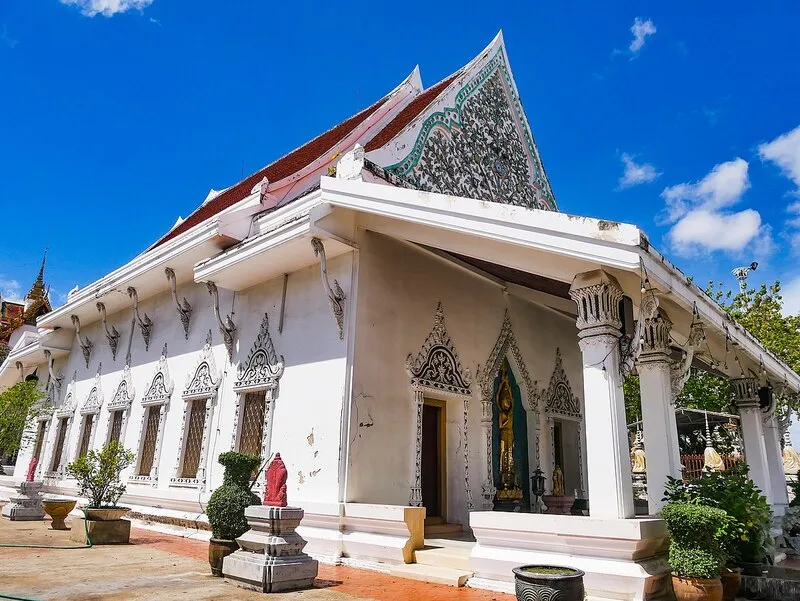
Wat Ratchakhue Worawihan
Open Days: Daily
Opening Hours: Contact The Temple Directly Before Entering Important Interior Areas
Wat Ratchakhue in Phayao Province, also locally known as Wat Mai, is a peaceful Buddhist temple located in the heart of Mueang Phayao. Although it stands within the city area, the temple offers a calm and shaded atmosphere suitable for visitors who want to pay respect to Buddha images, appreciate Lanna-style architecture, and explore a lesser-known cultural site close to Kwan Phayao. Its most distinctive features are the ornate khong-style entrance gateway and the elegant octagonal chedi behind the ordination hall.
The temple is located at 460/3 Phahonyothin Road, Wiang Subdistrict, Mueang Phayao District, Phayao Province. Because of its central location, it is easy to combine with nearby attractions such as the City Pillar Shrine, Kwan Phayao, King Ngam Muang Monument, Wat Si Umong Kham, Wat Li and Wiang Phayao Museum, Wat Tilok Aram, and Wat Si Khom Kham. For travelers interested in old temples and local Buddhist art, Wat Ratchakhue is worth a focused visit.
The entrance gateway is the first highlight visitors will notice. It is a large brick-and-stucco khong gateway decorated with sculpted angels, celestial beings, nagas, floral motifs, and a four-faced Brahma figure at the top. The decoration is rich and eye-catching, yet it still carries the graceful character of Lanna temple art. In northern Thai temple culture, such gateways are more than entrances; they mark the transition from ordinary community space into a sacred Buddhist area.
The figures on the gateway carry symbolic meaning. Nagas are associated with protection and Buddhist faith. Celestial beings and angels suggest auspiciousness and a sacred realm. Floral motifs soften the structure and add decorative rhythm, while the four-faced Brahma at the top gives the gateway a strong visual identity. Visitors should take time to observe the stucco details before entering the temple grounds, as this gateway is one of the temple’s most memorable artistic features.
Inside the temple stands the ordination hall, which houses a gilded sandstone Buddha image. This is significant because Phayao is well known for its sandstone Buddhist sculpture. Sandstone Buddha images appear in many historical and cultural sites across the province, reflecting the skill of local artisans and the importance of stone craftsmanship in Phayao’s Buddhist heritage. The Buddha image at Wat Ratchakhue therefore links the temple with a broader artistic tradition of the city.
Behind the ordination hall is the temple’s chedi, a small but graceful structure that deserves close attention. The chedi is an octagonal indented form, about 20 meters high, set on a square base. It has niches on the 4 sides and subsidiary chedis on the 4 directions. Important parts of the chedi are gilded, giving it a luminous appearance when sunlight falls on the surface. Although it is not a large monument, its proportions and details make it one of the attractive Lanna-style chedis in Phayao city.
The chedi is especially interesting because its form differs from many other Lanna chedis found in Phayao. The octagonal indented shape creates visual depth from every direction. The niches on the 4 sides suggest a sacred orientation toward the cardinal directions, while the subsidiary chedis create balance around the central structure. This composition gives the chedi architectural rhythm and makes it more engaging than its modest size might suggest.
A circumambulatory terrace surrounds the chedi, with a width of about 1.50 meters on each side. A low enclosing wall marks the sacred area, and there are 4 entrance gates. Each gate is guarded by a pair of lion sculptures. This layout reflects the idea of a protected sacred space. Visitors pass through the enclosing wall and the guardian lions before entering the area around the chedi, where they can walk, observe, and pay respect.
The guardian lions are important elements of Lanna Buddhist architecture. They symbolize strength, protection, and sacred guardianship. At Wat Ratchakhue, the presence of lion pairs at all 4 entrances gives the chedi area a strong sense of order and protection. Visitors who enjoy architectural details should walk around the chedi slowly and observe how the lions, gates, enclosing wall, terrace, niches, and subsidiary chedis work together as a complete sacred composition.
Wat Ratchakhue is best appreciated through slow observation. A brief stop may be enough for a quick prayer, but a more meaningful visit should include time to study the gateway, ordination hall, sandstone Buddha image, chedi, circumambulatory terrace, enclosing wall, and guardian lions. Most visitors should allow around 30 to 45 minutes, while those interested in photography or Lanna art may want to spend about 1 hour.
The temple is also suitable for travelers planning a cultural route through central Phayao. Because it is located in town, it can be visited before or after Kwan Phayao. A practical route is to begin at Wat Ratchakhue, continue to Wat Si Umong Kham, visit Wat Li and Wiang Phayao Museum, then go to Kwan Phayao, Wat Tilok Aram, and Wat Si Khom Kham. This route gives travelers a balanced view of Phayao through gateways, chedis, sandstone Buddha images, museums, old temples, and lakeside heritage.
For art and architecture enthusiasts, Wat Ratchakhue offers a compact but valuable example of local Buddhist craftsmanship. The gateway shows refined stucco work. The chedi shows Lanna architectural planning with possible early Chiang Saen influence. The sandstone Buddha image connects the temple with Phayao’s broader stone-carving tradition. Together, these features show that important art in Phayao is not limited to the best-known tourist temples, but is also preserved in smaller community temples within the city.
The atmosphere of the temple is another reason to visit. Despite being in the middle of town, the grounds feel calm and shaded. Visitors can pray inside the ordination hall, walk around the chedi, and rest quietly before continuing to nearby attractions. Morning and late afternoon are good times to visit because the light is softer and the details of the stucco gateway and gilded chedi are easier to appreciate.
Visitors should dress respectfully and behave quietly because Wat Ratchakhue remains an active Buddhist temple. Shoes should be removed before entering sacred buildings. Buddha images, old stucco details, and temple structures should not be touched unnecessarily. Visitors should not climb on the enclosing wall or chedi terrace, and photography should be done with respect. If entering important interior areas, it is best to contact the temple directly first.
Getting There is convenient from central Phayao. The temple is located on Phahonyothin Road in Wiang Subdistrict, close to the City Pillar Shrine and not far from Kwan Phayao. Visitors can reach the temple by private car, rental car, motorcycle, local transport, or ride-hailing services. From the lakeside area or King Ngam Muang Monument, the trip takes only a short time, making the temple easy to include in a half-day or full-day Phayao city itinerary.
For first-time visitors, Wat Ratchakhue may be less famous than Wat Si Khom Kham or Wat Tilok Aram, but it adds an important layer to the cultural picture of Phayao. The temple shows how local religious art is preserved in everyday urban space. Its gateway and chedi reveal the artistic care given to a community temple, while the calm atmosphere makes it a rewarding stop for travelers who appreciate quiet heritage sites.
In summary, Wat Ratchakhue is a peaceful and beautiful temple in Phayao city. Its value lies in the ornate khong gateway, gilded sandstone Buddha image, octagonal chedi, circumambulatory terrace, enclosing wall, and guardian lion sculptures. For travelers who want to explore Phayao through Lanna architecture and local temple art, this temple is a meaningful and accessible destination in the heart of the city.
| Name | Wat Ratchakhue (Wat Mai), Phayao Province |
| Location | Wiang Subdistrict, Mueang Phayao District, Phayao Province |
| Address | 460/3 Phahonyothin Road, Wiang Subdistrict, Mueang Phayao District, Phayao Province 56000 |
| Highlights | Ornate khong gateway decorated with angels, celestial beings, nagas, floral stucco, and a four-faced Brahma top, together with an octagonal indented chedi behind the ordination hall |
| History | Formerly known locally as Wat Mai, Wat Ratchakhue is a community Buddhist temple in Phayao city, established in 1900 CE and known for its Lanna artistic features. |
| Name Origin | Wat Ratchakhue is also locally called Wat Mai, meaning the new temple in local usage. |
| Distinctive Features | A peaceful city temple with a khong gateway, ordination hall, gilded sandstone Buddha image, octagonal chedi, enclosing wall, circumambulatory terrace, and guardian lions at all 4 chedi entrances |
| Key Evidence | Stucco khong gateway, gilded sandstone Buddha image, ordination hall, octagonal indented chedi, niches, subsidiary chedis, enclosing wall, and guardian lion sculptures |
| Travel Information | Located on Phahonyothin Road in central Phayao, near the City Pillar Shrine and Kwan Phayao. Accessible by private car, rental car, motorcycle, local transport, or ride-hailing services. |
| Current Status | Open as a local Buddhist temple and cultural site in Phayao city |
| Open Days | Daily |
| Opening Hours | Contact The Temple Directly Before Entering Important Interior Areas |
| Fees | Free Admission |
| Facilities | Worship area, ordination hall, chedi, circumambulatory terrace, temple grounds, and nearby parking space |
| Main Areas / Zones | Khong gateway, ordination hall, sandstone Buddha image, chedi behind the ordination hall, enclosing wall, circumambulatory terrace, and 4 guardian-lion entrances |
| Abbot / Caretaker | Phra Khru Wisit Worakhun |
| Main Contact Number | 054-412-847 |
| Nearby Tourist Attractions | 1. Phayao City Pillar Shrine, About 1 km 2. Kwan Phayao, About 1 km 3. King Ngam Muang Monument, About 1 km 4. Wat Si Umong Kham, About 1 km 5. Wat Li And Wiang Phayao Museum, About 1 km 6. Wat Tilok Aram, About 2 km 7. Wat Si Khom Kham, About 2 km |
| Nearby Restaurants | 1. Pad Thai Ratchakhue, About 1 km 2. An Charoen Meatball Noodles Behind Phayao Market, About 1 km, Tel. 054-410-966 3. Kuai Tiao Pa Phan Wat Li, About 1 km, Tel. 099-142-6157 4. Khao Soi Saeng Phian, About 2 km, Tel. 054-482-006, 054-482-996 5. Aurora Kwan Phayao, About 2 km, Tel. 054-410-493 6. Phayao Cruise, About 2 km, Tel. 085-488-9101, 086-729-1773 |
| Nearby Accommodations | 1. Kwan Phayao Villa, About 1 km 2. The Cozy Nest Boutique Rooms, About 1 km, Tel. 054-071-222, 096-556-0665 3. Hop Inn Phayao, About 1 km, Tel. 02-080-2222 4. Mee Hug Guesthouse, About 1 km 5. Phayao Gateway Hotel, About 1 km, Tel. 063-696-2249, 054-484-333, 054-411-333 6. M2 Hotel Waterside, About 2 km, Tel. 063-164-7824 |
Frequently Asked Questions (FAQ)
Q: Where is Wat Ratchakhue located?
A: Wat Ratchakhue is located at 460/3 Phahonyothin Road, Wiang Subdistrict, Mueang Phayao District, Phayao Province, close to the Phayao City Pillar Shrine.
Q: What is another name for Wat Ratchakhue?
A: Wat Ratchakhue is also locally known as Wat Mai.
Q: What is Wat Ratchakhue known for?
A: The temple is known for its ornate khong gateway decorated with angels, celestial beings, nagas, floral stucco, and a four-faced Brahma top, as well as its octagonal chedi behind the ordination hall.
Q: What does the chedi at Wat Ratchakhue look like?
A: The chedi is an octagonal indented structure about 20 meters high, with niches on the 4 sides, subsidiary chedis, a circumambulatory terrace, an enclosing wall, and guardian lions at all entrances.
Q: Is Wat Ratchakhue suitable for cultural travelers?
A: Yes. It is suitable for visitors interested in Buddhist worship, Lanna architecture, stucco decoration, sandstone Buddha images, and quiet old temples in Phayao city.
Q: Who is the abbot of Wat Ratchakhue?
A: The abbot is Phra Khru Wisit Worakhun.
Q: Is there an admission fee?
A: No. Admission is free, but visitors should contact the temple directly before entering important interior areas.
Q: What nearby attractions can be visited on the same route?
A: Nearby attractions include the Phayao City Pillar Shrine, Kwan Phayao, King Ngam Muang Monument, Wat Si Umong Kham, Wat Li and Wiang Phayao Museum, Wat Tilok Aram, and Wat Si Khom Kham.
Website : http://www.watrajkrueh.com
 Website :
 Tel : 054431368
 Tel : 054431368
 Category: ●Places of Worship
 Group: ●Temple
Last Update : 1 MonthAgo
 Last Update : 1 MonthAgo
 Click to Access the Navigation Map GPS
Wat Ratchakhue Worawihan Map
Recommend

 Art, Culture and Heritage
 Historical Sites and Monuments(4)
 Landmarks and Memorials(4)
 Art, Craft Centres, Tradition(1)
 Museums(2)
Temple(39)
Museums(2)
Temple(39)
 Other Sacred Sites(5)
 Research and Development
 Royal Project(1)
 Suburban Living
 Village, Community(2)
 Local Market(4)
 Nature and Wildlife
 National Parks and Marine Reserves(6)
 Mountain (Doi)(2)
 Dam, Reservoir, Lake(11)
 Waterfalls(8)
 Caves(5)
 River, Canal(3)
 Other natural attractions(5)


