
lovethailand home >North Travel Attractions >Phayao Travel Attractions >Chiang Muan >Sa > Chiang Muan Mine
TL;DR: Chiang Muan Mine is located at Ban Sa Subdistrict, Chiang Muan District, Phayao Province, open Daily, hours Daytime Visit Recommended.

Chiang Muan Mine
Open Days: Daily
Opening Hours: Daytime Visit Recommended
Chiang Muan Mine in Phayao Province, also known today as the old Ban Sa lignite coal mine viewpoint, is one of the most distinctive geological, fossil, and landscape attractions in Chiang Muan District. Located in Ban Sa Subdistrict, Chiang Muan District, Phayao Province, the area was formerly a large lignite coal mine covering approximately 2,570 rai. Commercial coal production began in 1996, and the coal found here was low-sulfur lignite, mainly supplied to domestic industries such as electricity generation, cement, and pulp production. Today, the former mine area is known for its wide open landscape, blue-green water basin, and remarkable fossil discoveries dating back to the Middle Miocene, around 13 – 15 million years ago.
The appeal of Chiang Muan Mine is not limited to the scenery of a former mining pit that has become a beautiful water basin. Its deeper value lies in the layers of history connected to energy resources, industrial development, environmental rehabilitation, and paleontological discoveries. The site allows visitors to see how a former resource-extraction area can be transformed into a place of learning, landscape appreciation, and historical interpretation. The blue-green water, open terrain, exposed slopes, and surrounding hills create a striking viewpoint, while the fossil story gives the place a scientific and cultural depth rarely found in ordinary scenic spots.
Chiang Muan Mine is located in Ban Sa Subdistrict. From Chiang Muan District, visitors can travel along Highway 1091 toward Pong District. When reaching the Ban Sa junction, turn left onto Highway 1251 in the direction of Dok Kham Tai District. After approximately 3 km from the junction, the viewpoint area of Chiang Muan Mine is located on the right-hand side. This route is most convenient by private car, as it allows travelers to stop safely, enjoy the landscape along the way, and connect the trip with other attractions in Chiang Muan District.
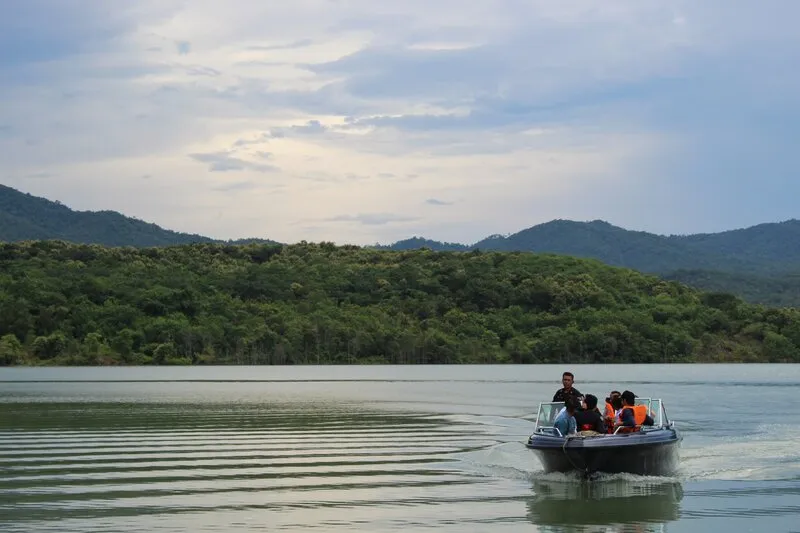
The old Ban Sa lignite mine viewpoint is characterized by a large water-filled former mining pit. Over time, water accumulated in the excavated area and formed a basin with a greenish-blue appearance. From the viewpoint, the water contrasts beautifully with the surrounding earth layers, open slopes, hills, and sky. The scenery is unusual for Phayao, a province more commonly associated with lakes, temples, mountains, and rural communities. This makes Chiang Muan Mine a memorable stop for travelers looking for a different visual experience in northern Thailand.
In the past, Chiang Muan Mine played an important role as a lignite coal production site. Lignite is a type of coal that is softer and lower in carbon content than harder coal, but it has been widely used as a fuel source in many industries. The lignite from Chiang Muan was notable for its low sulfur content and was supplied mainly to domestic customers in power generation, cement manufacturing, and pulp-related industries. This history reflects the relationship between geological resources and economic development during a period when coal remained an important industrial fuel.
After mining operations ended, the site entered a new chapter. The former mine landscape became a place where visitors could learn about land rehabilitation, post-mining landscapes, and the possibility of converting an industrial site into a viewpoint and learning area. A former coal pit may appear at first to be only a scar of extraction, but when studied carefully, it becomes evidence of how humans use natural resources and how landscapes can change after industrial activity. Chiang Muan Mine therefore invites visitors to think about energy, the environment, and the long-term responsibility of land use.
One of the most important aspects of Chiang Muan Mine is the discovery of many fossils within the mining area. During lignite mining, fossil remains of several ancient animals and plants were found, including bones and teeth of ancient four-tusked elephants known as trilophodont gomphotheres. Other fossil discoveries include crocodiles, fish, barking deer, pigs, turtles, shells, ancient plant seeds, and fossil remains related to an ape lineage associated with orangutans. These discoveries made Chiang Muan an important paleontological area in northern Thailand.
Many of the fossils discovered at Chiang Muan Mine date to the Middle Miocene, approximately 13 – 15 million years ago. During this period, the environment of the region was very different from today. The area that is now Phayao Province was once part of a sedimentary basin where plants and animals lived, died, and were gradually buried by natural processes. The discovery of aquatic animals, land mammals, plants, and shell remains in the same general area helps researchers reconstruct the ancient ecosystem of northern Thailand during that time.
The ancient four-tusked elephants found in Chiang Muan are among the most striking fossil highlights. For general visitors, the idea of a four-tusked elephant immediately shows how different prehistoric animals were from modern elephants. Gomphotheres had features that differed from today’s Asian elephants, and the discovery of their bones and teeth in Chiang Muan helps illustrate the evolutionary diversity of large mammals in Southeast Asia. This gives the former mine an importance far beyond its industrial history.
The discovery of crocodiles, fish, turtles, shells, and ancient plant seeds also suggests that the ancient Chiang Muan environment was closely connected with water. These fossils act like pieces of a larger puzzle. When placed together, they indicate that the area may once have included rivers, wetlands, lakes, forested margins, or other water-rich habitats suitable for many types of life. Learning about these fossils is therefore not only about seeing old bones; it is about understanding an ancient landscape that existed millions of years before the present-day province of Phayao.
The fossil ape remains associated with Chiang Muan add another layer of importance. Fossils related to ape evolution help scientists study the history of primates in Asia and their connection to modern great apes. Fossil teeth and fragments can provide clues about diet, environment, adaptation, and evolutionary relationships. For this reason, Chiang Muan is not only a local fossil site, but also part of a wider scientific discussion about the development of life in this region of the world.
The fossil discoveries at Chiang Muan Mine also connect well with nearby learning sites such as Kaeng Luang Dinosaur Forest Park and fossil-related attractions in Chiang Muan District. A trip that combines the old mine viewpoint with fossil learning areas allows visitors to understand the district more completely. They can see the former mining landscape, learn about ancient animals, and explore how geology, fossils, rivers, and human activity are connected within the same area.
For general travelers, Chiang Muan Mine makes geology easier to understand. Instead of reading about coal, sedimentary basins, and fossils only in a textbook, visitors can stand in front of the landscape and ask direct questions: How did lignite form? Why were fossils preserved here? Why did the former mining pit become a water basin? What does the land reveal about the ancient environment? These questions turn a simple viewpoint into a real outdoor classroom.
The best time to visit the viewpoint is during the daytime, especially in the morning or late afternoon. In the morning, the air is usually clearer and the colors of the water and surrounding hills can be seen more distinctly. In the late afternoon, warm light can create attractive reflections on the water and highlight the shape of the former mine slopes. Visitors should avoid getting too close to steep edges or unstable ground, as the area was formerly a mine and may have differences in ground levels. Safety should always come before photography.
Chiang Muan Mine should be approached as a viewpoint and learning destination, not as a place for risky activities. The water basin in the former mining pit may be deep, and the underwater ground conditions are not the same as ordinary natural ponds or lakes. Visitors should not enter the water, climb down slopes, cross restricted areas, ignore warning signs, or leave rubbish behind. Responsible behavior helps preserve the site and reduces risk for all visitors.
This destination is suitable for several types of travelers, including landscape photographers, students, families, geology enthusiasts, fossil lovers, and visitors interested in unusual attractions in Phayao. Those with limited time can stop briefly for photographs, while those interested in science and history can use the place as a starting point for learning about mining, lignite, fossils, and the Miocene ecosystem of Chiang Muan.
Within the tourism landscape of Phayao Province, Chiang Muan Mine adds a rare dimension. Phayao is often associated with Kwan Phayao, temples, ancient communities, and mountain scenery. Chiang Muan Mine introduces a different story: energy resources, coal mining, fossil discoveries, and landscape rehabilitation. This variety makes Phayao more interesting for educational travel and encourages visitors to explore beyond the provincial capital into Chiang Muan District.
A trip to Chiang Muan Mine can be planned as a half-day or full-day excursion. From Chiang Muan town, visitors can first stop at the old Ban Sa lignite mine viewpoint, then continue to Kaeng Luang Dinosaur Forest Park or nearby fossil learning areas, before ending the trip at a local restaurant or café in Chiang Muan. Travelers coming from Phayao town or other districts should allow enough travel time because the route to Chiang Muan passes through rural and hilly areas that require careful driving.
The viewpoint is also attractive for photography because it offers several visual layers. The blue-green water, exposed earth, former mine edges, open sky, distant hills, and wide terrain create a dramatic composition. Wide-angle shots can show the scale of the former mine, while closer views of the water and slopes can emphasize color and texture. Photographers should use safe viewpoints and lens choice rather than moving into dangerous areas.
For families with children, Chiang Muan Mine can be used to explain natural resources in simple terms. Children can learn that coal forms from ancient plant material buried and transformed over long periods of time, that mines are places where people extract underground resources, and that former industrial land must be managed and rehabilitated after use. The fossil story also helps children imagine that the area was once home to ancient elephants, crocodiles, fish, turtles, and ape-like animals millions of years ago.
The story of Chiang Muan Mine is strongest when understood through three connected themes: energy, geology, and tourism. The energy theme explains how lignite was used in industrial production. The geology theme reveals sedimentary basins, earth layers, and Miocene fossils. The tourism theme shows how a former mine can become a viewpoint and learning destination. When these themes are considered together, Chiang Muan Mine becomes much more than a scenic stop; it becomes a place where visitors can reflect on the relationship between natural resources, human use, and long-term environmental care.
Visitors should remember that this is a former mining area, not an ordinary public park. Even though it is known as a viewpoint and tourist attraction, preparation is still important. Bring drinking water, a hat, sunglasses, and comfortable shoes. Keep children close when near viewpoint areas. Avoid walking outside safe areas, and visit during daylight when visibility is good. Good preparation allows visitors to enjoy the scenery and learn about the site with confidence.
The mine is also connected with the communities of Ban Sa and Chiang Muan District. Travelers can support the local economy by eating at local restaurants, visiting cafés, buying local products, or staying overnight in the district. This helps make tourism more beneficial to the community and turns the visit into more than a brief photo stop.
For an educational itinerary, visitors can begin at the old Ban Sa mine viewpoint to understand the mining landscape, then continue to a fossil learning site or Kaeng Luang Dinosaur Forest Park to learn more about ancient life. This route works well for schools, families, science-oriented travelers, and nature groups because it combines real scenery, local history, fossil evidence, and geological interpretation in one trip.
Chiang Muan Mine is an important example of how former industrial land can be seen in a new way. A place once used for extracting underground resources can later become a learning landscape if properly rehabilitated, interpreted, and managed. The open mine basin in front of visitors is not only a reminder of coal extraction, but also a record of resource use, environmental change, and the possibility of giving new meaning to a post-mining landscape.
Today, the name “Chiang Muan Mine” carries several layers of meaning. For some people, it refers to the former Banpu lignite mine. For travelers, it refers to the old Ban Sa mine viewpoint with its blue-green water. For geologists and fossil enthusiasts, it refers to an important Miocene fossil area in northern Thailand. This diversity of meaning makes the site valuable to different groups of visitors and explains why it deserves to be presented as more than a simple viewpoint.
Visitors should allow at least 30 minutes to 1 hour to enjoy the viewpoint, take photographs, and absorb the history of the area. Those who plan to combine the mine with fossil-related sites or nearby natural attractions should allow more time. Daytime visits are recommended because they provide better visibility of the water, terrain, and surrounding landscape. Late afternoon can be beautiful, but travelers should consider safe driving time, especially if they are unfamiliar with rural and hilly roads in Chiang Muan District.
In summary, Chiang Muan Mine in Phayao Province combines post-mining scenery, energy history, Miocene fossils, and land rehabilitation into one meaningful destination. The blue-green water basin may attract visitors at first glance, but the deeper value comes from the story of lignite coal, four-tusked ancient elephants, Chiang Muan ape fossils, crocodiles, fish, turtles, shells, ancient plant seeds, and a landscape that dates back millions of years. For travelers who visit with care and curiosity, Chiang Muan Mine offers one of the most unusual and educational experiences in Phayao.
| Name | Chiang Muan Mine or Old Ban Sa Lignite Mine |
| Location | Ban Sa Subdistrict, Chiang Muan District, Phayao Province |
| Address | Old Ban Sa Mine Area, Ban Sa Subdistrict, Chiang Muan District, Phayao Province 56160, Thailand |
| Coordinates | 18.8786, 100.3198 |
| Highlights | A former lignite coal mine viewpoint with a blue-green water basin, wide post-mining landscape, and important fossil discoveries. |
| History / Period | The former lignite mine began commercial production in 1996 on an area of about 2,570 rai. Fossils discovered here date to the Middle Miocene, approximately 13 – 15 million years ago. |
| Key Evidence | Fossils of four-tusked ancient elephants, trilophodont gomphotheres, crocodiles, fish, barking deer, pigs, turtles, various shells, ancient plant seeds, and ape-related fossil remains associated with orangutan evolution. |
| Name Origin | The name refers to the mine’s location in Chiang Muan District and its former role as a lignite coal mine in Ban Sa Subdistrict. |
| Distinctive Features | A former mine landscape transformed into a blue-green water viewpoint with stories of geology, energy, and paleontology in one area. |
| Travel Information | From Chiang Muan District, take Highway 1091 toward Pong District. At Ban Sa junction, turn left onto Highway 1251 toward Dok Kham Tai. After about 3 km, the Chiang Muan Mine viewpoint is on the right-hand side. |
| Current Status | A former Ban Sa lignite mine viewpoint and a learning area connected with fossil discoveries in Chiang Muan District. |
| Open Days | Daily |
| Opening Hours | Daytime visit recommended for safety and clear views of the water basin and landscape. |
| Facilities | Viewpoint area near the former mine, photo spots, and routes connecting to other attractions in Chiang Muan District. |
| Main Areas / Zones | Former mine water basin, Ban Sa viewpoint, mine edge landscape, post-mining terrain, and routes connected to Chiang Muan fossil learning areas. |
| Caretaker | The former mine area is associated with Banpu Public Company Limited, while development as a learning attraction is connected with Phayao Province, the Department of Mineral Resources, and local agencies in Chiang Muan District. |
| Main Contact Number | Banpu Public Company Limited, Tel. 02-694-6600 |
| Official Website / Official Page | Banpu Public Company Limited, Department of Mineral Resources, Tourism Authority of Thailand |
| Nearby Tourist Attractions | 1. Kaeng Luang Dinosaur Forest Park, about 8 km 2. Kaeng Luang Chiang Muan, about 9 km 3. Yom River Viewpoint, Chiang Muan District, about 10 km 4. Wat Tha Fa Tai, about 12 km 5. Chiang Muan Fossil Learning Area, about 12 km 6. Ban Tha Fa and Yom River Community Area, about 13 km |
| Nearby Restaurants | 1. Oon Ruean, Chiang Muan District, about 8 km, Tel. 064-269-2263 2. Ban Tha Fa Cafe, Sa Subdistrict, about 10 km, Tel. 080-898-9662, 095-685-1965 3. Baan Mon Muan, about 10 km, Tel. 083-318-6444 4. PunThai Coffee Chiang Muan, about 8 km 5. Huean Muan Suan Hug, about 9 km 6. Larb Lam Chiang Muan, about 9 km |
| Nearby Accommodations | 1. P&P House Hotel, Chiang Muan District, about 8 km, Tel. 086-001-2011, 061-252-8615 2. Dee Tor Jai Resort Chiang Muan, about 8 km, Tel. 085-627-6422 3. Suan Siri Homestay Hotel, Chiang Muan Subdistrict, about 9 km, Tel. 096-772-5214 4. Warinda Garden Resort, about 9 km 5. Baan Suan Siri Garden, about 9 km 6. P&P House Chiang Muan, about 8 km |
Frequently Asked Questions (FAQ)
Q: Where is Chiang Muan Mine located?
A: Chiang Muan Mine, also known as the old Ban Sa lignite mine, is located in Ban Sa Subdistrict, Chiang Muan District, Phayao Province.
Q: What is Chiang Muan Mine known for?
A: It is known as a former lignite coal mine viewpoint with a blue-green water basin and important fossil discoveries from the Miocene period.
Q: What fossils were found at Chiang Muan Mine?
A: Fossils found in the area include four-tusked ancient elephants, crocodiles, fish, barking deer, pigs, turtles, shells, ancient plant seeds, and ape-related fossil remains linked to orangutan evolution.
Q: How old are the fossils from Chiang Muan Mine?
A: Many fossils from Chiang Muan Mine date to the Middle Miocene, around 13 – 15 million years ago.
Q: How do visitors get to Chiang Muan Mine?
A: From Chiang Muan District, take Highway 1091 toward Pong District. At Ban Sa junction, turn left onto Highway 1251 toward Dok Kham Tai. After about 3 km, the mine viewpoint is on the right-hand side.
Q: Who is Chiang Muan Mine suitable for?
A: It is suitable for travelers interested in viewpoints, geology, fossils, energy history, educational travel, and unusual attractions in Phayao Province.
Q: What should visitors be careful about at the viewpoint?
A: Visitors should stay in safe viewing areas, avoid steep mine edges, not enter the water, avoid climbing unstable slopes, and visit during daylight for safety.
Q: What nearby places can be visited on the same trip?
A: Nearby places include Kaeng Luang Dinosaur Forest Park, Kaeng Luang Chiang Muan, Yom River Viewpoint, Wat Tha Fa Tai, and Chiang Muan fossil learning areas.
 Category: ●Nature and Wildlife
 Group: ●Other natural attractions
Last Update : 4 MonthAgo
 Last Update : 4 MonthAgo
 Click to Access the Navigation Map GPS
 Art, Culture and Heritage
 Historical Sites and Monuments(4)
 Landmarks and Memorials(4)
 Art, Craft Centres, Tradition(1)
 Museums(2)
 Places of Worship
 Temple(39)
 Other Sacred Sites(5)
 Research and Development
 Royal Project(1)
 Suburban Living
 Village, Community(2)
 Local Market(4)
 National Parks and Marine Reserves(6)
 Mountain (Doi)(2)
 Dam, Reservoir, Lake(11)
 Waterfalls(8)
 Caves(5)
 River, Canal(3)
Other natural attractions(5)
River, Canal(3)
Other natural attractions(5)


