
lovethailand home >North Travel Attractions >Phayao Travel Attractions >Mae Chai >Mae Chai > Wat Sri Suphan
TL;DR: Wat Sri Suphan is located at Moo 1, Mae Chai Subdistrict, Mae Chai District, Phayao Province, open Daily, hours 08.00 – 17.00.
Wat Sri Suphan
Open Days: Daily
Opening Hours: 08.00 – 17.00
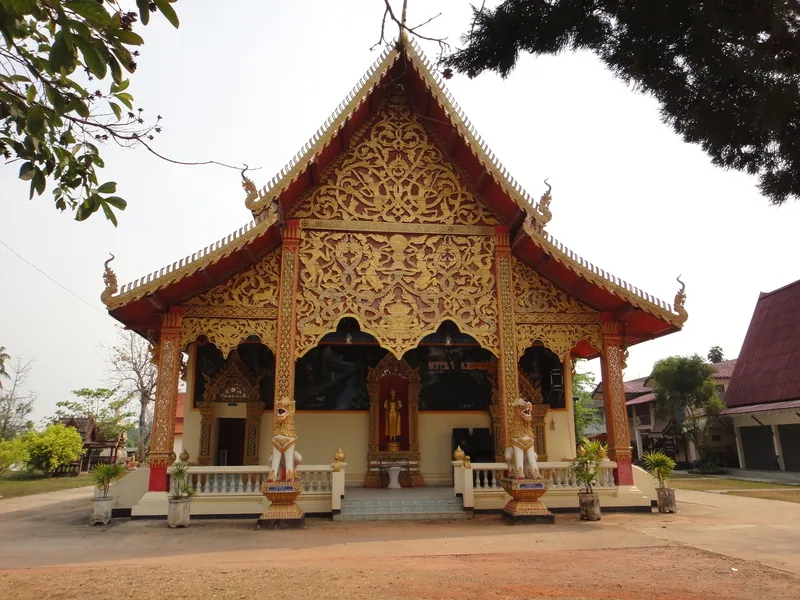
Wat Sri Suphan in Phayao Province is located at 57 Moo 1, Mae Chai Subdistrict, Mae Chai District, Phayao Province. It is one of the most important temples in Mae Chai and has long served as a spiritual center for local residents. The temple stands opposite the Mae Chai District Office, in the heart of the district community, making it easily accessible and closely connected with everyday life in the area. Its most important highlight is Phra Chao Thong Thip, the revered Buddha image regarded as the guardian Buddha of Mae Chai. This sacred image is deeply respected by local Buddhists and visitors from other areas. Phra Chao Thong Thip is a beautifully crafted bronze Buddha image in the third-period Chiang Saen style. The face has a naturally radiant golden tone, the neck is finely formed, and the flame-shaped hair finial is elegant. The image measures 72 cm across the lap and 150 cm in height. Every year on April 17, the community holds the Song Nam Phra Chao Thong Thip ceremony, a major local tradition dedicated to bathing the sacred Buddha image.
Wat Sri Suphan is not merely a community temple in the ordinary sense. It is a place where the history of local settlement, Buddhist faith, Chiang Saen Buddhist art, and the traditions of Mae Chai District are closely connected. The temple was formerly known among local people as “Wat Mae Chai Pong Sanuk” or, in earlier historical references, “Wat Chai Pong Sanuk.” These names reflect the connection with people from Ban Pong Sanuk in Lampang Province who migrated and settled in the Mae Chai area. The temple therefore serves not only as a place for religious ceremonies, but also as a living record of migration, community formation, and the continuation of old faith in a new home.
The history of Wat Sri Suphan is significant. It is a community Buddhist temple under the Mahanikaya order, established in 1819 and granted its consecrated boundary in 1939. With more than 200 years of history, the temple has become one of the important Buddhist centers of Mae Chai. Its establishment reflects the local community’s need for a sacred place for merit-making, Dhamma listening, monastic ceremonies, and social gathering. As the temple developed alongside Mae Chai, Wat Sri Suphan became a place where generations of local people have participated as donors, caretakers, restorers, festival participants, and devotees of Phra Chao Thong Thip.
The temple’s location opposite the Mae Chai District Office gives it both religious and civic significance. It stands where people in the district can easily visit, almost like a spiritual center placed beside the administrative heart of the community. Visitors can stop to pay respect to Phra Chao Thong Thip, make merit, walk around the temple, and learn about Mae Chai’s local history without traveling far from the district center. Because the temple is located in the middle of the community, its role is not separated from daily life. It continues to exist alongside work, trade, education, local administration, and the ordinary activities of people in Mae Chai.
Phra Chao Thong Thip is the spiritual heart of Wat Sri Suphan and the most revered sacred object of Mae Chai. The Buddha image is a fine example of third-period Chiang Saen art, a phase of northern Buddhist art known for graceful balance and refined expression. The face of the image appears gentle and serene, while the bronze surface has a warm golden radiance. The neck is delicate, the flame-shaped hair finial rises elegantly, and the overall proportions, with a lap width of 72 cm and a height of 150 cm, give the image a dignified yet approachable presence. When visitors enter the viharn and pay respect closely, the image conveys both artistic refinement and strong devotional power.
The name “Phra Chao Thong Thip” suggests a Buddha image of celestial golden beauty and sacred value. For local people, Phra Chao Thong Thip is not only an old Buddha image of artistic importance. It is the guardian Buddha of the community, a spiritual anchor, and a sacred object connected with peace, virtue, and inner protection. Devotion to Phra Chao Thong Thip is expressed through individual worship, family merit-making, and the annual bathing ceremony that remains one of the most important traditions of Mae Chai.
The story of the discovery of Phra Chao Thong Thip gives the image a strong local sacred character. According to local tradition, the Buddha image was originally found in a grove of bamboo known as phai dae. The villagers built a small shelter over the image at that same location. Later, they worked together to build a permanent viharn around the original bamboo grove site without moving the image elsewhere. This decision to preserve the original location is deeply meaningful. It reflects respect for the place where the image was found and the belief that the site itself is sacred. Rather than relocating the Buddha image, the community chose to build around it, showing humility and deep devotion.
The bamboo grove in the story of Phra Chao Thong Thip gives the image a local legendary dimension. It is not merely an artistic object created and placed inside a temple from the beginning. The discovery of a sacred Buddha image in a natural setting, followed by the community’s effort to protect and enshrine it, is a familiar pattern in many Lanna local traditions. Such stories often express the appearance of sacredness within the local landscape. Once a sacred object is discovered, the community gathers to care for it, protect it, and establish it as a center of shared faith. Wat Sri Suphan therefore combines Buddhism, nature, and the collective memory of Mae Chai in one sacred space.
Phra Chao Thong Thip is also highly valuable as Buddhist art, particularly because it belongs to the third-period Chiang Saen style. Chiang Saen art is one of the most important Buddhist artistic traditions of northern Thailand. It reflects the religious beliefs, artistic influences, and aesthetic values of Lanna across different periods. Later Chiang Saen Buddha images often show softer facial expressions, balanced proportions, and more refined details. Phra Chao Thong Thip allows visitors to appreciate the beauty of northern Buddhist art through its form, bronze surface, and calm spiritual presence.
Visitors should take time to observe Phra Chao Thong Thip quietly rather than simply pay respect and leave quickly. The image contains many layers of beauty: the compassionate expression of the face, the delicate neck, the elegant flame-shaped hair finial, and the glowing bronze surface when touched by light inside the viharn. These details give the image both artistic and spiritual value. Standing or sitting respectfully before the Buddha image can become a moment for mindfulness, recollection of the Buddha’s virtues, and a quiet intention to do good.
Every year on April 17, Wat Sri Suphan holds the Song Nam Phra Chao Thong Thip ceremony. This important tradition is closely connected with the northern Thai New Year, or Pi Mai Muang. Bathing a sacred Buddha image is an act of respect, renewal, and spiritual cleansing. It is also a way of beginning the traditional New Year with merit and purity of mind. Because the ceremony is held every year on April 17, it has become an important date in Mae Chai’s community calendar. Local residents, returning family members, and visitors can gather to make merit and continue their shared devotion to Phra Chao Thong Thip.
The Song Nam Phra Chao Thong Thip ceremony is more than a religious activity. It brings together people across Mae Chai District. Villagers, local organizations, monks, and Buddhist devotees all take part in preparing and preserving the tradition. The atmosphere of the event reflects gratitude, reverence for the guardian Buddha of the district, and the close relationship between the temple and the community. The continued observance of this annual ceremony shows that Phra Chao Thong Thip remains a true spiritual center for the people of Mae Chai.
Songkran in northern Thailand is not only about water play or celebration. It is the traditional New Year, a time for merit-making, paying respect to elders, asking forgiveness, cleansing the body and mind, and beginning the year with good intentions. Wat Sri Suphan helps preserve this deeper meaning through the Song Nam Phra Chao Thong Thip ceremony. Visitors who come during this period can witness Buddhist devotion blended with Lanna cultural practice in a vivid and meaningful way.
Beyond Phra Chao Thong Thip, Wat Sri Suphan continues to serve as an important religious space for Mae Chai. The temple is used for major Buddhist occasions such as Makha Bucha, Visakha Bucha, Asalha Bucha, Buddhist Lent, the end of Buddhist Lent, Kathin, Pha Pa, and local annual merit-making traditions. It provides a central place where people can meet, make merit, listen to Dhamma teachings, and take part in community activities. Its central location in the district allows religious life to remain closely connected with the everyday lives of local people.
Wat Sri Suphan also functions as a local learning space for Mae Chai. The temple has been associated with a Mae Chai district museum, where cultural objects, Buddhist art, and local heritage related to the community are preserved. This learning role expands the temple’s importance beyond ritual practice. It becomes a place that stores community memory and helps younger generations and visitors understand the history, beliefs, artistic traditions, and cultural objects of the Mae Chai area.
For cultural travelers, Wat Sri Suphan is suitable for those who want to explore Phayao beyond its major tourist routes. Visitors should not treat the temple as only a quick stop along the road. It is better to spend time paying respect to Phra Chao Thong Thip, observing the viharn, noticing the temple’s role as a community center, and learning about the annual bathing ceremony. This approach helps visitors understand that Mae Chai has its own unique spiritual heritage that remains alive and meaningful.
Phra Chao Thong Thip is a strong example of how one Buddha image can become the center of identity for an entire district. Its value does not come only from age or artistic style, but from the way local people continue to worship, tell stories about it, care for it, and organize traditions around it. This living devotion makes Phra Chao Thong Thip part of Mae Chai’s identity and makes Wat Sri Suphan one of the district’s most important spiritual places.
Visitors interested in Buddhist art should carefully observe the features of Phra Chao Thong Thip, especially the flame-shaped hair finial, the gentle facial expression, the bronze surface, and the overall proportions that reflect third-period Chiang Saen art. Viewing the image with understanding reveals that it is not only a sacred object, but also a work of art containing belief, beauty, and the cultural taste of Lanna in a single form.
For families and young people, Wat Sri Suphan is a valuable educational site. Children and youth can learn about a guardian Buddha image, the meaning of Buddha image bathing during the northern New Year, the temple’s connection with the Pong Sanuk community, and the role of a temple as the center of a district. Learning at the actual site makes history and culture feel more alive than reading from books alone.
Photography inside the temple should be done respectfully, especially around the place where Phra Chao Thong Thip is enshrined. Visitors should avoid inappropriate poses with the Buddha image, should not climb or touch the sacred image without permission, and should not disturb people who are worshipping. During the Song Nam Phra Chao Thong Thip ceremony, visitors should allow space for participants and follow guidance from the temple or local officials.
Wat Sri Suphan can be included in a travel route around Mae Chai District. Visitors may begin by paying respect to Phra Chao Thong Thip, then continue to nearby temples such as Wat Mae Chai Tai or Wat Photharam, followed by local restaurants and cafés such as Kod Rak Cafe, Hug View Cafe, 108 Coffee Ban Din, or local eateries in Mae Chai town. With more time, the route can continue to Phayao city, Kwan Phayao, or Wat Si Khom Kham within the same day.
Getting There Wat Sri Suphan is located at 57 Moo 1, Mae Chai Subdistrict, Mae Chai District, Phayao 56130. It stands opposite the Mae Chai District Office in the main community area of the district. The temple is easily accessible by private car, motorcycle, public transport, or local hired vehicle. From Phayao city, take Phahonyothin Road toward Mae Chai District, enter the district center, and look for the Mae Chai District Office. The temple is located on the opposite side. For map navigation, search for Wat Sri Suphan, Mae Chai District, Phayao Province.
From Mae Chai town, the temple is very easy to reach because it is located in the community center near the main district office. Visitors arriving by public transport can get off in Mae Chai town and continue by local hired vehicle or travel a short distance to the temple. A private car is the most convenient option for those who plan to visit several places in one day, as it allows easy connection between Wat Sri Suphan, nearby restaurants, accommodations, and other attractions.
The best time to visit is from morning to late afternoon, when the weather is more comfortable for worship and walking around the temple. Visitors who want to experience the most important tradition should plan to come on April 17, the annual bathing day of Phra Chao Thong Thip. Those who prefer a quiet visit for worship and close observation of the Buddha image may find ordinary weekdays more suitable because the temple is less crowded.
Visitors should dress modestly when entering the temple. Clothing should cover shoulders and knees. Speak politely, behave calmly, and avoid disturbing people who come to pay respect to Phra Chao Thong Thip. During the annual ceremony, visitors should respect the temple’s organization, allow space for elders and worshippers, and follow local customs. Respect for the place and the people is central to visiting a living temple of faith.
Wat Sri Suphan is therefore one of the most important temples in Mae Chai District and is well worth visiting. It is an old temple connected with the Pong Sanuk community, a community Buddhist temple established in 1819, the home of Phra Chao Thong Thip, the revered guardian Buddha image of Mae Chai, and the center of the annual Song Nam Phra Chao Thong Thip ceremony on April 17. For travelers who want to experience Phayao through Buddhist faith, Chiang Saen Buddhist art, and the northern Thai New Year culture of Mae Chai, Wat Sri Suphan should be included in a cultural travel route through the province.
| Name | Wat Sri Suphan |
| Location | Moo 1, Mae Chai Subdistrict, Mae Chai District, Phayao Province |
| Address | 57 Moo 1, Mae Chai Subdistrict, Mae Chai District, Phayao 56130, Thailand |
| Highlights | Home of Phra Chao Thong Thip, the revered guardian Buddha image of Mae Chai, third-period Chiang Saen Buddhist art, and the annual Song Nam Phra Chao Thong Thip ceremony held every April 17 |
| Former Names | Wat Mae Chai Pong Sanuk / Wat Chai Pong Sanuk / Wat Phra Chao Thong Thip |
| History | A community Buddhist temple under the Mahanikaya order, established in 1819 and granted its consecrated boundary in 1939. The temple is historically connected with people from Ban Pong Sanuk in Lampang Province who migrated to settle in the Mae Chai area. |
| Sacred Object | Phra Chao Thong Thip, a bronze Buddha image in the third-period Chiang Saen style, measuring 72 cm across the lap and 150 cm in height, with a radiant face, refined neck, and elegant flame-shaped hair finial |
| Local Legend | Phra Chao Thong Thip was originally found in a phai dae bamboo grove. Villagers first built a shelter over the image, then later built a permanent viharn around the original bamboo grove site without moving the Buddha image from its original location. |
| Important Tradition | Song Nam Phra Chao Thong Thip, the annual bathing ceremony of the sacred Buddha image, held every April 17 as an important northern Thai New Year tradition of Mae Chai District |
| Cultural Importance | A spiritual center for the people of Mae Chai, a community temple, and a place preserving devotion to Phra Chao Thong Thip, Chiang Saen Buddhist art, and Lanna Songkran tradition |
| Travel Information | From Phayao city, take Phahonyothin Road toward Mae Chai District. The temple is located opposite the Mae Chai District Office and is easily accessible by private car, motorcycle, public transport, or local hired vehicle. |
| Current Status | Active community Buddhist temple, sacred site of Phra Chao Thong Thip, and faith-based cultural attraction in Mae Chai District |
| Open Days | Daily |
| Opening Hours | 08.00 – 17.00 |
| Facilities | Temple courtyard, worship area, viharn of Phra Chao Thong Thip, merit-making area, community parking area, and restaurants and accommodations in Mae Chai town |
| Main Areas / Zones | Viharn of Phra Chao Thong Thip, worship area of the guardian Buddha image, temple courtyard, religious activity buildings, and annual ceremony area for Song Nam Phra Chao Thong Thip |
| Abbot / Caretaker | Phra Khru Suwan Sirirak (Phuriphat Panyawaro) |
| Main Contact Number | 054-417-180 |
| Nearby Tourist Attractions | 1. Mae Chai District Office, about 0 km 2. Wat Mae Chai Tai, about 1 km 3. Wat Photharam, Mae Chai District, about 4 km 4. Kwan Phayao, about 24 km 5. Wat Si Khom Kham, about 25 km 6. Phayao City, about 25 km |
| Nearby Restaurants | 1. Kod Rak Cafe Mae Chai, about 2 km 2. Mae Bai Tong Northern Thai Food, about 2 km 3. 108 Coffee Ban Din, about 4 km, Tel. 083-067-5204 4. Hug View Cafe, about 8 km, Tel. 095-705-5601 5. Local Restaurants In Mae Chai Town, about 1 km |
| Nearby Accommodations | 1. Eden’home Daily And Monthly Rooms, Mae Chai, about 1 km, Tel. 080-306-7030 2. Ban Manao Mae Chai, about 2 km 3. Leng Sai Resort, about 8 km, Tel. 065-970-2284 4. White And Bloom, about 10 km, Tel. 081-560-4755 5. Accommodations In Phayao City, about 25 km |
Frequently Asked Questions (FAQ)
Q: Where is Wat Sri Suphan Mae Chai located?
A: Wat Sri Suphan is located at 57 Moo 1, Mae Chai Subdistrict, Mae Chai District, Phayao 56130, opposite the Mae Chai District Office.
Q: What is Wat Sri Suphan known for?
A: It is known as the home of Phra Chao Thong Thip, the revered guardian Buddha image of Mae Chai, and as the center of the annual Song Nam Phra Chao Thong Thip ceremony held every April 17.
Q: What kind of Buddha image is Phra Chao Thong Thip?
A: Phra Chao Thong Thip is a bronze Buddha image in the third-period Chiang Saen style. It measures 72 cm across the lap and 150 cm in height, with a radiant face, refined neck, and elegant flame-shaped hair finial.
Q: Where was Phra Chao Thong Thip originally found?
A: It was originally found in a phai dae bamboo grove. Villagers built a shelter and later a permanent viharn around the original site without moving the Buddha image.
Q: When is the Song Nam Phra Chao Thong Thip ceremony held?
A: The ceremony is held every year on April 17 as an important northern Thai New Year tradition of Mae Chai District.
Q: Who is the abbot of Wat Sri Suphan?
A: The abbot is Phra Khru Suwan Sirirak (Phuriphat Panyawaro).
Q: Is there a contact number for Wat Sri Suphan?
A: The main contact number is 054-417-180.
Q: What nearby attractions can be visited with Wat Sri Suphan?
A: Nearby places include Wat Mae Chai Tai, Wat Photharam, Kwan Phayao, Wat Si Khom Kham, and Phayao city.
 Category: ●Places of Worship
 Group: ●Temple
Last Update : 1 MonthAgo
 Last Update : 1 MonthAgo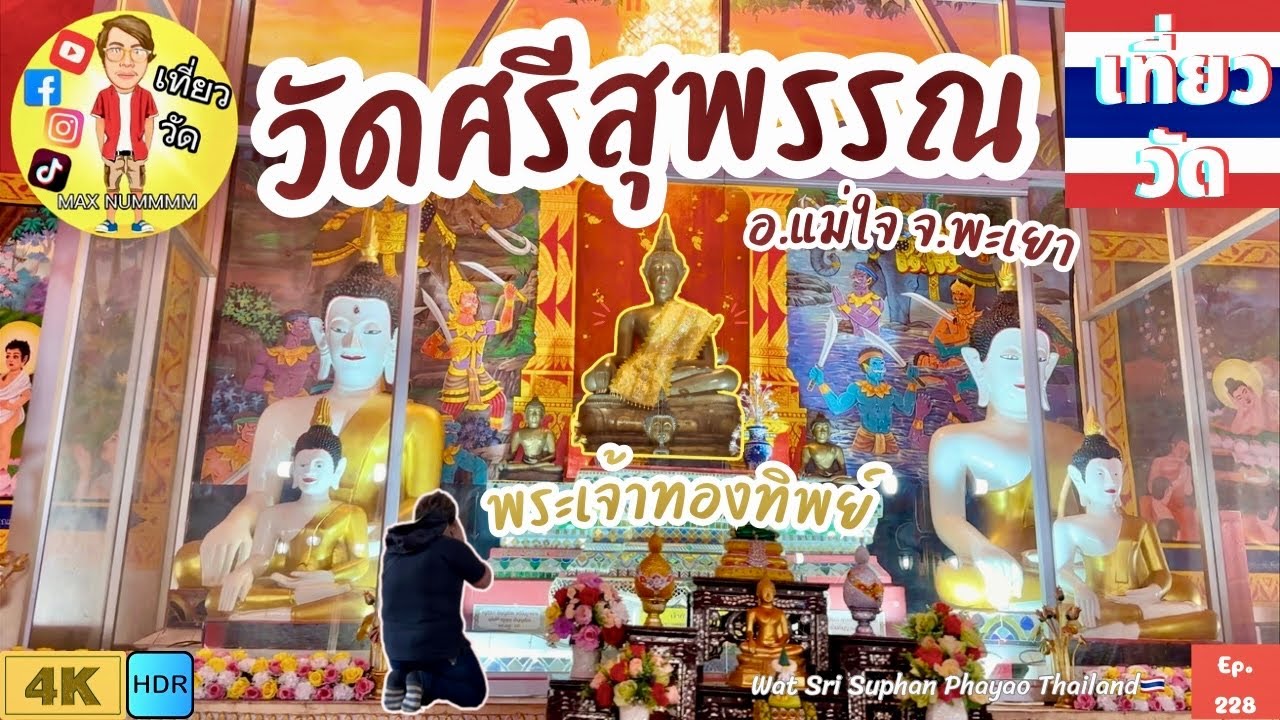
 Click to Access the Navigation Map GPS
Wat Sri Suphan Map
Recommend

 Art, Culture and Heritage
 Historical Sites and Monuments(4)
 Landmarks and Memorials(4)
 Art, Craft Centres, Tradition(1)
 Museums(2)
Temple(39)
Museums(2)
Temple(39)
 Other Sacred Sites(5)
 Research and Development
 Royal Project(1)
 Suburban Living
 Village, Community(2)
 Local Market(4)
 Nature and Wildlife
 National Parks and Marine Reserves(6)
 Mountain (Doi)(2)
 Dam, Reservoir, Lake(11)
 Waterfalls(8)
 Caves(5)
 River, Canal(3)
 Other natural attractions(5)


