
lovethailand home >North Travel Attractions >Phayao Travel Attractions >Chun >Huai Yang Kham > Wat Phra That Sam Duang
TL;DR: Wat Phra That Sam Duang is located at Ban Dong Khian, Moo 3, Huay Yang Kham Subdistrict, Chun District, Phayao Province, open Daily, hours Contact The Temple Or Huay Yang Kham Community Before Visiting The.

Wat Phra That Sam Duang
Open Days: Daily
Opening Hours: Contact The Temple Or Huay Yang Kham Community Before Visiting The Archaeological Area And Important Interior Areas
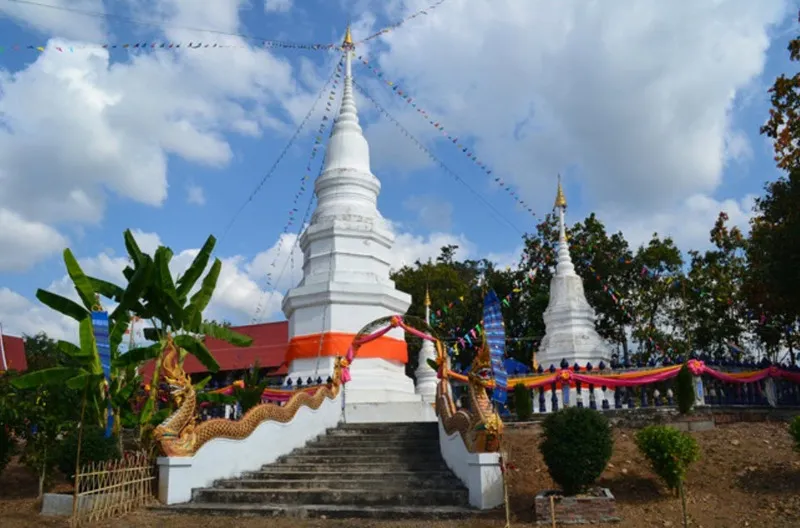
Wat Phra That Sam Duang in Phayao Province is an ancient Buddhist site located near Ban Dong Khian, Moo 3, Huay Yang Kham Subdistrict, Chun District. Formerly known as Phra Chedi Sam Ong, or locally as Phra That Sam Duang, the site is one of the meaningful archaeological and religious landmarks of the local community. It is situated on a low mound about 1 kilometer east of Ban Dong Khian village and about 10 kilometers north of Chun District town. The most important feature is the remains of 3 ancient brick chedis, which preserve the memory of an old Buddhist sanctuary that once stood in this area.
Wat Phra That Sam Duang is not a large or highly developed tourist attraction. Its value lies in the quiet presence of the ruins, the long memory of local faith, and the surviving traces of old Buddhist architecture. For visitors interested in ancient temples, local archaeology, and the cultural landscape of rural Phayao, this site offers a different experience from the better-known temples in Mueang Phayao. The atmosphere is calm and simple, allowing visitors to reflect on time, faith, loss, and preservation.
The name Phra That Sam Duang directly reflects the character of the site. It refers to 3 sacred chedis or relic monuments located within the same area. In the past, the site was abandoned and contained the remains of 3 ancient brick chedis, along with many damaged Buddha images carved from laterite stone. Over time, those damaged Buddha images were reportedly removed from the site, leaving only the collapsed chedi remains. This history makes the site especially important as a reminder of the vulnerability of local heritage.
The ancient bricks found at the site suggest that Phra That Sam Duang may be at least 700 years old. Although the exact construction date is not clearly recorded, the surviving brick remains, chedi bases, and local memory all indicate that this was once an important Buddhist place for the surrounding community. Its age and condition make the site valuable for understanding the historical spread of Buddhism in Chun District and the wider cultural landscape of Phayao Province.
As a former abandoned religious site, Wat Phra That Sam Duang reflects the fate of many ancient temples in northern Thailand. Over the centuries, temples may decline because of population movement, environmental change, war, economic shifts, or lack of continuous care. What once may have been a complete religious compound can eventually become a field of ruins. Yet ruins are still meaningful. They preserve evidence of belief, architecture, community memory, and the craftsmanship of earlier generations.
The former presence of laterite Buddha images at the site is an important part of its story. Laterite was used in many ancient Buddhist structures and sculptures in Thailand. Its texture, strength, and reddish-brown tone make it a distinctive material in old religious art. The fact that many laterite Buddha images once existed here suggests that Phra That Sam Duang was not merely a group of isolated chedis, but part of a wider sacred compound with Buddha images, ritual areas, and community worship.
Today, those laterite Buddha images are no longer present at the site. Their disappearance gives Wat Phra That Sam Duang an additional meaning as a place that teaches the importance of heritage protection. Old bricks, stones, sculpture fragments, and ruined foundations may appear simple, but they are historical evidence. Visitors should never remove, touch, damage, or relocate any ancient material from the site. What remains must be treated with care so that future generations can still study and respect the place.
The location of Wat Phra That Sam Duang on a low mound before the route to Huay Yang Kham Reservoir adds to its quiet atmosphere. The site is separated from busy tourist areas and retains the feeling of a rural sacred place. Visitors can walk slowly around the remains and observe the relationship between the 3 chedis, the old brickwork, the ground level, and the surrounding landscape. The beauty of the site is not polished or complete; it is the beauty of endurance after centuries of change.
A meaningful visit should begin by looking at the whole area before focusing on details. Visitors should observe the positions of the 3 chedi remains, the layout of the mound, the ancient bricks, and the signs of collapse. This kind of slow observation helps reveal that Wat Phra That Sam Duang is not simply a place to stop briefly, but a site that should be read through its traces. The remaining materials, even when fragmented, still communicate the religious and historical role of the place.
The 3 chedis also carry symbolic importance in local memory. Even though detailed historical records are limited, the continued use of the name Phra That Sam Duang shows that local people have preserved the identity of the site through language and remembrance. A place can survive not only through written documents, but also through names, stories, rituals, and community recognition. In this sense, the name itself is part of the site’s cultural evidence.
In terms of landscape, the temple belongs to Huay Yang Kham Subdistrict, a quiet rural area of Chun District. Visiting this site allows travelers to see a side of Phayao that is different from the lakeside scenery of Kwan Phayao or the city temples of Mueang Phayao. The province contains many small archaeological and religious sites scattered through villages and farming communities. Wat Phra That Sam Duang helps reveal this deeper historical layer of Phayao at the village level.
The site is also useful as a local learning place. Young people in the community can learn about local history, Buddhist heritage, archaeological remains, and the importance of protecting ancient objects. Seeing a real site where Buddha images were once present but later disappeared helps explain why heritage conservation matters. It shows that once ancient objects are removed from their original place, the story of the site becomes harder to understand.
For cultural travelers, Wat Phra That Sam Duang should be visited with realistic expectations. It is not a fully restored temple with large buildings, visitor facilities, or elaborate interpretation. It is a local archaeological site where the surviving remains must be approached with respect. Visitors should wear comfortable shoes, bring drinking water during hot weather, and walk carefully because the ground may be uneven and old brick fragments may remain in the area.
Proper behavior is especially important here. Visitors should dress respectfully, avoid loud behavior, never climb on the chedi remains, never step on ancient bases, never remove bricks or fragments, and never write or mark anything on the old structures. These actions help preserve the site and show respect for both the sacred character of the place and the local community that continues to recognize its importance.
Wat Phra That Sam Duang is also suitable for quiet spiritual reflection. Visitors may pay respect to the chedi remains, make a simple prayer, and reflect on the long history of Buddhism in this area. Standing before the old brick chedis gives a strong sense of impermanence, a central Buddhist idea. The ruined condition of the site makes this feeling especially clear: religious monuments, communities, and material forms all change over time, but faith and memory can continue.
During local festivals or periods when people return to their hometowns, the site can serve as a place for paying respect and reconnecting with community roots. Nearby places such as Huay Yang Kham Reservoir, local temples, and village landscapes can be included in a slow cultural route through the area. This kind of travel allows visitors to experience rural Phayao through faith, history, landscape, and local life rather than through major tourist landmarks alone.
Getting There can be done from Chun District town by traveling toward Huay Yang Kham Subdistrict and Ban Dong Khian, Moo 3. The site is about 10 kilometers north of Chun District town and about 1 kilometer east of Ban Dong Khian village. Visitors coming from Mueang Phayao should head toward Chun District, continue to Huay Yang Kham Subdistrict, and then follow local directions to the ancient site. A private car or motorcycle is recommended because the site is located in a rural community area rather than a major tourist zone.
Travelers unfamiliar with the area should check an online map and ask local residents in Ban Dong Khian or local authorities in Huay Yang Kham Subdistrict before visiting. Rural access routes can sometimes be confusing, especially for those who have not traveled in the area before. Asking local people also helps visitors approach the site more respectfully and may provide useful local context about the chedi remains.
Wat Phra That Sam Duang can be included in a deeper cultural itinerary through Chun District and nearby areas. Possible places to combine with the visit include Huay Yang Kham Reservoir, local temples in Huay Yang Kham Subdistrict, Chun District town, Wiang Lo Ancient Town, Wat Si Ping Mueang, Wat Phra That Khing Kaeng, and Wat Phra That Sop Waen. This route is suitable for travelers who want to understand Phayao beyond the main city and explore older village-level Buddhist heritage.
For visitors seeking quiet and uncrowded places, Wat Phra That Sam Duang offers a rare kind of experience. The site is simple, quiet, and not commercialized. It asks visitors to slow down, look carefully, and imagine the former religious compound from the remaining traces. This is the kind of place where cultural value is not immediately obvious through size or decoration, but becomes clear through attention and respect.
From a conservation perspective, Wat Phra That Sam Duang is an important reminder that local heritage depends on protection from everyone. The reported loss of laterite Buddha images from the site shows how easily cultural evidence can disappear. What remains today should be treated as irreplaceable. Visitors, villagers, and local authorities all share responsibility for preserving the chedi remains and the memory of the place.
In a deeper sense, Wat Phra That Sam Duang is not only a ruin of 3 chedis. It is a symbol of survival and loss at the same time. What remains includes the chedi bases, old bricks, the local name, and community memory. What has disappeared includes the laterite Buddha images and some parts of the original sacred compound. A visit here therefore teaches both devotion and fragility: faith can last for centuries, but physical heritage can be lost if it is not protected.
In summary, Wat Phra That Sam Duang is an important ancient Buddhist site in Ban Dong Khian, Huay Yang Kham Subdistrict, Chun District, Phayao Province. Its highlights are the remains of 3 ancient brick chedis, the memory of laterite Buddha images that once stood in the area, and the estimated age of at least 700 years based on surviving brick evidence. The site is meaningful for visitors interested in local history, Buddhist archaeology, rural Phayao, and heritage conservation. Visiting this place is not only an act of worship, but also an encounter with the fragile memory of an old Buddhist community.
| Name | Wat Phra That Sam Duang |
| Former / Local Name | Phra Chedi Sam Ong Or Phra That Sam Duang |
| Location | Ban Dong Khian, Moo 3, Huay Yang Kham Subdistrict, Chun District, Phayao Province |
| Highlights | Remains of 3 ancient brick chedis on a low mound, forming an important local Buddhist archaeological site in Huay Yang Kham Subdistrict and Chun District |
| History | An old Buddhist site that was formerly abandoned. It once contained 3 ancient brick chedis and many damaged laterite Buddha images. Brick evidence suggests an age of at least 700 years. |
| Distinctive Features | A quiet local archaeological site suitable for paying respect, studying old temple remains, and learning about Buddhist heritage conservation in a rural community |
| Key Evidence | Three chedi remains, ancient brick fragments, old foundation traces, and historical memory of laterite Buddha images formerly found at the site |
| Visitor Guidelines | Do not climb on the chedi remains, remove ancient bricks or fragments, write on old structures, leave trash, or disturb the sacred and archaeological character of the site |
| Travel Information | From Chun District town, travel toward Huay Yang Kham Subdistrict and Ban Dong Khian, Moo 3. The site is about 1 km east of the village and about 10 km north of Chun District town. |
| Current Status | Open as an archaeological site and sacred chedi area of Ban Dong Khian community, Huay Yang Kham Subdistrict, Chun District |
| Open Days | Daily |
| Opening Hours | Contact The Temple Or Huay Yang Kham Community Before Visiting The Archaeological Area And Important Interior Areas |
| Fees | Free Admission |
| Facilities | Chedi worship area, archaeological ground, and parking space according to local community conditions |
| Caretaker / Related Local Authority | Wat Phra That Sam Duang, Ban Dong Khian Community, And Huay Yang Kham Subdistrict Administrative Organization |
| Nearby Tourist Attractions | 1. Huay Yang Kham Reservoir, About 1 km 2. Ban Dong Khian, Huay Yang Kham Subdistrict, About 1 km 3. Wat Huay Yang Kham, About 5 km 4. Chun District Town, About 10 km 5. Wiang Lo Ancient Town, About 25 km 6. Wat Si Ping Mueang, About 25 km 7. Wat Phra That Khing Kaeng, About 30 km |
| Nearby Restaurants | 1. Khrua Mo Kaeng Tong, Ban Huay Yang Kham, About 5 km 2. Tam Zaap Chun, About 12 km, Tel. 093-342-6680, 084-343-9835 3. Laeng Ma Se, Huay Khao Kam Subdistrict, About 12 km, Tel. 080-880-7969 4. Ban Suan Ai Oon Chun Branch, About 12 km, Tel. 092-279-3978, 086-013-5054 5. Palms Coffee Chun, About 12 km 6. Pad Thai Violin, Chun District, About 12 km |
| Nearby Accommodations | 1. Ban Suan Homestay, Chun District, About 12 km, Tel. 081-021-1502, 080-135-6076, 081-032-3156 2. Wang Nam Cham Resort, Chun District, About 15 km, Tel. 089-954-8584 3. Chiang Kham Grand Villa, Chiang Kham District, About 35 km 4. Suk Sabai Rooms, Chiang Kham District, About 35 km 5. Rico Resort Chiang Kham, About 35 km 6. Accommodations In Mueang Phayao, About 45 km |
Frequently Asked Questions (FAQ)
Q: Where is Wat Phra That Sam Duang located?
A: Wat Phra That Sam Duang is located near Ban Dong Khian, Moo 3, Huay Yang Kham Subdistrict, Chun District, Phayao Province, about 10 km north of Chun District town.
Q: What was Wat Phra That Sam Duang formerly called?
A: It was formerly called Phra Chedi Sam Ong and is locally known as Phra That Sam Duang.
Q: Why is Wat Phra That Sam Duang important?
A: It is an ancient Buddhist archaeological site with the remains of 3 brick chedis, preserving evidence of old Buddhist faith in Ban Dong Khian community.
Q: How old is Phra That Sam Duang?
A: Based on the ancient brick evidence found at the site, it is estimated to be at least 700 years old.
Q: Were there Buddha images at the site in the past?
A: Yes. The site once contained many damaged laterite Buddha images, but they were later removed from the area, leaving mainly the chedi remains and archaeological traces.
Q: Is there an admission fee?
A: No. Admission is free, but visitors should dress respectfully, walk carefully, and never remove or damage ancient materials at the site.
Q: Who is the abbot of Wat Phra That Sam Duang?
A: Available monastic directory information does not clearly list the current abbot, so visitors should contact the temple or Huay Yang Kham community before traveling.
Q: What nearby places can be visited on the same route?
A: Nearby places include Huay Yang Kham Reservoir, Wat Huay Yang Kham, Chun District town, Wiang Lo Ancient Town, Wat Si Ping Mueang, and Wat Phra That Khing Kaeng.
 Category: ●Places of Worship
 Group: ●Temple
Last Update : 1 MonthAgo
 Last Update : 1 MonthAgo
 Click to Access the Navigation Map GPS
Wat Phra That Sam Duang Map
Recommend

 Art, Culture and Heritage
 Historical Sites and Monuments(4)
 Landmarks and Memorials(4)
 Art, Craft Centres, Tradition(1)
 Museums(2)
Temple(39)
Museums(2)
Temple(39)
 Other Sacred Sites(5)
 Research and Development
 Royal Project(1)
 Suburban Living
 Village, Community(2)
 Local Market(4)
 Nature and Wildlife
 National Parks and Marine Reserves(6)
 Mountain (Doi)(2)
 Dam, Reservoir, Lake(11)
 Waterfalls(8)
 Caves(5)
 River, Canal(3)
 Other natural attractions(5)


