
lovethailand home >North Travel Attractions >Phayao Travel Attractions >Muang Phayao >Mae Pim > Sandstone Buddha
TL;DR: Sandstone Buddha is located at Ban Huai Bong School, Moo 18, Mae Puem Subdistrict, Mueang Phayao District, Phayao 56000, Thailand, open School Days, hours Open During School Hours.
Sandstone Buddha
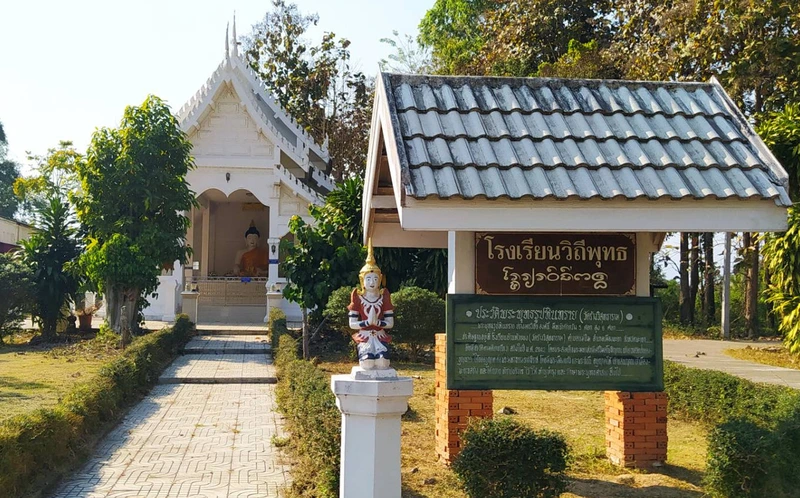
Open Days: School Days
Opening Hours: Open During School Hours
The Sandstone Buddha Image at Ban Huai Bong School in Phayao Province is an important local cultural site connected with Buddhist art, community memory, and education. The image is enshrined inside Ban Huai Bong School in Mae Puem Subdistrict, Mueang Phayao District, on the grounds of an old abandoned temple known locally as Wat Wisuttharam. Carved from sandstone, the Buddha image is regarded as one of the largest and most complete ancient sandstone Buddha images in Phayao, making it a meaningful destination for travelers interested in local Buddhist heritage and lesser-known cultural sites.
The Buddha image is made of sandstone, but the exact year of its creation is not clearly known. It was found within the area of an abandoned temple inside Ban Huai Bong School. This makes the site unusual because it is both an active educational institution and a place that preserves traces of an old Buddhist sanctuary. The presence of the image inside the school shows how history, religion, education, and community life can exist together in one place.
The most distinctive feature of this Buddha image is its impressive size and surviving condition. Local sources describe it as a large sandstone Buddha image in the Mara Vichai posture, measuring about 5 sok across the lap and about 6 sok in height. It is considered one of the largest complete sandstone Buddha images still found in Phayao. This makes the image important not only as a sacred object of worship but also as a valuable example of local Buddhist sculpture.
The image is located on what was formerly an abandoned temple site within the school grounds. Over time, the original monastic buildings disappeared or deteriorated, but the sandstone Buddha image remained. Its survival gives the place strong cultural meaning. The image now serves as a visible reminder that the school area was once part of a religious landscape. By preserving the image within the school, the local community helps keep the memory of the old temple alive.
Phayao has a long history of sandstone Buddha images and is known for its distinctive local Buddhist art. Many Buddha images associated with Phayao reflect the skill of regional artisans, especially in their calm expressions, balanced proportions, and grounded spiritual presence. The sandstone Buddha image at Ban Huai Bong School should therefore be understood within this wider artistic context. It is part of the broader story of Buddhist art in Phayao, not merely an old statue standing inside a school.
Sandstone is an important material in Phayao’s Buddhist sculpture tradition. It can be carved into strong and graceful forms, but it requires skill and sensitivity. The artisan must understand the texture of the stone, the balance of the body, the expression of the face, and the symbolic meaning of the posture. The continued survival of this large sandstone image reflects both the ability of the original craftsmen and the care of the community that has preserved it.
The Mara Vichai posture is one of the most meaningful postures in Buddhist art. It represents the moment when the Buddha overcame Mara before attaining enlightenment. The right hand reaches down toward the earth, symbolizing steadfastness, truth, and victory over temptation. When this posture is expressed through sandstone, the image gives a strong feeling of stillness and spiritual strength. This is one reason why the image remains deeply respected by local people.
Although the exact date of construction is not known, the value of the image is clear. It is an old and large sandstone Buddha image associated with an abandoned temple and the living memory of the Ban Huai Bong community. Its importance lies in its artistic form, its sacred presence, and its role as evidence of the historical Buddhist landscape of Mae Puem and Mueang Phayao.
The location of the Buddha image inside Ban Huai Bong School gives the site a special educational role. Students can learn about local history, Buddhist art, abandoned temples, heritage conservation, and community identity directly from an object located within their own school. History is not presented only through textbooks; it is physically present in the place where they study. This gives the site strong value as a local learning resource.
For the Ban Huai Bong community, the Buddha image is a source of faith and pride. It represents a link between the old temple, the present school, and the village community. The image is not isolated from daily life. It stands within a shared space used by teachers, students, parents, and villagers. This makes the image part of the continuing cultural life of the community rather than a distant museum object.
Visitors should understand that the image is located inside school grounds. This means that visits should be arranged respectfully and appropriately. Travelers should visit during school days and school hours, contact the school or caretaker before entering, and avoid disturbing classes or student activities. This is different from visiting a regular temple, because the area is both a sacred site and an active educational environment.
When paying respect to the sandstone Buddha image, visitors should dress modestly, speak quietly, and avoid touching or climbing on the image. Photography should be done with respect and should not disturb students, teachers, or school activities. If visitors wish to take photographs for publication, they should consider the privacy and appropriateness of the school setting. Respecting the location helps protect both the sacred object and the learning environment.
The Buddha image also serves as a valuable local history learning site. It can help students and visitors understand abandoned temples, archaeological traces, Buddhist sculpture, sandstone carving, and community-based heritage preservation. Unlike major tourist attractions, this site offers a quieter and more intimate encounter with local culture. Its value lies in the fact that a significant piece of Phayao’s Buddhist heritage remains embedded within a living community.
For cultural travelers, the sandstone Buddha image at Ban Huai Bong School is suitable for inclusion in a route focused on Buddhist art and local history in Phayao. It can be combined with major sites such as Wat Si Khom Kham, Wat Phra That Chom Thong, Phayao Lake, and Mae Puem National Park. This type of route allows visitors to see Phayao from different perspectives: city temples, lakeside landscapes, forest areas, and small community heritage sites.
Getting There is most convenient by private car. Travelers can drive to Mae Puem Subdistrict in Mueang Phayao District. Ban Huai Bong School is located in Moo 18, Mae Puem Subdistrict, and can be reached from main roads in the Mueang Phayao area. From Phayao town, the site can be included in a half-day cultural route together with Wat Si Khom Kham, Phayao Lake, Wat Phra That Chom Thong, or Mae Puem National Park.
Mae Puem is an area with communities, schools, agricultural land, water resources, and natural attractions. Nearby places include Huai Bong Reservoir and Mae Puem National Park. A visit to the sandstone Buddha image can therefore be combined with nature-based travel. Travelers can begin with a respectful visit to the Buddha image and then continue to nearby reservoirs or forested areas for relaxation.
Mae Puem National Park is one of the natural attractions in the wider area. It includes forest landscapes, water resources, and places suitable for nature recreation. Combining the school’s sandstone Buddha image with Mae Puem National Park gives travelers both cultural and natural experiences. It also shows that Mae Puem is not only a natural area but also a place with traces of Buddhist heritage and local history.
Phayao Lake and Wat Si Khom Kham can also be included in the same travel plan. Phayao Lake is one of the province’s most recognizable landmarks, while Wat Si Khom Kham is an important city temple. Traveling from these major sites to Ban Huai Bong School gives visitors a broader view of Phayao: from well-known provincial landmarks to a lesser-known heritage site preserved within a local school.
The most important point for visitors is to respect the context of the place. Ban Huai Bong School is an active school offering education from primary to lower secondary levels. Visitors should avoid entering without permission, especially during class hours. Contacting the school in advance helps ensure that the visit is orderly, safe, and does not interfere with students and teachers.
From a conservation perspective, sandstone Buddha images require careful care. Although sandstone is strong, its surface can erode through repeated touching, moisture, dust, and environmental change. Visitors can help preserve the image by not touching it unnecessarily, not applying substances to the surface, and keeping the surrounding area clean. Respectful behavior is one of the simplest and most effective forms of conservation.
The site also highlights the role of schools as community learning centers. In many rural areas, schools are not only places for classroom learning. They are connected with local temples, historical traces, agricultural projects, community knowledge, and cultural memory. The sandstone Buddha image at Ban Huai Bong School can support learning in history, art, Buddhism, civic responsibility, and cultural preservation.
For visitors interested in Buddhist art, this image is worth comparing with other sandstone Buddha images in Phayao. Some images are kept in temples, some in museums, and some in community spaces. The Ban Huai Bong image is distinctive because it is preserved within a school. This context shows that cultural heritage can survive in many types of places and can remain meaningful when local people continue to care for it.
During school or community activities, the relationship between the school and the local community becomes even clearer. Ban Huai Bong School has long served as a place for education and community development. The sandstone Buddha image adds a cultural layer to this role. It connects students, teachers, parents, villagers, and visitors with the older religious history of the area.
Overall, the sandstone Buddha image at Ban Huai Bong School is suitable for travelers who want to understand Phayao beyond its main tourist attractions. Its significance comes from its size, material, condition, and connection with the abandoned Wat Wisuttharam site. More importantly, it shows how Buddhist heritage can remain part of everyday community life through careful preservation within a school setting.
This Buddha image should not be viewed simply as an old statue inside a school. It is a local cultural treasure that quietly tells the story of Phayao’s Buddhist past. From an abandoned temple to a modern school, the image has remained present through changing times. It continues to serve as a sacred object, a learning resource, and a reminder of the importance of preserving community heritage.
Visitors who plan to come should treat the site as a respectful cultural learning destination rather than a quick photo stop. Taking time to understand the story, observe the details of the image, respect school rules, and appreciate the connection between the old temple and the present school will make the visit far more meaningful. The sandstone Buddha image at Ban Huai Bong School is another quiet but important reminder that Phayao still holds many cultural treasures within its local communities.
| Name | Sandstone Buddha Image At Ban Huai Bong School |
| Location | Ban Huai Bong School, Moo 18, Mae Puem Subdistrict, Mueang Phayao District, Phayao 56000, Thailand |
| Address | Phahonyothin Road, Mae Puem Subdistrict, Mueang Phayao District, Phayao Province |
| Coordinates | 19.26787, 99.85736 |
| Highlights | Large sandstone Buddha image in the Mara Vichai posture, enshrined within the old Wat Wisuttharam site inside Ban Huai Bong School |
| History | An old sandstone Buddha image of unknown exact date, found within an abandoned temple area inside Ban Huai Bong School and preserved as a local cultural learning site |
| Key Evidence | Large sandstone Buddha image in the Mara Vichai posture, about 5 sok across the lap and about 6 sok high, together with remains of the old Wat Wisuttharam area |
| Name Origin | Named after its material, a Buddha image carved from sandstone, and its location inside Ban Huai Bong School |
| Distinctive Features | A large and well-preserved sandstone Buddha image reflecting Phayao Buddhist art and the role of the school as a local heritage learning center |
| Travel Information | Best reached by private car via Mae Puem Subdistrict, Mueang Phayao District; visitors should contact the school before entering the grounds |
| Current Status | Enshrined inside Ban Huai Bong School as a local cultural learning site and sacred object respected by the community |
| Open Days | School Days |
| Opening Hours | Open During School Hours |
| Visitor Guidelines | Contact the school before visiting, dress modestly, do not disturb classes, and follow the instructions of the school caretaker |
| Facilities | School grounds, inner school courtyard, and the area enshrining the sandstone Buddha image |
| Main Areas / Zones | Sandstone Buddha image area, old Wat Wisuttharam site, and local learning area within Ban Huai Bong School |
| Caretaker | Ban Huai Bong School, administered by Mr. Pichet Chaiban, Director of Ban Huai Bong School |
| Main Contact Number | 085-717-9544 |
| Official Website / Official Page | Ban Huai Bong School, Mae Puem Subdistrict, Mueang Phayao District, Phayao Province, under Phayao Primary Educational Service Area Office 1 |
| Nearby Tourist Attractions | 1. Huai Bong Reservoir, about 3 km 2. Phra That Pong Kluea, about 6 km 3. Mae Puem Reservoir, about 12 km 4. Mae Puem National Park, about 15 km, Tel. 088-290-9433, 093-265-3035 5. Wat Si Khom Kham, about 18 km 6. Phayao Lake, about 19 km 7. Wat Phra That Chom Thong, about 20 km |
| Nearby Restaurants | 1. LOST CONTROL Cafe And Restaurants, about 2 km, Tel. 093-482-8301 2. Pa Por Old-Style Pork Noodle, about 6 km 3. Ko Sai Lap Khom, about 7 km 4. Kin Khao Lam, about 8 km 5. Man Tueng Lam Cafe’ & Rest, about 14 km, Tel. 061-348-5831, 088-906-9339 6. Hummingbird Coffee, about 15 km |
| Nearby Accommodations | 1. Taklom Chom Doi Resort And Homestay, about 9 km, Tel. 095-264-6539 2. DD Garden Home Phayao, about 15 km, Tel. 093-130-3111, 093-130-3222 3. Naga Tara Resort, about 18 km, Tel. 054-430-838 4. ABIZZ Hotel Kwan Phayao, about 21 km, Tel. 062-941-6228 5. Sabuy Best Hotel, about 22 km 6. Phayao Northern Lake Hotel, about 22 km |
Frequently Asked Questions (FAQ)
Q: Where is the Sandstone Buddha Image at Ban Huai Bong School located?
A: It is enshrined inside Ban Huai Bong School, Moo 18, Mae Puem Subdistrict, Mueang Phayao District, Phayao Province.
Q: Why is this sandstone Buddha image important?
A: It is a large ancient sandstone Buddha image found within an abandoned temple site inside Ban Huai Bong School and is an important example of Phayao Buddhist art.
Q: What posture is the Buddha image in?
A: The image is in the Mara Vichai posture, symbolizing the Buddha’s victory over Mara and his firm resolve before enlightenment.
Q: How large is the sandstone Buddha image?
A: It is described as about 5 sok across the lap and about 6 sok high, making it one of the largest complete sandstone Buddha images in Phayao.
Q: Can visitors see the Buddha image inside Ban Huai Bong School?
A: Visitors can see the image, but they should contact the school or caretaker before entering and avoid disturbing classes or school activities.
Q: Who takes care of the site?
A: The site is under the care of Ban Huai Bong School, administered by Mr. Pichet Chaiban, Director of Ban Huai Bong School.
Q: How can visitors get there?
A: The most convenient way is by private car to Mae Puem Subdistrict, Mueang Phayao District. Visitors can use the coordinates 19.26787, 99.85736 for navigation.
Q: What nearby attractions can be visited with this site?
A: Nearby attractions include Huai Bong Reservoir, Phra That Pong Kluea, Mae Puem Reservoir, Mae Puem National Park, Wat Si Khom Kham, Phayao Lake, and Wat Phra That Chom Thong.
 Category: ●Places of Worship
 Group: ●Other Sacred Sites
Last Update : 4 MonthAgo
 Last Update : 4 MonthAgo
 Click to Access the Navigation Map GPS
 Art, Culture and Heritage
 Historical Sites and Monuments(4)
 Landmarks and Memorials(4)
 Art, Craft Centres, Tradition(1)
 Museums(2)
 Temple(39)
Other Sacred Sites(5)
Temple(39)
Other Sacred Sites(5)
 Research and Development
 Royal Project(1)
 Suburban Living
 Village, Community(2)
 Local Market(4)
 Nature and Wildlife
 National Parks and Marine Reserves(6)
 Mountain (Doi)(2)
 Dam, Reservoir, Lake(11)
 Waterfalls(8)
 Caves(5)
 River, Canal(3)
 Other natural attractions(5)


