
lovethailand home >North Travel Attractions >Phayao Travel Attractions >Muang Phayao >Ban Tom > Wat Tom Dong
TL;DR: Wat Tom Dong is located at Ban Tom Dong, Moo 5, Ban Tom Subdistrict, Mueang Phayao District, Phayao Province, open Daily, hours 08.00 – 17.00.

Wat Tom Dong
Open Days: Daily
Opening Hours: 08.00 – 17.00
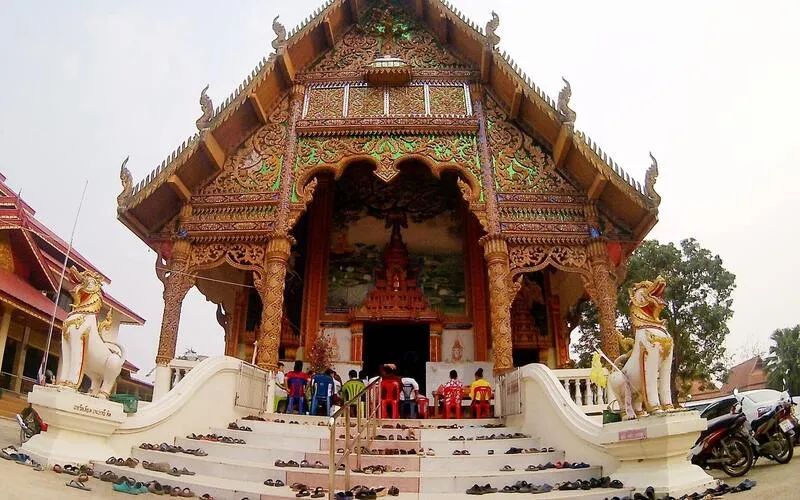
Wat Tom Dong in Phayao Province is an old community temple located in Ban Tom Dong, Moo 5, Ban Tom Subdistrict, Mueang Phayao District. Established around 1847 CE, the temple has long served as a spiritual and social center for local residents. It is not a large or highly ornate tourist temple, but it represents an important kind of northern Thai temple: a living community temple where religion, tradition, social support, and local identity remain closely connected.
Wat Tom Dong is located in a local community near Phayao city. The surrounding area still reflects the rhythm of a village community, while also being accessible from the main urban area of Mueang Phayao. Visitors who come here will find a quieter and more local atmosphere than the better-known temples around Kwan Phayao. The temple is suitable for those who want to experience the everyday role of Buddhism in a northern Thai community.
The temple covers an area of about 3 rai, 3 ngan, and 13 square wah. It received its consecrated boundary in 1966 CE, allowing proper monastic ceremonies to be performed within the temple. Wat Tom Dong belongs to the Mahanikaya order and continues to have monks in residence. The temple grounds include an ordination hall, sermon hall, monks’ residences, and an activity area used for merit-making events and community gatherings.
The ordination hall is the religious heart of the temple. Although it is simple in appearance, its importance lies in its function. It is the place where monks perform important monastic acts and where villagers come to pay respect, make merit, and reflect on Buddhist teachings. The simplicity of the ordination hall reflects the character of a village temple that emphasizes practice, faith, and community use rather than visual grandeur.
The sermon hall is another important space at Wat Tom Dong. In many northern Thai villages, the sermon hall functions as a shared community building. It is used for listening to sermons, holding meetings, preparing merit-making events, and supporting ceremonies such as ordinations, funerals, and annual festivals. At Wat Tom Dong, this space helps connect the religious life of the temple with the social life of the village.
The activity ground within the temple has supported many community events over the years. These include Buddhist ceremonies, village meetings, occupational training, activities for elderly residents, and local cultural events. This is one of the most important aspects of Wat Tom Dong: it is not only a place for worship, but also a space where people gather, learn, support each other, and maintain the social fabric of the community.
In 2009 CE, the temple was used as a venue for the Ton Kla Achip OTOP project, which provided occupational training for local residents. Training topics included food, herbs, and traditional handicrafts. This activity shows that Wat Tom Dong has played a role in community development as well as religious life. By hosting such programs, the temple helped local people turn traditional knowledge into useful skills and potential sources of income.
Wat Tom Dong has also been associated with activities for elderly residents, including a senior learning school. This role expands the meaning of the temple beyond formal religious ceremonies. Elderly residents can gather at the temple, meet friends, join activities, learn new skills, and maintain emotional and physical well-being. In this way, the temple functions as a social care space for the community.
Throughout the year, Wat Tom Dong hosts Buddhist and local merit-making activities. Important Buddhist days such as Makha Bucha, Visakha Bucha, Asalha Bucha, Buddhist Lent, and the end of Buddhist Lent bring villagers together for alms giving, sermons, meditation, candlelight processions, and offerings to monks. These activities help preserve Buddhist values and northern Thai community traditions.
The annual merit-making activities at Wat Tom Dong are usually simple but meaningful. Villagers prepare food, offerings, flowers, candles, and other items to present to monks. These acts of giving are not only personal religious practices; they also strengthen relationships among villagers. The temple therefore preserves both faith and social connection.
Another story that brought attention to Wat Tom Dong is the local belief surrounding an old takhian tree, believed to be more than 500 years old. The tree once stood near the temple entrance. After it died, the temple cut it down and kept it within the temple grounds. Local reports described it as a large tree with a circumference of more than 4 meters and a length of more than 18 meters. Some villagers believed that the tree brought good luck, especially after lottery-related stories spread in the community.
This takhian tree story should be understood as part of local belief and folk culture. In Thai society, old takhian trees are often associated with sacred presence, spirits, and fortune. While the story attracted many visitors during a certain period, the deeper value of Wat Tom Dong remains its role as a temple for the community: a place for merit-making, social support, cultural continuity, and local Buddhist life.
For cultural travelers, Wat Tom Dong is valuable because it shows how a community temple works in daily life. It may not have grand architecture, but it has living functions. It supports monks, villagers, children, adults, and elderly residents. It hosts ceremonies, training programs, and community activities. It preserves religious practice and social connection at the same time.
Visitors should approach Wat Tom Dong with respect and calmness. This is a local temple used by residents, not a large tourist attraction. Dress modestly, keep voices low, avoid disturbing monks or villagers, and ask before entering important interior areas. If community activities are taking place, visitors should observe respectfully and avoid interfering with local ceremonies.
Getting There is convenient from central Phayao. Travelers can head toward Ban Tom Subdistrict and continue to Ban Tom Dong, Moo 5. The temple can be found by searching for Wat Tom Dong on online maps or by using the coordinates 19.19506, 99.82713. Private cars, motorcycles, rental cars, local transport, and ride-hailing services are practical options. It can be combined with nearby places such as Wat Tom Klang, Kwan Phayao, Wat Si Khom Kham, Wat Tilok Aram, King Ngam Muang Monument, Wat Li, and Wat Si Umong Kham.
Wat Tom Dong is best suited for travelers who want to understand the local side of Phayao. It reveals that the value of a temple is not measured only by size or decoration. A temple can be meaningful because it gathers people, supports community life, preserves Buddhist practice, and provides a place where different generations remain connected. This quiet village temple offers a warm and authentic view of northern Thai culture.
In summary, Wat Tom Dong is an old community temple of Ban Tom Dong that continues to serve as a center of faith, culture, and social activity. With its ordination hall, sermon hall, monks’ residences, activity ground, history dating back to around 1847, consecrated boundary from 1966, OTOP training activities, elderly learning activities, and the local story of the old takhian tree, the temple provides a meaningful insight into the living relationship between Buddhism and community life in Phayao.
| Name | Wat Tom Dong |
| Location | Ban Tom Dong, Moo 5, Ban Tom Subdistrict, Mueang Phayao District, Phayao Province |
| Address | Ban Tom Subdistrict, Mueang Phayao District, Phayao Province 56000 |
| Coordinates | 19.19506, 99.82713 |
| Highlights | Old community temple of Ban Tom Dong with an ordination hall, sermon hall, monks’ residences, community activity ground, and the local story of a takhian tree believed to be more than 500 years old |
| History | Established around 1847 CE, covering about 3 rai, 3 ngan, and 13 square wah. The temple received its consecrated boundary in 1966 and belongs to the Mahanikaya order. |
| Distinctive Features | A simple village temple reflecting the daily religious, social, and cultural life of Ban Tom Dong community |
| Key Evidence | Ordination hall, sermon hall, monks’ residences, activity ground, consecrated boundary area, and the former area associated with the old takhian tree |
| Tradition / Ritual | Alms giving, sermons, candlelight processions, Makha Bucha, Visakha Bucha, Asalha Bucha, Buddhist Lent, end of Buddhist Lent, northern Thai merit-making events, and community activities |
| Community Role | Venue for the Ton Kla Achip OTOP project in food, herbs, and handicrafts, and a community space formerly associated with senior learning activities |
| Travel Information | From central Phayao, travel toward Ban Tom Subdistrict and continue to Ban Tom Dong, Moo 5. Accessible by private car, motorcycle, rental car, local transport, or ride-hailing services. |
| Current Status | Open as a local Buddhist temple and spiritual center of Ban Tom Dong community |
| Open Days | Daily |
| Opening Hours | 08.00 – 17.00 |
| Fees | Free Admission |
| Facilities | Ordination hall, sermon hall, monks’ residences, community activity ground, worship area, temple grounds, and parking area |
| Main Areas / Zones | Ordination hall, sermon hall, monks’ residences, activity ground, merit-making area, and surrounding community space |
| Abbot / Caretaker | Phra Athikan Phaibun Panyawaro |
| Nearby Tourist Attractions | 1. Wat Tom Klang, About 2 km 2. Kwan Phayao, About 5 km 3. Wat Si Khom Kham, About 5 km 4. Wat Tilok Aram, About 6 km 5. King Ngam Muang Monument, About 6 km 6. Wat Li And Wiang Phayao Museum, About 7 km 7. Wat Si Umong Kham, About 7 km |
| Nearby Restaurants | 1. Kuai Tiao Ahan Tam Sang Ban Tom, About 2 km, Tel. 061-306-6003 2. Lap Ban Tom, About 3 km, Tel. 084-042-0474 3. Cafe Ban Tom, About 3 km, Tel. 085-615-3592 4. Khao Kaeng Lai Kwan Ban Tom Klang Ruean Ton Tor, About 3 km, Tel. 097-824-2646 5. So Good Phayao, About 5 km 6. Phayao Coffee Roaster, About 5 km |
| Nearby Accommodations | 1. ABIZZ Hotel KwanPhayao, About 4 km 2. NAGA TARA Boutique Resort, About 4 km 3. B2 Phayao Boutique & Budget Hotel, About 5 km 4. M2 Hotel Waterside, About 5 km 5. Dee Hotel Phayao, About 5 km 6. Phayao Gateway Hotel, About 7 km, Tel. 063-696-2249, 054-484-333, 054-411-333 |
Frequently Asked Questions (FAQ)
Q: Where is Wat Tom Dong located?
A: Wat Tom Dong is located in Ban Tom Dong, Moo 5, Ban Tom Subdistrict, Mueang Phayao District, Phayao Province.
Q: When was Wat Tom Dong established?
A: Wat Tom Dong was established around 1847 CE and received its consecrated boundary in 1966.
Q: Why is Wat Tom Dong important to the community?
A: It serves as a spiritual and social center for local residents, supporting merit-making, sermons, festivals, occupational training, and elderly community activities.
Q: What are the main structures inside Wat Tom Dong?
A: The temple includes an ordination hall, sermon hall, monks’ residences, and a community activity ground.
Q: What is the story of the old takhian tree at Wat Tom Dong?
A: The temple was once associated with a takhian tree believed to be more than 500 years old, which local people connected with fortune and good luck.
Q: What are the opening hours of Wat Tom Dong?
A: Wat Tom Dong is open daily from 08.00 to 17.00.
Q: Who is the abbot of Wat Tom Dong?
A: The abbot of Wat Tom Dong is Phra Athikan Phaibun Panyawaro.
Q: What nearby places can be visited with Wat Tom Dong?
A: Nearby places include Wat Tom Klang, Kwan Phayao, Wat Si Khom Kham, Wat Tilok Aram, King Ngam Muang Monument, Wat Li, and Wat Si Umong Kham.
 Category: ●Places of Worship
 Group: ●Temple
Last Update : 1 MonthAgo
 Last Update : 1 MonthAgo
 Click to Access the Navigation Map GPS
 Art, Culture and Heritage
 Historical Sites and Monuments(4)
 Landmarks and Memorials(4)
 Art, Craft Centres, Tradition(1)
 Museums(2)
Temple(39)
Museums(2)
Temple(39)
 Other Sacred Sites(5)
 Research and Development
 Royal Project(1)
 Suburban Living
 Village, Community(2)
 Local Market(4)
 Nature and Wildlife
 National Parks and Marine Reserves(6)
 Mountain (Doi)(2)
 Dam, Reservoir, Lake(11)
 Waterfalls(8)
 Caves(5)
 River, Canal(3)
 Other natural attractions(5)


