
lovethailand home >North Travel Attractions >Phayao Travel Attractions >Muang Phayao >Mae Tam > Wat Inthan
TL;DR: Wat Inthan is located at Ban Mae Tam, Mae Tam Subdistrict, Mueang Phayao District, Phayao Province, open Daily, hours Contact The Temple Directly Before Entering Important Interior Areas.
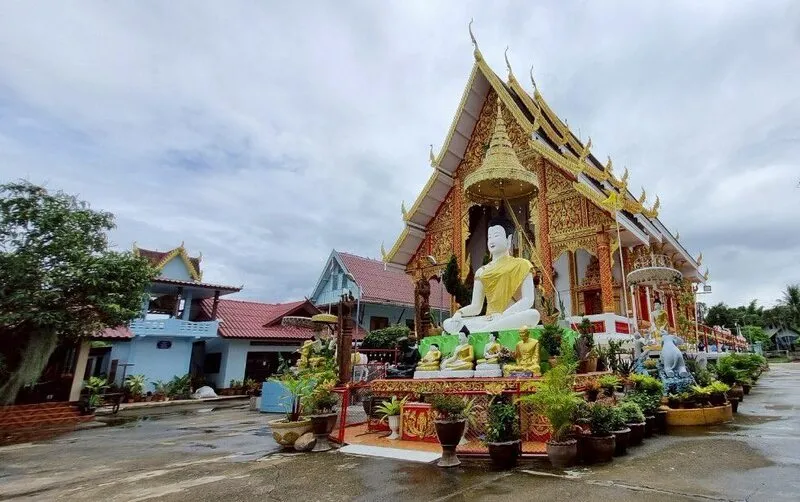
Wat Inthan
Open Days: Daily
Opening Hours: Contact The Temple Directly Before Entering Important Interior Areas
Wat Inthan in Phayao Province is a quiet community temple located in Ban Mae Tam, Mae Tam Subdistrict, Mueang Phayao District. Built in 1936 CE, the temple stands within a peaceful northern Thai agricultural community and continues to serve as a spiritual center for local residents. Although it is not a large temple, Wat Inthan is valuable for its local craftsmanship, religious atmosphere, wooden architectural details, and close relationship with the traditions of the Mae Tam community.
The temple is located on Mae Tam Sai Nai Road, not far from central Phayao. The surrounding area still reflects the rhythm of a local community rather than a busy tourist zone. This makes Wat Inthan suitable for travelers who want to experience a quieter side of Phayao, away from the main lakeside attractions. It is a place for respectful temple visiting, observation of local woodwork, and understanding how Buddhism remains part of everyday life in northern Thai villages.
The most important highlight of Wat Inthan is its ordination hall, which stands on a raised base. The building reflects a combination of local northern Thai taste and artistic influences from the late Ayutthaya to early Rattanakosin period. The raised base gives the ordination hall a dignified appearance and marks it as a sacred space within the temple grounds. Visitors should walk slowly around the building and observe the relationship between the base, wooden details, entrance, and interior Buddha image.
The wooden doors of the ordination hall are especially worth seeing. They are carved with delicate patterns that reflect both local wisdom and Buddhist devotion. Floral motifs, celestial figures, and auspicious religious patterns appear across the wooden surface. These carvings are not merely decorative; they express the faith of the community and the skill of local woodcarvers. The doors act as a symbolic threshold between the ordinary world outside and the sacred space of Buddhist worship inside.
The carved wooden pediment is another distinctive feature. It includes a Thai-style pierced wood design with an image of Indra seated on a throne or sacred seat. This detail is closely related to the temple’s name, Wat Inthan. In Buddhist and traditional Thai belief, Indra is associated with protection, merit, and support for Buddhism. The presence of Indra on the pediment gives the ordination hall a meaningful symbolic identity and connects the temple name with its architectural decoration.
Inside the ordination hall, the atmosphere feels warm and wooden in character. The interior houses a gilded sandstone Buddha image. Sandstone Buddha images are strongly associated with Phayao’s local Buddhist art, and this image connects Wat Inthan with the wider artistic identity of the province. The combination of sandstone and gilding creates a balance between strength, simplicity, and sacred radiance.
Behind the ordination hall is a modest chedi. Although it is not large, it completes the sacred layout of the temple. In a community temple like Wat Inthan, the chedi serves as a spiritual focus and a symbol of Buddhism. Together with the ordination hall, wooden doors, Indra pediment, and Buddha image, the chedi helps form a complete religious landscape for local worship and community ceremonies.
Another interesting detail at the temple is the carved wooden ceremonial banner with a swan-shaped end. The swan is a graceful and auspicious motif often found in northern Thai Buddhist art. This small but meaningful element shows that the temple’s artistic value is not limited to the main doors. It also appears in other wooden features that reflect local craftsmanship and religious aesthetics.
Wat Inthan remains active in local Buddhist life. Villagers gather at the temple for important Buddhist days such as Makha Bucha, Visakha Bucha, Asalha Bucha, Buddhist Lent, and the end of Buddhist Lent. Activities include merit-making, alms giving, listening to sermons, candlelight processions, and community ceremonies. These events show that the temple is not only a place of art, but also a living center of faith and social connection.
During Buddhist Lent, local residents come to the temple to make offerings, listen to Dhamma teachings, and support the monks. On full-moon Buddhist holy days, the temple becomes a gathering space where people express faith through simple but meaningful rituals. The modest scale of the temple makes these ceremonies feel intimate and deeply connected to the local community.
For cultural travelers, Wat Inthan is a good example of a northern Thai community temple. Its value is not based on grandeur or fame, but on continuity. The temple shows how Buddhism, woodcarving, local identity, agriculture-based community life, and annual traditions remain connected. It helps visitors understand that small temples can preserve important cultural knowledge just as meaningfully as larger and more famous temples.
A recommended visit should begin with a quiet walk around the temple grounds. Visitors can then observe the raised ordination hall, the carved wooden doors, the Indra pediment, the gilded sandstone Buddha image inside the hall, and the chedi behind the building. Those interested in local craftsmanship should spend extra time examining the carved details on the doors and wooden elements, as they reveal the skill and devotion of local artisans.
Visitors should dress respectfully, remove shoes before entering sacred buildings, avoid touching carved wooden doors or Buddha images, and ask the monks or caretakers before entering important interior areas. Photography should be done quietly and respectfully. Because the temple is still used by the community for religious activities, visitors should avoid disturbing local worship and ceremonies.
Getting There is convenient from central Phayao. Travelers can head toward Mae Tam Subdistrict and follow Mae Tam Sai Nai Road to Ban Mae Tam. The temple can be reached by private car, motorcycle, rental car, local transport, or ride-hailing services. It can be combined with a route that includes Wat Pa Lan Kham, Mae Tam Market, Kwan Phayao, Wat Tilok Aram, Wat Si Khom Kham, King Ngam Muang Monument, and Wat Li.
Wat Inthan is best appreciated by visitors who enjoy quiet cultural places. It is not a crowded landmark, but a community temple where wooden craftsmanship, Buddhist faith, and local life remain closely connected. The carved ordination hall doors, Indra pediment, gilded sandstone Buddha image, and peaceful setting make the temple a meaningful stop for travelers who want to see the gentler and more local side of Phayao.
In summary, Wat Inthan is a valuable temple in Ban Mae Tam. It preserves a raised ordination hall, beautifully carved wooden doors, a carved pediment depicting Indra, a gilded sandstone Buddha image, a modest chedi, and the continuing religious life of the Mae Tam community. A visit here is not only about seeing temple architecture, but also about understanding the spiritual roots of a northern Thai village community.
| Name | Wat Inthan |
| Location | Ban Mae Tam, Mae Tam Subdistrict, Mueang Phayao District, Phayao Province |
| Address | 184 Mae Tam Sai Nai Road, Mae Tam Subdistrict, Mueang Phayao District, Phayao Province 56000 |
| Coordinates | 19.13737, 99.90927 |
| Highlights | Raised ordination hall, beautifully carved wooden doors, carved wooden pediment with Indra, swan-ended wooden ceremonial banner, and a gilded sandstone Buddha image inside the ordination hall |
| History | Wat Inthan was built in 1936 CE and remains a community temple of Ban Mae Tam, serving local religious, cultural, and social life. |
| Name Origin | The temple name is associated with Indra, reflected in the carved wooden pediment depicting Indra seated on a sacred throne. |
| Distinctive Features | A small and peaceful community temple with local wooden craftsmanship, an ordination hall influenced by late Ayutthaya to Rattanakosin artistic forms, and a calm agricultural-community setting |
| Key Evidence | Carved wooden ordination hall doors, carved wooden pediment with Indra, swan-ended wooden ceremonial banner, gilded sandstone Buddha image, and chedi behind the ordination hall |
| Tradition / Ritual | Makha Bucha, Visakha Bucha, Asalha Bucha, Buddhist Lent, the end of Buddhist Lent, alms giving, sermons, candlelight processions, and community Buddhist ceremonies |
| Travel Information | From central Phayao, travel toward Mae Tam Subdistrict and follow Mae Tam Sai Nai Road to Ban Mae Tam. Accessible by private car, motorcycle, rental car, local transport, or ride-hailing services. |
| Current Status | Open as a local Buddhist temple and spiritual center of Ban Mae Tam community |
| Open Days | Daily |
| Opening Hours | Contact The Temple Directly Before Entering Important Interior Areas |
| Fees | Free Admission |
| Facilities | Worship area, ordination hall, wooden artwork viewing area, temple grounds, surrounding community area, and nearby parking space |
| Main Areas / Zones | Raised ordination hall, carved wooden doors, Indra pediment, gilded sandstone Buddha image, chedi behind the ordination hall, and community religious activity area |
| Abbot / Caretaker | Phra Chaturong Silasamvaro |
| Nearby Tourist Attractions | 1. Wat Pa Lan Kham, About 1 km 2. Mae Tam Market / Mae Thong Kham Fresh Market, About 2 km 3. Kwan Phayao, About 4 km 4. Wat Tilok Aram, About 5 km 5. Wat Si Khom Kham, About 5 km 6. King Ngam Muang Monument, About 5 km 7. Wat Li And Wiang Phayao Museum, About 5 km |
| Nearby Restaurants | 1. Khao Tom Mae Tam, About 2 km, Tel. 094-545-7716 2. Tam Sang Som Tam Yam Zaap Mae Tam Sai Nai, About 1 km, Tel. 080-223-4221 3. Homework Kitchen Mae Tam Sai Nai, About 1 km, Tel. 080-834-2137 4. Kuai Tiao Kai Mara Mae Tam, About 2 km, Tel. 061-793-8885 5. Mae Tam Fried Chicken And Fried Pork, About 2 km, Tel. 062-506-4729 6. Ruean Bunyatan, About 2 km, Tel. 094-642-3855 |
| Nearby Accommodations | 1. Fak Nam Resort, About 2 km, Tel. 098-249-9250 2. Hop Inn Phayao, About 5 km, Tel. 02-080-2222 3. P Bliss Hotel Phayao, About 5 km, Tel. 054-431-599, 092-501-7441 4. Phuglong Hotel, About 5 km, Tel. 054-481-915, 063-789-1999 5. Green Hill Hotel Phayao, About 5 km, Tel. 054-482-277 6. KM Kwanphayao Hotel, About 5 km |
Frequently Asked Questions (FAQ)
Q: Where is Wat Inthan located?
A: Wat Inthan is located in Ban Mae Tam, Mae Tam Subdistrict, Mueang Phayao District, Phayao Province, on Mae Tam Sai Nai Road.
Q: When was Wat Inthan built?
A: Wat Inthan was built in 1936 CE and remains an important community temple of Ban Mae Tam.
Q: What is Wat Inthan known for?
A: The temple is known for its raised ordination hall, carved wooden doors, carved wooden pediment depicting Indra, swan-ended wooden ceremonial banner, and gilded sandstone Buddha image.
Q: Why are the wooden doors of Wat Inthan important?
A: The wooden doors are finely carved with floral, celestial, and auspicious Buddhist motifs, reflecting local craftsmanship and community devotion.
Q: What Buddha image is enshrined inside the ordination hall?
A: A gilded sandstone Buddha image is enshrined inside the ordination hall, reflecting Phayao’s local Buddhist art tradition.
Q: What religious activities take place at Wat Inthan?
A: The temple hosts Buddhist merit-making, alms giving, sermons, candlelight processions, Buddhist Lent ceremonies, and other important Buddhist holy day activities.
Q: Who is the abbot of Wat Inthan?
A: The abbot of Wat Inthan is Phra Chaturong Silasamvaro.
Q: What nearby places can be visited with Wat Inthan?
A: Nearby places include Wat Pa Lan Kham, Mae Tam Market, Kwan Phayao, Wat Tilok Aram, Wat Si Khom Kham, King Ngam Muang Monument, and Wat Li.
 Category: ●Places of Worship
 Group: ●Temple
Last Update : 1 MonthAgo
 Last Update : 1 MonthAgo
 Click to Access the Navigation Map GPS
 Art, Culture and Heritage
 Historical Sites and Monuments(4)
 Landmarks and Memorials(4)
 Art, Craft Centres, Tradition(1)
 Museums(2)
Temple(39)
Museums(2)
Temple(39)
 Other Sacred Sites(5)
 Research and Development
 Royal Project(1)
 Suburban Living
 Village, Community(2)
 Local Market(4)
 Nature and Wildlife
 National Parks and Marine Reserves(6)
 Mountain (Doi)(2)
 Dam, Reservoir, Lake(11)
 Waterfalls(8)
 Caves(5)
 River, Canal(3)
 Other natural attractions(5)


