
lovethailand home >South Travel Attractions >Phatthalung Travel Attractions >Khuan Khanun >Phanang Tung > Thale Noi Non-Hunting Area
TL;DR: Thale Noi Non-Hunting Area is located at Thale Noi area, Khuan Khanun District, Phatthalung Province, with a wider wetland ecosystem extending into Songkhla and Nakhon Si Thammarat, open Daily, hours 08.30 – 16.30.

Thale Noi Non-Hunting Area
Open Days: Daily
Opening Hours: 08.30 – 16.30
Thale Noi Non-Hunting Area in Phatthalung Province, often known by visitors as Thale Noi Waterfowl Park, is one of Thailand’s most important wetland destinations. Located in Khuan Khanun District, with a wider ecological area extending across Phatthalung, Songkhla, and Nakhon Si Thammarat, Thale Noi is known for its freshwater lake, peat swamp forest, grasslands, aquatic plants, lotus fields, waterbirds, water buffalo, and lakeside communities. It is a major destination for nature travel, birdwatching, early-morning boat trips, wetland education, and responsible ecotourism in southern Thailand.
Thale Noi was declared a non-hunting area on 18 February 1975 and is recognized as Thailand’s first non-hunting area. It is managed under the Department of National Parks, Wildlife and Plant Conservation, Ministry of Natural Resources and Environment. This protected status reflects the ecological importance of Thale Noi as a habitat, feeding ground, nesting area, and breeding site for many waterbirds and other wetland wildlife.
The protected area covers approximately 285,625 rai across 3 provinces: Phatthalung, Songkhla, and Nakhon Si Thammarat. The open-water part known as Thale Noi covers around 17,500 rai. The lake itself is about 5 km wide and 6 km long, with an average depth of about 1.25 meters. Around the lake are rice fields, peat swamp forest, wet grasslands, aquatic vegetation, and local communities that depend on the wetland landscape. This combination gives Thale Noi ecological, cultural, economic, and tourism value in one integrated landscape.
Khuan Khi Sian peat swamp within Thale Noi Non-Hunting Area is Thailand’s first Ramsar Site, meaning it is a wetland of international importance under the Ramsar Convention. This area contains natural peat swamp, Melaleuca forest, wet grasslands, and important habitats for many bird species. Its Ramsar status confirms that Thale Noi is not simply a scenic attraction, but an internationally significant wetland that plays an important role in biodiversity conservation.
The natural character of Thale Noi is shaped by shallow water and abundant aquatic plants. Visitors can see water hyacinth, sedge, lotus, floating plants, and wetland vegetation spread across the lake. In the early morning, lotus flowers open above the water, forming one of Phatthalung’s most iconic landscapes. When waterbirds fly over the lotus fields and long-tail boats move slowly across the lake, Thale Noi becomes a memorable scene for travelers, photographers, birdwatchers, and wetland researchers.
Wildlife diversity is one of the strongest reasons to visit Thale Noi. Public natural-resource information describes the area as home to about 287 waterbird species, 26 reptile species, and 6 mammal species. Important bird species include painted storks, ibises, herons, egrets, little cormorants, night herons, swamphens, jacanas, Asian openbills, and many migratory birds. Some are resident birds, while others arrive seasonally. This makes Thale Noi one of Thailand’s best-known waterbird destinations.
The painted stork is one of the symbols of Thale Noi. It is a large, striking waterbird and an important species for wetland conservation. The area around the Thale Noi office has become a notable nesting zone, especially during the period when birds pair and nest from December to February. Conservation and reintroduction efforts have helped reinforce the role of Thale Noi as a protected refuge for waterbirds.
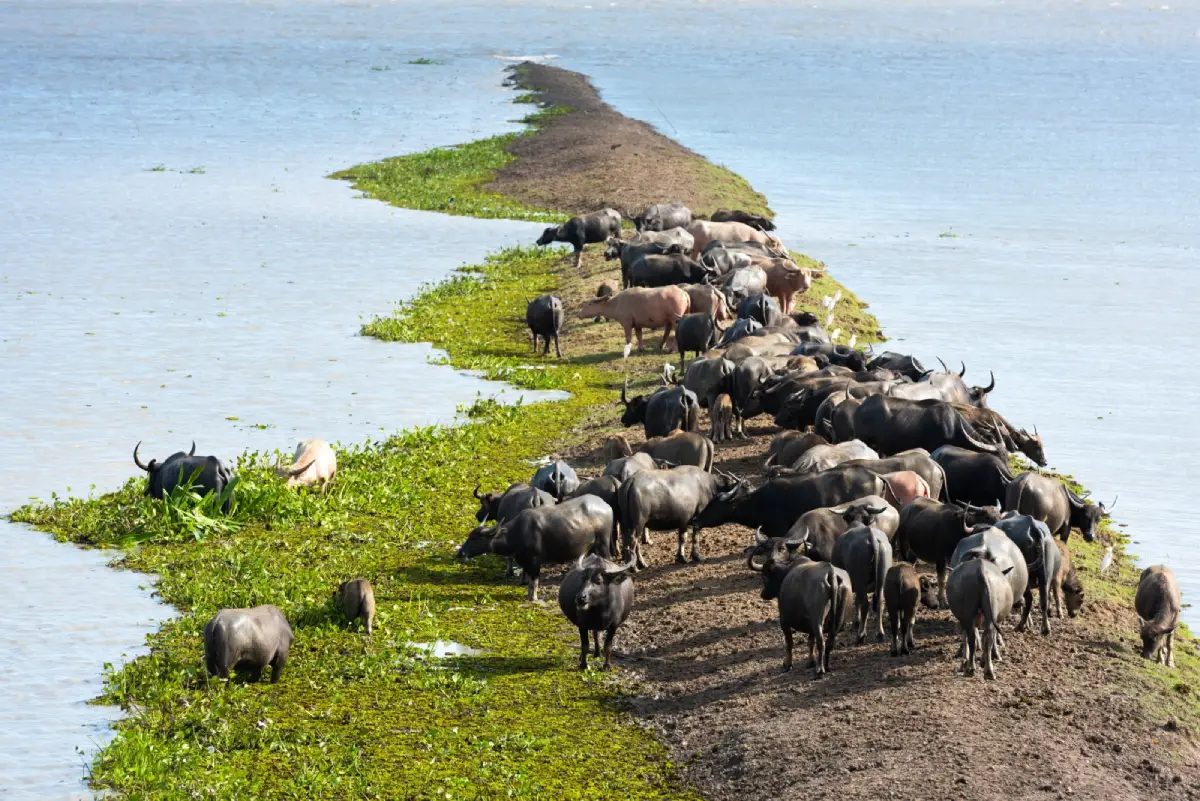
Thale Noi is also known for its water buffalo, locally associated with the wetland lifestyle. The buffalo move through water, grasslands, and wetland margins as part of a long-standing local livestock system. Their presence creates a distinctive image of Phatthalung’s wetland culture, where people, animals, grasslands, and water have coexisted for generations. For many visitors, the sight of buffalo moving through the lake landscape is one of the most memorable parts of the trip.
The most popular activity at Thale Noi is taking a boat trip. Visitors can board boats near the Thale Noi Non-Hunting Area office or, on some routes, from Pak Pra. Boat routes may include lotus fields, birdwatching areas, fishing structures, water buffalo habitats, Khlong Nang Riam, and wetland scenery that changes with season and water level. The best boat trips usually begin before or shortly after sunrise, when lotus flowers open, light reflects on the water, and birds begin feeding.
The best time to see lotus flowers is early morning because the flowers begin to close later in the day. Lotus blooms are commonly seen from late March through the period before the monsoon season, while waterbirds and migratory birds are most active from the cool season through early summer. Travelers who want to see lotus flowers, birds, and water buffalo should plan around season, weather, water level, and early boat departure times.
Important places in and around the non-hunting area include the visitor center, nature trail, observation tower, Sala Nang Riam, Khlong Nang Riam, Khuan Khi Sian peat swamp, lotus fields, bird nesting areas around Ao Mo, Khuan Khi Sian ranger unit, Khuan Thale Mong nesting area, and Thale Noi royal residence area. Each zone offers a different experience: walking, birdwatching, boat travel, wetland learning, or quiet scenery.
The visitor center is the best place to begin a trip. It provides basic information about the wetland, birds, plants, boat routes, and visitor behavior in the protected area. The non-hunting area also has welfare shops, 5 guest houses, tour boats, nature trails, an observation tower, and boat access points. Starting with the visitor center helps travelers understand the area before entering sensitive habitats.
The nature trail near the office is suitable for visitors who want to experience Thale Noi without taking a boat. Birds such as swamphens, jacanas, Asian openbills, and painted storks may be observed in suitable seasons. The trail is appropriate for families, students, and visitors with limited time. Walking quietly, keeping distance from wildlife, and avoiding feeding animals are important practices.
Sala Nang Riam is a well-known rest point on boat routes. Located near Khlong Nang Riam, it offers a quiet waterside atmosphere. Khlong Nang Riam connects Thale Noi with the broader Songkhla Lake system, and its banks include plants such as cork trees, freshwater mangrove-like vegetation, Melaleuca, and lotus species. Traveling through this canal helps visitors see how open water, canals, and peat swamp habitats connect.
Khuan Khi Sian peat swamp should be visited only on permitted routes and with proper guidance. It is a sensitive wetland habitat and an internationally recognized Ramsar Site. Visitors should avoid approaching bird nesting sites, making loud noise, leaving rubbish, or entering restricted areas. The area is valuable precisely because it remains an active habitat for wildlife.
Local communities around Thale Noi add another layer to the experience. Ban Thale Noi and nearby villages are known for sedge products, local food, fish-based specialties, and wetland livelihoods. Sedge is woven into mats, bags, hats, coasters, and household items. Pla duk ra, or fermented catfish, is one of Phatthalung’s well-known local products. A visit to Thale Noi can therefore connect nature conservation with community economy.
Food around Thale Noi reflects the wetland environment. Local restaurants and market food stalls serve dishes made from fish, shrimp, shellfish, fish eggs, aquatic vegetables, and southern Thai ingredients. Travelers should try local wetland-based dishes after the morning boat trip. Eating in the area also supports local businesses and adds a community dimension to the nature experience.
Getting There is easiest by private car or rental car. From Phatthalung town, take Highway 4048 on the Phatthalung-Khuan Khanun route for about 32 km. The road is paved and signposted. Travelers by train can get off at Pak Khlong Railway Station, then continue by local transport for about 8 km to Thale Noi. Visitors planning an early-morning boat trip should either arrive very early or stay near Thale Noi the night before.
Thale Noi can be visited as a morning trip from Phatthalung town, but staying nearby is more convenient for sunrise boat trips. The wider route can be combined with Na Po Kae, Wat Khao Or, Wat Don Sala, Wat Ban Suan, the 80th Birthday Anniversary Bridge, and Pak Pra. This makes Thale Noi a strong starting point for exploring Khuan Khanun and the northern part of Phatthalung.
The best time to visit depends on the purpose of the trip. For lotus flowers, go early in the morning. For waterbirds, the cool season through early summer is ideal. For water buffalo, visitors should ask local boat operators because buffalo movement depends on season and water level. Photographers should prepare for low light before sunrise and protect equipment from water spray during boat travel.
Visitors should dress for outdoor and boat activities. Light clothing, a hat, sunglasses, non-slip footwear, drinking water, and a waterproof bag are useful. Early-morning trips may feel cool on the water, so a light jacket is helpful. Avoid carrying too many loose items on the boat.
Responsible behavior is essential. Visitors should not feed wildlife, pick lotus flowers, pull aquatic plants, throw rubbish into the water, approach nesting birds, or enter restricted habitats. Thale Noi is first a protected area and wildlife habitat, and tourism should support conservation rather than disturb it.
Families with children or elderly visitors should choose safe boats, wear life jackets, and avoid trips during heavy rain or strong wind. Visitors who do not wish to take a boat can still enjoy the visitor center, nature trail, observation tower, and areas near the non-hunting area office.
A good half-day itinerary starts with an early boat trip to see lotus fields and waterbirds, followed by a stop at Sala Nang Riam or Khlong Nang Riam depending on the route. After returning, visitors can walk through the visitor area and buy local products such as sedge crafts or pla duk ra. This route works well for travelers with limited time.
A full-day route can begin with Thale Noi at sunrise, continue to the 80th Birthday Anniversary Bridge, then visit Na Po Kae for rice-field culture or Wat Khao Or for religious and cultural history. This route combines wetland ecology, local communities, agriculture, and cultural heritage in one day.
Thale Noi is suitable for many types of travelers. Birdwatchers can observe waterbirds and migratory birds. Photographers can capture lotus fields, sunrise, fishing structures, buffalo, and lake scenery. Families can learn about wetlands through boat trips and the visitor center. Students can study Ramsar wetlands and conservation. Visitors seeking quiet nature can enjoy the calm of a broad lake at dawn.
What makes Thale Noi special is that it changes with the seasons. Water level, lotus blooms, bird species, boat routes, peat swamp grasslands, and community activities all shift through the year. A single visit reveals only one version of Thale Noi, while returning in another season offers a different landscape and a deeper understanding of wetland life.
The value of Thale Noi Non-Hunting Area lies in the way conservation, ecology, community livelihood, and tourism come together. It is a home for waterbirds, a resource base for local communities, Thailand’s first Ramsar Site through Khuan Khi Sian, a learning area for students and researchers, and one of Phatthalung’s most important natural destinations.
A visit to Thale Noi should be more than a quick photo stop. Travelers should see the relationships among lotus flowers, waterbirds, buffalo, sedge, peat swamp, fishing communities, boat operators, conservation officers, and local food producers. Together, these elements keep Thale Noi alive as one of the most important wetland landscapes in Thailand.
| Name | Thale Noi Non-Hunting Area / Thale Noi Waterfowl Park |
| Location | Thale Noi area, Khuan Khanun District, Phatthalung Province, with a wider wetland ecosystem extending into Songkhla and Nakhon Si Thammarat Provinces |
| Main Office / Visitor Area Address | 113 Moo 2, Phanang Tung Subdistrict, Khuan Khanun District, Phatthalung Province 93150, Thailand |
| Approximate Coordinates | 7.76667, 100.15306 |
| Highlights | Thailand’s first non-hunting area, Thailand’s first Ramsar Site through Khuan Khi Sian, morning lotus fields, waterbirds, water buffalo, Khuan Khi Sian peat swamp, Khlong Nang Riam, Sala Nang Riam, and wetland boat routes. |
| History | Declared Thale Noi Non-Hunting Area on 18 February 1975 to protect waterbirds, wildlife, and the wetland ecosystem. |
| Total Area | About 285,625 rai across Phatthalung, Songkhla, and Nakhon Si Thammarat Provinces. The open-water Thale Noi lake covers about 17,500 rai. |
| Natural Characteristics | Shallow wetland landscape with rice fields, peat swamp forest, grasslands, aquatic plants, lotus fields, and habitats suitable for many waterbird species. |
| Important Wildlife | Around 287 waterbird species, 26 reptile species, and 6 mammal species, including painted storks, ibises, herons, egrets, cormorants, night herons, swamphens, jacanas, and migratory birds. |
| Best Time To Visit | Early morning is best for lotus flowers and birdwatching. Lotus blooms are common from late March until before the monsoon period, while many waterbirds are active from the cool season through early summer. |
| Travel Information | From Phatthalung town, take Highway 4048 on the Phatthalung-Khuan Khanun route for about 32 km. By train, get off at Pak Khlong Railway Station and continue by local transport for about 8 km. |
| Current Status | Open as a non-hunting area, nature learning site, ecotourism destination, and one of Thailand’s most important protected wetlands. |
| Open Days | Daily |
| Opening Hours | 08.30 – 16.30 |
| Facilities / Activity Areas | Visitor center, welfare shop, 5 guest houses, tour boats, nature trail, observation tower, boat access points, and visitor areas near the non-hunting area office. |
| Main Areas / Zones | Visitor center, morning lotus fields, Khlong Nang Riam, Sala Nang Riam, Khuan Khi Sian peat swamp, Ao Mo, Khuan Thale Mong, Khuan Khi Sian ranger unit, and bird nesting areas. |
| Caretaker / Related Agency | Department of National Parks, Wildlife and Plant Conservation, Ministry of Natural Resources and Environment, and Thale Noi Non-Hunting Area Office. |
| Contact Number | Thale Noi Non-Hunting Area, Tel. 074-685-230 |
| Key Activities | Boat trips through lotus fields, birdwatching, observing water buffalo, walking nature trails, sunrise photography, visiting Khuan Khi Sian peat swamp, learning about Ramsar wetlands, and buying local community products. |
| Visitor Etiquette | Do not feed wildlife, make loud noise, pick lotus flowers, pull aquatic plants, throw rubbish into water, approach nesting birds, or enter restricted habitats. Follow staff and boat-operator guidance. |
| Nearby Tourist Attractions | 1. Thale Noi Wildlife And Nature Education Center / Observation Tower, about 1 km 2. 80th Birthday Anniversary Bridge, about 7 km 3. Khuan Khi Sian Peat Swamp, about 10 km by boat 4. Na Po Kae, about 19 km 5. Wat Khao Or, about 23 km |
| Nearby Restaurants | 1. Lenoi Buri, about 1 km, Tel. 074-610-457 2. Muek Sot Yang by Nam Nueng, Thale Noi Market Branch, about 1 km, Tel. 080-894-1040 3. Nong Ying Restaurant, about 1 km, Tel. 074-685-068 4. Muang Lung Curry Shop Thale Noi, about 2 km, Tel. 095-435-1965 5. Suan Park Nai Phut, about 5 km, Tel. 081-445-5991 |
| Nearby Accommodations | 1. Nabua Thale Noi Resort, about 1 km, Tel. 061-410-5946 2. Chuanchom Resort Thale Noi, about 2 km, Tel. 090-180-1991 3. The Rich Resort Thale Noi, about 5 km, Tel. 074-673-787, 095-440-7425, 089-590-5685 4. VARNI Homestay / VARNI Craft, about 9 km, Tel. 074-610-415, 087-760-9879 5. Sai Klong Song Lae Resort Pak Pra Phatthalung, about 18 km, Tel. 084-076-6251 |
Frequently Asked Questions (FAQ)
Q: Where is Thale Noi Non-Hunting Area located?
A: It is located in the Thale Noi area of Khuan Khanun District, Phatthalung Province, with a wider wetland ecosystem extending into Songkhla and Nakhon Si Thammarat Provinces.
Q: Why is Thale Noi important?
A: Thale Noi is Thailand’s first non-hunting area, an important waterbird habitat, and home to Khuan Khi Sian, Thailand’s first Ramsar Site.
Q: When is the best time to visit Thale Noi?
A: Early morning is the best time for boat trips, lotus flowers, and birdwatching. The cool season through early summer is especially suitable for waterbirds and migratory birds.
Q: What are the opening days and hours?
A: Thale Noi Non-Hunting Area is open daily from 08.30 to 16.30. For early-morning boat trips, visitors should contact local boat operators or nearby accommodation in advance.
Q: What can visitors see at Thale Noi?
A: Visitors can see morning lotus fields, many waterbird species, water buffalo, Khuan Khi Sian peat swamp, Khlong Nang Riam, Sala Nang Riam, nature trails, observation points, and lakeside community life.
Q: How do visitors get to Thale Noi?
A: From Phatthalung town, take Highway 4048 toward Khuan Khanun for about 32 km. By train, get off at Pak Khlong Railway Station and continue by local transport for about 8 km.
Q: What nearby places can visitors combine with Thale Noi?
A: Nearby places include the 80th Birthday Anniversary Bridge, Khuan Khi Sian peat swamp, Na Po Kae, Wat Khao Or, Wat Don Sala, and Pak Pra community.
Tel : 074685230
 Tel : 074685230
 Category: ●Nature and Wildlife
 Group: ●National Parks and Marine Reserves
Last Update : 2 MonthAgo
 Last Update : 2 MonthAgo
 Click to Access the Navigation Map GPS
Thale Noi Non-Hunting Area Map
Gellery
Recommend

 Art, Culture and Heritage
 Historical Sites and Monuments(1)
 Landmarks and Memorials(1)
 Art, Craft Centres, Tradition(6)
 Historic Homes and Cities(1)
 Educational Places
 Educational Gardens, Farm(1)
 Places of Worship
 Temple(25)
 Other Sacred Sites(3)
 Research and Development
 Royal Project(2)
 Suburban Living
 Village, Community(3)
National Parks and Marine Reserves(3)
Village, Community(3)
National Parks and Marine Reserves(3)
 Mountain (Doi)(4)
 Dam, Reservoir, Lake(7)
 Waterfalls(16)
 Hot Springs(2)
 Caves(12)
 River, Canal(5)
 Bays and Beaches(6)
 Islands(2)
 Other natural attractions(4)
 Entertainment and Agricultural
 Farms, Parks and Ecotourism(4)
 Travel Articles, Recipes
 Travel Review, Food Review(1)


