
lovethailand home >South Travel Attractions >Phang Nga Travel Attractions >Ka Pong >Le > Wat Narainikaram
TL;DR: Wat Narainikaram is located at Moo 3, Le Subdistrict, Kapong District, Phang Nga Province, open Daily, hours 06.00 – 17.00. Highlights include Replica Vishnu image, Lakshmana image, Sita image, Khao Phra Narai inscription, and local museum inside the temple.

Wat Narainikaram
Open Days: Daily
Opening Hours: 06.00 – 17.00
Wat Narainikaram in Phang Nga Province, locally known as Wat Le, is a historic Buddhist temple in Le Subdistrict, Kapong District. It is one of the most important cultural and archaeological places in this inland part of Phang Nga because it connects a living Buddhist community with ancient Hindu-Brahmanical evidence, maritime trade history, and the story of Takola, the old name associated with ancient Takua Pa. The temple is suitable for travelers who want to pay respect, see replicas of ancient Vishnu-related sculptures, learn about Tamil inscriptions, and understand Phang Nga beyond beaches, islands, and limestone seascapes.
Wat Narainikaram is located in Moo 3, Le Subdistrict, Kapong District, Phang Nga Province, postal code 82170. It is a Mahā Nikāya local temple with an area of about 12 rai. The temple was officially registered in 1927 and received its consecrated boundary in 1935. As a Buddhist institution, it developed strongly in the modern period, but the cultural landscape around the temple is much older. The area is associated with stone sculptures and an inscription dating back around 1,300 to 1,400 years, making it a key place for understanding early cultural contact between Southern Thailand and South India.
The temple was formerly known as Wat Le or Wat Lao, after the local village and subdistrict name. Local history records that villagers donated land for the establishment of the temple. In its early period, the monastic buildings were simple temporary structures. Over time, the temple became more stable and better developed. The earliest abbot known in the temple’s history was Phra Bi. Later, during the period of Phra Khru Sophon Wiriyaphon, the temple became more firmly established and played a stronger role in preserving important archaeological materials connected with the area.
The name Wat Narainikaram is closely tied to Narayana, or Vishnu, one of the most important deities in Hindu tradition. This connection makes the temple distinctive. Inside the temple are replicas of important stone sculptures related to Vishnu, Lakshmana, and Sita. The original Vishnu and Lakshmana images are preserved at Thalang National Museum in Phuket, while the temple continues to serve as a local place of remembrance and veneration. For visitors, the temple provides a rare chance to understand the relationship between ancient Hindu-Brahmanical culture and the later Buddhist community in this part of Phang Nga.
The Vishnu-related sculptures from Khao Phra Narai and Khao Wiang in Le Subdistrict are important in the study of Southern Thai art history. They are associated with the Vaishnava tradition, which gives central importance to Vishnu or Narayana. The discovery of Vishnu, Lakshmana, Rama, Sita, Shiva linga, wheel-like stone pieces, garment fragments, and other sculptural remains shows that the area was not an ordinary rural settlement. It was part of a larger cultural and trade network linked to South India and the maritime routes of the Andaman coast.
One of the most important pieces of evidence connected with this area is the Khao Phra Narai inscription, also known as Inscription No. 26. The inscription is written in Pallava script and Tamil language and dates to around the 11th Buddhist century. It refers to a pond called Sri Avani Naranam and mentions the Manigramam, a South Indian merchant association. This inscription is extremely important because it confirms that Tamil-speaking merchant groups were active in the ancient Takua Pa region. It also supports the view that this part of Phang Nga was connected with the Indian Ocean trade network.
The name Takola is central to understanding Wat Narainikaram. Takola is associated with ancient Takua Pa, a historic port area on the Andaman coast. The sculptures and inscription linked with Wat Narainikaram help explain how this region functioned as a meeting point for trade, belief, language, and settlement. Visitors who come to this temple are therefore not only visiting a local Buddhist temple. They are entering a landscape that preserves evidence of ancient maritime contact between the Thai-Malay Peninsula and South India.
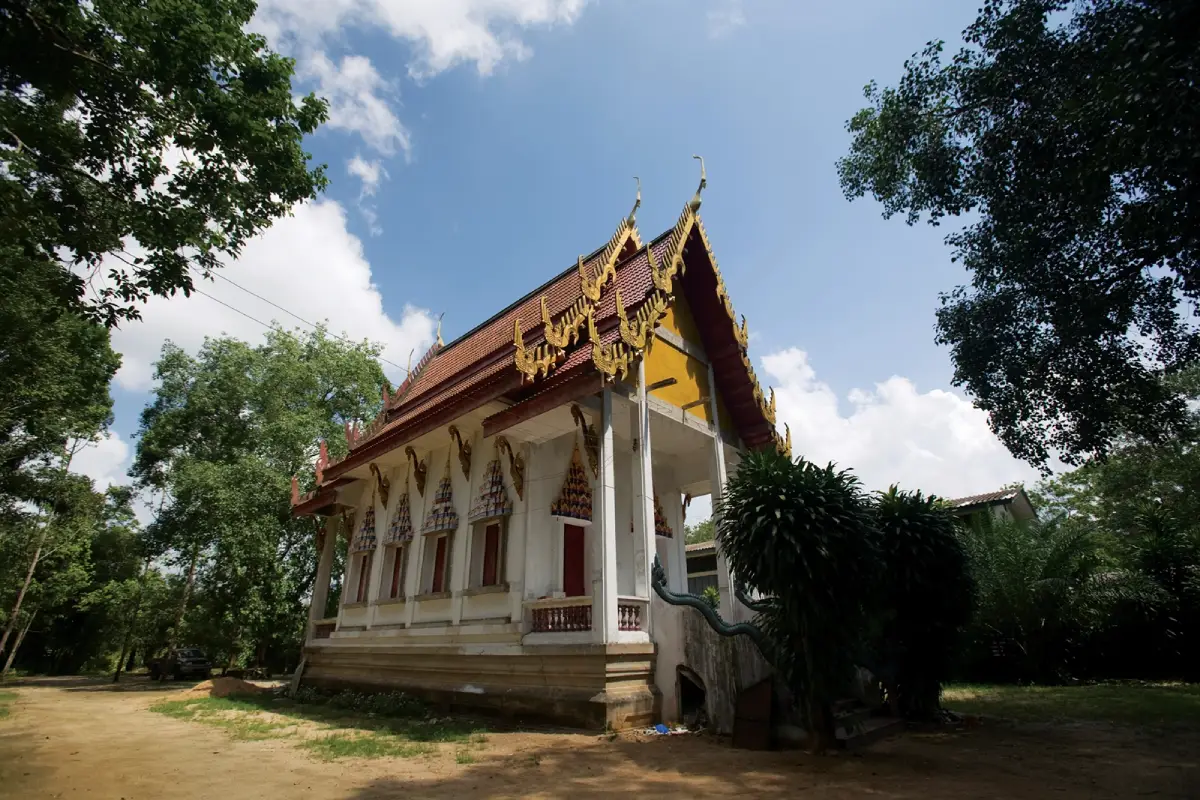
Several important areas inside the temple are worth visiting. The old vihara reflects Southern Thai local architecture and contains a principal Buddha image as well as old objects found in the area or donated by villagers. These include pots, jars, bowls, knives, spears, swords, and other tools. Although some objects may appear simple at first glance, they reveal the daily life, occupations, and material culture of the local community. Within a temple setting, these objects become part of the historical memory of Kapong and Takua Pa.
Near the Buddha altar in the old vihara are ancient stone carvings more than 1,000 years old. One piece resembles a blooming lotus or a wheel, a form associated with Vishnu symbolism. Another piece is connected with an arm fragment of the original Narayana image. These objects make the vihara especially meaningful because they place Buddhist devotion and earlier Hindu-Brahmanical evidence in the same sacred space. Visitors can see how religious landscapes in Southern Thailand have absorbed and preserved multiple cultural layers over many centuries.
Another important area is the open pavilion in the lower courtyard of the temple, where archaeological objects are displayed. This pavilion houses the replica of the stone Vishnu image, created in a form and scale close to the original, as well as a replica of Rama, an image of Sita, a Shiva linga, and other ancient materials. This area functions like a small local museum. Travelers should spend time reading the information, observing the sculptures carefully, and connecting the objects with the broader history of Takola and the ancient port communities of the Andaman coast.
The local museum inside the temple, often associated with the Narayana collection, is an important part of the visit. It preserves a wide range of antiquities and historical objects, including old ceramics, blue-and-white porcelain, jars, firearms, cabinets, clocks, earthenware, and livelihood tools. Some items were donated by local people from Takua Pa and Kapong, while others were collected to support the temple’s educational role. The museum therefore preserves not only major archaeological objects but also ordinary things that show how people in the area lived, worked, traded, and worshipped.
The story of the sculptures also adds depth to the site. Historical records about the Vishnu group from Khao Phra Narai and Khao Wiang mention that the images were originally associated with a hilltop location before being moved. During the construction of Highway 401 between Surat Thani and Takua Pa in 1966, some parts of the sculptures were damaged or stolen. This incident led the Fine Arts Department to preserve key sculptures and the Takua Pa inscription in national museum collections. The replicas and remaining local objects at Wat Narainikaram help keep the memory of the original site alive for the local community.
Even though some original sculptures are preserved at Thalang National Museum, Wat Narainikaram remains essential because it is connected to the landscape where the objects were found and remembered. Seeing replicas at the temple allows visitors to understand the geography, village setting, and cultural environment that produced these objects. A museum display explains the artifact, but the temple explains the place. For this reason, Wat Narainikaram remains an important destination for travelers interested in archaeology, art history, and local memory.
As a functioning Buddhist temple, Wat Narainikaram remains part of community life in Le Subdistrict. It has resident monks and continues to host Buddhist activities such as merit-making, Kathin ceremonies, and local religious events. The temple is not a frozen archaeological site. It is a living religious space where Buddhism, local history, and ancient cultural evidence coexist. Visitors should dress modestly, speak quietly, avoid touching antiquities, and respect monks and local worshippers.
A good visit should begin with the overall temple grounds to understand the layout and atmosphere. Then visitors can continue to the old vihara, the Buddha image, the ancient stone fragments, and the pavilion displaying archaeological materials. If time allows, it is worth learning about the Vishnu sculptures, the Khao Phra Narai inscription, Manigramam merchants, and the history of Takola before or during the visit. The temple’s value does not lie in grandeur or size. It lies in the density of historical evidence preserved in a small local setting.
Wat Narainikaram also broadens the image of Kapong District. Kapong is often associated with waterfalls, hot springs, gardens, and quiet rural landscapes. This temple shows that Kapong also has deep historical significance. For families, students, cultural travelers, and researchers, the temple works well as an open learning site. It can be used to explain inscriptions, maritime trade, South Indian cultural contact, Hindu-Buddhist interaction, and the transformation of ancient settlement areas into modern Buddhist communities.
For a cultural route, Wat Narainikaram can be combined with nearby attractions in Kapong and Takua Pa. Visitors may start at the temple to understand the history of Takola, then continue to Rommanee Hot Spring, Narai Public Park, Takua Pa Old Town, or natural attractions in Kapong. This route gives a fuller picture of Phang Nga by combining old temples, archaeological evidence, hot springs, local communities, and regional food. It is especially suitable for travelers who want a no-boat itinerary or a cultural alternative to coastal sightseeing.
Getting There is convenient by private car or rental car. From Kapong District Office, Wat Narainikaram is about 14 km away. Use Highway 401 on the Takua Pa-Surat Thani route, then take the side road into Le Subdistrict for about 2 km. Travelers coming from Takua Pa or Khao Lak can include the temple in a Kapong day route. Those coming from Phang Nga town should allow extra travel time, especially during the rainy season when road and weather conditions may affect the trip.
Basic visitor facilities include parking, public toilets, and accessible areas for disabled visitors. The temple is open daily and is best visited in the morning or late afternoon, when the weather is more comfortable. Visitors who want to see the archaeological objects in detail should avoid crowded festival periods. Inside the temple, do not climb on display bases, move objects, or handle old materials. Many objects are fragile and form part of the cultural heritage of the community.
The current abbot listed for the temple is Phra Khru Sophon Prachanukun. The temple remains active with resident monks and continues to serve local Buddhist activities. Visitors who plan to make offerings, visit as a group, or use the temple as a study site should contact the temple in advance. This is particularly important for schools, universities, or cultural study groups that want a more structured visit to the local museum and archaeological display areas.
Wat Narainikaram is one of Phang Nga’s most meaningful cultural places because it brings together temple history, local architecture, ancient sculpture, Tamil inscription evidence, community memory, and the story of Takola. A visit here shows that Phang Nga is not only a destination of beaches and islands. It is also a province with deep cultural roots connected to South India, ancient maritime trade, and the early history of the Andaman coast. For travelers who want to understand the province in depth, Wat Narainikaram deserves a place on the itinerary.
| Name | Wat Narainikaram, also known as Wat Le |
| Location | Moo 3, Le Subdistrict, Kapong District, Phang Nga Province |
| Address | Le Subdistrict, Kapong District, Phang Nga 82170, Thailand |
| Coordinates | 8.78318, 98.42681 |
| Highlights | Replica Vishnu image, Lakshmana image, Sita image, Khao Phra Narai inscription, and local museum inside the temple |
| History | Formerly called Wat Le, the temple developed as a local Buddhist temple around 1877, was officially registered in 1927, received its consecrated boundary in 1935, and is linked with archaeological evidence dating from around the 11th to 14th Buddhist centuries |
| Name Origin | The old name Wat Le comes from the local village and subdistrict name. The name Narainikaram is connected with the Narayana or Vishnu sculptures found in the area |
| Distinctive Features | A Mahā Nikāya local temple of about 12 rai preserving archaeological evidence related to Takola and South Indian cultural influence |
| Main Buildings / Areas | Old Vihara In Southern Thai Local Architecture Ordination Hall Open Pavilion For Archaeological Objects Local Museum / Narayana Collection Abbot’s Residence And Community Religious Areas |
| Important Antiquities | Replica Vishnu Image Replica Lakshmana Image Sita Image Khao Phra Narai Inscription Shiva Linga Lakshmana Arm Fragment Vishnu Garment Fragment Wheel-Or Lotus-Like Stone Carving Old Ceramics, Jars, Firearms, Cabinets, Clocks, And Local Tools |
| Historical Importance | Important evidence of Takola, ancient Takua Pa, South Indian cultural influence, and Tamil merchant activity along the Andaman maritime trade route |
| Travel Information | From Kapong District Office, take Highway 401 on the Takua Pa-Surat Thani route for about 14 km, then turn into Le Subdistrict for about 2 km |
| Current Status | Active local Buddhist temple and archaeological learning site in Le Subdistrict, Kapong District |
| Open Days | Daily |
| Opening Hours | 06.00 – 17.00 |
| Facilities | Parking Public Toilets Accessible Areas For Disabled Visitors |
| Abbot / Caretaker | Phra Khru Sophon Prachanukun |
| Main Contact Number | 086-272-7880 |
| Nearby Tourist Attractions | 1. Narai Public Park, about 2 km 2. Wang Wiang Archaeological Area, about 4 km 3. Rommanee Hot Spring, about 14 km 4. Kapong Grand Canyon, about 15 km 5. Takua Pa Old Town, about 19 km |
| Nearby Restaurants | 1. Kapong Ahan Restaurant, about 6 km 2. Hug Kapong Cafe, about 9 km 3. N Plai Wa Cafe, about 12 km, Tel. 065-552-9163 4. Krua Rim Than, about 14 km, Tel. 080-443-1545 5. Ketwale Garden & Cafe, about 15 km |
| Nearby Accommodations | 1. Lake View Resort Kapong, about 7 km, Tel. 081-893-1899 2. Baansuan Jamlong Resort, about 7 km, Tel. 093-759-7754 3. Resort Kapong ATV, about 11 km, Tel. 081-737-7401 4. Kapong Garden Resort, about 13 km 5. Nava Tara Resort Takua Pa, about 15 km |
Frequently Asked Questions (FAQ)
Q: Where is Wat Narainikaram located?
A: Wat Narainikaram is located in Moo 3, Le Subdistrict, Kapong District, Phang Nga Province. Local people also call it Wat Le.
Q: Why is Wat Narainikaram important?
A: The temple is important because it preserves replicas and local evidence related to Vishnu, Lakshmana, Sita, the Khao Phra Narai inscription, and the ancient history of Takola and Takua Pa.
Q: Is the original Vishnu image still at Wat Narainikaram?
A: The original Vishnu image is preserved at Thalang National Museum in Phuket. Wat Narainikaram houses a replica connected with the original site and local memory.
Q: What buildings and areas should visitors see inside the temple?
A: Visitors should see the old vihara, ordination hall, archaeological display pavilion, local museum, stone fragments, and the replica images related to Vishnu tradition.
Q: Why is the Khao Phra Narai inscription important?
A: It is written in Pallava script and Tamil language, dates to around the 11th Buddhist century, and mentions Manigramam merchants, confirming South Indian trade activity in ancient Takua Pa.
Q: What are the opening hours of Wat Narainikaram?
A: The temple is open daily from 06.00 to 17.00.
Q: How can travelers get to Wat Narainikaram?
A: From Kapong District Office, take Highway 401 on the Takua Pa-Surat Thani route for about 14 km, then turn into Le Subdistrict for about 2 km.
Q: What nearby places can travelers visit after Wat Narainikaram?
A: Nearby places include Narai Public Park, Wang Wiang Archaeological Area, Rommanee Hot Spring, Kapong Grand Canyon, and Takua Pa Old Town.
 Category: ●Places of Worship
 Group: ●Temple
Last Update : 1 MonthAgo
 Last Update : 1 MonthAgo
 Click to Access the Navigation Map GPS
Wat Narainikaram Map
Recommend

 Art, Culture and Heritage
 Historical Sites and Monuments(2)
 Landmarks and Memorials(6)
 Art, Craft Centres, Tradition(3)
Temple(18)
Art, Craft Centres, Tradition(3)
Temple(18)
 Other Sacred Sites(8)
 Suburban Living
 Village, Community(3)
 Nature and Wildlife
 National Parks and Marine Reserves(12)
 Mountain (Doi)(8)
 Waterfalls(21)
 Hot Springs(2)
 Caves(12)
 River, Canal(4)
 Bays and Beaches(28)
 Islands(11)
 Other natural attractions(7)
 Entertainment and Agricultural
 Animal camps and shows(2)
 Farms, Parks and Ecotourism(2)
 Outdoor and Adventure Activities(3)
 Travel Articles, Recipes
 Southern Food Menu, Southern Food Recipes(1)


