
lovethailand home >South Travel Attractions >Phang Nga Travel Attractions >Thai Mueang >Thai Mueang > Tsunami Memorial Sculpture
TL;DR: Tsunami Memorial Sculpture is located at Soi Nai Teng, Phetkasem Road, Km. 61, Ban Bang Niang, Khuk Khak Subdistrict, Takua Pa District, Phang Nga Province, open Daily, hours 08.00 – 17.00.
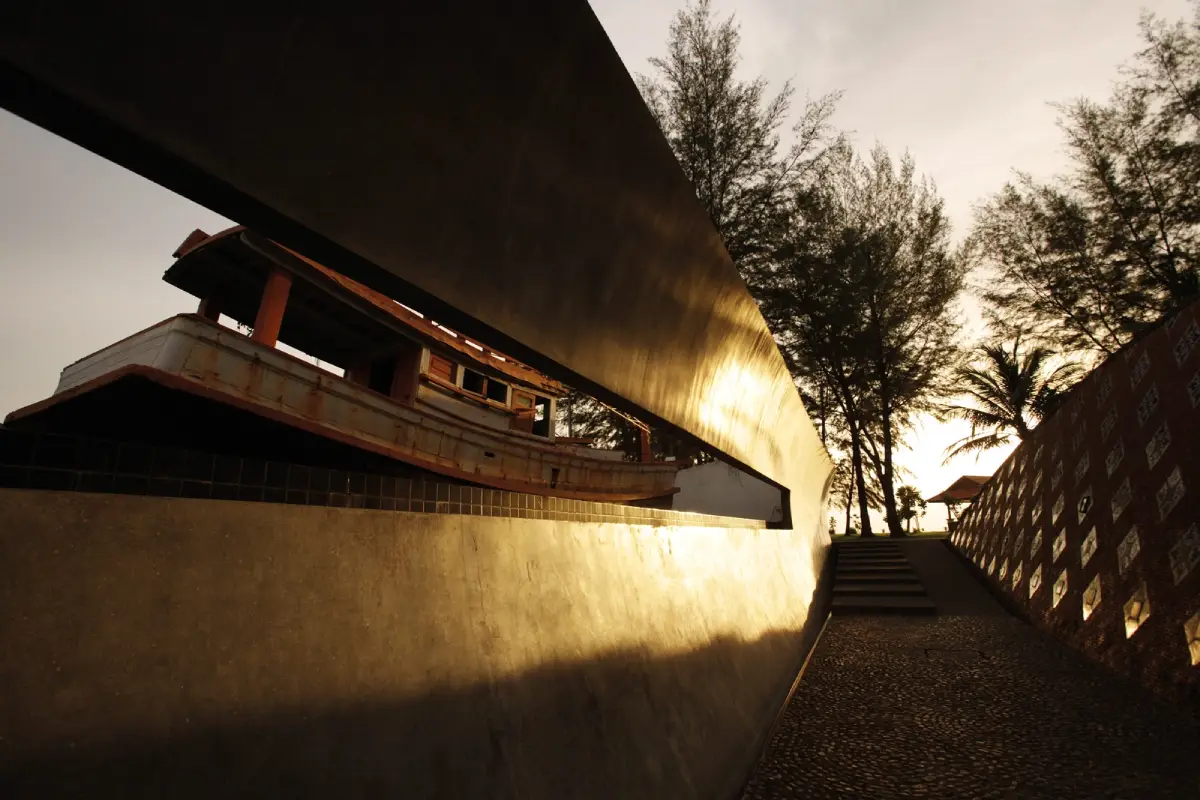
Tsunami Memorial Sculpture
Open Days: Daily
Opening Hours: 08.00 – 17.00
Tsunami Memorial Sculpture in Phang Nga Province is a contemporary memorial artwork created to commemorate the Indian Ocean tsunami of 26 December 2004. The sculpture is located at Soi Nai Teng, Phetkasem Road, Km. 61, Ban Bang Niang, Khuk Khak Subdistrict, Takua Pa District, in the Khao Lak area of Phang Nga. The main artwork, titled “Stabile,” was designed by Swedish artist Lars Englund. Made from five straight brushed stainless-steel elements interwoven into a geometric abstract structure about 6 meters high, the sculpture rises upward toward the sky and expresses ideas of stability, strength, unity, remembrance, and recovery after a devastating natural disaster.
This memorial is more than a photo stop in Khao Lak. It is a place where contemporary art, public memory, and disaster awareness come together. After the 2004 tsunami, the Andaman coast of Thailand, especially Phang Nga, Khao Lak, Bang Niang, and Ban Nam Khem, became deeply associated with loss, survival, and rebuilding. The creation of a contemporary sculpture in this landscape gives visitors a quiet space to reflect on the event without relying only on documentary displays or literal monuments.
“Stabile” is a geometric abstract sculpture with a minimalist character. It does not depict a wave, a boat, or a human figure directly. Instead, it uses five straight stainless-steel lines to create a strong but open structure. This allows viewers to form their own interpretations. Some may see the force of the wave. Others may see human resilience, collective strength, or the movement of the spirit upward after grief. The sculpture’s power lies in this openness. It gives the viewer space to think, remember, and feel.
The artwork was created by the Office of Contemporary Art and Culture under Thailand’s Ministry of Culture as a memorial to the tsunami disaster. In this context, art becomes a bridge between historical trauma and emotional healing. The choice of an international artist also reflects the global nature of the tragedy. The tsunami affected Thai communities, international visitors, rescue workers, business owners, and families from many countries. The memorial therefore belongs not only to one community but to a wider memory shared across borders.
The word “Stabile” refers to something stable, strong, and unified. This meaning gives the work particular significance in Khao Lak. After the tsunami, the region needed not only physical reconstruction but also emotional stability and community recovery. The interwoven steel elements suggest connection between separate parts that become one structure. In this way, the sculpture quietly reflects how people, communities, and institutions came together after the disaster.
Lars Englund is a Swedish artist known for minimalist work and international exhibitions. His “Stabile” sculpture is linked to ideas that developed from his furniture designs of the 1990s, including lamps, tables, chairs, and structural furniture legs. In the memorial context, this design language becomes more than a formal exercise. The firm lines and upward movement of the sculpture become a visual response to instability, loss, and the need to stand again after devastation.
The sculpture is especially meaningful because it does not over-explain itself. Visitors are invited to interpret the work through their own mind and memory. This is consistent with the artist’s view that the imagination in his work should be entered mentally. At the memorial site, that idea becomes very powerful. Each visitor brings a different background: some remember the tsunami directly, some know it through history, and others come to understand Khao Lak beyond beaches and resorts.
The location in Bang Niang also places the sculpture within a broader tsunami remembrance route. It is close to Police Boat T813 Tsunami Memorial, the real patrol boat carried inland by the tsunami, and to nearby tsunami-learning spaces in the Bang Niang area. Visiting the sculpture together with Boat 813 gives travelers two complementary ways to understand the event: physical evidence of the wave’s force and an artistic interpretation of memory and recovery.
The best way to experience the sculpture is slowly and respectfully. Visitors should walk around the work, observe the stainless-steel lines, view it from different angles, and notice how the structure changes against the sky. The site is not designed for entertainment. It is a place for reflection. Even a short visit can be meaningful when visitors take time to understand why the sculpture stands here and what the tsunami meant to Phang Nga and the wider Andaman coast.
For travelers interested in modern history, disaster memory, and cultural interpretation, the Tsunami Memorial Sculpture adds depth to a Khao Lak itinerary. Khao Lak is often known for beaches, resorts, diving trips, and national parks, but this memorial reveals a more serious layer of the area’s identity. It reminds visitors that coastal beauty and natural vulnerability can exist in the same place.
Visitors should behave respectfully at the memorial. Climbing on the sculpture, making excessive noise, littering, or using the site for inappropriate posing should be avoided. Photography is suitable, but it should be done with awareness that the place commemorates a real disaster and many lives lost. The most appropriate photographs are those that capture the form of the work, the surrounding atmosphere, and the sense of remembrance.
Morning and late afternoon are the most comfortable times to visit. The softer light helps reveal the form of the stainless-steel sculpture and makes outdoor walking more pleasant. Midday can be hot, so visitors should bring water, sun protection, and comfortable footwear. A late-afternoon visit can be combined with Bang Niang Market, Bang Niang Beach, nearby restaurants, or a wider Khao Lak route.
Getting There is convenient by private car, rental car, local taxi, tourist van, or transfer within Khao Lak. From central Khao Lak or Nang Thong Beach, travel along Phetkasem Road toward Bang Niang and Takua Pa, then enter Soi Nai Teng around Km. 61. From Takua Pa town or Takua Pa Old Town, travel south along Phetkasem Road toward Khao Lak and Bang Niang. Using a map search for “Tsunami Memorial Sculpture” or “Stabile Khao Lak” is recommended.
A practical route can begin at the Tsunami Memorial Sculpture, then continue to Police Boat T813 Tsunami Memorial, the tsunami-learning area, Bang Niang Market, Bang Niang Beach, Nang Thong Beach, Khao Lak Lighthouse, Khao Lak-Lam Ru National Park, or Ton Chong Fa Waterfall. This route gives visitors a fuller understanding of Phang Nga through contemporary art, tsunami history, local community life, beaches, and nature.
The Tsunami Memorial Sculpture is ideal for travelers who want a meaningful stop in Khao Lak. It offers art, history, reflection, and emotional depth in a compact open-air site. A visit here is not only about seeing a sculpture; it is about acknowledging the past, honoring loss, and recognizing the resilience of the Andaman coast after one of the most significant disasters in modern regional history.
| Name | Tsunami Memorial Sculpture |
| Artwork Title | Stabile |
| Thai Name | ประติมากรรมอนุสรณ์สถานสึนามิ |
| Location | Soi Nai Teng, Phetkasem Road, Km. 61, Ban Bang Niang, Khuk Khak Subdistrict, Takua Pa District, Phang Nga Province |
| Address | Ban Bang Niang, Khuk Khak Subdistrict, Takua Pa District, Phang Nga 82190, Thailand |
| Artist | Lars Englund, Swedish artist |
| Commissioning Body | Office of Contemporary Art and Culture, Ministry of Culture, Thailand |
| Purpose | Created to commemorate the tsunami disaster of 26 December 2004 |
| Artwork Features | Geometric abstract sculpture made from five straight brushed stainless-steel elements interwoven into a structure about 6 meters high |
| Meaning Of Stabile | Something stable, strong, and unified, expressing resilience and recovery after disaster |
| Main Areas / Zones | Outdoor sculpture area, walking space around the artwork, photo area, artwork information point, and connection to the Bang Niang tsunami remembrance route |
| Travel Information | Accessible by private car, rental car, tourist van, local taxi, or transfer in Khao Lak via Phetkasem Road to Soi Nai Teng around Km. 61 |
| Current Status | Open as an outdoor contemporary art memorial for visitors and the general public |
| Open Days | Daily |
| Opening Hours | 08.00 – 17.00 |
| Fees | No admission fee |
| Facilities | Outdoor walking space, photo area, information point, and nearby restaurants and market facilities in Bang Niang |
| Main Contact Number | Tourism Authority of Thailand, Phang Nga Office, Tel. 0-7641-3400 to 2 |
| Visitor Guidelines | Visit quietly, do not climb on the sculpture, do not litter, avoid excessive noise, and take photographs respectfully |
| Nearby Tourist Attractions | 1. Police Boat T813 Tsunami Memorial, about 0.5 km 2. Tsunami Museum / Bang Niang tsunami-learning area, about 0.5 km 3. Bang Niang Market, about 1 km 4. Bang Niang Beach, about 2 km 5. Nang Thong Beach and Khao Lak Lighthouse, about 3 km 6. Khao Lak-Lam Ru National Park, about 5 km 7. Ton Chong Fa Waterfall, about 6 km |
| Nearby Restaurants | 1. Blue Sea Restaurant, about 0.5 km, Tel. 091-654-2838 2. Khao Niau Restaurant, about 0.8 km, Tel. 089-999-2380 3. Family Restaurant and Bar, about 1 km, Tel. 096-356-6847 4. Green Pepper Khao Lak, about 2 km, Tel. 085-655-7626 5. Lucky Restaurant, about 2 km, Tel. 086-307-4680 6. Kokulo Beach Club, about 3 km, Tel. 076-428-555 |
| Nearby Accommodations | 1. The Waters Khao Lak by Katathani, about 1.5 km, Tel. 076-427-700 2. La Vela Khao Lak, about 2 km, Tel. 076-428-555 3. Ramada Resort by Wyndham Khao Lak, about 2 km, Tel. 076-427-777 4. Ayara Villas Khao Lak, about 2.5 km, Tel. 081-970-6301 5. Hotel Gahn Khao Lak, about 2.5 km, Tel. 076-679-588 6. Casa de La Flora, about 3 km, Tel. 076-486-281 |
Frequently Asked Questions (FAQ)
Q: Where is the Tsunami Memorial Sculpture located?
A: It is located at Soi Nai Teng, Phetkasem Road, Km. 61, Ban Bang Niang, Khuk Khak Subdistrict, Takua Pa District, Phang Nga Province.
Q: Why was the Tsunami Memorial Sculpture created?
A: It was created to commemorate the tsunami disaster of 26 December 2004 and to use contemporary art as a medium for remembrance, reflection, and recovery.
Q: Who designed Stabile?
A: Stabile was designed by Lars Englund, a Swedish artist known for minimalist work and international exhibitions.
Q: What does Stabile look like?
A: It is a geometric abstract sculpture made from five straight brushed stainless-steel elements woven into a structure about 6 meters high.
Q: Is there an admission fee?
A: No. Visitors can enter the outdoor memorial area without an admission fee.
Q: What nearby places can be visited with the sculpture?
A: Nearby places include Police Boat T813 Tsunami Memorial, the tsunami-learning area in Bang Niang, Bang Niang Market, Bang Niang Beach, Nang Thong Beach, Khao Lak-Lam Ru National Park, and Ton Chong Fa Waterfall.
Q: What is the best time to visit?
A: Morning and late afternoon are the best times because the light is softer, the outdoor area is more comfortable, and the sculpture is easier to photograph.
Q: How should visitors behave at the memorial?
A: Visitors should remain respectful, avoid climbing on the sculpture, avoid littering, keep noise low, and take photographs in a way that honors the memory of those affected by the tsunami.
 Category: ●Art, Culture and Heritage
 Group: ●Landmarks and Memorials
Last Update : 1 DayAgo
 Last Update : 1 DayAgo
 Click to Access the Navigation Map GPS
Tsunami Memorial Sculpture Map
Recommend

 Historical Sites and Monuments(2)
Landmarks and Memorials(6)
Historical Sites and Monuments(2)
Landmarks and Memorials(6)
 Art, Craft Centres, Tradition(3)
 Places of Worship
 Temple(18)
 Other Sacred Sites(8)
 Suburban Living
 Village, Community(3)
 Nature and Wildlife
 National Parks and Marine Reserves(12)
 Mountain (Doi)(8)
 Waterfalls(21)
 Hot Springs(2)
 Caves(12)
 River, Canal(4)
 Bays and Beaches(28)
 Islands(11)
 Other natural attractions(7)
 Entertainment and Agricultural
 Animal camps and shows(2)
 Farms, Parks and Ecotourism(2)
 Outdoor and Adventure Activities(3)
 Travel Articles, Recipes
 Southern Food Menu, Southern Food Recipes(1)


