
lovethailand home >South Travel Attractions >Nakhon Si Thammarat Travel Attractions >Mueang NaKhon Si Thammarat >Nai Muang > Suat Dan Thai Tradition
TL;DR: Suat Dan Thai Tradition.
Suat Dan Thai Tradition
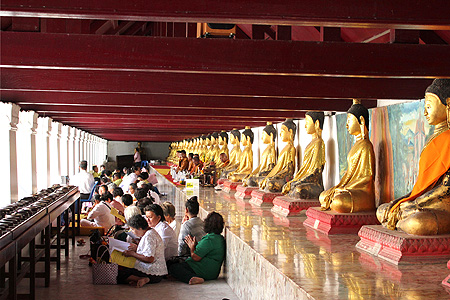
Suat Dan Thai Tradition The "Suat Dan" tradition is one of the significant and ancient customs of Nakhon Si Thammarat, reflecting the city's advancement in Buddhism and local culture. Suat Dan involves reciting verse books or performing readings of folk tales in the local dialect of Nakhon Si Thammarat. This tradition plays a crucial role in occupying the time while waiting for monks to deliver sermons on Buddhist holy days, providing both entertainment and educational value.
Meaning and Origin of the Tradition Meaning of "Suat Dan": "Suat Dan" refers to the recitation of verse books, which is locally known as “reciting books.” It is performed in the cloister or periphery of the pagoda surrounding the Phra Borom That Chedi, where there are 173 Buddha statues. Hence, "Suat Dan" denotes the recitation of books around the pagoda.
Origin of the Term “Dan”: The term "Dan" refers to each side of the cloister or periphery where Buddha statues are enshrined, known as "Phra Dan." With a total of 173 Buddha statues, the term "Dan" reflects the connection between the ritual and the sacred space central to the practice of Dharma.
Ceremony and Methods of Suat Dan Ceremony Arrangement: The Suat Dan tradition begins on Buddhist holy days, such as the 8th and 15th days of each lunar month. People gather at the cloister of Wat Phra Mahathat Woramahawihan. The recitation starts before the monks' arrival, allowing uninterrupted time for sermon delivery and avoiding boredom.
Method of Suat Dan: Suat Dan employs a similar melodic method to the recitation at Wat Phra Si Rattana Satsadaram, but differs in the content. It uses various texts, including folk tales and Jataka tales, and is performed in the local dialect of Nakhon Si Thammarat.
Books Used for Recitation: Commonly used texts for Suat Dan include Jataka tales and local folk tales written in verse, such as "Subin," "Wankara," "Thinwong," and "Si Sao." These works are created by local poets skilled in crafting verse. Selecting appropriate texts and reciting them artistically are crucial for engaging the audience.
The practice of Suat Dan has evolved over time. In the past, it was held in every side of the cloister, using texts written by local poets. Today, Suat Dan has diminished due to modern advancements and changes in sermon styles.
In recent times, the tradition has seen changes in the texts used, such as the introduction of printed materials from Raksachon Printing House. Additionally, sermon delivery has been divided among different temples. Although the recitation at the cloister and periphery has decreased, monks still deliver sermons at Wat Phra Mahathat Woramahawihan.
Significance of the Tradition Religious and Cultural Importance: Suat Dan represents respect for Buddhism and promotes the study of Dharma and local literature. It is not only a way to pass time waiting for sermons but also serves to preserve and transmit local cultural heritage. Listening to Suat Dan allows the community to enjoy learning about religious teachings and local folk tales.
Suat Dan fosters understanding of moral teachings and the continuation of local traditions. It enables elderly community members who are illiterate to memorize and retain verse and stories through listening. This practice helps preserve local knowledge and literature in the community’s memory.
The Suat Dan tradition is a vital cultural heritage of Nakhon Si Thammarat, reflecting respect for and study of Buddhism and local literature. Despite its decline in modern times, it remains significant in preserving cultural values and education within the local community. Suat Dan reflects the community’s connection to its traditions and religion, maintaining its importance and value in the collective memory of the people.
 Category: ●Art, Culture and Heritage
 Group: ●Art, Craft Centres, Tradition
Last Update : 2 YearAgo
 Last Update : 2 YearAgo

 Historical Sites and Monuments(9)
 Landmarks and Memorials(9)
 Royal Palace(1)
Art, Craft Centres, Tradition(12)
Royal Palace(1)
Art, Craft Centres, Tradition(12)
 Museums(5)
 Educational Places
 Educational Gardens, Farm(2)
 Places of Worship
 Temple(44)
 Mosque(2)
 Other Sacred Sites(17)
 Research and Development
 Royal Project(2)
 Suburban Living
 Village, Community(8)
 Local Market(1)
 Floating Market(1)
 Nature and Wildlife
 National Parks and Marine Reserves(6)
 Mountain (Doi)(11)
 Dam, Reservoir, Lake(11)
 Waterfalls(43)
 Hot Springs(1)
 Caves(14)
 River, Canal(3)
 Bays and Beaches(29)
 Islands(2)
 Other natural attractions(3)
 Entertainment and Agricultural
 Farms, Parks and Ecotourism(3)
 Outdoor and Adventure Activities(4)
 Travel Articles, Recipes
 Travel Review, Food Review(1)
 Southern Food Menu, Southern Food Recipes(18)


