
lovethailand home >Eastern Travel Attractions >Trat Travel Attractions >Khao Saming >Pranit > Wat Mueang Kao Saen Tum
TL;DR: Wat Mueang Kao Saen Tum is located at Moo 7, Ban Irem, Pranit Subdistrict, Khao Saming District, Trat Province, open Daily, hours Daytime.
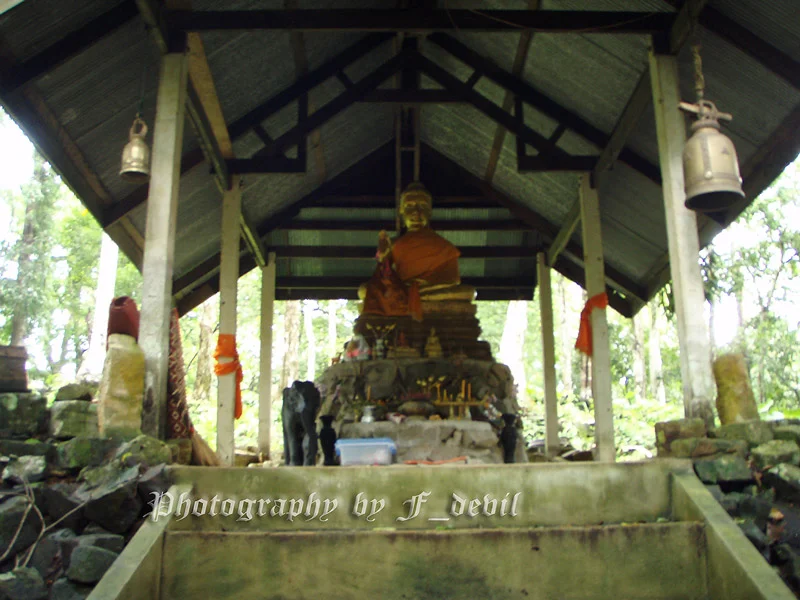
Wat Mueang Kao Saen Tum
Open Days: Daily
Opening Hours: Daytime
Wat Mueang Kao Saen Tum and Khao To Mo Archaeological Site are located in Moo 7, Ban Irem, Pranit Subdistrict, Khao Saming District, Trat Province. This quiet temple and mysterious archaeological landscape offer a very different side of Trat. Instead of beaches, islands, and ferry piers, visitors encounter a peaceful meditation temple, a wooded ancient mound, dark brown polygonal stones, local legends about hidden treasure, and a rare combination of geology, archaeology, and spiritual culture.
The temple is located about 38 km from Khao Saming District Office, in a rural area of Pranit Subdistrict. Its setting is calm, green, and suitable for visitors who want to slow down and experience a quieter cultural route in Trat Province. Wat Mueang Kao Saen Tum is not a large commercial attraction. Its value lies in its atmosphere, its connection with local belief, and the unusual stone formations of Khao To Mo Archaeological Site on the southern side of the temple.
The name “Saen Tum” is closely connected with a local legend. People believe that beneath the ground around the archaeological site there are treasures stored in countless jars, described as “saen tum,” or a hundred thousand jars. This belief became part of the identity of the temple and the surrounding area. Whether understood as folklore, symbolic memory, or local imagination, the story gives the site a strong cultural character and makes it more than a simple temple visit.
On the southern side of the temple lies Khao To Mo Archaeological Site. The site appears as an earthen mound covered with trees, with many stones scattered and arranged in different positions. These stones are dark brown and polygonal, ranging from four-sided to nine-sided forms. They vary in length from about 30 cm to 150 cm and weigh from around 10 kg to 100 kg. Their appearance immediately attracts attention because they do not look like ordinary loose rocks.
One of the most memorable features of Khao To Mo is that some stones produce a clear ringing sound when struck gently, similar to the sound of a bell. This unusual sound has made the stones famous among visitors and has strengthened the mysterious reputation of the site. The ringing stones create a direct sensory experience: visitors do not only see the stones, but also hear them. This makes Khao To Mo one of the most unusual cultural and natural sites in Trat.
From a geological perspective, the polygonal stones can be understood in connection with volcanic rock, especially basalt that naturally breaks into column-like forms. When volcanic material cools and contracts, it can develop cracks and form polygonal columns. This natural process explains why some stones appear as angular pillars. At the same time, the way the stones are placed and arranged at Khao To Mo raises cultural and archaeological questions. Nature may have created the stones, but human beings may have selected, moved, arranged, and interpreted them.
This is why Khao To Mo should be understood as a layered site. It is not simply a natural rock formation, and it is not only an archaeological monument in a conventional sense. It is a place where geology, human activity, ritual imagination, and local memory overlap. The stones may have natural origins, but their arrangement and the beliefs attached to them show how people can transform a landscape into a meaningful and possibly sacred place.
Some local descriptions suggest that Khao To Mo may date back to a very ancient period, even before the Buddhist era. This statement should be understood as part of local belief and cultural memory that emphasizes the great antiquity and mystery of the place. What can be clearly observed is that the site contains a distinctive mound, many polygonal stones, unusual arrangements, and a long-standing local legend. These elements make it a valuable place for cultural interpretation, archaeological curiosity, and geological education.
Wat Mueang Kao Saen Tum is also known as a peaceful place suitable for meditation practice. The temple grounds are shaded by trees and far from busy urban areas. The atmosphere supports quiet reflection, simple Buddhist practice, walking meditation, and short spiritual retreats. Visitors who come for merit-making or meditation will find that the environment encourages stillness and mindfulness.
The peaceful character of the temple is an important part of the visitor experience. This is not a place designed for quick tourism. It is a place where visitors should walk slowly, observe respectfully, and allow the landscape to reveal its meaning. The shaded temple area, the meditation atmosphere, the ancient mound, and the mysterious stones together create an experience that is both calm and thought-provoking.
Walking from the temple area toward Khao To Mo, visitors gradually move from a Buddhist temple environment into a more natural and archaeological setting. The trees, mound, stones, and quiet surroundings create the feeling of entering a semi-sacred landscape. Unlike fully restored archaeological parks, Khao To Mo retains a raw and natural character. This makes it especially attractive to travelers who enjoy hidden places, local legends, and sites that still preserve a sense of mystery.
Visitors should take time to observe the stones carefully. Their shapes, surfaces, lengths, and positions vary. Some stones look like four-sided columns, while others have more complex polygonal forms. Their sizes and weights also differ greatly. These differences raise many questions: how were the stones formed, how were they arranged, what meaning did people give them, and why were they associated with legends of hidden treasure?
For educational travel, Wat Mueang Kao Saen Tum and Khao To Mo are excellent for students, families, cultural travelers, geology enthusiasts, and visitors interested in hidden historical sites. The site can function as an open-air classroom where people learn about rock formation, sound-producing stones, local legends, sacred landscapes, and the relationship between nature and human belief.
For cultural travelers, Khao To Mo shows how ancient beliefs often begin with unusual natural landscapes. When people encounter strange stones, ringing rocks, wooded mounds, and unexplained arrangements, they create stories to explain and remember them. The legend of the hundred thousand treasure jars is therefore more than a mysterious tale. It is a way for the community to give meaning to a place that feels different from ordinary land.
The name “Khao To Mo” itself adds to the appeal of the site. It is memorable, distinctive, and often mentioned together with Wat Mueang Kao Saen Tum. Together, the two names create a two-layered identity: first, a peaceful meditation temple; second, a mysterious archaeological and geological site on the southern side of the temple. This dual identity makes the place suitable for cultural tourism development in Khao Saming District.
Visitors should prepare for a nature-based walk. Comfortable walking shoes are recommended, especially during or after rain when the ground and stones may be slippery. Visitors should not climb on the stones, move them, scratch them, or strike them forcefully. Each stone is part of the site’s context. Moving or damaging the stones would reduce the cultural and educational value of the place.
Conservation is important at Khao To Mo because the site contains both natural and cultural values. Any visitor development should be light, respectful, and compatible with the landscape. Clear interpretation signs, simple walking paths, and visitor guidance would help people understand the site without disturbing it. The best way to experience Khao To Mo is to respect its quietness and preserve its original atmosphere.
For photography, the temple and archaeological site offer several interesting scenes: shaded temple grounds, polygonal stones, wooded mounds, natural pathways, and quiet rural surroundings. Morning and late afternoon light are better than harsh midday light. Visitors should avoid disturbing monks, meditation practitioners, or local worshippers while taking photographs.
Getting There requires some planning. From Saen Tung Intersection, take Highway 3157 on the Saen Tung-Bo Rai route. At around km 18.5, turn left toward Ban Ta Phlai on Highway 3158 and continue for about 2.5 km. Then turn left onto the Ban Na Makham-Ban Irem road and continue for about 9 km. A private car or rental car is the most practical way to reach the temple because the area is rural and not served by frequent public transport.
Travelers coming from Trat town or Khao Saming should allow enough time for the drive. The site is relatively remote compared with major tourist attractions, so it is wise to check fuel, road conditions, and mobile signal before visiting. Those who prefer a relaxed trip should not combine too many distant attractions in one day. Khao To Mo deserves enough time for a slow and careful visit.
Wat Mueang Kao Saen Tum can be combined with other places in Khao Saming and nearby districts, such as Wat Saen Tung, Wat Wang Sappharot, Wat Tha Som, Wat Khao Saming, Namtok Phlio, or Trat town. However, travelers should plan by actual driving distance because these places are spread across different directions. A good itinerary should include only a few stops so that the visit does not feel rushed.
Food and accommodation should also be planned in advance. The immediate rural area may have limited restaurant options, so visitors may prefer to eat around Saen Tung, Khao Saming, or Trat town. For accommodation, travelers can stay in Khao Saming, Saen Tung, or Trat town depending on their route. Staying in Trat town is convenient for those continuing to Ko Chang, Laem Ngop, or other island routes.
Wat Mueang Kao Saen Tum is not a place to visit only for quick photos. Its value appears when visitors spend time observing the landscape. At first glance, it may seem like a quiet temple and a group of unusual stones. But when seen more carefully, the site reveals a relationship between sound, stone, forest, belief, meditation, and local memory. This layered experience is what makes the place different from mainstream tourist attractions.
For international travelers, Wat Mueang Kao Saen Tum and Khao To Mo can be described as a hidden archaeological and geological site in Trat Province. Its key attractions include basalt-like polygonal stones, ringing rocks, a local treasure legend, a peaceful meditation temple, and a rural cultural landscape. The site proves that Trat has much more to offer than islands and beaches.
In summary, Wat Mueang Kao Saen Tum and Khao To Mo Archaeological Site are recommended for travelers who enjoy quiet temples, local legends, unusual stones, rural landscapes, and meaningful cultural travel. The place combines meditation, mystery, geology, archaeology, and local belief in a way that is rarely found in ordinary tourist routes. For those who want to understand a deeper side of Trat, this site is well worth the journey.
| Name | Wat Mueang Kao Saen Tum And Khao To Mo Archaeological Site |
| Location | Moo 7, Ban Irem, Pranit Subdistrict, Khao Saming District, Trat Province |
| Address | Ban Irem, Pranit Subdistrict, Khao Saming District, Trat 23150, Thailand |
| Highlights | Peaceful meditation temple, Khao To Mo Archaeological Site, wooded ancient mound, dark brown polygonal stones, and ringing stones that sound like bells when gently struck |
| History | Associated with local belief about hidden treasure jars beneath the archaeological area and with a landscape combining natural rock formations, human arrangement, and sacred memory |
| Name Origin | The name Saen Tum comes from a local legend that countless jars of treasure lie beneath the ground around the archaeological site |
| Distinctive Features | Dark brown polygonal stones with four-sided to nine-sided forms, about 30-150 cm long and weighing about 10-100 kg, arranged in a way that resembles a ritual or sacred structure |
| Travel Information | From Saen Tung Intersection, take Highway 3157 toward Bo Rai. At km 18.5, turn left toward Ban Ta Phlai on Highway 3158 for about 2.5 km, then turn left onto the Ban Na Makham-Ban Irem road for about 9 km |
| Current Status | Active temple and archaeological site in Pranit Subdistrict, Khao Saming District, Trat Province |
| Open Days | Daily |
| Opening Hours | Daytime |
| Facilities | Worship Area, Meditation Area, Archaeological Site Area, Shaded Natural Area |
| Main Areas / Zones | Temple And Meditation Area, Khao To Mo Archaeological Site, Ancient Mound, Polygonal Stone Area, Shaded Woodland On The Southern Side Of The Temple |
| Abbot / Caretaker | Phra Khru Khurunatsamachan, Abbot Of Wat Mueang Kao Saen Tum |
| Nearby Tourist Attractions | 1. Wat Saen Tung, About 20 km 2. Wat Wang Sappharot, About 28 km 3. Wat Tha Som, About 32 km 4. Wat Khao Saming, About 36 km 5. Namtok Phlio, About 45 km 6. Trat Town, About 55 km |
| Nearby Restaurants | 1. BIChon Cafe, About 34 km 2. Adlin Chaeng 4 Jab, About 35 km 3. Ester, About 36 km 4. Ruedu Trat, About 40 km 5. Bica Busta Coffee — Slow Bar —, About 40 km 6. Café Amazon Saen Tung Branch, About 20 km |
| Nearby Accommodations | 1. Lamphurai Riverside Resort & Spa, About 30 km, Tel. 063-190-1099 2. Khao Saming Paradise Resort, About 36 km, Tel. 081-918-2377 3. Villa Green Leaf Saen Tung, About 22 km 4. iLOFT Resort Khao Saming, About 38 km 5. Garden Home Saen Tung, About 22 km 6. Accommodations In Trat Town, About 55 km |
Frequently Asked Questions (FAQ)
Q: Where is Wat Mueang Kao Saen Tum located?
A: It is located in Moo 7, Ban Irem, Pranit Subdistrict, Khao Saming District, Trat Province, about 38 km from Khao Saming District Office.
Q: What is special about Khao To Mo Archaeological Site?
A: The site has a wooded mound with dark brown polygonal stones arranged in unusual patterns. Some stones produce a ringing sound like a bell when gently struck.
Q: What does the name Saen Tum mean?
A: The name comes from a local belief that countless jars of treasure lie beneath the archaeological area, giving rise to the name Saen Tum.
Q: Is Wat Mueang Kao Saen Tum suitable for meditation?
A: Yes. The temple is quiet, shaded, and peaceful, making it suitable for worship, reflection, and simple meditation practice.
Q: How can visitors get to Wat Mueang Kao Saen Tum?
A: From Saen Tung Intersection, take Highway 3157 toward Bo Rai. At km 18.5, turn left to Ban Ta Phlai on Highway 3158 for about 2.5 km, then turn left onto the Ban Na Makham-Ban Irem road for about 9 km.
Q: How long should visitors spend at the site?
A: Visitors should allow about 1-2 hours to worship at the temple, walk to Khao To Mo, observe the stones, and experience the quiet natural setting.
Q: What should visitors be careful about at Khao To Mo?
A: Wear comfortable shoes, avoid climbing or moving stones, do not strike the rocks forcefully, and respect the archaeological and religious setting.
Q: What nearby places can be combined with this visit?
A: Nearby options include Wat Saen Tung, Wat Wang Sappharot, Wat Tha Som, Wat Khao Saming, Namtok Phlio, and Trat town, depending on the travel route.
 Category: ●Places of Worship
 Group: ●Temple
Last Update : 4 MonthAgo
 Last Update : 4 MonthAgo
 Click to Access the Navigation Map GPS
Wat Mueang Kao Saen Tum Map
Recommend

 Art, Culture and Heritage
 Historical Sites and Monuments(1)
 Landmarks and Memorials(1)
 Art, Craft Centres, Tradition(3)
 Museums(2)
 Educational Places
 Museum for Study(1)
 Educational Gardens, Farm(2)
Temple(11)
Educational Gardens, Farm(2)
Temple(11)
 Mosque(2)
 Other Sacred Sites(2)
 Suburban Living
 Village, Community(6)
 Local Market(2)
 Nature and Wildlife
 National Parks and Marine Reserves(2)
 Mountain (Doi)(1)
 Dam, Reservoir, Lake(3)
 Waterfalls(15)
 River, Canal(1)
 Bays and Beaches(21)
 Islands(19)
 Other natural attractions(12)
 Entertainment and Agricultural
 Outdoor and Adventure Activities(1)
 Shopping
 Shopping and Night Market(1)


