
lovethailand home >North Travel Attractions >Nan Travel Attractions >Song Kwar >Chon Daen > Ban Mai Chaidaen Thai–Lao Border Trade Checkpoint
TL;DR: Ban Mai Chaidaen Thai–Lao Border Trade Checkpoint is located at Moo 9, Ban Mai Chaidaen, Chon Daen Subdistrict, Song Khwae District, Nan Province, open Wednesday, Thursday, And Sunday, hours 09.00 AM–4.00 PM.

Ban Mai Chaidaen Thai–Lao Border Trade Checkpoint
Open Days: Wednesday, Thursday, And Sunday
Opening Hours: 09.00 AM–4.00 PM
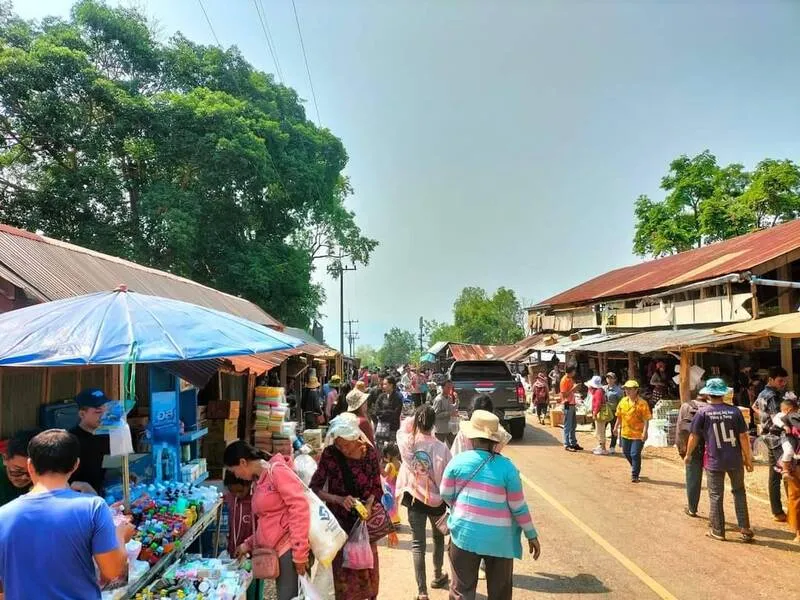
Ban Mai Chaidaen Thai–Lao Border Trade Checkpoint is located at Moo 9, Ban Mai Chaidaen, Chon Daen Subdistrict, Song Khwae District, Nan Province. It is a local border trade point connecting the Thai community on the Nan side with Ban Te Song, Chiang Hon District, Xayaburi Province, Lao PDR. This place is not a conventional tourist attraction, but it is an important border community space where local trade, daily life, cross-border relationships, and small-scale economic exchange can be observed in a real setting.
The checkpoint reflects another side of Nan Province beyond temples, old town streets, mountain viewpoints, and cultural attractions. Nan shares borders with Lao PDR, and border communities have long been connected through trade, language, food, agriculture, and local relationships. Ban Mai Chaidaen is one of the places where these connections become visible through a border market atmosphere. Visitors can see how people from both sides of the border exchange goods, meet one another, and maintain everyday relationships within the rules and opening hours set by the authorities.
The character of the market is simple and community-based. It is not a large commercial market designed mainly for tourism. Instead, it serves local people who come to buy and sell everyday goods, agricultural products, food items, household necessities, and seasonal local products. The types of goods may change according to season, availability, and the needs of border communities. This makes each visit slightly different and gives travelers a clearer picture of how local border trade works in practice.
Older local information described the market as opening on specific dates of each month, such as the 5th, 10th, 15th, 20th, 25th, and 30th. Current official information identifies the present operating days as Wednesday, Thursday, and Sunday, from 09.00 AM to 4.00 PM. Travelers should follow the current schedule and check again before departure because border trade points can be affected by official announcements, public holidays, weather, road conditions, and changes in border regulations.
In economic terms, Ban Mai Chaidaen Border Trade Checkpoint supports small-scale border trade in Song Khwae District. It gives local residents an opportunity to sell agricultural goods, daily-use products, food, and community products, while people from the Lao side can also participate within the permitted framework. This kind of local trade may not have the scale of a permanent international border crossing, but it is important to border communities because it helps circulate income and allows people to access goods that support daily life.
The term “border trade checkpoint” or “temporary border trade point” should be understood correctly. This is not the same as a major permanent border crossing. It operates under specific dates, times, rules, and official supervision. Movement of people, vehicles, and goods must follow the regulations of the responsible authorities. Visitors should comply with instructions from officers, carry identification documents, and avoid entering restricted areas or taking photos of official operations without permission.
The area is connected with several agencies, including Nan Province, local administrative authorities, security-related units, and Thung Chang Customs House for customs-related responsibilities. Thung Chang Customs House is responsible for customs work covering Ban Mai Chaidaen Border Trade Checkpoint. These agencies help supervise trade, movement of goods, and orderliness in the border area so that the market can operate within legal and administrative frameworks.
For travelers, the value of this place lies in observation and understanding rather than conventional sightseeing. A visit here offers a chance to see the everyday life of a Thai–Lao border community in Nan Province. The road, village setting, market stalls, local products, and interactions between people help reveal how border areas function beyond maps and official documents. It is a useful place for travelers interested in local livelihoods, rural geography, border trade, and community-based travel.
The market atmosphere is generally active during daytime. There is no night market operation, so visitors should plan to arrive during the morning or early afternoon. Bringing cash is recommended because digital payment may not be available at every stall. Travelers should also bring drinking water, a fully charged phone, and basic personal items, especially because this is a rural border area and facilities may not be as extensive as in Nan city or larger tourist districts.
Visitors should also remember that this is a working border area, not a recreational zone. Dress politely, behave respectfully, and follow signs or instructions from officers. If you intend to cross the border, move goods, or conduct any activity beyond ordinary market observation, ask the officers first. Regulations may differ from ordinary tourist places, and respecting the rules is essential for safety and smooth travel.
Getting There to Ban Mai Chaidaen Thai–Lao Border Trade Checkpoint is most practical by private car, rental car, or local transport arranged in advance. From Song Khwae District, travel toward Chon Daen Subdistrict and Ban Mai Chaidaen. The route passes through rural and mountainous areas, so travelers should check the vehicle, fuel level, weather, and road conditions before departure. Starting early is recommended because the market operates only during the day and there is no night trading.
If traveling from Nan city, the trip should be planned as at least a half-day or full-day journey because the checkpoint is far from the city center. Travelers should leave early in the morning to reach the border area while the market is still active and to allow enough time for the return trip before dark. The road to border communities can be different from city roads, so careful driving is important, especially during the rainy season or in foggy conditions.
The border setting also reflects the relationship between Thai and Lao communities. In rural border areas, the border is not only a political line, but also a zone of culture, language, food, family connections, trade, and daily interaction. The market therefore has meaning beyond buying and selling. It is a place where people meet, exchange goods, speak with one another, and maintain cross-border relationships under official rules.
Travelers interested in local culture should observe more than the products for sale. Pay attention to the language spoken, the types of food available, the way people negotiate prices, the seasonal goods brought to market, and the role of local communities in the trading process. These details help explain border life more clearly than written descriptions alone. A respectful and curious approach will make the visit more meaningful.
Song Khwae District itself has a rural and mountainous character, with communities spread across valleys and upland areas. Around Chon Daen, Na Rai Luang, and Yot Subdistricts, travelers may encounter local villages, agricultural landscapes, small cafés, community restaurants, and quiet countryside roads. A trip to Ban Mai Chaidaen can therefore be combined with local viewpoints, community stops, and simple rural travel experiences in Song Khwae District.
For documentary-style photographers, this border market can be visually interesting because it combines people, trade, local goods, rural roads, and borderland atmosphere. However, photography should be done respectfully. Ask permission before photographing people, avoid photographing officers, checkpoints, security areas, or official procedures, and do not interfere with trade or movement in the market. Sensitivity is especially important in border areas.
Families visiting the area should prepare carefully. Bring snacks, drinking water, personal medicine, and enough cash. Children should remain under adult supervision, especially near roads, vehicle movement, market stalls, and border-control areas. Older travelers should visit during the cooler part of the day and avoid overly rushed itineraries. Because facilities may be limited, a well-prepared trip will be more comfortable.
For those interested in border economics, Ban Mai Chaidaen is a useful example of community-level cross-border trade. Unlike large permanent border crossings, this type of checkpoint supports smaller transactions and local livelihoods. It helps people in border communities access goods, earn income, and maintain economic links within a controlled framework. The scale may be modest, but its importance to local life is significant.
Before traveling, visitors should prepare identification documents, cash, drinking water, a charged phone, and route information. During the rainy season, road conditions should be checked in advance because rural mountain roads may be slippery or affected by fog and rainfall. During the cool season, the morning and evening air can be chilly in upland border areas, so a light jacket may be useful.
As a learning destination, Ban Mai Chaidaen Border Trade Checkpoint is suitable for those interested in border geography, local trade, Thai–Lao relations, rural development, and community livelihoods. A visit to the actual area helps travelers understand that border trade is not only about large-scale import and export systems. It also exists in the everyday lives of people who live near the frontier and depend on legal, local trading channels for income and access to goods.
A good travel plan is to stay in or near Song Khwae District, visit Ban Mai Chaidaen in the morning, return for lunch at a local restaurant, then continue to cafés, viewpoints, or nearby communities in the afternoon. Travelers can later continue toward Tha Wang Pha, Pua, or Nan city depending on their route. This kind of slower itinerary is better than trying to combine too many distant places in one day.
In summary, Ban Mai Chaidaen Thai–Lao Border Trade Checkpoint is an important community border trade area in Nan Province. It offers insight into local economy, rural life, Thai–Lao relationships, and the practical role of border markets in everyday life. Although it is not a conventional tourist attraction, it is a meaningful place for travelers who want to understand Nan in a deeper and more realistic way. With proper planning, respect for rules, and an open mind, a visit here can add a distinctive dimension to a trip through northern Nan.
| Name | Ban Mai Chaidaen Thai–Lao Border Trade Checkpoint |
| Location | Moo 9, Ban Mai Chaidaen, Chon Daen Subdistrict, Song Khwae District, Nan Province |
| Distinctive Features | A Thai–Lao local border trade point connecting Ban Mai Chaidaen in Song Khwae District, Nan Province, with Ban Te Song, Chiang Hon District, Xayaburi Province, Lao PDR |
| Highlights | A simple community border market for observing Thai–Lao border life, local trade, and rural livelihoods in Song Khwae District |
| Travel Information | From Song Khwae District, travel toward Chon Daen Subdistrict and Ban Mai Chaidaen by private car, rental car, or arranged local transport. The route passes through rural and mountainous areas. |
| Current Status | Operating as a border trade checkpoint under Nan Province regulations and official supervision |
| Open Days | Wednesday, Thursday, And Sunday |
| Opening Hours | 09.00 AM–4.00 PM |
| Facilities | Border market area, community trading area, official operation area, and routes connecting nearby border villages |
| Caretaker | Nan Province, local administrative authorities, and Thung Chang Customs House for customs-related responsibilities |
| Main Contact Number | Thung Chang Customs House: 054-694073, 091-8373945 |
| Nearby Tourist Attractions | 1. Ban Mai Chaidaen Market, about 0 km 2. Chon Daen Subdistrict, Song Khwae District, about 5 km 3. Na Rai Luang Subdistrict, Song Khwae District, about 20 km 4. Viewpoints And Community Routes In Song Khwae District, about 20 km 5. Tha Wang Pha District, about 60 km 6. Pua District, about 70 km 7. Nan City, about 90 km |
| Nearby Restaurants | 1. Hang Thung Cafe, Na Rai Luang Subdistrict, Song Khwae District, about 25 km, Tel. 087-183-8394 2. Krua Rim Nam Yot, Yot Subdistrict, Song Khwae District, about 35 km, Tel. 081-170-9022 3. Thong Na View Restaurant, Song Khwae District, about 30 km, Tel. 085-979-2777 4. Food House Restaurant, Song Khwae District, about 25 km, Tel. 094-425-5156 5. Community Restaurants Around Chon Daen Subdistrict, about 5 km |
| Nearby Accommodations | 1. Baiya Homestay, Song Khwae District, about 25 km, Tel. 087-181-3311 2. Kanploy Home, Song Khwae District, about 25 km, Tel. 087-181-3311 3. Winthakorn Rooms, Song Khwae District, about 25 km, Tel. 087-081-8939 4. Song Khwae Guesthouse, Song Khwae District, about 25 km, Tel. 081-746-6836 5. Ban Suan Song Khwae Resort, Song Khwae District, about 25 km 6. Community Homestays In Song Khwae District, about 20–30 km |
Frequently Asked Questions (FAQ)
Q: Where is Ban Mai Chaidaen Thai–Lao Border Trade Checkpoint located?
A: It is located at Moo 9, Ban Mai Chaidaen, Chon Daen Subdistrict, Song Khwae District, Nan Province, opposite Ban Te Song, Chiang Hon District, Xayaburi Province, Lao PDR.
Q: When is Ban Mai Chaidaen Border Trade Checkpoint open?
A: Current information lists the operating days as Wednesday, Thursday, and Sunday from 09.00 AM to 4.00 PM.
Q: Is there night trading at Ban Mai Chaidaen border market?
A: No. There is no night trading. Visitors should travel during the morning or afternoon within the official opening hours.
Q: What kind of travelers should visit this place?
A: It is suitable for travelers interested in border life, community markets, Thai–Lao trade, local livelihoods, and learning-based travel in Song Khwae District.
Q: What should visitors prepare before going there?
A: Visitors should bring identification documents, cash, drinking water, a charged phone, and follow all instructions from officers in the border area.
Q: Who supervises Ban Mai Chaidaen Border Trade Checkpoint?
A: It is supervised by Nan Province, local administrative authorities, and Thung Chang Customs House for customs-related responsibilities.
Q: Who can visitors contact for official information?
A: Visitors can contact Thung Chang Customs House at 054-694073 or 091-8373945 for customs-related information and the responsible area.
 Category: ●Art, Culture and Heritage
 Group: ●Landmarks and Memorials
Last Update : 4 MonthAgo
 Last Update : 4 MonthAgo
 Click to Access the Navigation Map GPS
Ban Mai Chaidaen Thai–Lao Border Trade Checkpoint Map
Recommend
 Landmarks and Memorials(6)
 Art, Craft Centres, Tradition(6)
 Museums(4)
 Historic Homes and Cities(1)
 Art Gallery(1)
 Educational Places
 Educational Gardens, Farm(1)
 Places of Worship
 Temple(68)
 Church(1)
 Other Sacred Sites(18)
 Research and Development
 Royal Project(2)
 Suburban Living
 Village, Community(13)
 Local Market(1)
 Nature and Wildlife
 National Parks and Marine Reserves(9)
 Mountain (Doi)(6)
 Dam, Reservoir, Lake(16)
 Waterfalls(28)
 Hot Springs(1)
 Caves(11)
 River, Canal(5)
 Other natural attractions(10)
 Entertainment and Agricultural
 Farms, Parks and Ecotourism(4)
 Outdoor and Adventure Activities(2)


