
lovethailand home >North Travel Attractions >Nan Travel Attractions >Pua >Chai Wat Tha Na > Wat Si Sa Wong
TL;DR: Wat Si Sa Wong is located at Ban Tha Khwai, Moo 3, Chai Watthana Subdistrict, Pua District, Nan Province, open Daily, hours 08.00 - 17.00.
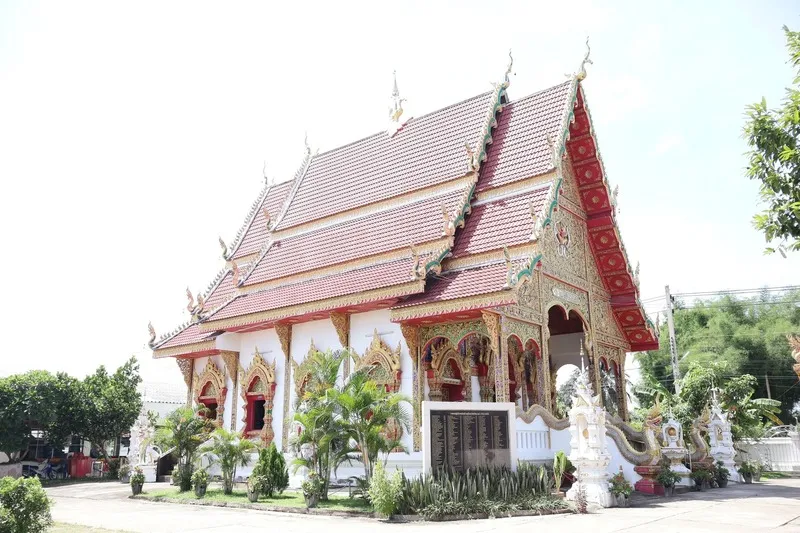
Wat Si Sa Wong
Open Days: Daily
Opening Hours: 08.00 - 17.00
Wat Si Sa Wong is a local Buddhist temple located in Ban Tha Khwai, Moo 3, Chai Watthana Subdistrict, Pua District, Nan Province. It is a community temple founded through the faith, cooperation, and generosity of local residents. The temple serves as a spiritual center for Ban Tha Khwai, a place for Buddhist ceremonies, community traditions, moral education, and shared religious life.
The temple was founded through the initiative of Pho Liang Thepwong Khuean Thana, who played an important role in establishing a temple for the local community. His vision was to create a sacred place where villagers could make merit, attend religious ceremonies, and gather around Buddhism without having to travel far from their own village.
The foundation of Wat Si Sa Wong was made possible by the generosity of several local supporters. Nang Kiang Suthampaeng donated land for the temple site, while Nai Fan Suthampong donated timber for constructing temple buildings and monastic facilities. These contributions reflect the strong communal faith that shaped the temple from its beginning.
Ban Tha Khwai has long been connected with the local landscape and community life of Chai Watthana Subdistrict. Wat Si Sa Wong is not separate from this local setting; it is part of the village’s cultural landscape, surrounded by homes, agricultural areas, community paths, and the everyday life of residents who continue to rely on the temple as a place of faith and unity.
Wat Si Sa Wong is important because it continues to serve the daily religious life of the community. Villagers come to the temple on Buddhist holy days, for ordination ceremonies, merit-making events, local traditions, and Dhamma activities for children and youth. Its simplicity is part of its value, because it represents the genuine role of a village temple that remains closely connected with local people.
The temple received its consecrated boundary on February 16, which confirmed its proper status for Buddhist monastic ceremonies. A consecrated boundary allows important Sangha ceremonies to be performed according to Buddhist discipline, especially ordination and other formal monastic acts. This made Wat Si Sa Wong a more complete religious center for the community.
Although Wat Si Sa Wong is not widely known as a major tourist temple, its value lies in being a true local temple created by the faith of villagers. Temples like this are essential for understanding Thai society at the community level. Buddhism here is not distant or ceremonial only; it is part of everyday life, from merit-making and ordination to funerals, village traditions, and moral education.
The temple’s history also tells the story of Ban Tha Khwai during a period when the community worked together with limited local resources. Land, timber, labor, and faith were brought together to create a temple. In this sense, Wat Si Sa Wong is a social record of cooperation, generosity, and Buddhist devotion.
Pho Liang Thepwong Khuean Thana should be remembered as a key figure in the temple’s founding. Establishing a temple required leadership, planning, donors, craftsmen, laborers, and the collective support of villagers. His role helped lay the religious foundation for Ban Tha Khwai.
Nang Kiang Suthampaeng, who donated the land, also holds an important place in the temple’s history. Donating land for a temple transforms private property into a shared sacred space for the community and Buddhism. Likewise, Nai Fan Suthampong’s timber donation made the construction of temple buildings possible. Their generosity reflects the Lanna idea of shared merit and community-based religious support.
Wat Si Sa Wong is best understood through the idea of collective faith. Its value does not depend on monumental architecture or fame, but on the people who built, maintained, and continue to use the temple. A living temple is sustained by villagers who make merit, organize activities, teach children, and preserve community customs through Buddhist practice.
The temple is connected with local Buddhist traditions such as merit-making on Buddhist holy days, Makha Bucha Day, Visakha Bucha Day, Asalha Bucha Day, Buddhist Lent, the end of Buddhist Lent, and local merit-making ceremonies. These activities allow older and younger generations to meet, participate, and pass on cultural knowledge.
Dhamma education for children and youth is another important role of Wat Si Sa Wong. Village temples often function as moral classrooms where young people learn respect, generosity, Buddhist manners, and community values. This role is quiet but deeply important for sustaining local identity.
For travelers, Wat Si Sa Wong is suitable for those who want to experience a genuine community temple in Pua District. It is not a commercial tourist attraction, but a place where visitors can see how Buddhism continues to shape village life in northern Thailand.
Ban Tha Khwai is located in Chai Watthana Subdistrict, an area with several culturally interesting temples and attractions nearby. Wat Si Sa Wong can be included in the same route as Wat Nat, Wat Ton Laeng, Wat Phra That Beng Sakat, Wat Phuket, and Wat Rong Ngae, giving visitors a broader understanding of Pua’s temple culture and local heritage.
Getting There is most convenient by private car. From Pua town, travel toward Chai Watthana Subdistrict and Ban Tha Khwai, Moo 3. From Nan city, drive north toward Pua District, then continue to Chai Watthana Subdistrict. The route is suitable for a one-day cultural trip around Pua.
Visitors should dress respectfully and keep a calm manner while visiting. Since Wat Si Sa Wong is an active community temple, photography should be done with care, especially around the ordination hall, viharn, or areas where villagers are holding ceremonies.
Wat Si Sa Wong is a meaningful example of a local temple created through sacrifice and shared devotion. Its story shows that a sacred place is not built only with physical materials, but also with intention, generosity, and the desire to give the community a spiritual center.
For cultural preservation, Wat Si Sa Wong should be recognized as a local historical learning site for Ban Tha Khwai. It preserves the memory of its founders, donors, local Buddhist practice, and the relationship between temple and village life. Such temples help younger generations understand how their community developed and how Buddhism continues to shape daily life.
Wat Si Sa Wong is therefore not merely a small temple in Ban Tha Khwai. It is a living symbol of local faith, generosity, and community identity. For travelers seeking a deeper and quieter side of Pua District, this temple offers a valuable glimpse into the everyday Buddhist culture of Nan Province.
| Name | Wat Si Sa Wong |
| Location | Ban Tha Khwai, Moo 3, Chai Watthana Subdistrict, Pua District, Nan Province |
| Address | Ban Tha Khwai, Moo 3, Chai Watthana Subdistrict, Pua District, Nan Province, Thailand |
| Highlights | A local community temple founded through the faith of Ban Tha Khwai residents, serving as a center for merit-making, traditions, and Dhamma education |
| History | Founded in 1947 by local initiative led by Pho Liang Thepwong Khuean Thana; another local source records the founding year as 1941 |
| Key Founding Figures | Pho Liang Thepwong Khuean Thana, founder; Nang Kiang Suthampaeng, land donor; Nai Fan Suthampong, timber donor |
| Distinctive Features | A simple village temple deeply connected with Ban Tha Khwai community and local Buddhist life |
| Main Areas / Zones | Ordination hall, viharn, religious activity area, and community ceremony space |
| Abbot / Caretaker | Phra Maha Thawisak Akkapanyo |
| Important Former Abbot | Phra Khru Sa-ngop Thammawaro, former abbot of Wat Si Sa Wong |
| Open Days | Daily |
| Opening Hours | 08.00 - 17.00 |
| Important Traditions / Activities | Merit-making on Buddhist holy days, ordination ceremonies, Dhamma education for children and youth, and local Ban Tha Khwai community traditions |
| Travel Information | Best reached by private car from Pua town to Chai Watthana Subdistrict and Ban Tha Khwai, Moo 3. From Nan city, drive north toward Pua District first, then continue to Chai Watthana Subdistrict |
| Current Status | An active local Buddhist temple and spiritual center for Ban Tha Khwai community in Chai Watthana Subdistrict, Pua District |
| Nearby Tourist Attractions | 1. Wat Nat, About 5 km 2. Wat Ton Laeng, About 5 km 3. Wat Phra That Beng Sakat, About 8 km 4. Cocoa Valley, About 8 km 5. Wat Phuket, About 11 km |
| Nearby Restaurants | 1. Cocoa Valley Cafe, About 8 km, Tel. 097-1866116, 086-3330099 2. Khrua Linda, About 9 km, Tel. 080-6916522 3. Renu Restaurant, About 9 km, Tel. 087-3663264 4. Pai Pua Ma, About 10 km, Tel. 065-9535262 5. Litte Le Cuisine, About 10 km, Tel. 091-8010889 |
| Nearby Accommodations | 1. Pua De View Boutique Resort, About 8 km, Tel. 064-1594563, 064-1594564 2. HOMU Villa, About 8 km, Tel. 094-1954163 3. Dai Jai Pua, About 12 km, Tel. 062-2624246, 092-6195928 4. Nan Muanjai Hotel, About 10 km, Tel. 080-1234689 5. Cocoa Valley Resort, About 8 km, Tel. 086-3330099 |
Frequently Asked Questions (FAQ)
Q: Where is Wat Si Sa Wong located?
A: Wat Si Sa Wong is located in Ban Tha Khwai, Moo 3, Chai Watthana Subdistrict, Pua District, Nan Province.
Q: When was Wat Si Sa Wong founded?
A: Local history states that the temple was founded in 1947, initiated by Pho Liang Thepwong Khuean Thana.
Q: Who were the key figures in the founding of Wat Si Sa Wong?
A: Pho Liang Thepwong Khuean Thana initiated the temple; Nang Kiang Suthampaeng donated the land; and Nai Fan Suthampong donated timber for construction.
Q: Who is the abbot of Wat Si Sa Wong?
A: The abbot is Phra Maha Thawisak Akkapanyo.
Q: What role does Wat Si Sa Wong play in the community?
A: It serves as a spiritual center for Ban Tha Khwai, supporting merit-making, ordination, Dhamma education, and local community traditions.
Q: What type of travel is Wat Si Sa Wong suitable for?
A: It is suitable for temple visits, community-based cultural travel, and learning about local Buddhist life in Pua District.
Q: Are there attractions near Wat Si Sa Wong?
A: Nearby places include Wat Nat, Wat Ton Laeng, Wat Phra That Beng Sakat, Cocoa Valley, and Wat Phuket.
 Category: ●Places of Worship
 Group: ●Temple
Last Update : 1 MonthAgo
 Last Update : 1 MonthAgo
 Click to Access the Navigation Map GPS
 Art, Culture and Heritage
 Landmarks and Memorials(6)
 Art, Craft Centres, Tradition(6)
 Museums(4)
 Historical Houses and The Ancient City(1)
 Art Gallery(1)
 Educational Places
 Educational Gardens, Farm(1)
Temple(68)
Educational Gardens, Farm(1)
Temple(68)
 Church(1)
 Other religious and spiritural sites(18)
 Research and Development
 Royal Project(2)
 Suburban Living
 Village, Community(13)
 Local Market(1)
 Nature and Wildlife
 National Parks and Marine Reserves(9)
 Mountain (Doi)(6)
 Dam, Reservoir, Lake(16)
 Waterfalls(28)
 Hot Springs(1)
 Caves(11)
 River, Canal(5)
 Other natural attractions(10)
 Entertainment and Agricultural
 Farm, Parks, Gardens and Ecotourism(4)
 Outdoor and Adventure Activities(2)


