
lovethailand home >North Travel Attractions >Nan Travel Attractions >Thung Chang >Thung Chang > The Civilian Police and Military Heroes Monument a..
TL;DR: The Civilian Police and Military Heroes Monument and Thung Chang Military Museum is located at Thung Chang Subdistrict, Thung Chang District, Nan Province, open By Official Request To The Responsible Unit, hours 09.00 AM–4.00 PM.

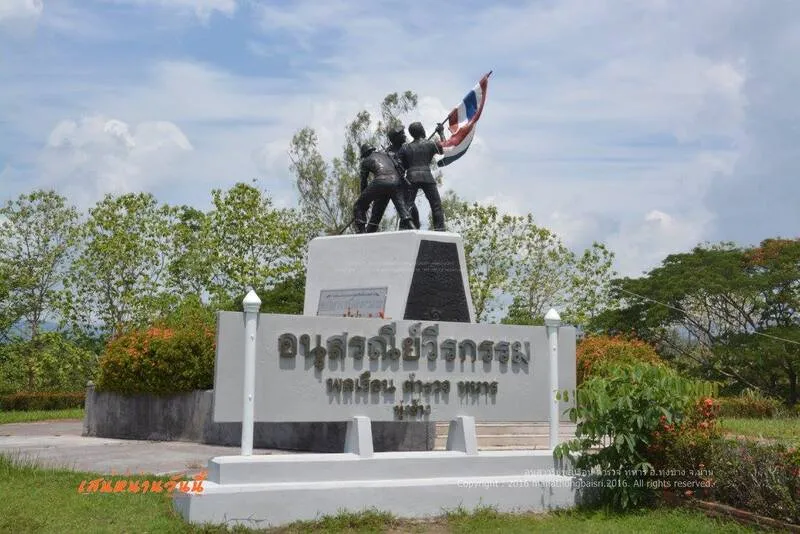
The Civilian Police and Military Heroes Monument and Thung Chang Military Museum
Open Days: By Official Request To The Responsible Unit
Opening Hours: 09.00 AM–4.00 PM
The Civilian, Police, and Military Heroes Monument and Thung Chang Military Museum is an important memorial site in Thung Chang District, Nan Province. It was established to honor civilians, police officers, and soldiers who sacrificed their lives to defend Thailand, the nation, religion, and the monarchy. Located along Highway 1080 on the Nan–Thung Chang route, around kilometer marker 84, the site is one of the most meaningful historical landmarks in northern Nan for visitors interested in national history, local memory, military heritage, and the sacrifices made by people in a borderland province.
This site is not a typical sightseeing attraction. Its importance lies in remembrance, respect, and education. The monument stands as a place where later generations can learn that peace and security were built through the courage, discipline, and sacrifice of many people, including local civilians, police officers, soldiers, and public servants who served in difficult conditions. For the people of Thung Chang and Nan, the monument is part of the province’s collective memory and a visible reminder of the price paid to protect the country.
The historical significance of the monument is closely linked with Thung Chang District, a northern border area with mountainous terrain and strategic importance. In earlier decades, the district played a role in national security operations in northern Thailand. The geography of Nan, with its mountains, valleys, rural communities, and routes toward border areas, made the region both beautiful and challenging. Security work in such terrain required endurance, cooperation, and personal sacrifice. The monument was therefore built to commemorate those who gave their lives while carrying out their duties and protecting the homeland.
His Majesty King Bhumibol Adulyadej the Great, Rama IX, and Her Majesty Queen Sirikit presided over the opening ceremony and laid wreaths at the monument on February 10, 1976. Since then, February 10 has been observed every year as a day for wreath-laying and merit-making ceremonies dedicated to the fallen heroes. This annual ceremony continues the memory of the site and reinforces the bond between government agencies, military personnel, police, local communities, and families connected with the events remembered here.
From a historical perspective, the monument records an important chapter of local and national memory. The events connected with Thung Chang were not only military matters; they also affected the lives of local people, communities, families, and public officials. The site helps visitors understand that national history is not confined to major cities or well-known battlefields. It can also be found in rural districts, mountain routes, and small communities where ordinary people lived through difficult periods and contributed to the protection of the country.
The monument area is located prominently beside the main road. Travelers using Highway 1080 between Nan city and Thung Chang can recognize it as they approach the district. The atmosphere around the site is calm and dignified. Visitors are encouraged to walk quietly, read the information available, observe the memorial area, and reflect on the meaning of sacrifice. Unlike leisure attractions, this is a place where respectful behavior is essential because the site is connected with loss, courage, loyalty, and collective remembrance.
Near the monument is Thung Chang Military Museum, which complements the memorial by presenting physical evidence and historical materials related to the area. The museum displays military weapons, equipment, objects, photographs, and historical information connected with past security operations in Thung Chang and Nan Province. While the monument serves as a symbolic place of remembrance, the museum functions as a learning space where visitors can better understand the context behind the stories of sacrifice.
Thung Chang Military Museum is located at Moo 4, Ban Huai Yang, Thung Chang District, Nan Province 55130. Visits are available by official request to the responsible unit, generally during 09.00 AM–4.00 PM, and there is no admission fee. This arrangement is especially suitable for schools, government agencies, youth groups, history learners, and organized study visits. Visitors should coordinate in advance so that the visit follows the museum’s procedures and the responsible unit can properly accommodate the group.
The value of Thung Chang Military Museum lies in its ability to make history visible. Weapons, equipment, documents, and related objects help visitors understand the difficulties of maintaining security in mountainous and borderland areas. The exhibits show that national defense in such terrain required more than physical strength; it required commitment, local knowledge, cooperation, discipline, and the support of communities. Through these displays, visitors can connect abstract historical events with real places, real people, and real sacrifices.
For students and history enthusiasts, the museum is a valuable field-learning site. It expands classroom knowledge into a real-world setting and helps younger generations understand that the past is not distant or theoretical. It was lived by people in communities, families, villages, and official units. Seeing the monument and museum together allows visitors to understand both the symbolic and material dimensions of remembrance: the monument honors the fallen, while the museum preserves evidence and context.
February 10 is the most important annual date associated with the site. The wreath-laying and merit-making ceremony reflects Thai cultural values of gratitude, remembrance, and respect for those who served the nation. The ceremony is not only a formal occasion, but a continuing act of memory. It keeps the stories of the fallen heroes alive and reminds society that peace should never be taken for granted.
In local cultural terms, the Civilian, Police, and Military Heroes Monument is part of Thung Chang’s identity. People in the district and across Nan Province recognize the place through annual ceremonies, local stories, community memory, and the experience of passing along the Nan–Thung Chang route. The monument is therefore not just a structure beside the road; it is a landmark of memory, gratitude, and historical awareness for the community.
The name of the monument itself is meaningful because it includes civilians, police, and soldiers together. This shows that the defense of the country was not the duty of one group alone. Civilians lived through difficult conditions and supported their communities. Police officers helped maintain peace and protect local people. Soldiers carried out security missions directly. By naming all three groups, the monument honors the shared responsibility and sacrifice of every sector involved in protecting the homeland.
Visitors should approach the site with calmness and respect. Because the monument commemorates people who lost their lives, behavior such as loud noise, climbing on memorial structures, or taking inappropriate photographs should be avoided. Historical and memorial tourism requires sensitivity. When visitors understand the memory behind the place, the experience becomes deeper than a brief stop along the road; it becomes a moment of reflection on courage, duty, and peace.
Thung Chang District offers a different atmosphere from Nan city. The route from Nan to Thung Chang passes through mountain landscapes, rural communities, and northern district areas that reveal another side of the province. Visiting the monument and museum allows travelers to see Nan beyond temples, cafés, and scenic viewpoints. It introduces the province as a place with layered histories, including stories of security, borderland life, community resilience, and national service.
Travelers planning a visit should allow enough time, especially if they want to enter the museum. Organized groups should contact the responsible unit in advance. This site is best experienced slowly and respectfully, with time to read, observe, and understand. The most meaningful details are not only in the monument itself, but also in the stories, displayed objects, annual ceremonies, and the historical context of Thung Chang District.
Getting There to the Civilian, Police, and Military Heroes Monument and Thung Chang Military Museum is straightforward by road. From Nan city, follow Highway 1080 on the Nan–Thung Chang route toward Thung Chang District. The site is located beside the road around kilometer marker 84 before entering the district area. Private cars, rental cars, and local tour vehicles are the most practical options. Travelers should plan for a longer drive than city sightseeing and check vehicle readiness if continuing toward mountain routes or nearby districts.
A common route from Nan city passes through Tha Wang Pha, Pua, Chiang Klang, and then toward Thung Chang. This route can be planned as a full-day itinerary, with stops at cultural and scenic sites along the way. Travelers may combine the monument and museum with visits to Wat Nong Daeng in Chiang Klang, Wat Phuket in Pua, or other northern Nan attractions. This makes the trip more varied, combining history, culture, community landscapes, and mountain scenery.
For travelers interested in historical tourism, the monument can be connected with other meaningful places in Nan Province, such as Nan National Museum, Wat Phumin, Wat Phra That Chang Kham Worawihan, and cultural sites in Pua or Thung Chang. Such an itinerary helps visitors understand Nan through several dimensions: old-town history, religion, art, local life, and the security history of a northern border province.
The strength of this site lies in the contrast between its simple appearance and the depth of its story. At first glance, it may seem like a roadside memorial. Once visitors understand its history, however, the place becomes much more powerful. It holds memories of loss, loyalty, courage, and cooperation during difficult times. A visit here reminds travelers that the peaceful atmosphere of Nan today was shaped in part by the sacrifices of people in the past.
As an educational attraction, the Civilian, Police, and Military Heroes Monument and Thung Chang Military Museum is suitable for visitors interested in national history, local history, military heritage, memorial sites, and borderland communities. It is also suitable for families who want younger members to learn outside the classroom. The site adds an important dimension to travel in Nan, showing that the province is not only about temples and landscapes, but also about memory, civic duty, and gratitude.
For teachers and youth group leaders, a study visit to the monument and museum can support lessons on local history, citizenship, national service, and peaceful coexistence. Learning in the actual place gives students a stronger understanding than reading from textbooks alone. They can see the landscape, observe the memorial, view historical materials, and understand that community history and national history are deeply connected.
Visitors who travel near February 10 may gain an even clearer sense of the site’s importance. Around this date, the annual wreath-laying and merit-making ceremony brings together officials, residents, and participants who continue to honor the fallen heroes. This living tradition keeps the monument active in community memory and ensures that the stories of sacrifice are passed from one generation to the next.
After visiting the monument and museum, travelers can continue to nearby attractions in Thung Chang and neighboring districts. Possible stops include the 700-year-old Buddha image in Thung Chang, King Naresuan Shrine in Thung Chang, Wat Nong Daeng in Chiang Klang, Wat Phuket in Pua, and scenic routes toward Doi Phu Kha or Bo Kluea. This type of route is best suited to travelers with private or rented vehicles who want to experience Nan through history, local culture, communities, and mountain landscapes.
In summary, the Civilian, Police, and Military Heroes Monument and Thung Chang Military Museum is one of Nan Province’s most meaningful historical learning sites. It preserves the memory of those who sacrificed their lives to protect Thailand and brings together the stories of civilians, police officers, and soldiers in one place. For travelers passing through Thung Chang District, a respectful visit here adds depth to a Nan itinerary and offers a clearer understanding of the people and history behind the province’s peaceful present.
| Name | Civilian, Police, and Military Heroes Monument and Thung Chang Military Museum |
| Location | Thung Chang Subdistrict, Thung Chang District, Nan Province |
| Address | Moo 4, Ban Huai Yang, Thung Chang District, Nan Province 55130 |
| Coordinates | 19.3729660392, 100.874416018 |
| Highlights | A memorial honoring fallen civilian, police, and military heroes, together with a military museum displaying weapons, equipment, and historical evidence from the Thung Chang area |
| History | His Majesty King Rama IX and Her Majesty Queen Sirikit presided over the opening ceremony and laid wreaths at the monument on February 10, 1976. |
| Distinctive Features | A memorial and historical learning site connected with national security history in Thung Chang District, Nan Province, with an annual wreath-laying and merit-making ceremony on February 10 |
| Travel Information | Follow Highway 1080 on the Nan–Thung Chang route from Nan city toward Thung Chang District. The site is located beside the road around kilometer marker 84 before entering Thung Chang District. |
| Current Status | Operating as a memorial and military museum in Thung Chang District, Nan Province, with visits arranged through prior coordination with the responsible unit |
| Open Days | By official request to the responsible unit |
| Opening Hours | 09.00 AM–4.00 PM |
| Fees | No Admission Fee |
| Facilities | Memorial area, military museum, exhibition area for historical objects and military equipment, and historical learning points |
| Main Areas / Zones | Civilian, Police, and Military Heroes Monument, wreath-laying area, Thung Chang Military Museum, weapons and equipment exhibition area, and historical evidence display area |
| Caretaker | Military unit in Thung Chang District, Nan Province |
| Main Contact Number | 054-795121, 091-776-4104 |
| Official Website / Official Page | Thung Chang Military Museum, Nan Province official Facebook page |
| Nearby Tourist Attractions | 1. 700-Year-Old Buddha Image, Thung Chang District, about 3 km 2. King Naresuan Shrine, Thung Chang, about 1 km 3. Wat Nong Daeng, Chiang Klang District, about 22 km 4. Wat Phuket, Pua District, about 42 km 5. Doi Phu Kha / Pua–Bo Kluea Route, about 55 km 6. Wat Phumin, Mueang Nan District, about 80 km |
| Nearby Restaurants | 1. Tiao Lung Ton / Tiao Lung Khon, Thung Chang District, about 2 km, Tel. 096-426-3004 2. Krua Khun Yai & Tom Yum Egg Noodle Thung Chang, about 2 km, Tel. 092-310-3709 3. Krua Plai Na, Thung Chang District, about 3 km, Tel. 085-940-7511 4. Gem Forest Coffee, Thung Chang District, about 3 km, Tel. 087-921-2100 5. Fa Ladda Restaurant, Thung Chang District, about 2 km |
| Nearby Accommodations | 1. Thung Chang Hill Resort, about 1 km, Tel. 086-374-4010 2. Nice Accommodation, Thung Chang District, about 2 km, Tel. 089-855-7223 3. Nan Lucky Hill, Thung Chang District, about 2 km, Tel. 090-892-6826, 082-515-1262 4. Ban Kru Phu Rim Nam Resort, Thung Chang, about 4 km, Tel. 082-648-5082, 081-694-4669, 089-791-2423 5. Bi-Bamboo Mountain House, Thung Chang District, about 3 km |
Frequently Asked Questions (FAQ)
Q: Where is the Civilian, Police, and Military Heroes Monument located?
A: It is located along Highway 1080 on the Nan–Thung Chang route, around kilometer marker 84, in Thung Chang District, Nan Province.
Q: Why was the monument built?
A: It was built to honor civilians, police officers, and soldiers who sacrificed their lives to protect Thailand, the nation, religion, and the monarchy.
Q: Why is February 10 important at this monument?
A: February 10 marks the day in 1976 when His Majesty King Rama IX and Her Majesty Queen Sirikit presided over the opening ceremony and laid wreaths at the monument. A remembrance ceremony has continued annually since then.
Q: What does Thung Chang Military Museum display?
A: The museum displays military weapons, equipment, historical objects, and information related to past security events and the sacrifices remembered in the Thung Chang area.
Q: Is there an admission fee for Thung Chang Military Museum?
A: No. There is no admission fee, but visits should be arranged in advance by official request to the responsible unit.
Q: What are the museum’s opening hours?
A: The museum is open for coordinated visits by official request from 09.00 AM to 4.00 PM.
Q: Who should visit this place?
A: It is suitable for visitors interested in national history, local history, military heritage, memorial sites, students, youth groups, and travelers who want to understand Nan beyond temples and nature.
Tel : 054521118
 Tel : 054521118
 Category: ●Art, Culture and Heritage
 Group: ●Landmarks and Memorials
Last Update : 3 MonthAgo
 Last Update : 3 MonthAgo
 Click to Access the Navigation Map GPS
The Civilian Police and Military Heroes Monument and Thung Chang Military Museum Map
Recommend
 Landmarks and Memorials(6)
 Art, Craft Centres, Tradition(6)
 Museums(4)
 Historic Homes and Cities(1)
 Art Gallery(1)
 Educational Places
 Educational Gardens, Farm(1)
 Places of Worship
 Temple(68)
 Church(1)
 Other Sacred Sites(18)
 Research and Development
 Royal Project(2)
 Suburban Living
 Village, Community(13)
 Local Market(1)
 Nature and Wildlife
 National Parks and Marine Reserves(9)
 Mountain (Doi)(6)
 Dam, Reservoir, Lake(16)
 Waterfalls(28)
 Hot Springs(1)
 Caves(11)
 River, Canal(5)
 Other natural attractions(10)
 Entertainment and Agricultural
 Farms, Parks and Ecotourism(4)
 Outdoor and Adventure Activities(2)


