
lovethailand home >North Travel Attractions >Nan Travel Attractions >Phu Pieng >Nam Kaen > Wat Pong Kham
TL;DR: Wat Pong Kham is located at Ban Mai Phatthana, Village No. 4, Nam Kian Subdistrict, Phu Phiang District, Nan Province, Thailand, open Daily, hours Open During Regular Temple Visiting Hours.
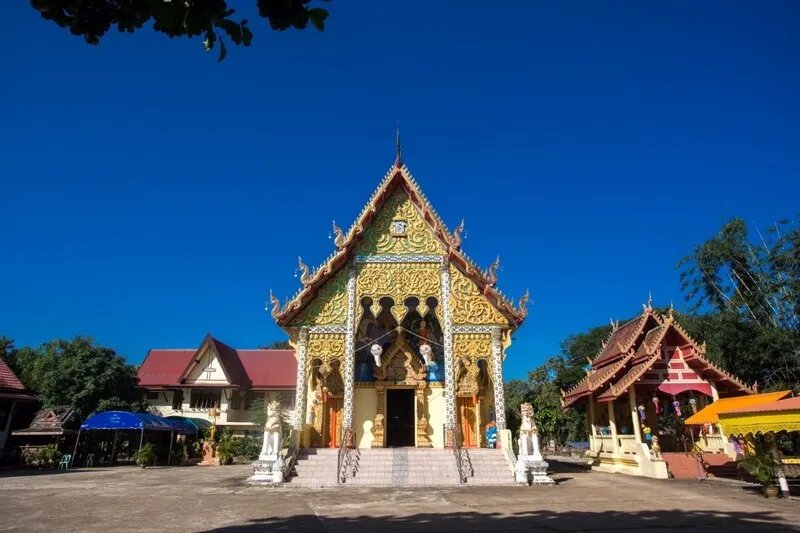
Wat Pong Kham
Open Days: Daily
Opening Hours: Open During Regular Temple Visiting Hours
Wat Pong Kham is located at No. 9, Ban Mai Phatthana, Village No. 4, Nam Kian Subdistrict, Phu Phiang District, Nan Province. It is a community temple under the Mahanikaya sect and covers 18 rai, 3 ngan, and 60 square wah of land. The temple is an important Buddhist site for the Nam Kian community, with a long history that began when it was known as Wat Pu Tong or Wat Phu Tong before becoming Wat Pong Kham.
Wat Pong Kham is meaningful for travelers who want to understand Nan through local community temples rather than only through major tourist landmarks. The temple preserves local Buddhist history, village memory, sacred Buddha images, inscriptions, Phra That Chao Phu Tong, Phra Chao Dap Phai, and the former role of Buddhist scripture education. It is a suitable stop for visitors interested in Phu Phiang District, Nam Kian community history, and quiet cultural routes near Nan town.
The temple was originally called Wat Pu Tong or Wat Phu Tong. Evidence from inscriptions on 2 wooden Buddha images in the subduing Mara posture refers to Wat Pu Tong in Nam Kian and records the creation of Buddha images for worship by local people. In 1887, a viharn was built and the temple was formally established according to administrative requirements. The temple was then renamed Wat Pong Kham, with Khru Ba Ka Wichai serving as the first abbot.
The name Pong Kham is connected with local belief and landscape. In northern Thai usage, “kham” means gold, while “pong” can refer to a mineral-rich spot or natural salt lick area. The name is associated with the belief that the temple area was near a pong and a golden pit. This gives Wat Pong Kham a strong sense of local identity, linking geography, belief, and community memory.
Wat Pong Kham was built in 1887 and received its royal boundary designation in 1892. The sacred boundary measures 40 meters wide and 42 meters long. This designation allowed the temple to conduct formal monastic ceremonies and confirmed its status as a fully functioning Buddhist temple for the Nam Kian community.
The temple land is spacious for a community temple. Its northern boundary extends about 6 sen to a rural development road, while the southern boundary extends about 6 sen to private land. The eastern and western boundaries each extend about 3 sen and 3 wa to private land. This layout places the temple within a real village landscape, connected with roads, local landholdings, and community life.
The main sacred objects at Wat Pong Kham include the principal Buddha image, Buddha images, Phra That Chao Phu Tong, Phra Chao Dap Phai, and the Wat Pong Kham inscription. The principal Buddha image serves as the spiritual focus of the temple, while the older Buddha image inscriptions connect the temple with its earlier name and local religious history.
Phra That Chao Phu Tong is especially important because it preserves the memory of the temple’s earlier identity as Wat Phu Tong. It adds a relic-shrine dimension to the temple and gives visitors another sacred point for worship. Together with the principal Buddha image and old inscriptions, it helps tell the layered history of the site.
Phra Chao Dap Phai is a more recent sacred image created on January 9, 2020 by Phra Samu Sathit Intapanyo, the abbot of Wat Pong Kham, together with devotees from Nam Kian Subdistrict. The belief behind Phra Chao Dap Phai is connected with ending suffering, sorrow, illness, and danger for worshippers. This makes the temple meaningful not only as an old site but also as a living place of contemporary devotion.
The known line of abbots includes Khru Ba Ka Wichai, Phra Thananchai, Phra Nam Wong, Phra Bunrat, Phra Athikan Intawong Intawangso, Phra Athikan Somboon Suntharo, Phra Athikan Sanit Khemacharo, Phra Inhwan Pasanno, and Phra Inphong Sirimangkhalo. This succession reflects the temple’s continuity as a religious center cared for by generations of monks.
Wat Pong Kham also had an educational role. A Buddhist scripture school was opened in 1987, showing that the temple served not only as a place of worship but also as a learning center for Buddhist studies. This is an important part of the temple’s community value, especially in rural northern Thailand, where temples often supported both moral and religious education.
Nam Kian Subdistrict has a strong local identity, and Wat Pong Kham should be understood within that community context. The temple brings together faith, local history, education, sacred art, and village memory. A visit here helps travelers see a quieter but meaningful side of Nan Province.
Getting There is convenient by private car, rental car, or local hired vehicle. From Nan town, cross the Nan River toward Phu Phiang District and continue to Nam Kian Subdistrict and Ban Mai Phatthana, Village No. 4. The temple can be combined with Wat Phra That Chae Haeng, Wat Phumin, Wat Ming Muang, and Nan National Museum in a cultural route near Nan town.
Visitors should dress respectfully, speak quietly, and avoid disturbing monks or local residents during religious activities. Since Wat Pong Kham is an active community temple, respectful behavior is important. Photography should be done politely, especially around Buddha images, relic shrines, and ceremonies.
The best time to visit is in the morning or late afternoon, when the weather is more comfortable and the temple atmosphere is calm. Visitors interested in local history should take time to understand the old name Wat Pu Tong, Phra That Chao Phu Tong, the wooden Buddha image inscriptions, and Phra Chao Dap Phai.
Overall, Wat Pong Kham is a valuable community temple in Phu Phiang District. Its earlier identity as Wat Pu Tong or Wat Phu Tong, formal establishment in 1887, royal boundary designation in 1892, principal Buddha image, old inscriptions, Phra That Chao Phu Tong, Phra Chao Dap Phai, and former Buddhist scripture school make it a meaningful cultural stop for travelers interested in local Buddhist heritage in Nan Province.
| Name | Wat Pong Kham |
| Location | Ban Mai Phatthana, Village No. 4, Nam Kian Subdistrict, Phu Phiang District, Nan Province, Thailand |
| Address | No. 9, Ban Mai Phatthana, Village No. 4, Nam Kian Subdistrict, Phu Phiang District, Nan Province 55000 |
| Temple Type | Community Temple Under The Mahanikaya Sect |
| Temple Area | 18 Rai, 3 Ngan, And 60 Square Wah |
| Highlights | Old Community Temple Of Nam Kian, Formerly Known As Wat Pu Tong Or Wat Phu Tong, With A Principal Buddha Image, Wooden Buddha Image Inscriptions, Phra That Chao Phu Tong, Phra Chao Dap Phai, And A Former Buddhist Scripture School |
| History | Believed To Have Begun As A Monastic Residence Around 1857, Formally Built With A Viharn In 1887, And Received Its Royal Boundary Designation In 1892 With A Boundary Measuring 40 Meters Wide And 42 Meters Long |
| Name Origin | The Temple Was Formerly Called Wat Pu Tong Or Wat Phu Tong; The Current Name Pong Kham Is Linked With Local Belief In A Mineral-Rich Pong And A Golden Pit Near The Temple Area |
| Distinctive Features | Evidence From Wooden Buddha Image Inscriptions, The Wat Pong Kham Inscription, Phra That Chao Phu Tong, And Phra Chao Dap Phai, Which Is Associated With Ending Suffering, Sorrow, Illness, And Danger |
| Main Sacred Objects | Principal Buddha Image, Buddha Images, Phra That Chao Phu Tong, Phra Chao Dap Phai, Wat Pong Kham Inscription, And Monk Residence |
| Travel Information | From Nan Town, Cross The Nan River Toward Phu Phiang District And Continue To Nam Kian Subdistrict And Ban Mai Phatthana, Village No. 4; Private Car, Rental Car, Or Local Hired Vehicle Is Recommended |
| Current Status | Active Community Buddhist Temple In Ban Mai Phatthana, Nam Kian Subdistrict, Phu Phiang District, Nan Province |
| Open Days | Daily |
| Opening Hours | Open During Regular Temple Visiting Hours |
| Main Areas / Zones | Principal Buddha Image Area, Buddha Images, Phra That Chao Phu Tong, Phra Chao Dap Phai, Monk Residence, And Community Religious Activity Area |
| Abbot / Caretaker | Phra Samu Sathit Intapanyo |
| Official Website / Official Page | Wat Pong Kham Nam Kian - Wat Pongkham |
| Nearby Tourist Attractions | 1. Nam Kian Community Museum 2 km 2. Wat Nam Kaen Tai 7 km 3. Wat Na Lueang Muang Khwa 8 km 4. Wat Phra That Chae Haeng Royal Temple 13 km 5. Wat Phumin 15 km |
| Nearby Restaurants | 1. Khao Soi Hoi Khaeng 13 km, Tel. 083-7620334 2. Ruean Chao Nang 13 km 3. Lemongrass 15 km 4. Chom Nan Café And Bistro 15 km 5. Hua Loet Rot Khao Tom Baht Diao 15 km |
| Nearby Accommodations | 1. Nan Seasons Boutique Resort 13 km 2. Nan Boutique Resort 14 km 3. Baan Nan B&B Hotel 15 km 4. Wiang Kaeo Hotel 15 km 5. Nan Nakara Boutique Hotel 15 km |
Frequently Asked Questions (FAQ)
Q: Where Is Wat Pong Kham Located?
A: Wat Pong Kham Is Located At No. 9, Ban Mai Phatthana, Village No. 4, Nam Kian Subdistrict, Phu Phiang District, Nan Province.
Q: What Was The Original Name Of Wat Pong Kham?
A: The Temple Was Originally Known As Wat Pu Tong Or Wat Phu Tong Before Being Renamed Wat Pong Kham.
Q: When Was Wat Pong Kham Built?
A: Wat Pong Kham Was Built With A Viharn In 1887 And Received Its Royal Boundary Designation In 1892.
Q: What Is The Origin Of The Name Pong Kham?
A: The Name Is Linked With Local Belief In A Mineral-Rich Pong And A Golden Pit Near The Temple Area, With “Kham” Meaning Gold In Northern Thai Usage.
Q: What Important Sacred Objects Are At Wat Pong Kham?
A: Important Sacred Objects Include The Principal Buddha Image, Buddha Images, Phra That Chao Phu Tong, Phra Chao Dap Phai, And The Wat Pong Kham Inscription.
Q: Was Wat Pong Kham Connected With Buddhist Education?
A: Yes. The Temple Had A Buddhist Scripture School That Opened In 1987, Showing Its Role As A Local Religious Learning Center.
Q: How Can Visitors Get To Wat Pong Kham?
A: From Nan Town, Cross The Nan River Toward Phu Phiang District And Continue To Nam Kian Subdistrict And Ban Mai Phatthana, Village No. 4. A Private Car, Rental Car, Or Local Hired Vehicle Is Recommended.
 Category: ●Places of Worship
 Group: ●Temple
Last Update : 4 MonthAgo
 Last Update : 4 MonthAgo
 Click to Access the Navigation Map GPS
 Art, Culture and Heritage
 Landmarks and Memorials(6)
 Art, Craft Centres, Tradition(6)
 Museums(4)
 Historic Homes and Cities(1)
 Art Gallery(1)
 Educational Places
 Educational Gardens, Farm(1)
Temple(68)
Educational Gardens, Farm(1)
Temple(68)
 Church(1)
 Other Sacred Sites(18)
 Research and Development
 Royal Project(2)
 Suburban Living
 Village, Community(13)
 Local Market(1)
 Nature and Wildlife
 National Parks and Marine Reserves(9)
 Mountain (Doi)(6)
 Dam, Reservoir, Lake(16)
 Waterfalls(28)
 Hot Springs(1)
 Caves(11)
 River, Canal(5)
 Other natural attractions(10)
 Entertainment and Agricultural
 Farms, Parks and Ecotourism(4)
 Outdoor and Adventure Activities(2)


