
lovethailand home >Northeastern Travel Attractions >Yasothon Travel Attractions >Muang Yasothon >Kho Nuea > Nong Ueng Royal Development Project
TL;DR: Nong Ueng Royal Development Project is located at Kho Nuea Subdistrict, Mueang Yasothon District, Yasothon Province, open Daily, hours 08.00 – 17.00.
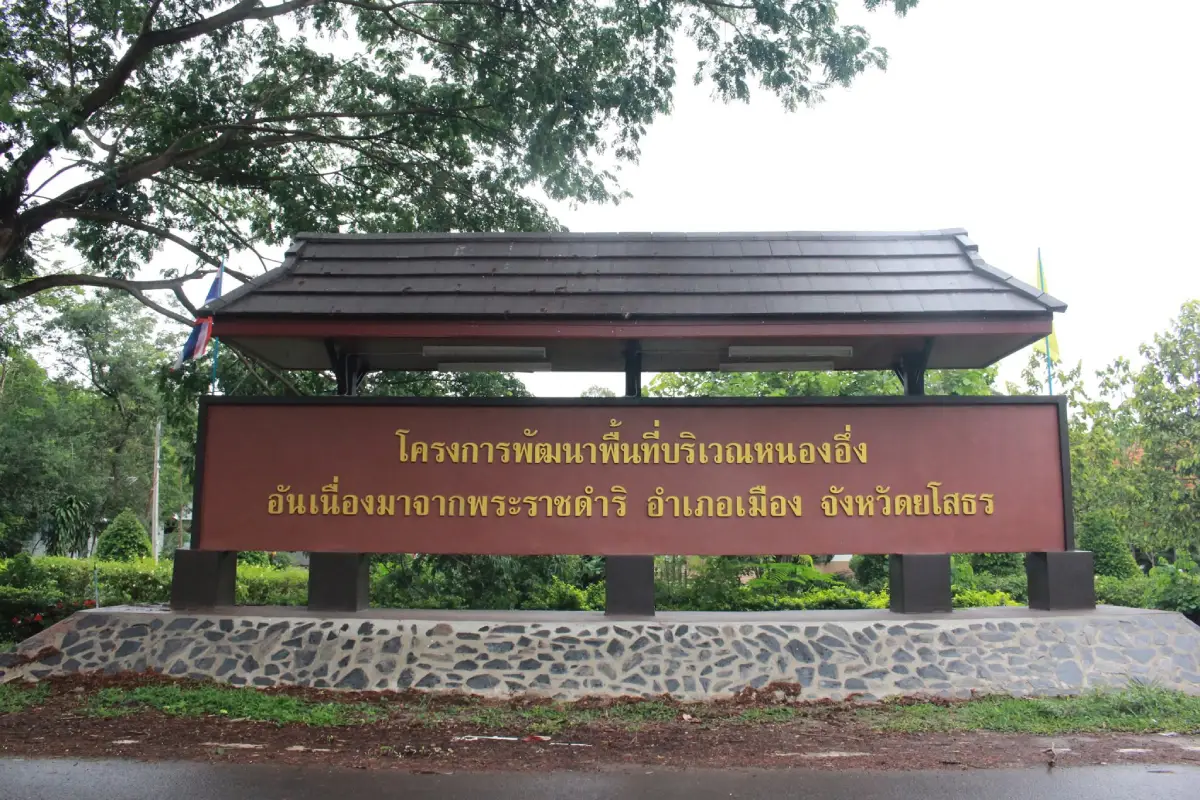
Nong Ueng Royal Development Project
Open Days: Daily
Opening Hours: 08.00 – 17.00
The Nong Ueng Royal Development Project in Yasothon is an important conservation tourism site and community learning area in Kho Nuea Subdistrict, Mueang Yasothon District, Yasothon Province. The project centers on Nong Ueng, a large public wetland and water resource, together with Dong Man Community Forest, an important forest area that supports local food security, livelihoods, ecological restoration, and community-based resource management. For travelers, the site offers a meaningful opportunity to understand how water, forest, agriculture, local products, and community life are connected in rural northeastern Thailand.
Nong Ueng was once part of an area affected by repeated flooding during the rainy season and water shortage during the dry season. These problems directly affected agriculture, daily life, transport, and local livelihoods. The development of the Nong Ueng area under the royal initiative focused on improving the public water source, dredging the pond, restoring the surrounding land, planting vetiver grass to reduce soil erosion, and rehabilitating nearby forest areas so that people and forest could live together in a balanced and mutually supportive way.
The main strength of the Nong Ueng Project is its integrated approach. It is not only a pond improvement project and not only a tourist site. It combines water management, forest restoration, food resources, fish breeding, local occupations, community products, and environmental education. Nong Ueng functions as a water storage area, a fish breeding ground, an ecological habitat, a local recreation area, and an outdoor classroom for people who want to learn about sustainable development at the community level.
The wetland landscape of Nong Ueng is also attractive for nature lovers. The area is known as a large water body where migratory ducks and other waterbirds can be seen in certain seasons. This makes the site suitable for birdwatching, nature photography, quiet walking, and learning about wetland ecosystems. Visitors should observe birds from a respectful distance, avoid loud noise, and avoid disturbing waterbird habitats. The value of the site depends on maintaining the balance between tourism and conservation.
Dong Man Community Forest is one of the most important parts of the project. Covering about 3,006 rai, the forest provides food, natural products, and seasonal resources for surrounding communities. Local people benefit from mushrooms, ant eggs, edible forest plants, herbs, firewood, and other natural resources under community rules and shared management. The restoration of Dong Man Forest shows how degraded forest can become productive again when local communities, government agencies, and conservation principles work together.
The success of the project can be seen not only in the restored forest, but also in the way local people have developed forest products into community products. Items associated with the area include salted mushrooms, bottled forest mushrooms, processed ant eggs, mushroom chili paste, and other processed forest foods under the “Wanathip” community product brand. These products reflect the relationship between conservation and local economy. When the forest is healthy, the community gains food, income, and a strong reason to protect the natural resource base.
The Nong Ueng Project also serves as a learning center for government agencies, students, farmers, community groups, and visitors. Important topics include water resource management, vetiver grass planting, soil conservation, community forest management, fish breeding, natural resource restoration, processed forest products, and community-based livelihood development. This makes the site especially useful for study visits and educational travel. It is a place where visitors can learn from actual community practice rather than from theory alone.
Nong Ueng performs several roles at the same time. It stores water for the dry season, supports fish breeding and local fisheries, helps maintain wetland ecology, provides a place for recreation, supports birdlife, and creates a learning environment for sustainable community development. This multi-purpose role makes the project different from a typical reservoir or public park. It is a living system that supports people, water, forest, wildlife, and local economy together.
The landscape of the project includes the water body, embankments, vetiver grass areas, forest restoration zones, community product areas, demonstration plots, and natural learning paths. Visitors should explore the area slowly and with attention. The project is most meaningful when understood as a working landscape, not simply as a scenic viewpoint. Every part of the area reflects a practical function: water storage, erosion control, fish breeding, forest recovery, community learning, or local livelihood development.
The birdwatching value of Nong Ueng is one of the most appealing features for travelers who enjoy quiet nature. During appropriate seasons, migratory ducks and waterbirds use the wetland as a resting and feeding area. The best way to enjoy this experience is to remain quiet, keep distance, and use binoculars or a zoom lens rather than approaching birds directly. Responsible birdwatching helps preserve the site and allows wildlife to remain undisturbed.
The project has also improved the quality of life in Kho Nuea Subdistrict. The development of water resources supports agriculture, while forest restoration provides food and additional income. Community products create value from local resources, and the learning center function brings outside visitors to study the area. This combination helps strengthen the community and shows how conservation can contribute to local livelihoods when managed carefully.
For general travelers, Nong Ueng is suitable for quiet relaxation, nature observation, photography, birdwatching, and learning about local products. It is not a flashy tourist attraction with large buildings or entertainment facilities. Its value lies in the real relationship between people and natural resources. Visitors who appreciate community-based travel and environmental learning will find the site especially meaningful.
For families, the project is a useful outdoor classroom. Children can learn about water, forests, birds, fish, local food, community rules, and sustainable resource use. The site helps explain that nature is not separate from daily life. Water affects farming, forests provide food, and community cooperation helps protect shared resources. A family visit to Nong Ueng can therefore become a practical lesson in ecology, agriculture, and local culture.
For international travelers, the Nong Ueng Royal Development Project is a clear example of Thailand’s community-based resource development under a royal initiative. It shows how a rural wetland and forest area can be restored and transformed into a learning site that supports agriculture, conservation, food security, and local income. It also gives visitors a deeper view of Isan beyond temples and festivals, showing how local communities depend on and protect natural resources.
The best time to visit is in the morning or late afternoon. These periods are more comfortable for walking, photography, and bird observation. Midday can be hot, but it is suitable for organized study visits and indoor or guided learning activities. Visitors interested in birds should choose a quiet time and allow enough time to observe the wetland calmly.
Getting There is most convenient by private car. From Yasothon city, travel toward Kho Nuea Subdistrict in Mueang Yasothon District. A private vehicle allows visitors to combine Nong Ueng with nearby attractions in Yasothon city, such as Phaya Thaen Public Park, the Toad Museum, Wat Mahathat, Ban Sing Tha Old Quarter, and Phra That Kong Khao Noi. Groups planning an educational visit should coordinate with the project or related local agencies in advance.
There is no admission fee for visiting the Nong Ueng Project during its operating hours. Visitors should follow conservation rules, avoid littering, avoid disturbing wildlife, avoid entering operational areas without permission, and respect local community space. Since the site is both a public learning area and a community resource area, responsible behavior is essential.
The site is also suitable for nature photography. Good subjects include the wetland landscape, waterbirds, forest edges, community learning areas, and local activities. However, visitors should not disturb villagers, staff, birds, or aquatic habitats for the sake of photography. The best photographs are those that capture the calm and ecological character of the place while respecting the people and environment.
A practical one-day route can begin at Nong Ueng and Dong Man Community Forest in the morning, then continue to Yasothon city for Phaya Thaen Public Park, the Toad Museum, Wat Mahathat, Ban Sing Tha Old Quarter, and Phra That Kong Khao Noi. This route gives travelers a balanced view of Yasothon: nature, community development, local products, Buddhist heritage, folklore, and historic urban culture.
The Nong Ueng Project expands the travel identity of Yasothon beyond its famous Rocket Festival. It reveals a province with serious environmental learning resources, community forest management, wetland ecology, and locally driven livelihood development. For travelers who want to understand the deeper foundations of Isan community life, Nong Ueng provides a valuable and grounded experience.
Visitors interested in local products can ask about community products from Dong Man Community Forest. Forest mushroom products, ant egg products, chili pastes, and seasonal processed foods are important examples of how local resources are turned into community income. Supporting these products helps reinforce the link between forest conservation and local livelihoods.
In summary, the Nong Ueng Royal Development Project in Yasothon is a valuable conservation tourism and learning destination. Its main highlights include the large Nong Ueng wetland, seasonal waterbirds and migratory ducks, Dong Man Community Forest of about 3,006 rai, water management systems, vetiver grass planting, fish breeding, forest restoration, community products, and outdoor learning activities. It is suitable for visitors who want a quiet, educational, and meaningful travel experience rooted in real community development and natural resource conservation.
| Name | Nong Ueng Royal Development Project, Yasothon |
| Location | Kho Nuea Subdistrict, Mueang Yasothon District, Yasothon Province |
| Address | Nong Ueng and Dong Man Community Forest area, Kho Nuea Subdistrict, Mueang Yasothon District, Yasothon 35000, Thailand |
| Highlights | Large wetland, seasonal waterbirds and migratory ducks, Dong Man Community Forest, water management learning, conservation tourism, and community products from forest resources |
| Background | The project was developed under the royal initiative to improve Nong Ueng as an agricultural water source and fish breeding area, restore the surrounding forest, protect soil with vetiver grass, and support communities in living with forest resources sustainably. |
| Site Characteristics | Nong Ueng is a public water resource developed for water storage, fish breeding, wetland ecology, recreation, conservation tourism, and outdoor learning. |
| Important Areas | Nong Ueng wetland of about 155 rai Dong Man Community Forest of about 3,006 rai Embankment and water control areas Vetiver grass and soil restoration areas Natural learning and community livelihood areas |
| Suitable Activities | Nature observation, birdwatching, photography, water management learning, community forest study, local product learning, and community development study visits |
| Community Products | Forest products from Dong Man Community Forest, including salted mushrooms, processed forest mushrooms, processed ant eggs, mushroom chili paste, and other seasonal forest food products under the “Wanathip” brand |
| Travel Information | Travel from Yasothon city toward Kho Nuea Subdistrict in Mueang Yasothon District. A private car is the most convenient option for visiting the project and nearby attractions in Yasothon city. |
| Current Status | Open as a conservation tourism site, recreation area, and learning center for water, forest, and community livelihood development |
| Open Days | Daily |
| Opening Hours | 08.00 – 17.00 |
| Fees | No admission fee |
| Facilities | Wetland viewing areas, community forest learning areas, study visit areas, community product areas, nature walking areas, and parking areas at project service points |
| Main Areas / Zones | Nong Ueng wetland zone Seasonal waterbird and migratory duck observation zone Embankment and water storage system zone Vetiver grass and soil restoration zone Dong Man Community Forest zone Wanathip community product zone Natural learning and study visit zone Demonstration and community livelihood activity zone |
| Caretaker / Related Agencies | Yasothon Province as the coordinating lead agency, together with the Office of the Royal Development Projects Board, Royal Forest Department, related government agencies, the project working group, and communities in Kho Nuea Subdistrict |
| Project Head Mentioned In Government News | Mr. Somsak Thawinan, Head of the Nong Ueng Royal Development Project |
| Community Product Contact | 099-7650857, 080-3945337 |
| Nearby Tourist Attractions | 1. Phaya Thaen Public Park, about 13 km 2. Toad Museum, about 13 km 3. Wat Mahathat Yasothon, about 14 km 4. Ban Sing Tha Old Quarter, about 15 km 5. Phra That Kong Khao Noi, about 19 km 6. Bung Noi Bung Yai Public Park, about 15 km 7. Phra That Ku Chan, about 35 km |
| Nearby Restaurants | 1. Local restaurants in Kho Nuea Subdistrict, about 2 km 2. Ban Khun Ya Yasothon, about 13 km, Tel. 045-721141-2 3. Samrit Restaurant Yasothon, about 14 km, Tel. 086-2492508 4. Kuay Tiao Ruea Rotniyom Yasothon, about 14 km, Tel. 098-7997269 5. Rai Hug Kuk Yasothon, about 15 km, Tel. 099-2896554, 061-9501942 6. Moo Kratha Oil 3, about 16 km, Tel. 090-8239100, 085-6310918, 088-1291200 7. Jib Fae Ban Nuea, about 14 km, Tel. 085-0241324 |
| Nearby Accommodations | 1. The Green Park Grand Hotel Yasothon, about 14 km, Tel. 045-714700-4 2. JP Emerald Hotel Yasothon, about 14 km, Tel. 045-714456 3. The Zen Hotel Yasothon, about 14 km, Tel. 045-711455 4. BM Grand Hotel Yasothon, about 15 km, Tel. 045-712333 5. RP City Hotel, about 15 km, Tel. 045-711648 6. Botanic Garden Hotel, about 16 km, Tel. 045-712064 7. Ban Rak Resort, about 23 km, Tel. 081-9558234, 045-787280 |
Frequently Asked Questions (FAQ)
Q: Where is the Nong Ueng Royal Development Project located?
A: It is located in Kho Nuea Subdistrict, Mueang Yasothon District, Yasothon Province, covering the Nong Ueng wetland and Dong Man Community Forest area.
Q: Why is the Nong Ueng Project important?
A: The project is important for water management, forest restoration, community livelihood development, food security, conservation education, and sustainable use of local natural resources.
Q: What are the opening hours?
A: The project is open daily from 08.00 to 17.00.
Q: Is there an admission fee?
A: No. Visitors can enter during operating hours without an admission fee and should follow conservation and community rules.
Q: What activities are suitable at Nong Ueng?
A: Suitable activities include nature observation, birdwatching, photography, wetland learning, community forest study, local product learning, and study visits on natural resource management.
Q: Why is Dong Man Community Forest important?
A: Dong Man Community Forest covers about 3,006 rai and serves as a community food source, providing mushrooms, ant eggs, edible forest plants, herbs, and forest products that support local livelihoods.
Q: When is the best time to visit?
A: Morning and late afternoon are the best times for nature observation, birdwatching, and photography, while daytime is suitable for organized study visits.
Q: What nearby attractions can be visited on the same trip?
A: Nearby attractions include Phaya Thaen Public Park, the Toad Museum, Wat Mahathat Yasothon, Ban Sing Tha Old Quarter, Phra That Kong Khao Noi, and other attractions in Yasothon city.
 Category: ●Research and Development
 Group: ●Royal Project
Last Update : 1 MonthAgo
 Last Update : 1 MonthAgo
 Click to Access the Navigation Map GPS
Nong Ueng Royal Development Project Map

 Art, Culture and Heritage
 Historical Sites and Monuments(6)
 Landmarks and Memorials(1)
 Art, Craft Centres, Tradition(4)
 Museums(1)
 Historic Homes and Cities(1)
 Places of Worship
 Temple(22)
 Church(1)
 Other Sacred Sites(9)
Royal Project(2)
Other Sacred Sites(9)
Royal Project(2)
 Suburban Living
 Village, Community(3)
 Local Market(1)
 Nature and Wildlife
 National Parks and Marine Reserves(2)
 Mountain (Doi)(2)
 Dam, Reservoir, Lake(7)
 River, Canal(2)
 Bays and Beaches(1)
 Other natural attractions(2)
 Entertainment and Agricultural
 Farms, Parks and Ecotourism(1)


