
lovethailand home >Northeastern Travel Attractions >Yasothon Travel Attractions >Kho Wang >Kho Wang > Don Phra That
TL;DR: Don Phra That is located at Ban Phi Phuan Community Forest, Moo 5, Kho Wang Subdistrict, Kho Wang District, Yasothon Province, open Daily, hours 08.00 – 17.00.
Don Phra That
Open Days: Daily
Opening Hours: 08.00 – 17.00
Don Phra That, also known as Don That Archaeological Site at Ban Phi Phuan, is an important local archaeological and sacred site in Kho Wang District, Yasothon Province. It is located inside the community forest of Ban Phi Phuan, Moo 5, Kho Wang Subdistrict. The site contains the remains of an old “that”, a term used in Isan for a sacred stupa or reliquary structure, together with traces of an old brick-and-plaster building. Although the site is modest in size, it carries strong cultural meaning for the local community and remains one of the most distinctive heritage places in Kho Wang District.
Don Phra That stands in a quiet community forest rather than in a busy town or a large temple complex. This natural setting is part of its character. Visitors who come here will find an atmosphere of stillness, old trees, a sacred mound, and ancient remains that suggest the presence of an old religious site. It is suitable for travelers who appreciate quiet archaeological places, local legends, community traditions, and rural Isan culture away from mainstream tourist routes.
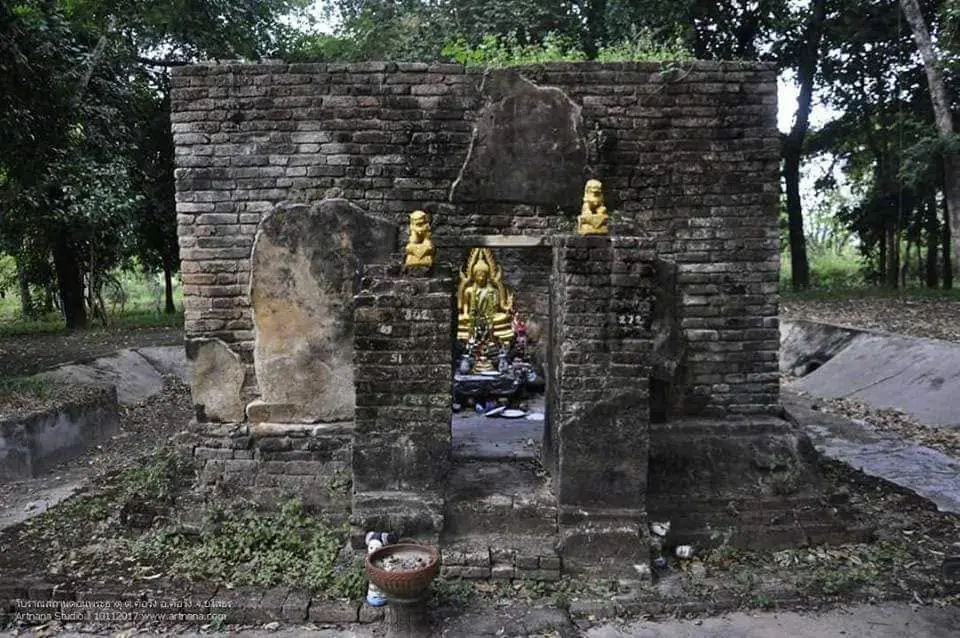
The archaeological remains at Don Phra That can be understood in 2 main areas. The first area is the front stupa or “that”, whose base rises clearly from the central structure. It was built of brick and plaster and still preserves the main form of the old sacred structure. The second area is located about 4-5 meters further inside. It contains the remains of a rectangular brick-and-plaster building with 4 walls and a front doorway. This building is believed to have been a structure used for enshrining sacred objects or for worship in the past.
The history of Don Phra That is preserved mainly through local memory. The site is said to have been known for about 200 years. Local stories tell that there were once old villages to the west of the site, including Ban Kaen and Ban Noi. These communities later moved away because of hardship, food shortage, and insecurity. What remained was the sacred site in the forest, together with stories that continued to be passed down by later generations.
According to local tradition, Don Phra That was once an old temple where a monk named Luang Pu Lao lived. In the past, villagers held annual merit-making activities around the sixth lunar month. These activities included giving alms, offering lunch to monks, and presenting Sangha offerings. After Luang Pu Lao passed away and the site no longer had continuous monastic care, Don Phra That became an abandoned temple and later a forest archaeological site. This story explains why local people still treat the place with respect.
In the fiscal year 2012, Kho Wang Subdistrict Administrative Organization coordinated with the Fine Arts Department Region 11 in Ubon Ratchathani to restore the old stupa while preserving as much of its original condition as possible. This restoration was important because it helped protect the fragile remains from further deterioration. At the same time, the restoration did not remove the old character of the place. Visitors can still sense the atmosphere of an old sacred site in a community forest.
Today, Don Phra That is cared for by Kho Wang Subdistrict Administrative Organization together with local communities. The site has been developed as a local historical and cultural attraction. Every year, around June or the seventh lunar month, the annual Don Phra That worship event is held. Kho Wang Subdistrict Administrative Organization joins with villagers from Ban Phi Phuan, Ban Lao Noi, and Ban Po to make merit, offer lunch to monks, present Sangha offerings, and build sand pagodas as part of the local tradition.
The annual worship event is one of the most important living traditions connected with Don Phra That. It brings people back to the old sacred site and renews the relationship between the community and the ancient remains. The merit-making ceremonies reflect Buddhist devotion, while the building of sand pagodas links the event with broader Isan and Thai traditions of creating merit through symbolic construction. Because of this annual activity, Don Phra That remains a living cultural site rather than a forgotten ruin.
The appeal of Don Phra That lies in its quietness and authenticity. It has not been transformed into a large commercial attraction. Its value comes from the old stupa, the brick structure, the forest setting, the stories of an abandoned temple, and the community that still gathers there every year. Travelers who enjoy meaningful local places will find Don Phra That more rewarding when they approach it slowly and respectfully.
The word “that” in Isan culture usually refers to a sacred stupa or reliquary structure. It is not simply an ordinary building. A “that” often marks a place of devotion and community memory. Although Don Phra That is smaller than major stupas in northeastern Thailand, it remains important to Ban Phi Phuan and nearby villages. It shows how sacred places in rural Isan can continue to hold meaning even after the original temple has become abandoned.
From a cultural landscape perspective, Don Phra That reflects the relationship between an abandoned temple, community forest, old settlements, and local ritual life. Many abandoned temple sites in northeastern Thailand are found on raised ground, near old settlement areas, and in places protected by trees or sacred groves. Don Phra That follows this pattern. Its forest setting helps preserve the atmosphere of the old site and makes the visit feel different from a typical temple visit.
Kho Wang District lies in the southern part of Yasothon Province and is connected to surrounding districts in Yasothon, Ubon Ratchathani, and Si Sa Ket. The area belongs to the cultural landscape of the Chi River basin and is shaped by agriculture, local temples, community forests, and village traditions. Visiting Don Phra That helps travelers see another side of Yasothon beyond well-known provincial festivals. It reveals a quieter layer of local heritage that remains important to people in the district.
Don Phra That is best suited for travelers interested in archaeology, abandoned temples, local Buddhist traditions, community forests, and rural Isan heritage. Visitors should not expect a large tourist facility. Instead, they should come prepared for a quiet cultural visit. The site rewards those who take time to observe the stupa, the building remains, the surrounding forest, and the relationship between the old sacred structures and the present community.
Because Don Phra That is an archaeological site inside a community forest, visitors should be careful and respectful. The old structures are fragile and can be affected by humidity, tree roots, soil conditions, and human movement. Visitors should stay on existing paths, avoid climbing on the old brickwork, avoid touching or moving bricks, and keep the site clean. These simple actions help preserve the site for future generations.
Getting There is most convenient by private car. From Maha Chana Chai District, travel toward Kho Wang District. Before reaching Ban Phi Phuan by about 1 km, turn right at the sign. The entrance route passes through the community forest for about 2-3 km before reaching Don Phra That. Travelers coming from Yasothon city can drive toward Kho Wang District through the most convenient route according to their starting point, then continue toward Ban Phi Phuan and follow local signs.
The final part of the route passes through a community forest, so visitors should use a vehicle in good condition. During the rainy season, the route may be affected by weather and ground conditions. Morning is the best time to visit because the temperature is more comfortable and the light is suitable for photography. Afternoon visits are also possible, but visitors should leave the forest area before evening for convenience and safety.
Visitors should prepare for a forest heritage visit. Comfortable walking shoes, drinking water, a hat, and sun protection are useful. Food should not be brought into the archaeological area unless necessary, and all waste must be taken out. Photography is allowed when done respectfully. Visitors should avoid standing on the stupa base or the old walls in order to protect the remains.
The annual worship event around June or the seventh lunar month is the most active time to visit. During this period, local people gather to make merit, offer food to monks, present Sangha offerings, and build sand pagodas. Visitors who come during the event can experience a living local tradition, but they should be mindful of the community’s religious activities. Photography should be discreet, and visitors should not block ceremonies or walk in front of monks and worshippers.
On ordinary days, Don Phra That is a quiet place for slow exploration. A visit may begin at the front stupa, continue to the rectangular brick structure inside, and then extend to the surrounding community forest. This route helps visitors imagine how the area may once have functioned as a temple or sacred site. It also shows that heritage in rural communities is not limited to active temples, but includes abandoned temples and sacred remains preserved by local memory.
Don Phra That can be combined with other attractions in Kho Wang District and nearby areas, such as Huai Phra Bang Reservoir, Wat Ban Lao Noi, Wat Ban Phi Phuan, and local community routes around Kho Wang. Travelers who wish to extend the route can continue to Phra That Ku Chan, Ban Song Pueai, Dong Mueang Toei, Wat Phra Phutthabat Yasothon, Phra That Kong Khao Noi, or Phaya Thaen Public Park in Yasothon city.
For families and student groups, Don Phra That is a useful learning site. It can be used to explain abandoned temples, local archaeology, community-based conservation, restoration by government agencies, and the role of local administrative organizations in protecting cultural heritage. The site also shows that conservation is not only the work of specialists, but also depends on local people who continue to value and care for the place.
For foreign travelers, Don Phra That is best understood as a small rural archaeological site with living local meaning. The word “that” can be explained as an Isan stupa or sacred reliquary structure. The annual worship event shows that the site is not just an old ruin in the forest, but a place still connected to community faith and social life. It is suitable for visitors who want to explore local culture beyond mainstream destinations.
Don Phra That also expands the image of Yasothon as a travel destination. The province is widely known for the Rocket Festival, but sites like Don Phra That reveal another layer of Yasothon: old stupas, abandoned temples, community forests, rural traditions, and local heritage. These smaller places help visitors understand the depth of Isan culture and the way sacred sites are preserved within village life.
A visit to Don Phra That should be based on respect. Visitors should respect the archaeological remains, the forest, and the local community. They should not litter, collect bricks or objects, light fires, or disturb the natural environment. Responsible behavior helps keep the site meaningful and sustainable for both local people and future travelers.
In summary, Don Phra That at Ban Phi Phuan is a valuable archaeological and cultural site in Kho Wang District, Yasothon Province. Its main features include an old stupa, a brick-and-plaster building structure, a forest setting, local stories about an abandoned temple and Luang Pu Lao, restoration by the Fine Arts Department Region 11, and an annual worship event organized by Kho Wang Subdistrict Administrative Organization and nearby communities. It is a meaningful destination for travelers seeking quiet heritage, local Buddhist traditions, and a deeper understanding of rural Isan culture.
| Name | Don Phra That / Don That Archaeological Site at Ban Phi Phuan |
| Location | Ban Phi Phuan Community Forest, Moo 5, Kho Wang Subdistrict, Kho Wang District, Yasothon Province |
| Address | Ban Phi Phuan, Moo 5, Kho Wang Subdistrict, Kho Wang District, Yasothon 35160, Thailand |
| Highlights | A forest archaeological site with an old stupa and brick-and-plaster building remains, reflecting an abandoned temple and the faith of Ban Phi Phuan community |
| History | The site has been known for about 200 years. Local tradition says it was once an old temple where a monk named Luang Pu Lao lived, before later becoming an abandoned sacred site. |
| Distinctive Features | The site has 2 main areas: the front stupa or “that”, and a rectangular brick-and-plaster structure inside with 4 walls and a front doorway. |
| Restoration | In fiscal year 2012, Kho Wang Subdistrict Administrative Organization coordinated with the Fine Arts Department Region 11 in Ubon Ratchathani to restore the old stupa while preserving its original condition as much as possible. |
| Traditions / Rituals | Around June or the seventh lunar month each year, Kho Wang Subdistrict Administrative Organization and villagers from Ban Phi Phuan, Ban Lao Noi, and Ban Po hold the annual Don Phra That worship event with merit-making, offering lunch to monks, Sangha offerings, and sand pagoda building. |
| Travel Information | From Maha Chana Chai District, travel toward Kho Wang District. About 1 km before Ban Phi Phuan, turn right at the sign and continue through the community forest for about 2-3 km to reach Don Phra That. |
| Current Status | Open as an archaeological site and community tourism attraction of Kho Wang District |
| Open Days | Daily |
| Opening Hours | 08.00 – 17.00 |
| Fees | No admission fee |
| Facilities | Community forest access route, local direction signs, archaeological walking area, and ceremonial space during the annual worship event |
| Main Areas / Zones | Front stupa or “that” Old stupa base Inner brick-and-plaster building remains Ban Phi Phuan community forest Annual worship and sand pagoda building area during the seventh lunar month |
| Caretaker | Kho Wang Subdistrict Administrative Organization together with Ban Phi Phuan, Ban Lao Noi, and Ban Po communities |
| Local Administrative Contact | Kho Wang Subdistrict Administrative Organization, Tel. 045-795067 |
| Nearby Tourist Attractions | 1. Wat Ban Phi Phuan, about 3 km 2. Wat Ban Lao Noi, about 6 km 3. Huai Phra Bang Reservoir, about 8 km 4. Kho Wang District Center, about 10 km 5. Wat Mahathat Ban Sai Mun, about 23 km 6. Wat Phra Phutthabat Yasothon, about 36 km 7. Phra That Ku Chan, about 41 km |
| Nearby Restaurants | 1. Local restaurants in Kho Wang District Center, about 10 km 2. Kai Yang Pa Win Restaurant, about 40 km, Tel. 062-8958375, 099-9269504 3. Kalam Ice Cream Cafe Kham Khuean Kaeo, about 45 km, Tel. 090-2575081 4. Krua Kan Eng Kham Khuean Kaeo, about 45 km, Tel. 094-8570422 5. KAO NA COFFEE Yasothon, about 46 km 6. Restaurants in Maha Chana Chai District Center, about 24 km |
| Nearby Accommodations | 1. Local accommodations in Kho Wang District, about 10 km 2. Thong Suphatchot Resort Maha Chana Chai, about 24 km, Tel. 085-7798857 3. Ban Ton Mai Pai Resort Maha Chana Chai, about 25 km 4. Ruen Lamool Hotel Kham Khuean Kaeo, about 45 km, Tel. 063-0236989 5. Chamchuri Resort Kham Khuean Kaeo, about 45 km, Tel. 080-2085723 6. Namthip Resort Kham Khuean Kaeo, about 46 km, Tel. 093-5317435 7. Sukhon Nakhon Hotel Kham Khuean Kaeo, about 46 km, Tel. 081-7254262 |
Frequently Asked Questions (FAQ)
Q: Where is Don Phra That located?
A: Don Phra That is located in Ban Phi Phuan Community Forest, Moo 5, Kho Wang Subdistrict, Kho Wang District, Yasothon Province.
Q: Why is Don Phra That important?
A: Don Phra That is an archaeological site known for about 200 years. It contains an old stupa and brick-and-plaster building remains that reflect an abandoned temple and local community faith.
Q: What are the opening hours of Don Phra That?
A: The site is open daily from 08.00 to 17.00.
Q: Is there an admission fee?
A: No. Visitors can enter and explore the site without an admission fee.
Q: When is the annual Don Phra That worship event held?
A: The annual worship event is held around June or the seventh lunar month. It includes merit-making, offering lunch to monks, Sangha offerings, and sand pagoda building.
Q: How can travelers get to Don Phra That?
A: From Maha Chana Chai District, travel toward Kho Wang District. About 1 km before Ban Phi Phuan, turn right at the sign and continue through the community forest for about 2-3 km.
Q: Who is Don Phra That suitable for?
A: It is suitable for travelers interested in archaeology, abandoned temples, community forests, local Buddhist traditions, and quiet cultural travel in Yasothon Province.
Q: How should visitors behave at Don Phra That?
A: Visitors should dress respectfully, stay on existing paths, avoid climbing on old structures, avoid touching or moving bricks, keep the area clean, and respect the community forest.
Tel : 045756985
 Tel : 045756985
 Category: ●Places of Worship
 Group: ●Other Sacred Sites
Last Update : 1 MonthAgo
 Last Update : 1 MonthAgo
 Click to Access the Navigation Map GPS
 Art, Culture and Heritage
 Historical Sites and Monuments(6)
 Landmarks and Memorials(1)
 Art, Craft Centres, Tradition(4)
 Museums(1)
 Historic Homes and Cities(1)
 Temple(22)
 Church(1)
Other Sacred Sites(9)
Church(1)
Other Sacred Sites(9)
 Research and Development
 Royal Project(2)
 Suburban Living
 Village, Community(3)
 Local Market(1)
 Nature and Wildlife
 National Parks and Marine Reserves(2)
 Mountain (Doi)(2)
 Dam, Reservoir, Lake(7)
 River, Canal(2)
 Bays and Beaches(1)
 Other natural attractions(2)
 Entertainment and Agricultural
 Farms, Parks and Ecotourism(1)


