
lovethailand home >Northeastern Travel Attractions >Yasothon Travel Attractions >Muang Yasothon >Samran > Cow-Krabue Market
TL;DR: Cow-Krabue Market is located at Ban Chiang Wang, Moo 11, Samran Subdistrict, Mueang Yasothon District, Yasothon Province, open Every Tuesday (market activity begins to build from Monday afternoon), hours From early morning to late morning on Tuesday.

Cow-Krabue Market
Open Days: Every Tuesday (market activity begins to build from Monday afternoon)
Opening Hours: From early morning to late morning on Tuesday
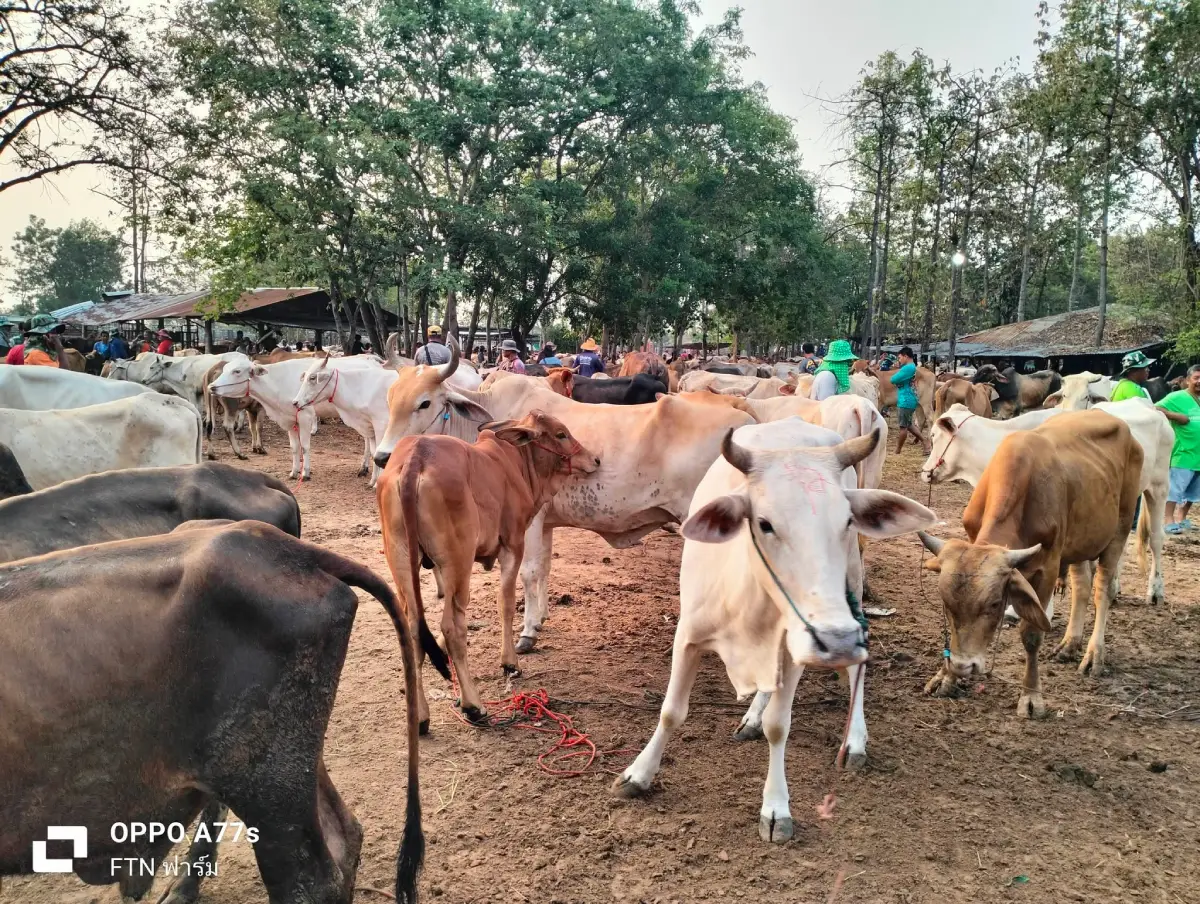
Ban Chiang Wang Cattle And Buffalo Market in Yasothon is one of the most important livestock markets in northeastern Thailand. Located at Ban Chiang Wang, Moo 11, Samran Subdistrict, Mueang Yasothon District, Yasothon Province, the market serves as a major trading point for cattle, buffaloes, farmers, livestock owners, traders, middlemen, buyers, and government officers involved in animal health and livestock movement control. This is not a typical tourist market. It is a real working livestock market where rural economy, animal trade, local knowledge, and Isan agricultural life meet in one place.
The market is a key part of Yasothon’s grassroots economy. Farmers and livestock owners bring cattle and buffaloes to sell, while traders and buyers inspect animals directly before making deals. The market brings together people from many areas, including local farmers, professional livestock traders, and buyers looking for animals to raise, trade, or distribute further. The result is a dense and energetic trading atmosphere that reflects how livestock remains an important economic asset for many rural households in Isan.
The main trading activity becomes active from Monday afternoon, when animals and transport vehicles begin entering the market area. The busiest period is early Tuesday morning, when buyers, sellers, cattle, buffaloes, trucks, and officials are all present in the same space. For visitors, this is the most meaningful time to see the market. The atmosphere is full of movement: animals are unloaded, buyers inspect body structure and condition, owners explain animal details, and prices are negotiated directly.
Ban Chiang Wang Cattle And Buffalo Market currently receives a large number of animals in each market session. On active market days, around 1,000 to 1,200 animals may enter the market, including Thai native cattle, Brahman-cross cattle, European-cross cattle, and meat buffaloes. This volume makes the market an important indicator of livestock demand, price movement, animal quality, and the overall trading situation in the region. For people studying rural economics or animal trade, the market provides a direct view of a living livestock supply chain.
The market’s importance comes from its direct trading structure. Farmers can bring animals to sell without relying only on distant negotiations, while buyers can examine the animals in person. They can look at body shape, muscle condition, legs, hooves, eyes, skin, age, movement, temperament, breed, and overall health. Sellers provide information about how the animal was raised, its feeding background, its age, and its suitability for further raising or trading. This makes the market a place where experience and judgment matter greatly.
In Isan livestock culture, the word “nai hoi” carries an important cultural meaning. It refers to cattle traders or drovers who historically moved cattle and buffaloes across regions for trade. Ban Chiang Wang Market continues the spirit of this livestock trading culture in a modern form. Instead of long-distance walking routes and carts, animals now arrive by pickup trucks and transport vehicles. Instead of informal movement alone, animal trading now involves permits, veterinary monitoring, and disease surveillance. Yet the core remains the same: people who understand animals meet, inspect, negotiate, and trade.
The early morning scene at the market is especially vivid. The sound of cattle and buffaloes mixes with vehicle engines, people calling to one another, and sellers explaining animal details to potential buyers. Some buyers walk carefully from one animal to another, comparing weight and form. Some negotiate prices while standing beside the animal. Some traders move quickly because the best opportunities may appear early. The market is fast, practical, and deeply connected to working rural life.
Cattle in the market vary by breed and purpose. Thai native cattle are valued for their ability to adapt to local conditions. Brahman-cross cattle are popular because of their strong body structure and suitability for beef production. European-cross cattle may be sought by buyers interested in improved meat qualities or breed development. Buffaloes are also traded in significant numbers, especially meat buffaloes and animals selected for continued raising. Each animal carries different value depending on its structure, condition, age, breed, and market demand.
Experienced buyers use practical knowledge when selecting animals. They observe the body frame, muscles, legs, hooves, eyes, skin, breathing, walking movement, and overall strength. Some examine teeth to estimate age. Others focus on breed, weight, and the animal’s potential for future growth. This knowledge is rarely written down in a simple formula. It is built from years of raising, buying, selling, and observing livestock. The market therefore functions as a living classroom of rural animal knowledge.
Animal health and biosecurity are important parts of the market. Because cattle and buffaloes from many places gather in one area, strict attention must be paid to disease prevention, movement control, and sanitation. Yasothon livestock officers, quarantine officers, market administrators, and related agencies monitor animal movement documents, observe signs of illness, and support disease prevention measures. These practices are essential because livestock disease can seriously affect farmer income and local economic stability.
Important disease-prevention concerns include monitoring for foot-and-mouth disease, lumpy skin disease, and other livestock diseases that may spread when animals from different sources are gathered together. Cleaning market areas, disinfecting risky zones, checking vehicles, and screening animal conditions help reduce potential outbreaks. The market is therefore not only a trading space but also a regulated livestock point where economic activity must be balanced with animal health responsibility.
Price fairness is another important issue. When many buyers and sellers gather in one location, prices become visible through real negotiation. Farmers can better understand current market demand, while buyers can compare animal quality directly. Government monitoring also helps strengthen confidence by encouraging transparent trading, disease control, and proper movement procedures. This makes Ban Chiang Wang Market important not only as a place of trade, but also as a platform for improving trust in the livestock economy.
For travelers, the market offers a rare view of real rural economic life. It is not designed mainly for sightseeing, which is exactly why it is valuable. Visitors can observe how cattle and buffaloes remain central to rural household income, how animal trading takes place, and how local knowledge is applied in a practical setting. This is a strong destination for those interested in agricultural life, livestock culture, documentary photography, rural economics, or authentic Isan market scenes.
Visitors should behave carefully because the market is a working livestock environment. Cattle and buffaloes are large animals and can react suddenly when stressed, crowded, or startled. Visitors should avoid standing too close, blocking animal paths, touching animals without permission, using flash photography near animals, or entering pens without approval. Staying aware of trucks, ropes, animals, and handlers is essential for safety.
Photography at the market can be rewarding, but it should be done respectfully. The best images come from observing the real atmosphere without interrupting trade. Visitors should ask before taking close photographs of people, avoid blocking buyers and sellers, and keep distance from animals being moved or examined. The market is a place of work for farmers and traders, so photography should never interfere with trading, animal handling, or official monitoring.
For families and students, the market can become a field classroom. Children and young people can learn that cattle and buffaloes are not only farm animals, but also valuable assets connected to household income, food systems, rural trade, and local identity. They can see how animal quality is evaluated, how farmers negotiate, and how public agencies help manage animal health. This type of learning is practical and much more vivid than classroom explanation alone.
For international travelers, Ban Chiang Wang Market is best understood as a real cattle and buffalo market in rural northeastern Thailand. It shows a side of Yasothon that is different from temples, festivals, and old-town attractions. Here, visitors see the agricultural economy in motion: livestock arriving by truck, buyers walking through pens, traders negotiating, and officials monitoring animal movement and health. It is an authentic experience for travelers who want to understand the working life of Isan.
The best time to visit is from early morning to late morning on Tuesday. This is when the market is most active and when visitors can see the largest concentration of animals, sellers, buyers, and transport vehicles. Activity begins to build from Monday afternoon, but Tuesday morning provides the clearest picture of the market. Visitors should arrive early because livestock markets often become active before sunrise and may become quieter earlier than ordinary tourist attractions.
Getting There is most convenient by private car. From Yasothon city, use Chaeng Sanit Road or Highway 23 toward Roi Et and travel to Samran Subdistrict in Mueang Yasothon District. The market is located in the Ban Chiang Wang area, Moo 11. A private car is the best option because the market is most active very early in the morning, and travelers can continue afterward to attractions in Yasothon city such as Phaya Thaen Public Park, the Toad Museum, Wat Mahathat, Ban Sing Tha Old Quarter, and Phra That Kong Khao Noi.
There is no admission fee for general visitors who come to observe the market atmosphere. Costs inside the market are related mainly to livestock trading, transport, and business arrangements between buyers, sellers, and market operators. General visitors should stay in appropriate areas, avoid entering animal pens without permission, and follow instructions from market staff or officials. This helps keep the visit safe and respectful.
The facilities at the market are designed mainly for livestock trade. They include truck and pickup parking areas, animal holding areas, animal movement routes, negotiation spaces, and monitoring areas for officials. General tourist facilities may be more limited than at leisure attractions. Visitors should prepare suitable shoes, drinking water, a hat, and protection from dust or mud, especially during the rainy season or on busy trading days.
After visiting the market, travelers can continue into Yasothon city for a balanced cultural route. Phaya Thaen Public Park and the Toad Museum introduce local folklore and contemporary city identity. Wat Mahathat and Phra That Kong Khao Noi offer religious and historical value. Ban Sing Tha Old Quarter provides old architecture and local history. Combining these places with Ban Chiang Wang Market gives visitors a broad view of Yasothon through livestock economy, rural life, history, religion, and local culture.
The market is also suitable for study groups interested in agriculture, livestock systems, rural economy, animal disease control, market management, and community-based trade. A real market setting allows learners to see animal movement, price negotiation, trader behavior, market infrastructure, and official monitoring at the same time. This makes Ban Chiang Wang Market a valuable living case study for anyone studying livestock and rural development.
In summary, Ban Chiang Wang Cattle And Buffalo Market is an important livestock trading center in Yasothon Province. Its main highlights are the large number of cattle and buffaloes traded each session, the active Tuesday morning market atmosphere, the presence of farmers and traders from many areas, direct animal inspection and price negotiation, and the role of government agencies in animal health and disease prevention. For visitors who want to understand Yasothon through its grassroots economy and real rural life, this market offers a strong and memorable experience.
| Name | Ban Chiang Wang Cattle And Buffalo Market |
| Type | Livestock Market, Cattle And Buffalo Trading Area, Rural Economy Learning Site, And Isan Livestock Culture Destination |
| Location | Ban Chiang Wang, Moo 11, Samran Subdistrict, Mueang Yasothon District, Yasothon Province |
| Address | Ban Chiang Wang, Moo 11, Samran Subdistrict, Mueang Yasothon District, Yasothon 35000, Thailand |
| Highlights | Large cattle and buffalo market, active Tuesday morning trading atmosphere, farmers, livestock owners, traders, buyers, direct negotiation, animal inspection, and real Isan livestock economy |
| Market Importance | A strategic livestock trading point in Yasothon Province that connects farmers, cattle and buffalo owners, buyers, traders, and government agencies involved in animal health and livestock movement control |
| Approximate Animal Volume | Around 1,000-1,200 animals per market session, including many types of beef cattle and meat buffaloes depending on market conditions |
| Animals Traded | Thai Native Cattle Brahman-Cross Cattle European-Cross Cattle Meat Buffaloes Large Livestock Connected With Farmer Livelihoods |
| Suitable Activities | Observing livestock market life, learning about cattle and buffalo selection, seeing price negotiation, photographing rural market scenes, studying grassroots economy, and learning about animal disease prevention measures |
| Travel Information | From Yasothon city, use Chaeng Sanit Road or Highway 23 toward Roi Et and travel to Samran Subdistrict. The market is located in the Ban Chiang Wang area, Moo 11. |
| Current Status | Open as a major livestock market in Yasothon Province, with monitoring of sanitation, animal movement, disease prevention, and fair trading by relevant government agencies |
| Open Days | Every Tuesday, with market activity beginning to build from Monday afternoon |
| Opening Hours / Recommended Visiting Hours | Early morning to late morning on Tuesday, when animal trading is most active and the market atmosphere is strongest |
| Fees | No admission fee for general observation. Trading, transport, and business-related costs follow the market and operator system. |
| Facilities | Truck and pickup parking areas, animal holding zones, animal movement paths, negotiation spaces, official monitoring areas, and basic food and drink stalls on market days |
| Main Areas / Zones | Cattle Holding Zone Buffalo Holding Zone Livestock Transport Vehicle Zone Price Negotiation And Trading Zone Animal Health And Movement Document Monitoring Zone Farmer And Trader Resting Zone Market-Day Food And Drink Stall Zone Truck And Pickup Entrance-Exit Zone |
| Caretaker / Related Agencies | Ban Chiang Wang Cattle And Buffalo Market administrators, Yasothon Provincial Livestock Office, Yasothon Animal Quarantine Station, Yasothon Provincial Agriculture And Cooperatives Office, Samran Subdistrict Municipality, and related government agencies |
| Contact Numbers | Yasothon Provincial Agriculture And Cooperatives Office, Tel. 0-4571-4074 Yasothon Provincial Livestock Office, Tel. 045-715412, 045-712231 Samran Subdistrict Municipality, Tel. 045-760030-2 |
| Nearby Tourist Attractions | 1. Yasothon Farmers Market / Yasothon Provincial Hall, about 8 km 2. Phaya Thaen Public Park, about 10 km 3. Toad Museum, about 10 km 4. Wat Mahathat Yasothon, about 11 km 5. Ban Sing Tha Old Quarter, about 12 km 6. Bung Noi Bung Yai Public Park, about 12 km 7. Phra That Kong Khao Noi, about 16 km 8. Phra That Ku Chan, about 38 km |
| Nearby Restaurants | 1. Chao Samran Restaurant, Ban Samran Yasothon, about 3 km, Tel. 087-0101955 2. Thai House Boat Noodles, about 8 km, Tel. 083-1015387 3. Ban Khun Ya Yasothon, about 10 km, Tel. 045-721141-2 4. Rasniyom Boat Noodles Yasothon, about 10 km, Tel. 098-7997269 5. Samrit Restaurant Yasothon, about 11 km, Tel. 086-2492508 6. Jib Fae Ban Nuea, about 11 km, Tel. 085-0241324 7. Rai Hug Kuk Yasothon, about 12 km, Tel. 099-2896554, 061-9501942 |
| Nearby Accommodations | 1. PK Garden Hotel, about 6 km, Tel. 045-711456 2. The Green Park Grand Hotel Yasothon, about 9 km, Tel. 045-714700-1 3. JP Emerald Hotel Yasothon, about 10 km, Tel. 045-714456 4. The Zen Hotel Yasothon, about 10 km, Tel. 045-711455 5. BM Grand Hotel Yasothon, about 11 km, Tel. 045-712333 6. RP City Hotel, about 11 km, Tel. 045-711648 7. Botanic Garden Hotel, about 12 km, Tel. 045-712064 |
Frequently Asked Questions (FAQ)
Q: Where is Ban Chiang Wang Cattle And Buffalo Market located?
A: The market is located at Ban Chiang Wang, Moo 11, Samran Subdistrict, Mueang Yasothon District, Yasothon Province, on the route from Yasothon city toward Roi Et.
Q: What day is Ban Chiang Wang Cattle And Buffalo Market open?
A: The main market day is Tuesday. Activity begins to build from Monday afternoon, and the busiest period is early Tuesday morning.
Q: What is the best time to visit the market?
A: The best time to visit is from early morning to late morning on Tuesday, when animal trading is most active and the market atmosphere is strongest.
Q: Is there an admission fee?
A: There is no admission fee for general visitors who come to observe the market atmosphere. Trading and transport costs apply only to livestock business activities.
Q: How many cattle and buffaloes are usually traded at the market?
A: Around 1,000-1,200 animals may enter the market in each active session, including Thai native cattle, Brahman-cross cattle, European-cross cattle, and meat buffaloes.
Q: Can general travelers visit the market?
A: Yes. General travelers can visit, but they should stay in appropriate areas, avoid standing too close to animals, avoid blocking animal and vehicle paths, and follow instructions from market staff or officials.
Q: Who is this market suitable for?
A: It is suitable for visitors interested in Isan livestock culture, grassroots economy, live animal trading, documentary photography, agricultural study visits, and authentic rural market life in Yasothon.
Q: What nearby attractions can be visited on the same trip?
A: Nearby attractions include Phaya Thaen Public Park, the Toad Museum, Wat Mahathat Yasothon, Ban Sing Tha Old Quarter, Bung Noi Bung Yai Public Park, and Phra That Kong Khao Noi.
 Category: ●Suburban Living
 Group: ●Local Market
Last Update : 1 MonthAgo
 Last Update : 1 MonthAgo
 Click to Access the Navigation Map GPS
 Art, Culture and Heritage
 Historical Sites and Monuments(6)
 Landmarks and Memorials(1)
 Art, Craft Centres, Tradition(4)
 Museums(1)
 Historic Homes and Cities(1)
 Places of Worship
 Temple(22)
 Church(1)
 Other Sacred Sites(9)
 Research and Development
 Royal Project(2)
 Village, Community(3)
Local Market(1)
Village, Community(3)
Local Market(1)
 Nature and Wildlife
 National Parks and Marine Reserves(2)
 Mountain (Doi)(2)
 Dam, Reservoir, Lake(7)
 River, Canal(2)
 Bays and Beaches(1)
 Other natural attractions(2)
 Entertainment and Agricultural
 Farms, Parks and Ecotourism(1)


