
lovethailand home >Northeastern Travel Attractions >Yasothon Travel Attractions >Muang Yasothon >Tat Thong > Ban Tat Thong Archaeological Site
TL;DR: Ban Tat Thong Archaeological Site is located at Ban Tat Thong, Tat Thong Subdistrict, Mueang Yasothon District, Yasothon Province, open Daily, hours Open 24 Hours.
Ban Tat Thong Archaeological Site
Open Days: Daily
Opening Hours: Open 24 Hours
Ban Tat Thong Archaeological Site in Yasothon Province is an ancient settlement in Tat Thong Subdistrict, Mueang Yasothon District. The site preserves traces of a large oval-shaped ancient town with earthen mounds, a surrounding moat and embankment, prehistoric burial evidence, painted pottery fragments, Dvaravati-style boundary stones, and important religious monuments such as Phra That Tat Thong, also known locally as Phra That Kong Khao Noi. The site is open daily, has no admission fee, and is ideal for travelers interested in archaeology, local history, Buddhist heritage, and the cultural landscape of northeastern Thailand.
Ban Tat Thong Archaeological Site in Yasothon Province is one of the most meaningful historical landscapes in the lower northeastern region of Thailand. Located at Ban Tat Thong, Tat Thong Subdistrict, Mueang Yasothon District, the site represents a long sequence of human settlement from the late prehistoric period through the Dvaravati period, Khmer cultural influence, and later Tai-Lao communities. It is not simply a place to view old ruins; it is a living cultural landscape where ancient earthworks, Buddhist monuments, agricultural land, village life, and local memory continue to exist together.
The most distinctive feature of Ban Tat Thong is the form of the ancient settlement itself. The old town appears as a large earthen mound about 3 meters high, surrounded by a single layer of moat and embankment. Its overall plan is oval and aligned from the northeast toward the southwest. The ancient town measures approximately 500 meters wide and 650 meters long. These physical features show that Ban Tat Thong was not a casual settlement but a community with organized land use, water management, territorial boundaries, and a strong relationship with the agricultural environment around it.
Ban Tat Thong is around 2,500 years old and is an important archaeological site for understanding early communities in the lower Chi River region. Evidence found in the area includes extended supine burials, pottery fragments with painted designs on the rim, and earthenware forms related to the wider cultural zone of Thung Kula Rong Hai. These findings reveal a settled farming community that produced and used pottery, organized daily life around agriculture, and developed ritual practices connected with death and the afterlife. The burial evidence is especially important because it shows that this was not merely a place of habitation, but a community with social structure and belief systems.
During the Dvaravati period, Ban Tat Thong became part of a wider Buddhist cultural network in northeastern Thailand. A large number of boundary stones, or sema stones, have been found in the area. These stones differ in style from those found in early and middle Chi River communities in provinces such as Chaiyaphum, Khon Kaen, Maha Sarakham, and Kalasin. This variation makes Ban Tat Thong significant because it helps demonstrate that Dvaravati culture in the Northeast was not uniform. Each local community adapted Buddhist symbols, sacred boundaries, and artistic forms according to its own environment, settlement pattern, and cultural connections.
The site also carries evidence related to Khmer-period influence. Local historical information refers to an inscription associated with King Isanavarman II, dating to around the 15th Buddhist century. This connection places Ban Tat Thong within a broader regional network of politics, religion, and cultural exchange in the lower northeastern region. The presence of evidence from multiple periods shows that Ban Tat Thong was not abandoned after one cultural phase. Instead, the site continued to be occupied, reinterpreted, and reused by later communities, making it a layered historical landscape rather than a single-period ruin.
Today, the ancient town area has been divided into two sections because Highway 23 passes through it. Houses, vegetable gardens, rice fields, and modern community spaces occupy much of the surrounding landscape. Some parts of the ancient moat and embankment have changed through local land use, and the western moat has been adapted as a drainage canal. Even with these changes, the site still preserves the essential form of the ancient town and provides valuable insight into how archaeological heritage and contemporary community life can overlap in the same place.
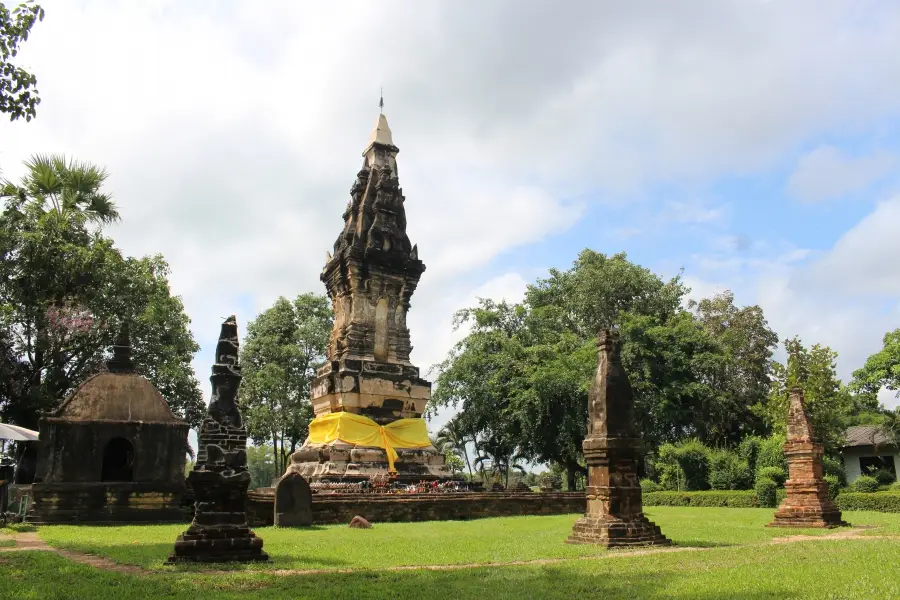
One of the most important monuments associated with Ban Tat Thong is Phra That Tat Thong, also known as Phra That That Thong, Phra That Kong Khao Noi, or the Kong Khao Noi Stupa. It stands northeast of the ancient town, about 300 meters from the eastern moat. The monument is a registered ancient site under the Fine Arts Department and is maintained in connection with Tat Thong Municipality. Architecturally, the stupa reflects Lan Xang influence commonly found in northeastern Thailand. It is built of brick and plaster, with a square body, niches on all four sides, a lotus-bud-like upper section, and a low surrounding boundary wall.
The name Phra That Tat Thong is linked to a local narrative connected with the Urangadhatu legend and the restoration of Phra That Phanom. According to the story, people from the Rattanaburi area gathered valuables, sacred objects, silver, and gold to be enshrined in Phra That Phanom. When they reached Ban Tat Thong, they learned that the restoration work had already been completed. Rather than continuing the journey, they decided to build a stupa at Ban Tat Thong and enshrine the valuables there. A golden tray used in the ritual became part of the story, giving rise to the name Phra That That Thong or Phra That Tat Thong.
The later local name Kong Khao Noi is connected with one of the best-known moral folktales in northeastern Thailand. The story tells of a young farmer who was working in the fields and waiting for his mother to bring him food. When she arrived late with a small rice container, he became overwhelmed by hunger and anger. Believing that the food would not be enough, he attacked his mother. After eating, he realized that the rice was still not finished and was filled with remorse. He then built a stupa as an act of atonement. This story has made Phra That Kong Khao Noi not only a religious monument, but also a moral landmark teaching gratitude, patience, and emotional restraint.
Around Phra That Tat Thong, visitors can see groups of red sandstone sema stones. Some stones have raised central ridges and forms associated with Dvaravati Buddhist art. These stones indicate that the area had religious significance before the later stupa became the main landmark. Sema stones functioned as sacred boundary markers in Buddhist ritual spaces, so their presence near the stupa and within the broader settlement helps connect several layers of history: the ancient town, early Buddhist practice, Dvaravati sacred space, Lan Xang-style architecture, and the later religious traditions of the Tai-Lao community.
Another important place for understanding the site is the Ban Tat Thong Folk Museum, located near Phra That Kong Khao Noi. The museum presents local history, community wisdom, and the cultural heritage of Ban Tat Thong. It displays archaeological objects and cultural materials found in the area, including bronze tools, pottery, and traditional implements. Visiting the museum alongside the archaeological landscape allows travelers to understand both the physical site and the objects that once belonged to the people who lived in this ancient community.
For travelers, Ban Tat Thong is best appreciated as a learning destination rather than a quick photo stop. It is suitable for students, families, researchers, cultural travelers, and anyone interested in seeing how a provincial town like Yasothon has deep roots beyond its modern identity. Many visitors know Yasothon for the famous Rocket Festival, but Ban Tat Thong shows another side of the province: a long history of settlement, agriculture, Buddhist practice, local legend, and cultural continuity.
A meaningful visit can begin with the ancient town area, where travelers observe the earthen mound, former moat, embankment traces, and the surrounding community landscape. The route can then continue to Phra That Kong Khao Noi to study the Lan Xang-style stupa, sema stones, and local legend. After that, the Ban Tat Thong Folk Museum adds context through objects and community stories. This sequence helps visitors understand the site from the larger settlement landscape to the religious monument and then to the material culture of the local people.
The surrounding atmosphere remains quiet and rural. Rice fields, small roads, community houses, and local agricultural areas shape the character of the site. Early morning and late afternoon are especially pleasant for walking, photography, and observing the relationship between the stupa, the old settlement, and the present-day village. Visitors who want to explore the site carefully should allow at least 1 to 2 hours for reading information, viewing the landscape, and connecting the archaeological evidence with the living community around it.
Getting There from Yasothon city center is straightforward. Take Highway 23 toward Tat Thong Subdistrict or Kham Khuean Kaeo District for about 7–9 kilometers, then turn into Ban Tat Thong for about 1 kilometer. The route is suitable for private cars, rental cars, and local hired vehicles. Travelers without their own transport can start from Mueang Yasothon and hire a local vehicle to Tat Thong. Because the site is close to the city, it can easily be combined with other Yasothon attractions such as Phaya Thaen Public Park, the Toad Museum, Wat Mahathat, and the old Ban Sing Tha community.
Visitors should treat Ban Tat Thong as both an archaeological site and a living community. Do not climb on ancient structures, move stones or archaeological fragments, damage sema stones, leave rubbish, or disturb local residents. Respectful travel helps protect the site and supports the community that continues to live with this heritage. Ban Tat Thong is valuable precisely because it has not been separated from everyday life; it remains a place where history, belief, farming, and local identity are still connected.
Ban Tat Thong Archaeological Site is therefore more than an old settlement in Yasothon. It brings together archaeology, Buddhist history, Lan Xang architecture, local folklore, rural landscape, and community memory. For foreign travelers and Thai visitors alike, the site offers a deeper understanding of Yasothon beyond its better-known festivals. It is a living classroom of northeastern Thai history and one of the most rewarding cultural stops for anyone who wants to understand how ancient communities shaped the identity of the region.
| Name | Ban Tat Thong Archaeological Site |
| Related Names | Tat Thong Ancient Community, Ban Tat Thong Ancient Town, Phra That Tat Thong, Phra That That Thong, Phra That Kong Khao Noi |
| Location | Ban Tat Thong, Tat Thong Subdistrict, Mueang Yasothon District, Yasothon Province |
| Address | Tat Thong Subdistrict, Mueang Yasothon District, Yasothon Province 35000, Thailand |
| Coordinates | Tat Thong Ancient Community: 15.7597792165, 104.203552625 Phra That Tat Thong: 15.763606, 104.207092 |
| Highlights | Oval-shaped ancient town with an earthen mound, surrounding moat and embankment, prehistoric agricultural settlement evidence, sema stones, and important Buddhist monuments |
| History | Late prehistoric period through the Dvaravati period, Khmer cultural influence, and later Tai-Lao settlement. Phra That Tat Thong dates archaeologically to around the 24th Buddhist century. |
| Key Evidence | Supine burials, painted pottery fragments, red sandstone sema stones, Phra That Tat Thong, Phra That Ban Sadao, and archaeological objects related to the Ban Tat Thong community |
| Name Origin | The name Phra That Tat Thong is linked to a story about a golden tray used to hold valuables intended for enshrinement at Phra That Phanom. The local name Kong Khao Noi is connected with a well-known northeastern Thai moral folktale. |
| Distinctive Features | Ancient earthen mound about 3 meters high, one surrounding moat and embankment, approximately 500 meters wide and 650 meters long, now divided by Highway 23 |
| Main Areas / Zones | 1. Ban Tat Thong Ancient Town And Moat Area 2. Present-Day Ban Tat Thong Community And Agricultural Landscape 3. Phra That Tat Thong Or Phra That Kong Khao Noi 4. Sema Stone And Buddhist Sacred Area 5. Ban Tat Thong Folk Museum 6. Phra That Ban Sadao And Related Local Heritage Area |
| Caretaker | Fine Arts Department And Tat Thong Municipality |
| Travel Information | From Yasothon city center, take Highway 23 toward Tat Thong Subdistrict or Kham Khuean Kaeo District for about 7–9 km, then turn into Ban Tat Thong for about 1 km. The route is suitable for private cars, rental cars, and local hired vehicles. |
| Current Status | Open to visitors as an archaeological and historical attraction of Tat Thong Subdistrict |
| Open Days | Daily |
| Opening Hours | Open 24 Hours |
| Fees | No Admission Fee |
| Facilities | Parking area near Phra That Tat Thong, local community area, nearby food and drink shops, and road access from Highway 23 |
| Main Contact Number | Tat Thong Municipality Tel. 045-756609 Tourism Promotion Officer Tel. 085-3084427 |
| Official Website / Official Page | Tat Thong Municipality Website: www.thadthong.go.th |
| Nearby Tourist Attractions | 1. Phra That Kong Khao Noi / Phra That Tat Thong, about 1 km 2. Ban Tat Thong Folk Museum, about 1 km 3. Phaya Thaen Public Park And Toad Museum, about 9 km 4. Wat Mahathat Yasothon, about 9 km 5. Ban Sing Tha Old Community, about 9 km 6. Phaya Thaen Public Park, about 9 km |
| Nearby Restaurants | 1. ChomSuan Restaurant, about 500 m, Tel. 083-913-0642 2. Tat Thong Stir-Fried Restaurant (Je Paula), about 600 m, Tel. 097-339-7272 3. Rim Sa Coffee Shop Phra That Kong Khao Noi, about 1 km, Tel. 095-867-5915 4. MORE Chafé PTT Tat Thong, about 1 km, Tel. 065-684-7899 5. Café Amazon - DD366 PTT Kriangsak Yasothon Petroleum, about 1 km |
| Nearby Accommodations | 1. Kind Giant Elephant Hotel, about 7 km, Tel. 045-711-123 2. Yasothon Orchid Garden, about 7 km, Tel. 045-712-212 3. B.M. Grand Hotel, about 8 km, Tel. 045-712-333 4. The Green Park Grand Hotel Yasothon, about 9 km, Tel. 045-714-700-1 5. JP Emerald Hotel, about 9 km, Tel. 045-714-455, 045-714-456 6. The Zen Hotel, about 7 km, Tel. 045-711-455 |
Frequently Asked Questions (FAQ)
Q: Where is Ban Tat Thong Archaeological Site located?
A: It is located at Ban Tat Thong, Tat Thong Subdistrict, Mueang Yasothon District, Yasothon Province, about 7–9 km from Yasothon city center via Highway 23.
Q: Why is Ban Tat Thong Archaeological Site important?
A: It is an ancient town and agricultural settlement dating back about 2,500 years. The site preserves burial evidence, painted pottery, sema stones, and Buddhist monuments that show continuous occupation from the late prehistoric period through later historical periods.
Q: What are the opening days and hours?
A: The site is open daily and accessible 24 hours. Morning and late afternoon are the most comfortable times for walking, photography, and cultural exploration.
Q: Is there an admission fee?
A: No. Visitors can explore the ancient settlement area, Phra That Tat Thong, and the surrounding community landscape without an admission fee.
Q: What should visitors see at Ban Tat Thong?
A: Key places include the ancient town area and moat traces, Phra That Kong Khao Noi or Phra That Tat Thong, sema stone groups, Ban Tat Thong Folk Museum, and the surrounding community landscape.
Q: How can travelers get there from Yasothon city?
A: Take Highway 23 toward Tat Thong Subdistrict or Kham Khuean Kaeo District for about 7–9 km, then turn into Ban Tat Thong for about 1 km. Private cars, rental cars, and local hired vehicles are suitable options.
Q: Who is this destination suitable for?
A: It is suitable for history lovers, archaeology enthusiasts, students, families, researchers, cultural travelers, and anyone who wants to understand Yasothon beyond its modern festivals.
Q: What nearby attractions can be combined with this visit?
A: Travelers can combine the visit with Phra That Kong Khao Noi, Ban Tat Thong Folk Museum, Phaya Thaen Public Park, the Toad Museum, Wat Mahathat, and the Ban Sing Tha old community.
 Category: ●Art, Culture and Heritage
 Group: ●Historical Sites and Monuments
Last Update : 2 MonthAgo
 Last Update : 2 MonthAgo
 Click to Access the Navigation Map GPS
Ban Tat Thong Archaeological Site Map
 Historical Sites and Monuments(6)
 Landmarks and Memorials(1)
 Art, Craft Centres, Tradition(4)
 Museums(1)
 Historic Homes and Cities(1)
 Places of Worship
 Temple(22)
 Church(1)
 Other Sacred Sites(9)
 Research and Development
 Royal Project(2)
 Suburban Living
 Village, Community(3)
 Local Market(1)
 Nature and Wildlife
 National Parks and Marine Reserves(2)
 Mountain (Doi)(2)
 Dam, Reservoir, Lake(7)
 River, Canal(2)
 Bays and Beaches(1)
 Other natural attractions(2)
 Entertainment and Agricultural
 Farms, Parks and Ecotourism(1)


