
lovethailand home >Northeastern Travel Attractions >Yasothon Travel Attractions >Loeng Nok Tha >Sawat > Dong Por and Dong Bang-I National Forest Reserve
TL;DR: Dong Por and Dong Bang-I National Forest Reserve is located at Loeng Nok Tha District, Yasothon Province, connected with the Phu Phan mountain range and Bung Kha Subdistrict community routes, open Daily, hours 06.00 – 18.00.
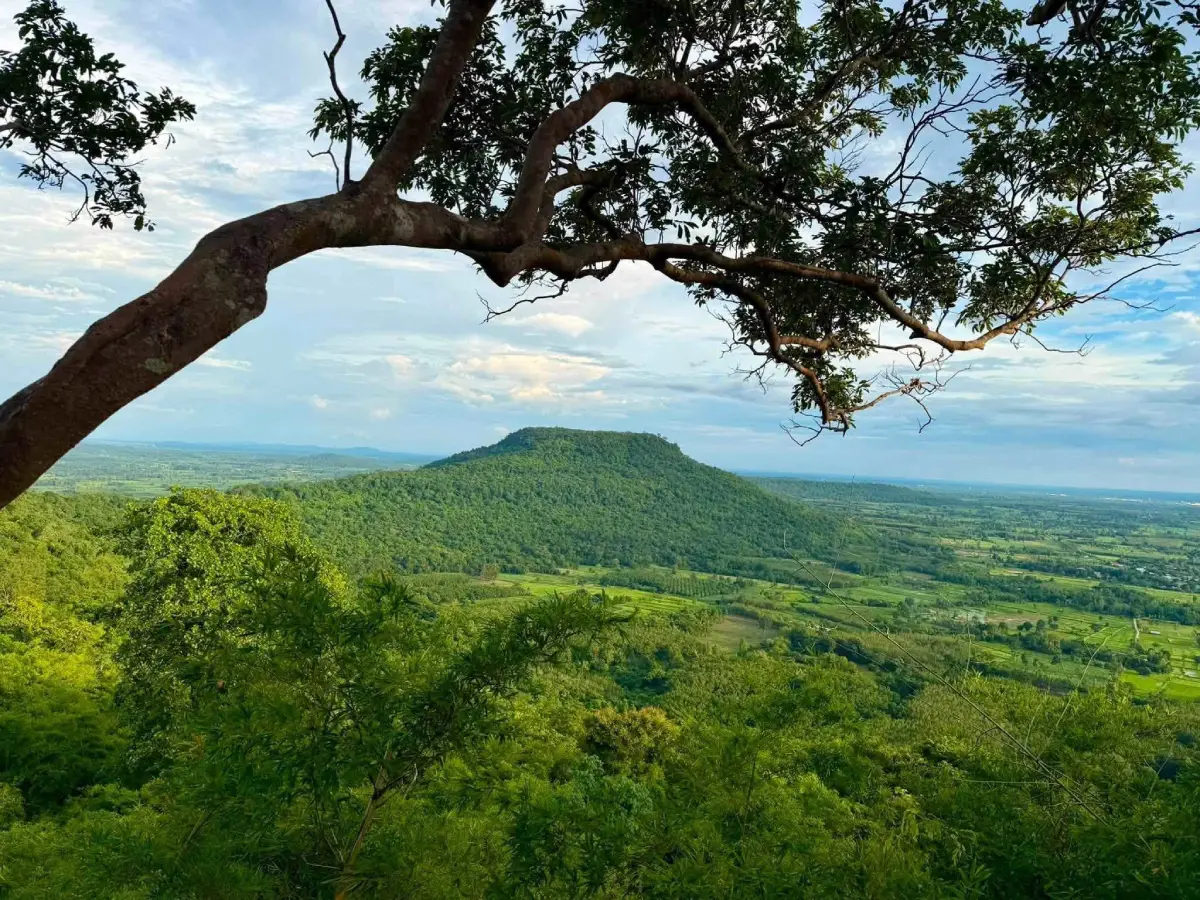
Dong Por and Dong Bang-I National Forest Reserve
Open Days: Daily
Opening Hours: 06.00 – 18.00
Dong Por And Dong Bang-I National Forest Reserve in Yasothon Province is an important forest landscape in Loeng Nok Tha District and the Phu Phan mountain range area. It is a large natural forest reserve connected with dry evergreen forest, mixed deciduous forest, upland valleys, local forest foods, medicinal plants, spice plants, and community-based conservation. The landscape is especially distinctive because its terrain forms a curved valley that resembles a ring, with the Phu Phan mountain range surrounding the northern and eastern sides. This gives the area a stronger upland forest character than many of the flatter landscapes commonly associated with Yasothon.
The reserve is known locally as Pa Dong Por and Dong Bang-I. Older tourism information describes the area as containing about 139,000 rai of relatively complete forest, representing about 48 percent of the total forest reserve area. This makes it one of the most significant forest landscapes connected with Yasothon. The forest is characterized by dry evergreen forest and mixed deciduous forest, both of which are important ecological systems in northeastern Thailand. These forest types support trees, shrubs, vines, herbs, forest-floor plants, insects, small animals, and seasonal natural resources that are closely connected with local livelihoods.
The most culturally significant plants associated with this forest are reo, also known locally as mak naeng, and cardamom. Both grow naturally on the forest floor in fertile and shaded forest conditions. Their dried fruits are aromatic and have long been used as spices and traditional herbal ingredients. In the past, Yasothon was one of the towns connected with the sending of reo and cardamom to the central authorities. This historical association makes Dong Por and Dong Bang-I more than a natural forest. It is also part of the history of forest products, spice trade, and local medicinal knowledge.
The dry evergreen forest in this area has a different character from open dry dipterocarp forest. It retains more moisture in some parts, supports denser vegetation, and allows important forest-floor plants to grow under shade. Mixed deciduous forest adds seasonal variety, with trees shedding leaves during the dry season and renewing growth when the rains return. Together, these forest types create a layered ecosystem that changes through the year. Visitors who observe carefully can see how light, soil moisture, leaf litter, and shade affect the plants growing on the forest floor.
The ring-like valley landform gives the forest a strong landscape identity. The Phu Phan mountain range surrounding the northern and eastern sides influences wind, moisture, drainage, and local ecological conditions. This terrain makes the area different from the lowland rice-field landscapes found in many parts of Yasothon. Traveling through Loeng Nok Tha and nearby community routes, visitors can experience a side of Yasothon shaped by mountains, forest edges, upland valleys, and community settlements connected with forest resources.
Dong Por and Dong Bang-I also function as a natural resource base for communities around the forest. The forest supports water retention, soil protection, local food resources, medicinal plants, and seasonal ecological cycles. During the rainy season, forest-floor plants become more active, mushrooms and herbs appear, and the forest becomes greener and more humid. During the dry season, deciduous trees shed leaves, the forest floor becomes drier, and wildfire prevention becomes especially important. This seasonal rhythm is central to the way local people understand and use the forest.
Reo and cardamom explain the relationship between forest ecology and everyday culture. These plants are not ordinary crops grown in open fields. They are forest-floor plants that depend on shade, humidity, and healthy natural conditions. Their fragrance and medicinal value connect the forest with food, traditional medicine, and historical trade. Protecting the forest therefore also means protecting the natural conditions that allow such plants to survive and continue as part of local knowledge.
The forest has value as a learning area for visitors interested in Isan ecology. Dry evergreen forest shows how a forest can remain shaded and relatively moist even in a region with a strong dry season. Mixed deciduous forest shows how trees and understory plants adapt to seasonal change. The presence of spice plants and medicinal plants shows how local communities have long recognized useful species and linked them with food, medicine, and trade. This makes the reserve meaningful for nature education, community studies, and cultural landscape interpretation.
Dong Por and Dong Bang-I is not a commercial tourist park with full leisure facilities. It is a national forest reserve and should be approached as a protected natural area. Visitors should use appropriate community routes, avoid entering deep forest zones without guidance, and respect both legal regulations and local community rules. This is especially important because the forest still supports ecological functions, local livelihoods, and conservation work. A good visit focuses on learning, observation, and respect rather than extraction or disturbance.
Current forest management in the area includes wildfire prevention, firebreak work, forest patrols, and monitoring against encroachment. These activities are important because dry-season leaf litter and forest-floor material can become fuel for forest fire. If wildfire spreads, it can damage young trees, forest-floor plants, medicinal herbs, reo, cardamom, small animals, and soil conditions. It can also affect air quality and nearby communities. The protection of this forest is therefore both an environmental and community responsibility.
Firebreak work is one of the most practical conservation activities in the area. It helps reduce the risk of fire spreading across the forest during the dry season. Local forestry units, natural resource agencies, local administrations, and communities around the forest all have roles in protecting the area. These efforts show that forest conservation is not only about preserving trees, but also about protecting food resources, cultural resources, climate resilience, and the wellbeing of local people.
The forest can be connected with several meaningful travel routes in Loeng Nok Tha District. Nearby community and nature destinations include the Ban Nomklao Royal Folk Arts and Crafts Project, Huai Sa Baek Reservoir, Phu Sung, and Phu Tham Phra. This makes the area suitable for travelers who want to understand Yasothon beyond the city center. A route through this area can combine forest ecology, community development, royal-initiative livelihood work, mountain scenery, reservoir landscapes, and Buddhist cave heritage.
Ban Nomklao is an especially important nearby community because it represents the idea of people living with the forest. The community is connected with livelihood development, forest restoration, sericulture, and local craft activities. Visiting Dong Por and Dong Bang-I together with Ban Nomklao helps travelers understand that forest conservation in rural Thailand can be connected with community livelihoods. When people have work, income, and a sense of responsibility toward local resources, conservation becomes more practical and meaningful.
Huai Sa Baek Reservoir adds another layer to the route. The reservoir is an important water resource in Bung Kha Subdistrict, surrounded by mountain scenery and used for irrigation and local activities. When viewed together with the forest landscape, it shows the relationship between mountains, forest, water, agriculture, and community life. Healthy forests support water retention and slope stability, while reservoirs support farming, local recreation, and water management.
Phu Tham Phra is another important destination in the broader Loeng Nok Tha area. It is known for caves, Buddha images, forested surroundings, and a calm religious atmosphere. Combining the forest reserve with Phu Tham Phra allows visitors to experience both nature and faith within the mountain landscapes of Yasothon. This route is especially suitable for travelers who want to see a quieter and more ecological side of the province.
The recommended visiting time is from morning to late afternoon, between 06.00 and 18.00. Daylight is important because this is a forest landscape rather than an urban tourist site. The rainy season is suitable for learning about forest-floor plants, humidity, and ecological renewal. The late rainy season and cool season are pleasant for travel and nature observation. The dry season is useful for understanding deciduous forest adaptation and fire prevention work, but visitors should be especially careful with fire risk.
Getting There is most convenient by private car. From Loeng Nok Tha District, travelers can continue toward Bung Kha Subdistrict, Ban Huai Sa Baek, Ban Nomklao, and community routes connected with Dong Por and Dong Bang-I Forest. Some routes pass rural and upland areas, so travelers should check road conditions, weather, and local access points before travel. Groups planning a study visit should coordinate with Bung Kha Subdistrict Municipality, local forestry units, or the Yasothon Provincial Office of Natural Resources and Environment in advance.
Visitors should dress for natural forest conditions. Closed shoes or walking shoes are recommended. Long sleeves and long trousers help protect against branches and insects. Drinking water, a hat, mosquito repellent, a personal trash bag, and a charged phone are useful. Visitors unfamiliar with the area should not walk into deep forest routes alone. Local guidance is important for safety and for avoiding disturbance to sensitive forest areas.
There is no admission fee for general nature visits along appropriate community routes. However, because this is a national forest reserve, visitors must respect forest laws and local rules. They should not cut trees, hunt animals, collect forest plants without permission, light fires, litter, or damage young plants. The purpose of visiting should be learning and appreciation, not removing resources from the forest.
For photography, Dong Por and Dong Bang-I offers subtle but meaningful subjects: mountain forest scenery, dry evergreen forest, mixed deciduous forest, shaded understory plants, reo and cardamom habitats, community routes, forest edges, nearby reservoirs, and conservation activities. Photographers should avoid moving plants or disturbing the forest floor for composition. They should also ask permission before photographing local people or community work closely.
For families, the forest can serve as an outdoor classroom. Children can learn that a forest contains more than large trees. It also contains medicinal plants, spice plants, insects, moisture, soil, water, wildlife, and the knowledge of communities that live around it. A family visit should emphasize observation, respect, and simple conservation habits: do not litter, do not light fires, do not collect plants, and stay on appropriate routes.
For international travelers, Dong Por and Dong Bang-I National Forest Reserve shows a deeper natural side of Yasothon. The province is often known for its Rocket Festival, temples, and old-town heritage, but this forest reveals a landscape of mountains, forest products, spice plants, medicinal knowledge, and community conservation. Reo and cardamom help explain the link between forest ecology, food, medicine, and historical trade. This makes the forest meaningful for travelers interested in ecology, ethnobotany, rural life, and conservation.
The importance of Dong Por and Dong Bang-I today lies in keeping the remaining forest healthy. The forest supports plant diversity, natural humidity, local resources, community knowledge, and climate resilience. Protecting it helps maintain the conditions needed for forest-floor plants, medicinal herbs, and spice plants to survive. It also protects water-related ecological functions and reduces the risk of environmental degradation around upland communities.
In summary, Dong Por And Dong Bang-I National Forest Reserve is a valuable natural forest landscape in Yasothon Province. Its highlights include the ring-shaped valley terrain, the Phu Phan mountain range, dry evergreen forest, mixed deciduous forest, reo or mak naeng, cardamom, forest-floor plants, community routes, wildfire prevention work, and nearby destinations such as Ban Nomklao, Huai Sa Baek Reservoir, Phu Sung, and Phu Tham Phra. It is suitable for visitors who want to understand Yasothon through forest ecology, local spice plants, medicinal knowledge, community conservation, and the mountain landscapes of Loeng Nok Tha District.
| Name | Dong Por And Dong Bang-I National Forest Reserve / Pa Dong Por Dong Bang-I, Yasothon |
| Type | National Forest Reserve, Natural Forest Area, Dry Evergreen Forest And Mixed Deciduous Forest Learning Site |
| Location | Loeng Nok Tha District, Yasothon Province, connected with the Phu Phan mountain range and Bung Kha Subdistrict community routes |
| Address Summary | Dong Por And Dong Bang-I National Forest Reserve Area, Loeng Nok Tha District, Yasothon 35120, Thailand |
| Highlights | Ring-shaped valley terrain, Phu Phan mountain range, dry evergreen forest, mixed deciduous forest, reo or mak naeng, cardamom, and forest-floor medicinal and spice plants |
| Landscape Characteristics | A curved valley resembling a ring, with the Phu Phan mountain range surrounding the northern and eastern sides, including upland forest, forest-edge communities, and community access routes |
| Forest Characteristics | Dry Evergreen Forest Mixed Deciduous Forest Forest-Floor Medicinal Plants Phu Phan Upland Forest Landscape Wildfire Monitoring And Conservation Area |
| Area Information | Older tourism information describes the forest as having about 139,000 rai of relatively complete forest, or about 48 percent of the total reserve area. |
| Important Plants | Reo Or Mak Naeng Cardamom Dry Evergreen Forest Species Mixed Deciduous Forest Species Forest-Floor Herbs And Medicinal Plants |
| Local Historical Significance | Reo or mak naeng and cardamom are aromatic forest-floor plants used as spices and traditional herbal ingredients. Yasothon was historically connected with sending these forest products to the central authorities. |
| Suitable Activities | Nature observation, dry evergreen and mixed deciduous forest learning, medicinal and spice plant study, nature photography, wildfire prevention learning, and connecting the trip with nature routes around Loeng Nok Tha District |
| Travel Information | From Loeng Nok Tha District, travel toward Bung Kha Subdistrict, Ban Huai Sa Baek, Ban Nomklao, or community routes connected with Dong Por and Dong Bang-I Forest. A private car is the most convenient option. |
| Current Status | Open as a natural forest and ecological learning area along appropriate community routes, with ongoing wildfire prevention, forest monitoring, and natural resource conservation by local forestry units, agencies, and communities |
| Open Days | Daily |
| Opening Hours / Recommended Visiting Hours | 06.00 – 18.00 |
| Fees | No admission fee for general nature visits along appropriate community routes |
| Facilities | Community access routes, local coordination points, some natural forest routes, firebreak areas, surrounding community areas, restaurants in Loeng Nok Tha District, and accommodations in Loeng Nok Tha District |
| Main Areas / Zones | Dry Evergreen Forest Zone Mixed Deciduous Forest Zone Forest-Floor Herb And Spice Plant Zone Reo Or Mak Naeng And Cardamom Zone Phu Phan Mountain Range Zone Ring-Shaped Valley Landscape Zone Forest-Edge Community Route Zone Firebreak And Wildfire Monitoring Zone Ban Nomklao And Huai Sa Baek Reservoir Connection Zone |
| Caretaker / Related Agencies | Royal Forest Department, Loeng Nok Tha forest protection and development units, local forestry agencies, Yasothon Provincial Office Of Natural Resources And Environment, Bung Kha Subdistrict Municipality, Loeng Nok Tha District, and surrounding forest communities |
| Contact Numbers | Yasothon Provincial Office Of Natural Resources And Environment, Tel. 045-715466 Bung Kha Subdistrict Municipality, Tel. 045-970229 Queen Sirikit Department Of Sericulture Call Center For The Ban Nomklao Community Route, Tel. 1275 |
| Nearby Tourist Attractions | 1. Ban Nomklao Royal Folk Arts And Crafts Project, about 5 km 2. Ban Nomklao And Phu Thai Community Route, about 5 km 3. Huai Sa Baek Reservoir, about 8 km 4. Phu Sung, about 18 km 5. Phu Tham Phra, about 36 km 6. Loeng Nok Tha District Center, about 48 km 7. Wat Mahathat Yasothon, about 120 km |
| Nearby Restaurants | 1. Local Restaurants In Ban Nomklao And Bung Kha Subdistrict, about 1-5 km 2. Aep Saep Restaurant Loeng Nok Tha, about 48 km, Tel. 080-4688662 3. Tor Nuea Yang Loeng Nok Tha, about 48 km, Tel. 088-3362460, 089-6137456 4. Lucky Shabu Loeng Nok Tha, about 48 km, Tel. 080-4062499, 095-2655097 5. Tum Hod Kot Yum Loeng Nok Tha, about 48 km, Tel. 080-1705870 6. Momocha Loeng Nok Tha, about 48 km, Tel. 099-3294266 |
| Nearby Accommodations | 1. Local Accommodations In Bung Kha Subdistrict And Nearby Ban Nomklao, about 1-10 km 2. Phudin Hotel Loeng Nok Tha, about 48 km, Tel. 045-782345 3. Phai Si Thong Resort Loeng Nok Tha, about 48 km, Tel. 083-3695005 4. Google House Loeng Nok Tha, about 48 km, Tel. 088-5633439 5. Thararuthai Resort Hotel Loeng Nok Tha, about 48 km, Tel. 088-5936442 6. Kings Palace Hotel Loeng Nok Tha, about 49 km, Tel. 089-5691802 |
Frequently Asked Questions (FAQ)
Q: Where is Dong Por And Dong Bang-I National Forest Reserve located?
A: It is located in Loeng Nok Tha District, Yasothon Province, connected with the Phu Phan mountain range and community routes around Bung Kha Subdistrict.
Q: What makes Dong Por And Dong Bang-I Forest distinctive?
A: The forest is known for its ring-shaped valley terrain, the Phu Phan mountain range surrounding the northern and eastern sides, dry evergreen forest, mixed deciduous forest, and important forest-floor plants such as reo or mak naeng and cardamom.
Q: What are the recommended visiting hours?
A: The recommended visiting hours are daily from 06.00 to 18.00, when there is enough daylight for safe nature observation.
Q: Is there an admission fee?
A: There is no admission fee for general nature visits along appropriate community routes.
Q: Why are reo or mak naeng and cardamom important here?
A: These aromatic forest-floor plants grow in fertile forest conditions, are used as spices and traditional herbal ingredients, and are historically connected with Yasothon’s forest product trade.
Q: When is the best time to visit?
A: Morning to afternoon is best. The rainy season is suitable for learning about forest-floor plants and humidity, while the dry season is useful for understanding deciduous forest adaptation and wildfire prevention.
Q: Can visitors collect forest plants or herbs?
A: General visitors should focus on observation and learning. They should not collect forest plants, herbs, or natural resources without permission because the area is a national forest reserve and an important community resource base.
Q: What nearby attractions can be visited on the same trip?
A: Nearby attractions include the Ban Nomklao Royal Folk Arts and Crafts Project, Huai Sa Baek Reservoir, Phu Sung, Phu Tham Phra, and natural community routes around Loeng Nok Tha District.
 Category: ●Nature and Wildlife
 Group: ●National Parks and Marine Reserves
Last Update : 1 MonthAgo
 Last Update : 1 MonthAgo
 Click to Access the Navigation Map GPS
Dong Por and Dong Bang-I National Forest Reserve Map

 Art, Culture and Heritage
 Historical Sites and Monuments(6)
 Landmarks and Memorials(1)
 Art, Craft Centres, Tradition(4)
 Museums(1)
 Historic Homes and Cities(1)
 Places of Worship
 Temple(22)
 Church(1)
 Other Sacred Sites(9)
 Research and Development
 Royal Project(2)
 Suburban Living
 Village, Community(3)
 Local Market(1)
National Parks and Marine Reserves(2)
Local Market(1)
National Parks and Marine Reserves(2)
 Mountain (Doi)(2)
 Dam, Reservoir, Lake(7)
 River, Canal(2)
 Bays and Beaches(1)
 Other natural attractions(2)
 Entertainment and Agricultural
 Farms, Parks and Ecotourism(1)


