
lovethailand home >Northeastern Travel Attractions >Yasothon Travel Attractions >Loeng Nok Tha >Kut Chiang Mi > Phu Tham Phra
TL;DR: Phu Tham Phra is located at Ban Kut Hae / Ban Hin Ngon, Kut Hae Subdistrict, Loeng Nok Tha District, Yasothon Province, open Daily, hours 09.00 – 16.00.
Phu Tham Phra
Open Days: Daily
Opening Hours: 09.00 – 16.00
Phu Tham Phra Yasothon, also known as Wat Phu Tham Phra, is one of the most distinctive Buddhist cave and nature destinations in Loeng Nok Tha District, Yasothon Province. Located in the Ban Kut Hae and Ban Hin Ngon area of Kut Hae Subdistrict, the site combines a forested hill, natural rock formations, sacred caves, Buddhist images, local legends, and the calm atmosphere of an Isan forest temple. It is an excellent destination for travelers who want to experience a quieter and more spiritual side of Yasothon beyond the province’s well-known festivals.
The name “Phu Tham Phra” directly reflects the identity of the place. “Phu” means hill or mountain in the local Isan context, while “Tham Phra” refers to a cave where Buddha images are enshrined. The name therefore describes both the landscape and the religious meaning of the site. Phu Tham Phra is located east of Ban Kut Hae, around 12 km from Loeng Nok Tha District center along Highway 212, and about 85 km from Yasothon city. The location makes it suitable for a half-day or one-day cultural and nature route in northern Yasothon.
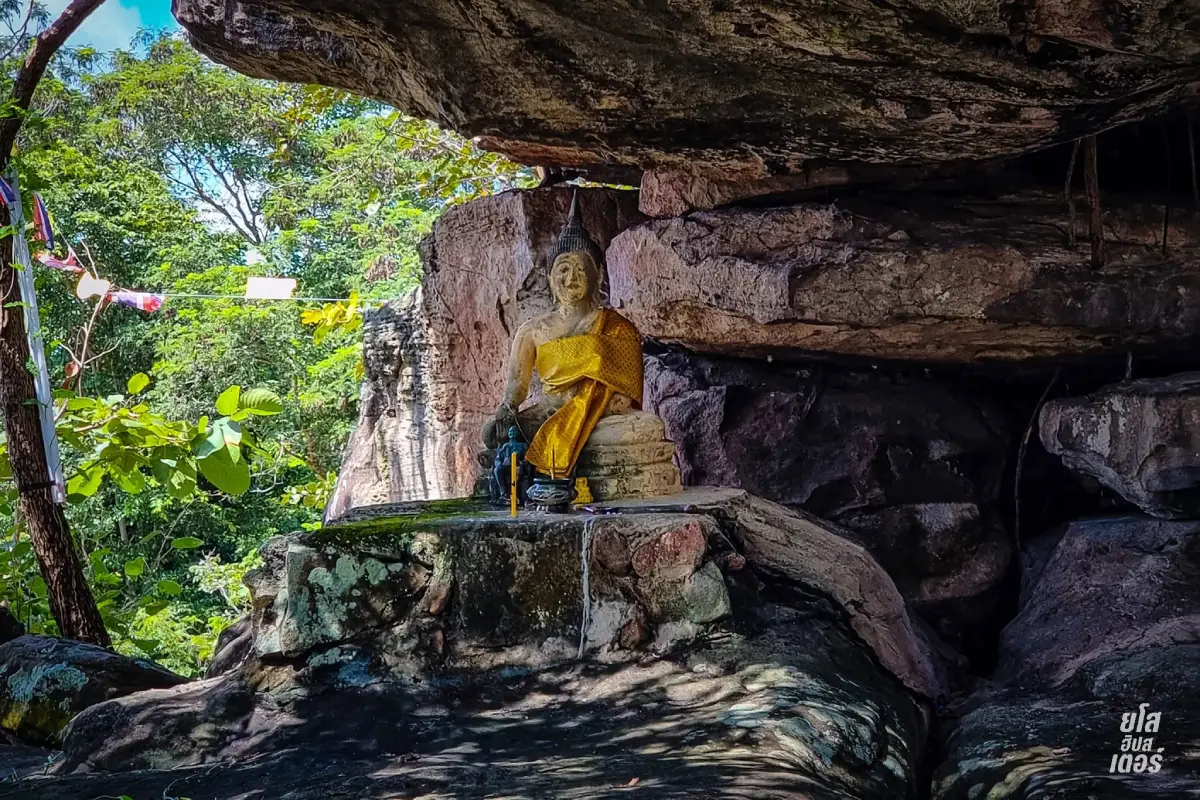
The main highlight is Tham Phra, the sacred Buddha cave. The cave is approximately 3 wa wide and 8 wa long and is located on the southern rock overhang of the hill. The entrance follows a natural gap between rocks, forming a tunnel-like passage. From the cave mouth, visitors can continue through the rock passage toward the north. Inside, the cave has a natural two-level character and contains many Buddha images arranged in rows. Reclining Buddha images and Phra Kaccayana images created during the time of Phra Ajarn Dee Channo are also enshrined here.
The atmosphere inside the cave is quiet, cool, and solemn. It is a place for worship rather than casual sightseeing. Visitors should enter with a respectful mind, speak softly, and avoid touching or moving any Buddha image or sacred object. The cave is important not only because of its physical beauty, but also because local people have long regarded it as a sacred place protected by spiritual power. This belief continues to shape the way people behave when entering the cave.
Phu Tham Phra covers a small hill area of about 200 rai. Mixed deciduous forest grows throughout the site, creating shade and a cool atmosphere. The area is also regarded as a source of small streams. Natural stone pillars, rock terraces, cliffs, and viewpoints give the site a landscape character similar to some sandstone attractions in northeastern Thailand. For travelers who enjoy both Buddhist culture and nature, Phu Tham Phra offers a strong combination of forest, rock, cave, and local faith.
Beyond the main Buddha cave, the hill contains several other caves and natural features. Important areas include Tham Kliang, Tham Phrom But, Tham Kheng or Tham Chan, Tham Kia or Bat Cave, Lan Ngu Suang, cliff areas, Ang Ruea, and the chedi of Phra Ajarn Dee Channo. Each area has its own natural form and local story. Some caves have smooth rock surfaces, some are wide shelters, and some are linked with wildlife such as bats. These features make the site more complex and rewarding than a single-cave attraction.
Tham Kliang is known for its smooth and unusual rock surface. Local descriptions compare the surface to stone that has been naturally polished over time. Tham Kheng, also called Tham Chan, is located toward the eastern side of the cliff and has a broad rock shelter with a flat floor. Tham Kia, or Bat Cave, is associated with a large number of bats. Together, these caves show the geological and ecological variety of the hill and explain why Phu Tham Phra has long fascinated local people.
The history of Wat Phu Tham Phra is closely connected with Phra Ajarn Dee Channo, a forest meditation monk associated with the lineage of Phra Ajarn Fan Ajaro. Phra Ajarn Dee came to practice meditation and wander as a forest monk in this area, which was formerly known as Phu Phek. Later, the temple was established near the northern side of the village, and local people began to call the place Phu Tham Phra. His presence gave the area a strong forest-temple identity and deepened the spiritual meaning of the caves.
Wat Phu Tham Phra was established as a temple in 1957 to mark the Buddhist semi-millennium period. Monks and novices later came to reside there. Phra Khru Chittaphawananusit, also known as Phra Ajarn Sommai Chittanopalo Thana Sing, became the abbot and worked with local villagers to develop the temple over time. The development of the temple has remained closely tied to local devotion and the forest meditation tradition, preserving the quiet atmosphere that defines the place.
Local legends form an important part of Phu Tham Phra’s identity. Villagers tell stories of many sacred Buddha images once found inside the cave, including wooden images, copper images, golden images, ivory images, and other sacred objects. The cave was believed to be protected by spiritual guardians. Because of this belief, people entering the cave were expected to watch their speech and behavior. The stories are not merely entertainment; they explain why the community continues to treat the cave with deep respect.
In the past, local villagers who went into the forest to collect natural products would come to the cave to pay respect before entering the forest. They believed that worship at the cave would bring good fortune in their livelihood and protection from danger. This tradition reveals the relationship between forest, faith, and daily life. Phu Tham Phra was not only a place for religious worship, but also a spiritual support for people whose lives were closely connected with the forest.
Near the route up to the hill is the old brick gateway called “Phu Ngo” or “Pratu Khong.” It is located about 1 km north of Phu Tham Phra and now remains as ruins. Even in its ruined state, it adds a historical layer to the site. The presence of caves, Buddha images, a chedi, and an old gateway shows that Phu Tham Phra is not only a natural cave site, but a cultural landscape shaped by Buddhist devotion and community memory over time.
The landscape of Phu Tham Phra is suitable for slow walking. Natural stone pillars, flat rock areas, forest shade, and openings between rocks create many points of interest. Visitors should walk carefully, especially during or after rain, because rock surfaces may become slippery. Comfortable walking shoes, drinking water, and sun protection are useful. The best experience comes from moving slowly, allowing time to observe the cave, forest, stone textures, and viewpoints.
Phu Tham Phra is suitable for many types of visitors: Buddhist pilgrims, cultural travelers, forest temple enthusiasts, families, student groups, and travelers who enjoy quiet natural attractions. It offers a different view of Yasothon, a province often associated mainly with the Rocket Festival. Here, visitors see Yasothon as a province of forest caves, sacred hills, meditation sites, local legends, and natural landscapes connected with Isan Buddhist life.
Visitors who come for worship should begin at the main Buddha cave. Inside the cave, Buddha images are arranged in a calm and sacred setting. Visitors may pay homage, make merit, meditate briefly, or quietly observe the cave interior. Modest dress is important because this is an active religious site. Loud conversation, joking, touching sacred objects, or removing anything from the cave are inappropriate. The dignity of the place depends on respectful behavior from every visitor.
Nature lovers should allow time to explore the forested surroundings as well as the cave. Mixed forest provides shade and a cool atmosphere, while the sandstone formations create visual interest throughout the area. The light passing through rock gaps and tree branches changes throughout the day, making the site especially attractive for quiet observation and photography. The beauty of Phu Tham Phra lies not only in the Buddha images, but also in the relationship between stone, forest, silence, and faith.
The recommended visiting period is from morning to early afternoon. The site is open daily from 09.00 to 16.00, and arriving earlier gives visitors enough time to worship, walk through the cave area, and enjoy the forest without rushing. Afternoon visits are possible, but visitors should leave enough time to walk back safely before closing. Because the site includes caves and natural rock paths, safety and sufficient daylight should be considered part of the visit.
There is no admission fee for Phu Tham Phra. Visitors can worship and explore without paying an entrance fee. Available facilities include a parking area and restrooms. As with many forest temple and nature sites, visitors should prepare personal necessities such as drinking water, suitable footwear, a hat, and any required medicine. Families traveling with children and elderly visitors should choose accessible points carefully and avoid difficult rock sections when necessary.
Getting There is most convenient by private car. From Loeng Nok Tha District center, follow Highway 212 toward Ban Kut Hae or Ban Hin Ngon for about 12 km. From Yasothon city, the distance is about 85 km. Travelers using public transport should first reach Loeng Nok Tha town, then continue by local vehicle or hired transport. A private car is the best option for combining Phu Tham Phra with nearby attractions such as Huai Sa Baek Reservoir, Phu Chan, local communities, and Loeng Nok Tha town.
Phu Tham Phra can be combined with Huai Sa Baek Reservoir on a one-day route. The reservoir is a medium-sized water storage area surrounded by hills and is popular as a local leisure area, especially around Songkran. A practical route is to visit Phu Tham Phra in the morning, return to Loeng Nok Tha for lunch, and continue to nearby natural or local sites in the afternoon. This route gives visitors both a sacred cave experience and a broader view of Loeng Nok Tha’s landscape.
The temple is also connected with local Buddhist traditions. On the full moon of the sixth lunar month, Visakha Bucha Day, local people hold a Buddha bathing tradition and merit-making activities. This annual ritual shows that Phu Tham Phra remains a living sacred site rather than only a natural attraction. It continues to bring the community together in Buddhist practice and local tradition.
For foreign travelers, Phu Tham Phra is best understood as an Isan Buddhist cave temple in a forest hill setting. It differs from large urban temples and famous monument-style attractions. The cave, Buddha images, forest, rock formations, local legends, and meditation history show how Buddhism in rural Thailand is often deeply connected with nature. It is a place where the natural landscape itself becomes part of religious experience.
A visit to Phu Tham Phra should not be rushed. Travelers should take time to observe the Buddha images, stone layers, cave passages, forest canopy, and quiet atmosphere. The value of the site lies in its small details: the silence inside the cave, the cool air under the rocks, the faith preserved through local stories, and the continuity of forest temple practice. These details explain why the place remains meaningful to the people of Ban Kut Hae and Loeng Nok Tha.
Photography should be done respectfully. Visitors should avoid using flash around Buddha images, blocking worshippers, climbing on rock structures for photo angles, or stepping onto areas that may damage the site. The most appropriate photographs are those that capture the calm mood of the cave, the forest, the rock formations, and the temple landscape without disturbing religious practice. Respect for the place is more important than getting a dramatic image.
Families visiting with children should watch them closely around rock paths and cave entrances. The site is useful for teaching children about caves, forest ecology, Buddhist images, and temple manners. Elderly visitors should choose accessible areas and avoid slippery or steep sections. With careful planning, Phu Tham Phra can be a meaningful and safe visit for people of different ages.
Overall, Phu Tham Phra adds depth to Yasothon’s travel identity. It shows that the province has more than festivals and town-based attractions. It has forest caves, sacred hills, meditation heritage, local beliefs, natural viewpoints, and quiet temple landscapes. Loeng Nok Tha is therefore not only a transit district between Yasothon, Amnat Charoen, and Mukdahan, but also a destination for travelers who want to understand the spiritual and natural side of Isan.
In summary, Phu Tham Phra Yasothon is a sacred cave temple and natural attraction in Loeng Nok Tha District. Its main highlights include the large Buddha cave with many Buddha images, a natural tunnel-like rock entrance, mixed forest over about 200 rai, several nearby caves, natural stone formations, the chedi of Phra Ajarn Dee Channo, and the Visakha Bucha Buddha bathing tradition. It is a worthwhile destination for worship, nature walking, cultural learning, and quiet reflection in Yasothon Province.
| Name | Phu Tham Phra / Wat Phu Tham Phra |
| Location | Ban Kut Hae / Ban Hin Ngon, Kut Hae Subdistrict, Loeng Nok Tha District, Yasothon Province |
| Address | Wat Phu Tham Phra, Kut Hae Subdistrict, Loeng Nok Tha District, Yasothon 35120, Thailand |
| Highlights | A large Buddha cave with many Buddha images, mixed forest, natural stone pillars, rock terraces, viewpoints, and a peaceful forest temple atmosphere |
| History | Wat Phu Tham Phra was established in 1957 and is associated with Phra Ajarn Dee Channo, a forest meditation monk who practiced in the area formerly known as Phu Phek. |
| Main Cave Features | The main cave is about 3 wa wide and 8 wa long, located on the southern rock overhang. Its entrance follows a natural rock gap like a tunnel, and the cave contains many Buddha images arranged inside. |
| Natural Setting | A small hill area of about 200 rai with mixed deciduous forest, cool shade, small stream sources, and natural stone pillars similar to northeastern sandstone landscapes |
| Important Caves And Areas | Tham Phra Tham Kliang Tham Phrom But Tham Kheng / Tham Chan Tham Kia / Bat Cave Lan Ngu Suang Cliff Area Ang Ruea Chedi of Phra Ajarn Dee Channo Phu Ngo / Pratu Khong |
| Traditions / Rituals | On the full moon of the sixth lunar month, Visakha Bucha Day, local people hold Buddha bathing and merit-making activities at the site. |
| Travel Information | From Loeng Nok Tha District center, follow Highway 212 toward Ban Kut Hae / Ban Hin Ngon for about 12 km. From Yasothon city, the distance is about 85 km. A private car is the most convenient option. |
| Current Status | Open for worship and visits during operating hours |
| Open Days | Daily |
| Opening Hours | 09.00 – 16.00 |
| Fees | No admission fee |
| Facilities | Parking area, restrooms, worship area, and walking paths for caves and natural surroundings |
| Main Areas / Zones | Buddha cave and Buddha image area Natural cave zone around the hill Rock terrace and stone pillar zone Chedi of Phra Ajarn Dee Channo Viewpoint and cliff zone Mixed forest nature trail zone Phu Ngo or Pratu Khong zone |
| Abbot / Caretaker | Phra Khru Chittaphawananusit, also known as Phra Ajarn Sommai Chittanopalo Thana Sing / Wat Phu Tham Phra monastic community |
| Main Contact Number | 095-5018856 |
| Nearby Tourist Attractions | 1. Ban Kut Hae / Ban Hin Ngon, about 1 km 2. Phu Ngo / Pratu Khong, about 1 km 3. Phu Chan, about 2 km 4. Huai Sa Baek Reservoir, about 28 km 5. Loeng Nok Tha District Center, about 12 km 6. Ban Lek Nai Pa Yai Royal Arts And Crafts Center Yasothon, about 48 km 7. Wat Mahathat Yasothon, about 85 km |
| Nearby Restaurants | 1. Aep Saep Restaurant Loeng Nok Tha, about 13 km, Tel. 080-4688662 2. Tor Nuea Yang Loeng Nok Tha, about 13 km, Tel. 088-3362460, 089-6137456 3. Lucky Shabu Loeng Nok Tha, about 13 km, Tel. 080-5637515, 080-4062499 4. Shabu Nai Phon Loeng Nok Tha, about 13 km, Tel. 086-4411581 5. Tum Hod Kot Yum Loeng Nok Tha, about 13 km, Tel. 080-1705870 6. Momocha Loeng Nok Tha, about 13 km, Tel. 099-3294266 |
| Nearby Accommodations | 1. Thararuthai Resort Hotel Loeng Nok Tha, about 13 km, Tel. 088-5936442 2. Kings Palace Hotel Loeng Nok Tha, about 14 km, Tel. 089-5691802 3. Pudin Hotel Loeng Nok Tha, about 14 km, Tel. 045-782345, 091-7173439 4. Little House Hotel Loeng Nok Tha, about 14 km 5. Loeng Thara Boutique Resort, about 14 km 6. Khwanjira Guesthouse Loeng Nok Tha, about 15 km 7. Ban Rai Khun Nai Resort Loeng Nok Tha, about 16 km |
Frequently Asked Questions (FAQ)
Q: Where is Phu Tham Phra Yasothon located?
A: Phu Tham Phra is located in the Ban Kut Hae / Ban Hin Ngon area of Kut Hae Subdistrict, Loeng Nok Tha District, Yasothon Province, about 12 km from Loeng Nok Tha District center and about 85 km from Yasothon city.
Q: What are the main highlights of Phu Tham Phra?
A: The main highlights are the large Buddha cave with many Buddha images, mixed forest, natural stone pillars, rock terraces, viewpoints, several nearby caves, and the peaceful atmosphere of an Isan forest temple.
Q: What are the opening hours of Phu Tham Phra?
A: Phu Tham Phra is open daily from 09.00 to 16.00.
Q: Is there an admission fee?
A: No. Visitors can enter, worship, and explore the site without an admission fee.
Q: What caves and areas can visitors see at Phu Tham Phra?
A: Important areas include Tham Phra, Tham Kliang, Tham Phrom But, Tham Kheng or Tham Chan, Tham Kia or Bat Cave, Lan Ngu Suang, cliff areas, Ang Ruea, and the chedi of Phra Ajarn Dee Channo.
Q: Who is the abbot of Wat Phu Tham Phra?
A: The abbot is Phra Khru Chittaphawananusit, also known as Phra Ajarn Sommai Chittanopalo Thana Sing.
Q: How can travelers get to Phu Tham Phra?
A: From Loeng Nok Tha District center, follow Highway 212 toward Ban Kut Hae or Ban Hin Ngon for about 12 km. Traveling by private car is the most convenient option.
Q: How should visitors behave at Phu Tham Phra?
A: Visitors should dress modestly, speak quietly inside the cave, avoid touching or moving Buddha images and sacred objects, keep the area clean, and walk carefully on natural rock paths.
 Category: ●Places of Worship
 Group: ●Other Sacred Sites
Last Update : 2 MonthAgo
 Last Update : 2 MonthAgo
 Click to Access the Navigation Map GPS
 Art, Culture and Heritage
 Historical Sites and Monuments(6)
 Landmarks and Memorials(1)
 Art, Craft Centres, Tradition(4)
 Museums(1)
 Historic Homes and Cities(1)
 Temple(22)
 Church(1)
Other Sacred Sites(9)
Church(1)
Other Sacred Sites(9)
 Research and Development
 Royal Project(2)
 Suburban Living
 Village, Community(3)
 Local Market(1)
 Nature and Wildlife
 National Parks and Marine Reserves(2)
 Mountain (Doi)(2)
 Dam, Reservoir, Lake(7)
 River, Canal(2)
 Bays and Beaches(1)
 Other natural attractions(2)
 Entertainment and Agricultural
 Farms, Parks and Ecotourism(1)
 Travel Articles, Recipes
 Travel Review, Food Review(2)


