
lovethailand home >Northeastern Travel Attractions >Yasothon Travel Attractions >Maha Chana Chai >Hua Muang > Wat Phra Phutthabat Yasothon
TL;DR: Wat Phra Phutthabat Yasothon is located at Ban Nong Yang, Hua Mueang Subdistrict, Maha Chana Chai District, Yasothon Province, open Daily, hours 07.00 – 18.00.
Wat Phra Phutthabat Yasothon
Open Days: Daily
Opening Hours: 07.00 – 18.00
Wat Phra Phutthabat Yasothon, also known as Phra Phutthabat Yasothon, is one of the most important Buddhist and cultural sites in Yasothon Province. Located in Ban Nong Yang, Hua Mueang Subdistrict, Maha Chana Chai District, the temple is about 6 km from the district office along Highway 2083. It is best known for the sacred Buddha footprint enshrined on a high white-sand mound by the Chi River, together with an ancient laterite Naga-protected Buddha image, a laterite inscription stone, a white ordination hall with a blue roof, Maha Chai Chana Chedi, and a large white jade Buddha image inside the ordination hall.
This temple is a meaningful destination for travelers who want to explore Buddhist heritage, local history, and peaceful temple architecture in northeastern Thailand. It is not only a place for worship, but also a cultural landscape where ancient objects, modern religious architecture, local devotion, and riverside nature come together. For Thai visitors, the temple is a sacred site closely connected with local faith. For foreign travelers, it offers a valuable introduction to how rural Buddhist temples in Isan preserve both historical evidence and living religious practice.
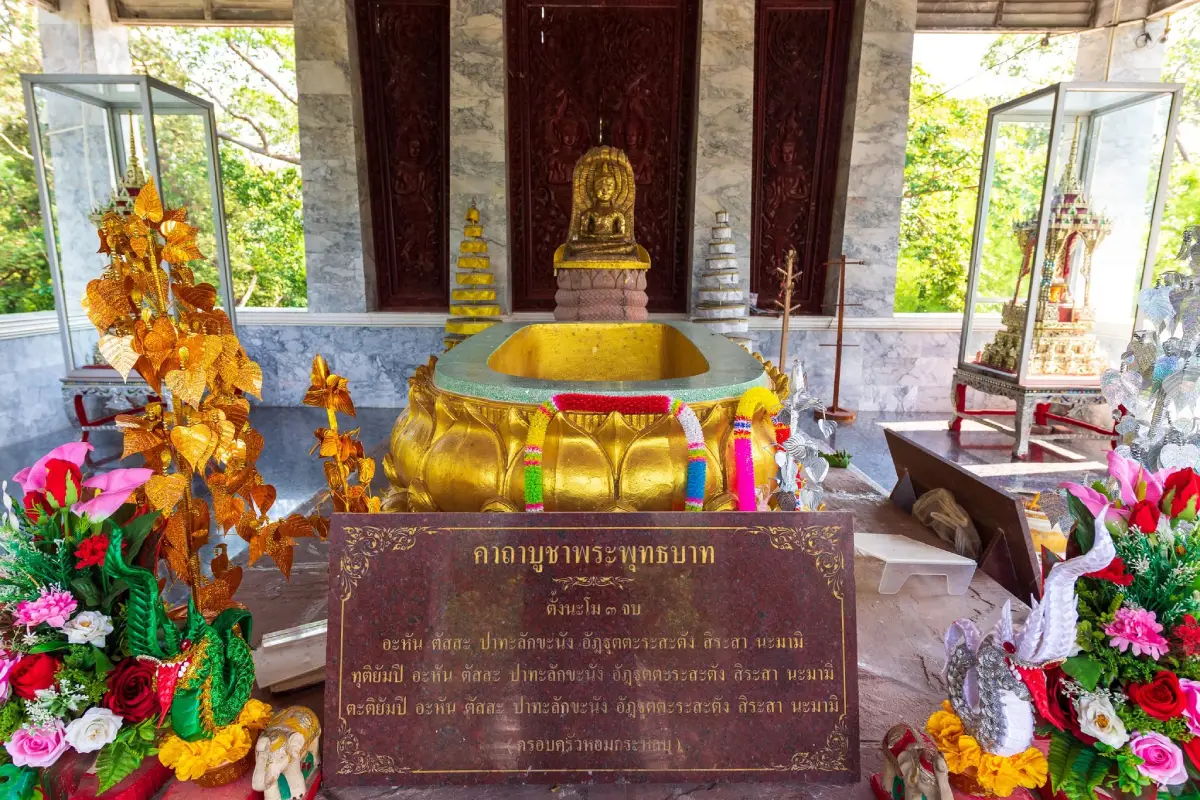
The most important feature of Wat Phra Phutthabat Yasothon is the Buddha footprint enshrined on a white-sand mound. This natural setting gives the temple a distinctive atmosphere. The mound rises above the lowland area of the Chi River, creating a peaceful and unusual landscape. The Buddha footprint is deeply respected by local communities in Maha Chana Chai District and nearby areas. Visitors come to pay homage, make merit, pray for blessings, and experience the calm atmosphere of a temple that remains meaningful to local people.
The temple is also regarded as a valuable historical site of Yasothon Province. Three important ancient objects are associated with the site: the Buddha footprint, a laterite Naga-protected Buddha image, and a laterite inscription stone. The inscription stone is about 1 meter high and 50 centimeters wide, with ancient writing that records the story of the sacred objects and words of homage to the Buddha footprint. Some letters have faded over time, but the inscription remains an important piece of historical evidence for the temple.
According to local tradition, Phra Maha Uttapanya and his disciples brought the three sacred objects from Ayutthaya in 1378 BE. These objects include the Buddha footprint, the laterite Naga-protected Buddha image, and the inscription stone. This story gives the temple a strong historical and spiritual identity. Whether visitors come for worship or cultural study, these ancient objects help explain why Wat Phra Phutthabat Yasothon has long been respected as one of the important sacred places of the province.
The Naga-protected Buddha image is another important ancient object within the temple. Made of laterite, it has a lap width of about one sok. In Buddhist tradition, the Naga-protected posture refers to the episode in which the Naga sheltered the Buddha from wind and rain after his enlightenment. At Wat Phra Phutthabat Yasothon, this image is meaningful both as an archaeological object and as a symbol of protection, faith, and spiritual continuity.
The inscription stone adds another layer of value to the temple. It connects religious devotion with written historical memory. The ancient characters on the stone help preserve the story of the Buddha footprint and related objects. For travelers interested in epigraphy, archaeology, and local Buddhist history, this stone is one of the most important items to observe carefully. Visitors should treat it with respect and should not touch or disturb it.
The white ordination hall with a blue roof is one of the most visually striking structures in the temple. Its applied architectural style gives the temple a clean, graceful, and peaceful appearance. The white walls, blue roof, decorative railings, and sculptural details create a distinctive look that is different from many older rural temples. The building is particularly beautiful in the morning or late afternoon, when sunlight softens the white surfaces and makes the structure stand out against the sky.
Inside the ordination hall is a large white jade Buddha image, one of the temple’s most admired highlights. The principal Buddha image has a lap width of about 2.31 meters and a height of about 3.7 meters. Its pale surface gives the interior a calm and luminous atmosphere. Many visitors spend time here to pay respect, pray, and appreciate the craftsmanship of the image. For foreign travelers, this is one of the easiest places within the temple to understand the link between visual beauty and Buddhist devotion.
Maha Chai Chana Chedi is another major landmark of Wat Phra Phutthabat Yasothon. The chedi is an octagonal, bell-shaped structure built in honor of King Bhumibol Adulyadej on the occasion of the 50th anniversary of his accession to the throne. It is about 45 meters high and has 3 levels. The first level displays traditional Isan handicrafts and tools and also functions as a library for Buddhist scripture and Vinaya study. The second level displays wax figures of respected Buddhist masters. The third level enshrines Buddha relics in a golden carved shrine.
Because of Maha Chai Chana Chedi, the temple offers more than a typical worship visit. Travelers can learn about local Isan culture, observe religious displays, study Buddhist texts, pay respect to revered teachers, and worship Buddha relics within one structure. This makes the temple especially suitable for families, students, cultural travelers, and visitors who want a deeper understanding of Buddhist heritage in Yasothon.
The building that houses the Buddha footprint is located near Maha Chai Chana Chedi. This is the spiritual heart of the temple and should be visited with respect. Worshipping the Buddha footprint is a long-standing Buddhist practice in Thailand. It represents reverence for the Buddha and reminds worshippers of the path of the Buddha’s teaching. At Wat Phra Phutthabat Yasothon, the footprint is also a symbol of local identity, community faith, and continuity between past and present.
The temple grounds cover a wide riverside area with trees, open spaces, worship areas, and buildings arranged in a peaceful setting. The white-sand mound by the Chi River creates a landscape that feels both natural and sacred. Visitors can walk slowly around the temple, observe its architecture, pay respect at the main sites, and enjoy the quietness of the surrounding area. The atmosphere is most pleasant in the morning and late afternoon.
Every year, especially between March and April, people from nearby districts and subdistricts travel to the temple in large numbers to worship the Buddha footprint. During the Songkran period, local worshippers also perform water-pouring rituals for the Naga-protected Buddha image and the Buddha footprint. These traditions show that Wat Phra Phutthabat Yasothon is not only a historical site, but also a living center of Buddhist faith for the local community.
The temple has also developed as a place for meditation and Buddhist training. Phra Winai Sunthon Methee, also known as Banlang Chinnantho, played an important role in developing the temple and contributing to religious and social work in the area. Under the influence of dedicated monks and local supporters, the temple became known not only as a place of worship, but also as a space for spiritual practice, learning, and community benefit.
Visitors should allow enough time to explore the temple properly. A good route begins at the white ordination hall and the white jade Buddha image, then continues to Maha Chai Chana Chedi. From there, visitors can proceed to the building that houses the Buddha footprint, the laterite Naga-protected Buddha image, and the inscription stone. This route helps travelers understand the temple from its modern religious architecture back to its ancient sacred objects.
Getting There is most convenient by private car. From Maha Chana Chai District Office, follow Highway 2083 toward Ban Nong Yang in Hua Mueang Subdistrict for about 6 km. From Yasothon city, drive toward Maha Chana Chai District, then continue to the temple. Travelers using public transport should first reach Maha Chana Chai town and then take a local vehicle or hire transport to the temple. A private car is recommended for visitors who want to combine the temple with other attractions in the area.
Wat Phra Phutthabat Yasothon can be included in a one-day cultural route through Yasothon. Nearby attractions include Dong Mueang Toei Archaeological Site, Phra That Ku Chan, Phra That Phon Than, Phra That Kong Khao Noi, Phaya Thaen Public Park, Wat Mahathat, and the old Ban Sing Tha quarter. This route gives visitors a broad view of Yasothon’s Buddhist heritage, archaeology, local traditions, and historic communities.
The best time to visit is in the morning or late afternoon. Morning is ideal for worship and quiet exploration, while late afternoon is suitable for photography. The white buildings look especially graceful under soft light. During March and April, the temple becomes more active because many local people come to worship. Visitors during this period should allow extra time for parking and movement around the temple grounds.
There is no admission fee to visit Wat Phra Phutthabat Yasothon. Visitors should dress modestly, remove shoes where required, keep noise low, and avoid touching ancient objects unnecessarily. The Buddha footprint, Naga-protected Buddha image, and inscription stone are important religious and historical objects. Respectful behavior is essential, especially when local worshippers or monks are present.
The temple is suitable for elderly visitors, families, students, cultural travelers, Buddhist pilgrims, and foreign travelers interested in local Thai temples. Elderly visitors can enjoy a peaceful place for worship. Families can use the visit to explain Buddhist footprints, ancient inscriptions, and temple etiquette to children. Cultural travelers can study the relationship between archaeology, riverside landscape, modern religious architecture, and local community faith.
For photography, the most attractive subjects include the white ordination hall, blue roof, Maha Chai Chana Chedi, architectural details, temple stairways, the riverside setting, and the overall peaceful atmosphere. Photography should be done respectfully. Visitors should avoid blocking worshippers, standing on sacred platforms, or taking close photographs of people without permission.
For foreign travelers, Wat Phra Phutthabat Yasothon is best understood as a living Buddhist heritage site. It is not only an “ancient temple” in the general sense, but a place where sacred objects, local worship, meditation practice, and community memory remain active. The Buddha footprint gives the temple its religious identity, while the chedi, ordination hall, white jade Buddha image, inscription stone, and Naga-protected Buddha image give the site historical and artistic depth.
Travelers who plan to stay overnight can choose accommodation in Maha Chana Chai District, Kham Khuean Kaeo District, or Yasothon city, depending on their route. Staying near Maha Chana Chai is practical for visitors focusing on local sites around the temple. Staying in Yasothon city offers more restaurants and services and works well for travelers who plan to continue to other provincial attractions.
In summary, Wat Phra Phutthabat Yasothon is one of the most worthwhile temple destinations in Yasothon Province. It brings together a sacred Buddha footprint, ancient laterite objects, an inscription stone, a striking white-and-blue ordination hall, a large white jade Buddha image, Maha Chai Chana Chedi, Buddhist relics, local worship traditions, and a peaceful riverside landscape. For travelers seeking a meaningful cultural and spiritual visit in northeastern Thailand, this temple should be included in the Yasothon travel route.
| Name | Phra Phutthabat Yasothon / Wat Phra Phutthabat Yasothon |
| Location | Ban Nong Yang, Hua Mueang Subdistrict, Maha Chana Chai District, Yasothon Province |
| Address | Moo 3, Ban Nong Yang, Hua Mueang Subdistrict, Maha Chana Chai District, Yasothon 35130, Thailand |
| Highlights | Sacred Buddha footprint on a white-sand mound by the Chi River, white ordination hall with blue roof, large white jade Buddha image, Maha Chai Chana Chedi, laterite Naga-protected Buddha image, and ancient inscription stone |
| History | Local tradition records that Phra Maha Uttapanya and his disciples brought the Buddha footprint, laterite Naga-protected Buddha image, and inscription stone from Ayutthaya in 1378 BE. |
| Distinctive Features | The temple stands on a white-sand mound by the Chi River and preserves key ancient objects: the Buddha footprint, Naga-protected Buddha image, and inscription stone. |
| Important Ancient Objects | Buddha footprint One laterite Naga-protected Buddha image with a lap width of about 1 sok Laterite inscription stone about 1 meter high and 50 centimeters wide |
| Ordination Hall | White ordination hall with a blue roof in an applied architectural style. Inside is a white jade Buddha image with a lap width of about 2.31 meters and a height of about 3.7 meters. |
| Maha Chai Chana Chedi | An octagonal, bell-shaped chedi about 45 meters high with 3 levels: Isan cultural displays and Buddhist library on the first level, wax figures of revered masters on the second level, and Buddha relics on the third level. |
| Traditions / Rituals | From March to April each year, people from nearby districts and subdistricts come to worship in large numbers. During Songkran, local worshippers perform water-pouring rituals for the Naga-protected Buddha image and the Buddha footprint. |
| Travel Information | From Maha Chana Chai District Office, follow Highway 2083 to Ban Nong Yang, Hua Mueang Subdistrict, about 6 km away. A private car is the most convenient option for visiting the temple and nearby attractions. |
| Current Status | Open for worship and visits during temple hours |
| Open Days | Daily |
| Opening Hours | 07.00 – 18.00 |
| Fees | No admission fee |
| Facilities | Temple courtyard, worship areas, parking area, restrooms, meditation area, Buddhist library, and exhibition areas inside Maha Chai Chana Chedi |
| Main Areas / Zones | Buddha footprint hall Laterite Naga-protected Buddha image Laterite inscription stone White ordination hall with blue roof White jade Buddha image inside the ordination hall Maha Chai Chana Chedi Isan handicraft display area Buddhist scripture and Vinaya library Wax figure display of revered masters Buddha relic enshrinement level |
| Caretaker / Important Monastic Developer | Wat Phra Phutthabat Yasothon and the temple’s monastic community. Phra Winai Sunthon Methee (Banlang Chinnantho) played an important role in developing the temple. |
| Main Contact Number | 045-756902 |
| Nearby Tourist Attractions | 1. Dong Mueang Toei Archaeological Site, about 18 km 2. Phra That Ku Chan, about 33 km 3. Phra That Phon Than, about 36 km 4. Phra That Kong Khao Noi, about 38 km 5. Phaya Thaen Public Park, about 42 km 6. Wat Mahathat Yasothon, about 43 km 7. Ban Sing Tha Old Quarter, about 44 km |
| Nearby Restaurants | 1. Nang Len Maha Chana Chai Restaurant, about 7 km, Tel. 098-6421674 2. Newton Cafe Ban Phra Sao, about 12 km, Tel. 098-5844679 3. Kai Yang Pa Win Restaurant, about 31 km, Tel. 062-8958375, 099-9269504 4. Kalam Ice Cream Cafe Kham Khuean Kaeo, about 36 km, Tel. 090-2575081 5. Krua Kan Eng Kham Khuean Kaeo, about 36 km, Tel. 094-8570422 6. KAO NA COFFEE Yasothon, about 39 km, Tel. 083-8054169 |
| Nearby Accommodations | 1. Thong Suphatchot Resort Maha Chana Chai, about 7 km, Tel. 085-7798857 2. Ban Ton Mai Pai Resort Maha Chana Chai, about 8 km 3. Sai Ngoen Resort Maha Chana Chai, about 9 km 4. Ruen Lamool Hotel Kham Khuean Kaeo, about 36 km, Tel. 063-0236989 5. Chamchuri Resort Kham Khuean Kaeo, about 36 km, Tel. 080-2085723 6. Namthip Resort Kham Khuean Kaeo, about 37 km, Tel. 093-5317435 |
Frequently Asked Questions (FAQ)
Q: Where is Wat Phra Phutthabat Yasothon located?
A: It is located in Ban Nong Yang, Hua Mueang Subdistrict, Maha Chana Chai District, Yasothon Province, about 6 km from Maha Chana Chai District Office.
Q: What are the main highlights of Wat Phra Phutthabat Yasothon?
A: The main highlights are the sacred Buddha footprint, laterite Naga-protected Buddha image, ancient inscription stone, white-and-blue ordination hall, large white jade Buddha image, and Maha Chai Chana Chedi.
Q: What are the opening hours of Wat Phra Phutthabat Yasothon?
A: The temple is open daily from 07.00 to 18.00.
Q: Is there an admission fee?
A: No. Visitors can enter, worship, and explore the temple without an admission fee.
Q: Why is Maha Chai Chana Chedi important?
A: Maha Chai Chana Chedi is an octagonal chedi about 45 meters high. It has 3 levels featuring Isan cultural displays, a Buddhist library, wax figures of revered masters, and Buddha relics.
Q: When is the best time to visit?
A: Morning and late afternoon are the best times for worship, photography, and walking around the temple. From March to April, many local people visit the temple for annual worship activities.
Q: How can travelers get to the temple?
A: From Maha Chana Chai District Office, follow Highway 2083 to Ban Nong Yang in Hua Mueang Subdistrict for about 6 km. Traveling by private car is the most convenient option.
Q: What nearby attractions can be visited on the same trip?
A: Nearby attractions include Dong Mueang Toei Archaeological Site, Phra That Ku Chan, Phra That Phon Than, Phra That Kong Khao Noi, Phaya Thaen Public Park, Wat Mahathat Yasothon, and Ban Sing Tha Old Quarter.
 Category: ●Places of Worship
 Group: ●Other Sacred Sites
Last Update : 1 MonthAgo
 Last Update : 1 MonthAgo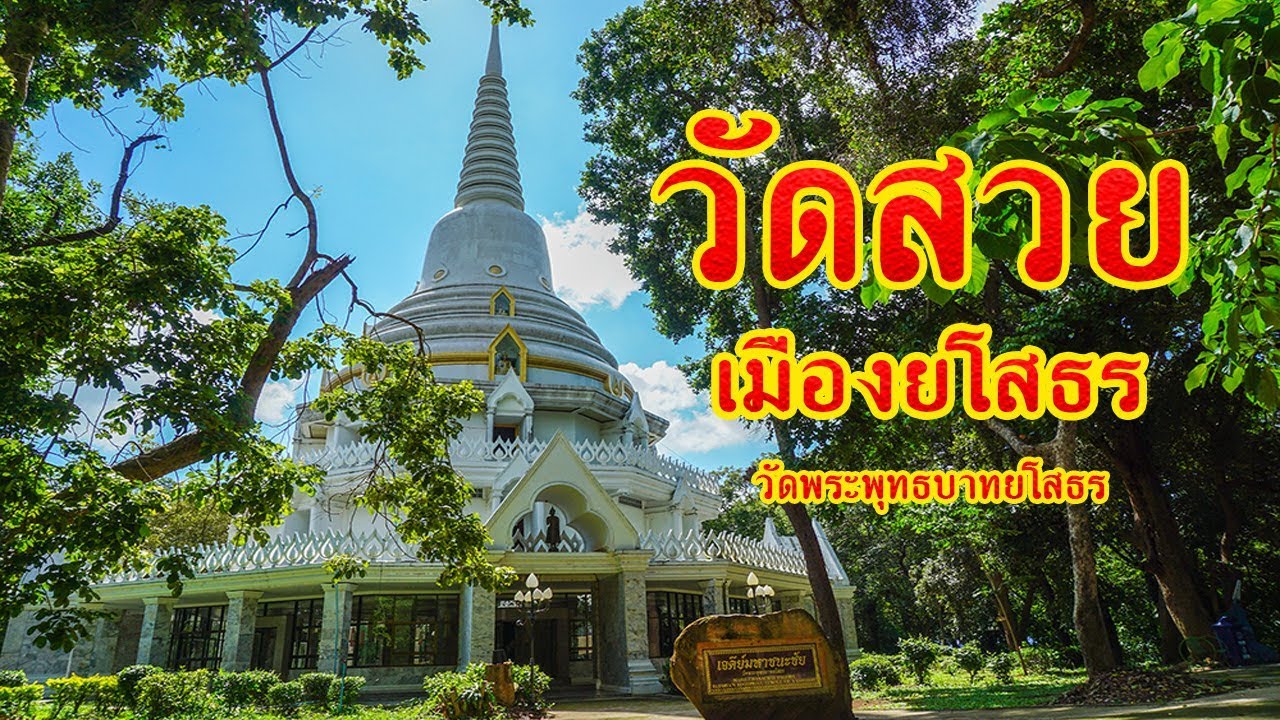
 Click to Access the Navigation Map GPS
Wat Phra Phutthabat Yasothon Map

 Art, Culture and Heritage
 Historical Sites and Monuments(6)
 Landmarks and Memorials(1)
 Art, Craft Centres, Tradition(4)
 Museums(1)
 Historic Homes and Cities(1)
 Temple(22)
 Church(1)
Other Sacred Sites(9)
Church(1)
Other Sacred Sites(9)
 Research and Development
 Royal Project(2)
 Suburban Living
 Village, Community(3)
 Local Market(1)
 Nature and Wildlife
 National Parks and Marine Reserves(2)
 Mountain (Doi)(2)
 Dam, Reservoir, Lake(7)
 River, Canal(2)
 Bays and Beaches(1)
 Other natural attractions(2)
 Entertainment and Agricultural
 Farms, Parks and Ecotourism(1)


