
lovethailand home >Northeastern Travel Attractions >Ubon Ratchathani Travel Attractions >Khong Chiam >Napho Klang > Dark Cave
TL;DR: Dark Cave is located at Ban Sa Som, Na Pho Klang Subdistrict, Khong Chiam District, Ubon Ratchathani Province, within Pha Taem National Park, open Daily, hours 06.00 – 18.00.
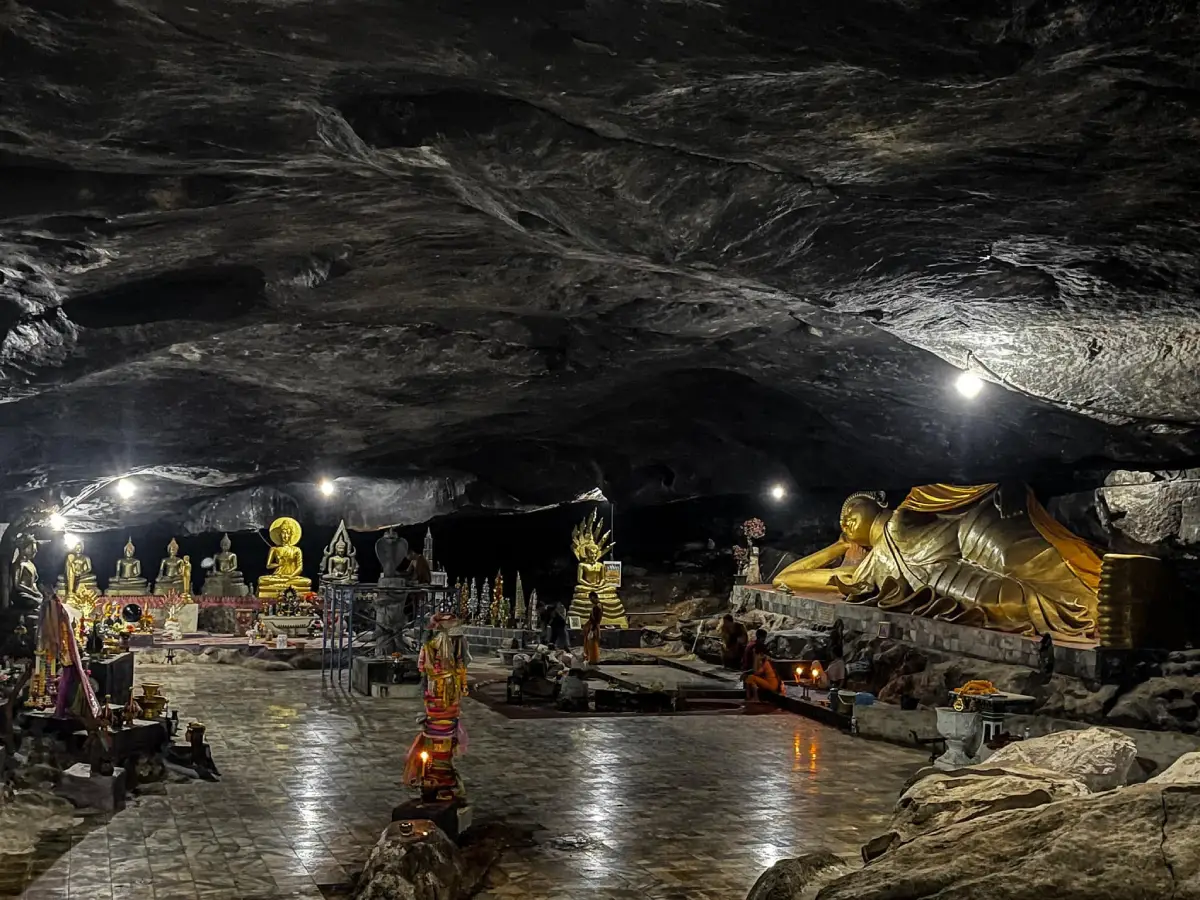
Dark Cave
Open Days: Daily
Opening Hours: 06.00 – 18.00
Wat Tham Patihan, also known as Tham Mued Cave, is a natural, cultural, and spiritual attraction near Ban Sa Som in Na Pho Klang Subdistrict, Khong Chiam District, Ubon Ratchathani Province. It is located within Pha Taem National Park and is connected with the Ban Sa Som-Ban Thung Na Mueang route. The place is known by 2 connected names. “Tham Mued” means Dark Cave and refers to the cave’s low-light interior, quiet atmosphere, and enclosed sandstone setting. “Wat Tham Patihan” means Miracle Cave Temple and reflects its current religious and cultural identity, including local legends, Buddhist devotion, wooden Buddha images, and beliefs connected with hidden realms and the Naga tradition of the Mekong region. Both names refer to the same place.
The site is reached from Highway 2112 by traveling toward Ban Sa Som and turning toward Ban Thung Na Mueang for about 15 km. This route passes through the natural landscape of Pha Taem National Park, where forest, sandstone plains, cliffs, caves, seasonal waterfalls, and local communities exist together. Wat Tham Patihan is therefore not an isolated cave. It is part of a wider landscape where geology, village life, Buddhist faith, and local storytelling are closely connected.
The cave traditionally known as Tham Mued is about 4 meters wide and 6 meters high. Although the cave is not large, it has strong cultural value because many carved wooden Buddha images are lined up inside. These images suggest that the cave was once used as a place of worship, ritual, meditation, or religious practice. The wooden material gives the Buddha images a simple and local character, different from metal or cement images found in larger temples. The result is a quiet sacred space where nature itself forms the walls, ceiling, and atmosphere of the shrine.
Understanding Wat Tham Patihan and Tham Mued as the same place helps visitors read the site correctly. Tham Mued describes the cave as a physical natural space: dark, quiet, and formed within sandstone. Wat Tham Patihan describes the same place as a sacred and legendary space: a cave temple associated with faith, hidden realms, the Naga, and local memory. The 2 names do not compete with each other. They complete each other. Together, they explain why this cave is both a natural feature and a meaningful spiritual landmark.
The name Tham Mued is direct and experiential. The interior receives limited natural light, so visitors immediately feel the cave’s stillness. This darkness changes the way people move. Instead of walking quickly as they would across an open viewpoint, visitors must slow down, look carefully, watch their steps, and observe the details of the wooden Buddha images and rock surfaces. The darkness supports a contemplative mood and helps explain why such a cave could become a religious space.
The name Wat Tham Patihan adds another layer of meaning. The word “Patihan” is associated with wonder, miracle, and sacred experience. In local accounts, the cave is connected with legends of a hidden city, a mysterious realm, and Naga-related beliefs. These stories are part of the cultural imagination of the Mekong region, where caves, rivers, underground passages, and sacred guardians often appear in local tradition. Visitors should understand these stories as local beliefs that give the place cultural depth.
Wat Tham Patihan is located in the Dong Na Tham forest zone of Pha Taem National Park. This area is known for sandstone plains, dry dipterocarp forest, seasonal wildflowers, cliff views, and natural routes leading to Pha Chanadai, Saeng Chan Waterfall, Thung Na Mueang Waterfall, and other park attractions. The presence of a cave temple in this landscape shows that Pha Taem is not only a place of prehistoric paintings, cliffs, and sunrise viewpoints. It also contains sacred cave spaces that connect later Buddhist practice with the same sandstone terrain.
The carved wooden Buddha images inside Tham Mued are central to the site’s identity. They should be approached as objects of faith and local craftsmanship. Wood was a practical and meaningful material in local communities, and carving Buddha images from wood reflects both devotion and skill. Placing the images inside the cave transformed a natural hollow into a sacred place. Visitors should not touch, move, or disturb the images because wooden objects are sensitive to touch, moisture, and careless movement.
The local legends connected with Wat Tham Patihan are important because they show how communities understand caves as more than geological formations. In the Mekong cultural region, caves are often imagined as thresholds between visible and invisible worlds. Stories of hidden cities, Bang Bot realms, Naga guardians, and underground connections express respect for places that feel deep, mysterious, and powerful. Wat Tham Patihan belongs to this cultural landscape of belief.
For clarity, this article uses the combined name “Wat Tham Patihan or Tham Mued Cave.” Tham Mued is the older descriptive name associated with the dark cave itself. Wat Tham Patihan is the broader name connected with the temple, sacred atmosphere, and local legends. Using both names together helps Thai and international readers understand that they are searching for the same destination near Ban Sa Som in Khong Chiam District.
The sandstone landscape of Pha Taem National Park is essential to the cave’s formation. Over long periods, water, wind, temperature changes, and natural weathering shaped the rock surfaces of the park. This process created cliffs, rock plains, pillars, shelters, and cave-like spaces. Tham Mued is one of these natural spaces. Its importance comes not from size but from the way people transformed a small, quiet cave into a place of religious meaning.
Pha Taem National Park is widely known for prehistoric rock paintings, Sao Chaliang rock formations, Mekong viewpoints, Pha Chanadai, and seasonal waterfalls. Wat Tham Patihan adds another cultural layer. The prehistoric paintings show earlier human presence in the landscape, while the wooden Buddha images in Tham Mued show a later Buddhist use of a natural cave. Together, they demonstrate that the sandstone landscape of Pha Taem has held meaning for people across different periods of time.
Ban Sa Som is the key community reference point for visiting Wat Tham Patihan. The village sits near the natural route into the Dong Na Tham forest zone and is known for community-based travel, local culture, and forest-edge landscapes. Passing through Ban Sa Som helps visitors see the human context of the cave. The destination is not only a cave in a national park; it is also connected with a local village that has lived with the surrounding forest and rock landscape.
Travel to Wat Tham Patihan is most convenient by private car or rental car. The route connects Highway 2112, Ban Sa Som, and the road toward Ban Thung Na Mueang. Having a private vehicle allows visitors to manage time, continue to nearby waterfalls, stop at park attractions, and return safely before evening. Morning to early afternoon is the best time to visit because the cave interior is dark and the surrounding natural routes require adequate daylight.
Getting There from Ubon Ratchathani city can be done by traveling toward Khong Chiam District and then following Highway 2112 to Ban Sa Som. From Ban Sa Som, continue toward Ban Thung Na Mueang for about 15 km to reach the Wat Tham Patihan or Tham Mued Cave area. From Pha Taem National Park headquarters, the cave can be included in a route with Sao Chaliang, Pha Taem rock paintings, Ban Sa Som, Saeng Chan Waterfall, and Thung Na Mueang Waterfall.
Travelers without a private vehicle should first reach Khong Chiam town, then arrange local transport to Ban Sa Som and the cave route. Direct public transport to the cave is limited, so hiring a local vehicle is the most practical option. This is especially useful for travelers who want to combine the cave with other Pha Taem attractions in one day.
The cave follows Pha Taem National Park operating hours: daily from 06.00 to 18.00. Visitors should enter during daytime and avoid arriving near closing time. The cave is dark, and the surrounding area is a natural route, so daylight is important for safety. Morning and early afternoon visits allow enough time for worship, observation, photography, and travel to nearby attractions.
Because Wat Tham Patihan or Tham Mued is located within Pha Taem National Park, the national park entrance fee applies. Pha Taem is in national park fee group 2. Thai adults pay 40 Baht and Thai children pay 20 Baht. Foreign adults pay 200 Baht and foreign children pay 100 Baht. Vehicle fees also apply, including 30 Baht for a 4-wheel car and 20 Baht for a motorcycle.
Safety is important inside the cave. The interior has limited light, uneven rock surfaces, and possible damp areas. Elderly visitors, children, and anyone with balance difficulties should be supervised closely. A small flashlight is useful, but light should be used respectfully. Visitors should avoid strong flash, avoid shining light directly at sacred objects for long periods, and avoid moving too close to the wooden Buddha images.
Temple and cave etiquette should be followed. Visitors should dress modestly, speak softly, avoid touching the wooden Buddha images, avoid moving objects, avoid writing on cave walls, avoid lighting fires in unsafe places, and avoid leaving rubbish. The site should be treated as both a natural cave and a sacred space. Respectful behavior helps preserve the atmosphere that gives the place its value.
Tham Mued is a strong cultural learning site. It shows how a natural cave can become a religious space. Caves are quiet, cool, and separated from ordinary activity, making them suitable for meditation and ritual. Once Buddha images were placed inside, the cave became a shrine without needing a large temple hall. The rock itself became the protective structure around the sacred area.
For visitors interested in local art, the carved wooden Buddha images are especially meaningful. Wood has texture, age, and warmth. When many wooden Buddha images are placed together inside a dim cave, the scene suggests accumulated devotion over time. This is different from a large temple where one main Buddha image dominates the hall. Here, the sacred feeling comes from quiet repetition, local craftsmanship, and the relationship between wood and stone.
The Naga and hidden-realm legends give the place additional depth. These stories should be understood as local belief and cultural memory. They show that people in the Mekong region often understand caves as places of transition, where the visible world meets the unseen. Whether visitors approach the cave through faith, culture, or curiosity, the stories help explain why the site is treated with respect.
For international travelers, Wat Tham Patihan or Tham Mued Cave offers a meaningful example of the connection between Thai Buddhism, natural landscapes, and local belief. It is not an urban temple, a museum, or a heavily developed tourist attraction. It is a small dark cave in a national park, filled with wooden Buddha images and surrounded by stories of hidden worlds and Naga guardians. This makes it valuable for travelers who want a deeper understanding of Thailand beyond standard tourist routes.
A full-day route can combine Wat Tham Patihan with major attractions in Pha Taem National Park. Travelers can visit Sao Chaliang, Pha Taem prehistoric paintings, Mekong viewpoints, Ban Sa Som, and Tham Mued Cave. In the right season, Saeng Chan Waterfall and Thung Na Mueang Waterfall can also be added. This route gives a complete view of Pha Taem through geology, archaeology, forest, cave culture, and seasonal water features.
A two-day itinerary gives a deeper experience. On the first day, travelers can focus on the main Pha Taem area and Khong Chiam. On the second day, they can explore Ban Sa Som, Wat Tham Patihan, Saeng Chan Waterfall, Thung Na Mueang Waterfall, and the Dong Na Tham route. This slower plan is suitable for travelers who want to understand eastern Ubon Ratchathani through communities, forests, rock plains, caves, and the Mekong landscape.
The best season to visit is from the late rainy season to the cool season. During this period, the surrounding forest remains fresh, nearby waterfalls are more scenic, and travel conditions are generally comfortable. During the rainy season, visitors should be careful with road surfaces, wet rock, and changing conditions around waterfalls. The cave itself is not a waterfall site, but the wider route is strongly influenced by seasonal rain.
Visitors should prepare shoes with good grip, a small flashlight, drinking water, a hat, a personal trash bag, and modest clothing. Since the cave is small, carrying only essential items is best. Food should not be brought into the cave. Clean, quiet, and respectful behavior is central to the experience.
Food options are most convenient in Khong Chiam town and along the Mekong River. The cave route itself is more natural and less service-oriented, so eating before or after the cave visit is practical. Restaurants in Khong Chiam commonly serve local fish dishes, Isan food, Thai food, and riverside meals. Keeping food outside the cave helps protect cleanliness and sacred atmosphere.
Accommodation can be planned in 2 ways. Travelers who want to connect closely with Ban Sa Som can choose local homestay options. Travelers who prefer broader access to restaurants, the Mekong River, Pha Taem National Park, and other attractions can stay in Khong Chiam. Khong Chiam offers small hotels, riverside resorts, and guesthouses suitable for travelers continuing to Pha Taem or the Mekong route.
Overall, Wat Tham Patihan or Tham Mued Cave is a valuable deep-travel destination in Ubon Ratchathani. Its strengths are the small dark sandstone cave, carved wooden Buddha images, sacred local atmosphere, legends of hidden realms and Naga belief, and its location within Pha Taem National Park near Ban Sa Som. Visitors who come with patience, preparation, and respect will experience a quieter and more layered side of eastern Ubon Ratchathani.
| Name | Wat Tham Patihan / Wat Tham Patihan Cave Temple / Tham Mued Cave |
| Location | Ban Sa Som, Na Pho Klang Subdistrict, Khong Chiam District, Ubon Ratchathani Province, within Pha Taem National Park |
| Address | Wat Tham Patihan, Ban Sa Som, Na Pho Klang Subdistrict, Khong Chiam District, Ubon Ratchathani 34220 |
| Coordinates / Navigation Point | Ban Sa Som-Ban Thung Na Mueang route, Pha Taem National Park. Use Highway 2112 and continue toward Ban Thung Na Mueang for about 15 km. |
| Distinctive Features | A small sandstone cave about 4 meters wide and 6 meters high, with many carved wooden Buddha images inside, connected with local legends of hidden realms, Bang Bot, and Naga belief. |
| Former / Related Name | Tham Mued is the older descriptive name related to the cave’s dark interior. Wat Tham Patihan is the current religious and cultural name connected with the sacred cave and local legends. |
| Natural Formation | A sandstone cave in the landscape of Pha Taem National Park, surrounded by Dong Na Tham forest, rock plains, forest paths, and the Ban Sa Som-Ban Thung Na Mueang natural corridor. |
| Cultural Value | The carved wooden Buddha images inside the cave show the connection between natural caves, Buddhist worship, local ritual practice, and community belief in the past. |
| Travel Information | From Khong Chiam or Pha Taem National Park, use Highway 2112 to Ban Sa Som, then continue toward Ban Thung Na Mueang for about 15 km. A private car or rental car is the most convenient option. |
| Current Status | Open as a cave temple and attraction within Pha Taem National Park |
| Open Days | Daily |
| Opening Hours | 06.00 – 18.00 |
| Fees | Pha Taem National Park Group 2 Rate Thai Visitors: Adult 40 Baht, Child 20 Baht Foreign Visitors: Adult 200 Baht, Child 100 Baht 4-Wheel Car: 30 Baht Per Vehicle Motorcycle: 20 Baht Per Vehicle |
| Facilities | Vehicle access route, parking according to site conditions, cave walking area, wooden Buddha image worship area, natural surroundings, and main visitor services at Pha Taem National Park headquarters |
| Main Areas / Zones | Ban Sa Som Access Zone Ban Thung Na Mueang Route Zone Cave Entrance Zone Low-Light Cave Interior Zone Carved Wooden Buddha Image Zone Sacred And Naga Legend Zone Rock Wall And Cave Floor Zone Surrounding Forest And Nearby Waterfall Connection Zone |
| Caretaker | Wat Tham Patihan, the local monastic and Ban Sa Som community, together with Pha Taem National Park, Department of National Parks, Wildlife and Plant Conservation |
| Main Contact Number | Pha Taem National Park, Tel. 045-252-581 Dong Na Tham Visitor Service Center, Tel. 081-070-8432, 089-501-6205 |
| Best Time To Visit | Late rainy season to cool season for comfortable cave travel and nearby waterfall routes; morning to early afternoon is best for the cave visit. |
| Safety Notes | The cave interior is dark and may have uneven or damp rock surfaces. Use a small flashlight, walk carefully, do not touch the wooden Buddha images, do not write on cave walls, dress modestly, and do not leave rubbish in the area. |
| Nearby Tourist Attractions | 1. Ban Sa Som, 1 km, Tel. 045-252-581 2. Saeng Chan Waterfall / Long Ru Waterfall, 14 km, Tel. 045-252-581 3. Thung Na Mueang Waterfall, 17 km, Tel. 045-252-581 4. Sao Chaliang, Pha Taem National Park, 35 km, Tel. 045-252-581 5. Pha Taem Prehistoric Paintings, 38 km, Tel. 045-252-581 6. Pha Taem National Park Headquarters, 38 km, Tel. 045-252-581 7. Pha Chanadai / Dong Na Tham, 50 km, Tel. 081-070-8432, 089-501-6205 8. Two-Color River, Khong Chiam District, 45 km |
| Nearby Restaurants | 1. Boeng Tawan Restaurant, Khong Chiam, 42 km, Tel. 089-717-7627 2. Khrua Khong Chiam, 45 km, Tel. 045-351-027, 062-829-3697 3. Phae Araya Khong Chiam, 45 km, Tel. 045-351-015 4. Larb Pla Khong Chiam, 45 km, Tel. 045-351-283 5. CAFE DE KHONG, 48 km, Tel. 081-860-5905, 045-351-174 6. Mae Nam Song Si Khong Chiam Restaurant, 45 km, Tel. 083-720-7706 |
| Nearby Accommodations | 1. Sa-Som Homestay, 1 km, Tel. 085-414-9176 2. Pha Taem National Park Accommodation And Camping Area, 38 km, Tel. 045-252-581 3. Khong Chiam Hotel, 45 km, Tel. 086-468-7431 4. View Khong Khong Chiam Hotel, 45 km, Tel. 065-242-3392 5. Baan Kieng Tawan Khong Chiam, 46 km, Tel. 099-039-4290 6. Tohsang Heritage Khongjiam, 48 km, Tel. 081-860-5905, 045-351-174-6 7. Khong Chiam Orchid Riverside Resort, 49 km, Tel. 098-916-8771 |
Frequently Asked Questions (FAQ)
Q: Are Wat Tham Patihan and Tham Mued Cave the same place?
A: Yes. They refer to the same place. Tham Mued is the older descriptive name related to the dark cave, while Wat Tham Patihan is the current religious and cultural name connected with the sacred cave and local legends.
Q: Where is Wat Tham Patihan or Tham Mued Cave located?
A: It is located near Ban Sa Som in Na Pho Klang Subdistrict, Khong Chiam District, Ubon Ratchathani Province, within Pha Taem National Park.
Q: What are the opening days and hours?
A: The site is open daily from 06.00 to 18.00, following Pha Taem National Park operating hours.
Q: Is there an entrance fee?
A: Yes. The Pha Taem National Park Group 2 entrance fee applies: Thai adult 40 Baht, Thai child 20 Baht, foreign adult 200 Baht, and foreign child 100 Baht. Vehicle fees also apply.
Q: What are the main highlights of Wat Tham Patihan or Tham Mued Cave?
A: The main highlights are the small dark sandstone cave, many carved wooden Buddha images, sacred local atmosphere, legends of hidden realms, and Naga-related beliefs.
Q: How can travelers get there?
A: Use Highway 2112 to Ban Sa Som, then continue toward Ban Thung Na Mueang for about 15 km. A private car or rental car is the most convenient option.
Q: What should visitors prepare?
A: Visitors should prepare shoes with good grip, a small flashlight, drinking water, a hat, a personal trash bag, and modest clothing suitable for a sacred cave containing Buddha images.
Q: What attractions can be visited together with Wat Tham Patihan or Tham Mued Cave?
A: Nearby attractions include Ban Sa Som, Saeng Chan Waterfall, Thung Na Mueang Waterfall, Sao Chaliang, Pha Taem Prehistoric Paintings, Pha Chanadai, Dong Na Tham, and the Two-Color River in Khong Chiam.
 Category: ●Nature and Wildlife
 Group: ●Caves
Last Update : 2 MonthAgo
 Last Update : 2 MonthAgo
 Click to Access the Navigation Map GPS
 Art, Culture and Heritage
 Historical Sites and Monuments(5)
 Landmarks and Memorials(2)
 Royal Palace(1)
 Art, Craft Centres, Tradition(7)
 Museums(3)
 Places of Worship
 Temple(37)
 Other Sacred Sites(4)
 Research and Development
 Royal Project(2)
 Suburban Living
 Village, Community(2)
 Local Market(4)
 National Parks and Marine Reserves(5)
 Mountain (Doi)(6)
 Dam, Reservoir, Lake(8)
 Waterfalls(12)
 Hot Springs(1)
Caves(2)
Hot Springs(1)
Caves(2)
 River, Canal(11)
 Bays and Beaches(8)
 Islands(2)
 Other natural attractions(6)
 Entertainment and Agricultural
 Zoos and Aquariums(1)
 Animal camps and shows(1)
 Farms, Parks and Ecotourism(1)


