
lovethailand home >Northeastern Travel Attractions >Ubon Ratchathani Travel Attractions >Trakan Phut Phon >Khulu > Ho Trai Nong Khulu
TL;DR: Ho Trai Nong Khulu is located at Nong Khulu Pond, Ban Khulu, Khulu Subdistrict, Trakan Phuet Phon District, Ubon Ratchathani Province, Thailand, open Daily, hours 08.30 – 16.30.
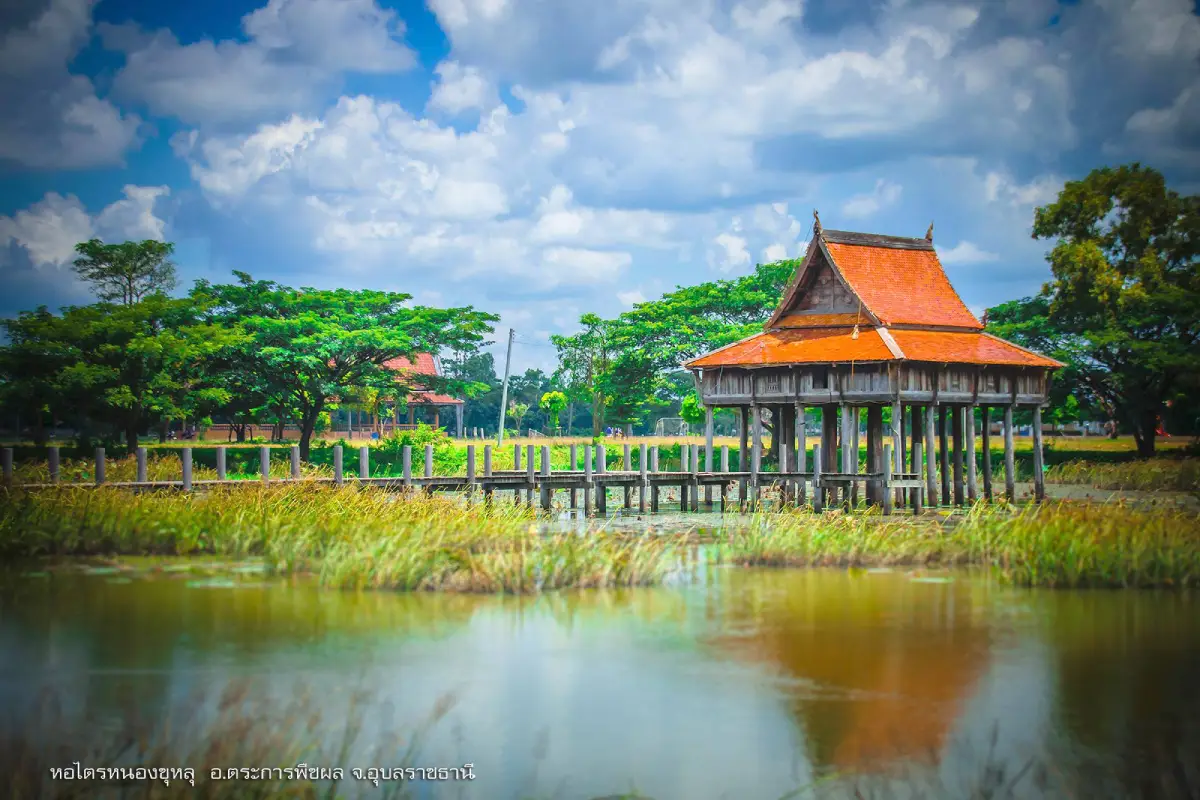
Ho Trai Nong Khulu
Open Days: Daily
Opening Hours: 08.30 – 16.30
Ho Trai Nong Khulu in Ubon Ratchathani is an important wooden scripture hall located in Nong Khulu pond, Ban Khulu, Khulu Subdistrict, Trakan Phuet Phon District. It is one of the most meaningful examples of local Isan architecture in Ubon Ratchathani because it was built specifically to preserve palm-leaf manuscripts and Buddhist texts. The hall stands above the water on wooden pillars, reached by a wooden bridge, and surrounded by the calm landscape of Nong Khulu public park. For international travelers, this is a rare place where architecture, Buddhism, local wisdom, water, and community life can be understood in one setting.
Ho Trai Nong Khulu is open daily from 08.30 to 16.30, with no admission fee. It is suitable for visitors interested in traditional Isan wooden architecture, palm-leaf manuscripts, Buddhist heritage, local history, and quiet cultural travel. The value of the site does not come from grand scale. It comes from the clarity of its purpose. The scripture hall was built in the middle of water to protect sacred manuscripts from termites, insects, rats, and other small animals. This makes the building an excellent example of practical conservation knowledge created long before modern archival technology.
The hall was built around 1916 – 1918 by Luang Pu Sing, the abbot of Wat Si Pho Chai at that time, together with Luang Rat Borihan, also known as Sot Kamutmat, the district chief of Trakan Phuet Phon during the same period. They recognized that Wat Si Pho Chai had many palm-leaf manuscripts and Buddhist texts that needed a safer storage place. Nong Khulu, a natural pond near the temple, was chosen because the water environment could help protect the manuscripts. Local villagers helped provide timber, wooden planks, and other materials for the construction, making the hall a product of shared faith and community cooperation.
The name Nong Khulu is also connected with local legend and Isan language. In local usage, “khu” or “khuu” can refer to a container or water bucket, while “lu” means to break through or become pierced. Local stories explain that a traveler once carried gold in a container through this area. The container broke, the gold fell, and the ground collapsed into a large pond. This story gives Nong Khulu an additional layer of cultural meaning. The site is therefore not only an architectural landmark, but also part of local memory and place-name tradition.
Architecturally, Ho Trai Nong Khulu is a raised wooden building supported by 25 wooden pillars arranged in 5 rows of 5. The building is a traditional timber structure using local carpentry methods. Its overall form is wide and balanced, with a high gabled roof and low sloping eaves. When viewed from the wooden bridge or from the edge of the pond, the relationship between the pillars, wooden body, roof, and water creates a calm and harmonious composition. This simplicity is the main strength of the building.
The roof consists of two main parts: an upper gabled roof and a lower bird-wing eave roof around the building. The original roof material was wooden shingles, while the present roof is covered with terracotta tiles. Decorative roof elements include carved wooden chofa, bai raka, hang hong, naga-like finials, and carved brackets. These details show the skill of local Isan craftsmen. The decoration is not overly elaborate, but its wooden lines, natural color, and carefully carved details give the hall strong artistic identity.
The walls are made of vertical joined wooden boards, forming a secure interior chamber for manuscript storage. Inside is a closed room that once held palm-leaf manuscripts. The hall has only one entrance, on the south side. This single entrance helped control access and protect the sacred texts. Every part of the building serves its function: the location in water, the raised floor, the closed room, the single entrance, the wide roof, and the wooden construction all support the preservation of manuscripts.
Palm-leaf manuscripts are essential to Buddhist and Isan cultural history. They were used to record Buddhist teachings, religious texts, local literature, traditional medicine, astrology, community knowledge, and other forms of learning. Building a special hall to protect them shows how seriously the community valued knowledge and faith. Ho Trai Nong Khulu was not merely a storage building. It was a community archive and a sacred place dedicated to preserving the Dhamma and local wisdom.
Originally, there was no bridge to the hall. Monks had to paddle a boat across the pond to place or retrieve palm-leaf manuscripts and Buddhist texts. In 1976, a wooden bridge was built to make access easier. Later, after the bridge deteriorated, a new bridge was constructed in 2001, allowing visitors to walk across the pond to view the building more closely. Today, the wooden bridge is one of the most memorable visual elements of the site because it creates a gradual movement from the public park into the sacred space above the water.
Ho Trai Nong Khulu has been restored and maintained over time. In 1999, the Fine Arts Department, through its regional archaeological and museum office in Ubon Ratchathani, carried out restoration work. In 2001, the Fine Arts Department registered Ho Trai Nong Khulu as a protected ancient monument and designated its historic site boundary. The protected area covers about 30 rai, 2 ngan, and 76 square wa. This official status confirms the national cultural value of the building.
In 2004, Ho Trai Nong Khulu received an outstanding architectural conservation award. The recognition reflects the national importance of this small wooden hall. Its value does not depend on luxury or scale. It depends on the completeness of its architectural character, its role in Buddhist manuscript preservation, its relationship with water, and the continued care of the local community. It is a clear example of heritage conservation that keeps architecture, landscape, religion, and community memory together.
A water-based scripture hall has a special role in Thai and Isan temple culture. Water acted as a natural protective barrier against termites and insects, helping safeguard fragile palm-leaf manuscripts. This practical idea makes Ho Trai Nong Khulu especially meaningful. The building shows that monks and villagers in the past understood conservation problems and solved them through local environmental knowledge. They used the pond itself as part of the preservation system.
The beauty of the hall lies in proportion and restraint. The building is not heavily decorated, yet every part feels balanced. The tall wooden pillars lift the hall above the pond. The wooden room sits calmly above the water. The high roof gives the structure dignity, while the low eaves soften the overall form. When the building is reflected in the pond, its calm presence becomes even stronger. Morning and late afternoon are the best times to appreciate the wood texture, roof form, and reflection on the water.
Nong Khulu is now a public park and community recreation area in Trakan Phuet Phon. Local residents use the surrounding area for walking, exercise, rest, and public activities. This means the scripture hall is not isolated from daily life. It continues to stand within a living community landscape. Visitors may see local people walking around the pond, relaxing under trees, or using the park as part of their daily routine. This living context gives the monument warmth and relevance.
The hall is located close to the center of Trakan Phuet Phon town. It is about 500 meters from the district office and local market area, and not far from Trakan Phuet Phon Municipality. This makes the site easy to reach compared with many rural heritage places. Visitors can combine the hall with local food, market walks, nearby temples, and other community sites in the same trip.
Wat Si Pho Chai is closely connected with the history of Ho Trai Nong Khulu. The manuscripts once stored in the hall belonged to Wat Si Pho Chai, and Luang Pu Sing, the abbot of the temple, was one of the key figures behind the construction. Visiting Wat Si Pho Chai together with the scripture hall helps travelers understand why the hall was built near the pond and how the temple, the water, and the community were connected.
In religious meaning, Ho Trai Nong Khulu is more than a wooden building. Since it was created to preserve Buddhist scriptures, it is also regarded as a Dhamma monument, or “Tham Chedi.” This gives the building sacred importance. Visitors should therefore approach it with respect. It is not only an attractive wooden structure over water, but also a former guardian of Buddhist teaching and local knowledge.
Although many ancient manuscripts and scripture chests were later moved to the ordination hall of Wat Si Pho Chai for better protection, the hall still remains a powerful symbol of manuscript preservation. Its continued presence allows visitors to understand how much earlier generations valued religious texts. Building an entire wooden hall in the middle of a pond to protect manuscripts shows a deep commitment to knowledge, faith, and community memory.
The wooden details deserve careful observation. Chofa, bai raka, hang hong, carved brackets, and roof decorations all show the hand of local craftsmen. The carving is simple but expressive. The aged wood surface adds character that cannot be created instantly in new buildings. Each part records time, use, repair, climate, and care.
The surrounding pond completes the experience. Water acts as a visual foreground and background at the same time. Trees around the pond provide shade, while the wooden bridge gives visitors a clear route toward the building. Walking around the pond before or after viewing the hall helps visitors understand the relationship between the architecture and its landscape. The hall belongs to the water, and the water is part of its meaning.
A good visit should begin from the edge of the pond, where the full form of the hall can be seen. Visitors can then walk slowly along the wooden bridge, observing the supporting pillars, raised floor, wall panels, south entrance, and roof decorations. This gradual approach reveals the building more clearly than a quick photo stop. The hall rewards slow looking.
Visitors should walk carefully, avoid climbing on the structure, avoid touching or scratching the wood, avoid writing on any surface, and keep the pond clean. Ho Trai Nong Khulu is an old wooden monument, and wood is sensitive to impact, moisture, sunlight, and careless handling. Respectful behavior helps preserve the building for future generations.
Most visitors can spend about 30 minutes to 1 hour at the site, including walking around the pond, crossing the bridge, taking photographs, and reading information. Those interested in architecture, local history, or Buddhist manuscripts may want to spend more time. The site can also be combined with Wat Si Pho Chai, Wat Phra Borommathat, Kasem Sima Museum, and local attractions around Trakan Phuet Phon.
The name Trakan Phuet Phon suggests a fertile town with many kinds of plants and agricultural abundance. The town’s character is shaped by water, temples, markets, farms, and local communities. Ho Trai Nong Khulu fits naturally into this setting. It should be understood as part of the town’s cultural landscape, not as a separate tourist object.
The best times to visit are morning and late afternoon. Morning light is soft and suitable for viewing the bridge, water reflection, and front of the hall. Late afternoon is comfortable for walking around the pond and relaxing in the public park. Midday can be hot, so visitors who want to photograph wooden details should choose softer light.
Getting There is convenient by private car, rental car, or local transport to Trakan Phuet Phon District. From Ubon Ratchathani city, the distance is about 50 kilometers. Once in Trakan Phuet Phon town, head toward Nong Khulu public park near the district center and local market. Restaurants, cafes, shops, and accommodations are available around the town, making the site easy to include in a half-day or full-day cultural trip.
For travelers staying overnight in Trakan Phuet Phon, the area around Nong Khulu is practical. Several accommodations are located near the pond or within the town area. Staying overnight allows visitors to see the hall in morning or evening light, walk around the local market, try local food, and experience the slower rhythm of a small Isan town.
For students and researchers, Ho Trai Nong Khulu is an excellent outdoor classroom. It connects traditional architecture, timber construction, Buddhist manuscripts, temple history, community cooperation, conservation, and place-name legends. Seeing the actual building in its pond setting provides a stronger understanding than reading about it alone.
For international visitors, Ho Trai Nong Khulu explains an important part of Isan culture in a simple and visual way. A wooden hall built over water to protect palm-leaf manuscripts is an idea that can be understood immediately. It shows that Thai local wisdom is not found only in large temples or famous monuments, but also in modest buildings created for practical religious purposes.
Ho Trai Nong Khulu deserves recognition as one of Ubon Ratchathani’s important cultural heritage sites. It preserves local architecture, Buddhist manuscript culture, community memory, and the landscape of Nong Khulu in one place. Its charm lies in silence, proportion, water, wood, and meaning. When visitors walk across the bridge and look at the hall above the pond, they encounter not only an old building, but also the memory of Trakan Phuet Phon and the care that earlier generations gave to the Dhamma.
| Name | Ho Trai Nong Khulu |
| Location | Nong Khulu Pond, Ban Khulu, Khulu Subdistrict, Trakan Phuet Phon District, Ubon Ratchathani Province, Thailand |
| Address | Ban Khulu, Khulu Subdistrict, Trakan Phuet Phon District, Ubon Ratchathani 34130, Thailand |
| Highlights | A wooden scripture hall over water, built for palm-leaf manuscripts, with traditional Isan wooden architecture, 25 wooden pillars, a wooden bridge, Nong Khulu pond scenery, and a public park setting |
| History | Built around 1916 – 1918 by Luang Pu Sing, abbot of Wat Si Pho Chai, together with Luang Rat Borihan (Sot Kamutmat), district chief of Trakan Phuet Phon, to preserve palm-leaf manuscripts and Buddhist texts |
| Registration | Registered by the Fine Arts Department as a protected ancient monument in 2001, with a protected historic area of about 30 rai, 2 ngan, and 76 square wa |
| Award | Outstanding Architectural Conservation Award, 2004 |
| Cultural Significance | A Dhamma monument and local Isan wooden heritage site that reflects the wisdom of preserving palm-leaf manuscripts by building a scripture hall over water to protect them from termites, insects, rats, and other damage |
| Distinctive Features | Raised wooden hall supported by 25 pillars in 5 rows, gabled roof, lower bird-wing eaves, terracotta roof tiles, carved wooden chofa, bai raka, hang hong, naga-like finials, and carved brackets |
| Travel Information | From Ubon Ratchathani city, travel to Trakan Phuet Phon District, about 50 km away. In town, head to Nong Khulu public park near the district center and local market. |
| Current Status | Open as a protected ancient monument and local Isan architectural learning site inside Nong Khulu public park |
| Open Days | Daily |
| Opening Hours | 08.30 – 16.30 |
| Fees | No admission fee |
| Facilities | Nong Khulu public park, walkway around the pond, wooden bridge to the hall, rest area, community activity space, nearby shops and restaurants, and parking space in the surrounding town area |
| Main Areas / Zones | Over-water scripture hall zone, wooden bridge zone, Nong Khulu pond zone, public park zone, pond-side walkway zone, photo area, and nearby Trakan Phuet Phon town-market zone |
| Founder / Initiator | Luang Pu Sing, abbot of Wat Si Pho Chai at that time, together with Luang Rat Borihan (Sot Kamutmat), district chief of Trakan Phuet Phon during the same period |
| Caretaker / Owner | Trakan Phuet Phon Municipality, together with the Fine Arts Department and related local agencies |
| Local Administrative Office | Trakan Phuet Phon Municipality, Tel. 045-481820, 045-481821 |
| Recommended Activities | Viewing local Isan wooden architecture, learning about palm-leaf manuscripts, photographing the hall and bridge, walking around Nong Khulu, relaxing in the public park, and exploring Trakan Phuet Phon town |
| Nearby Tourist Attractions | 1. Wat Si Pho Chai, about 1 km 2. Trakan Phuet Phon Local Market, about 1 km 3. Local Cotton Shop, about 3 km 4. Trakan Tiger Park, about 5 km 5. Kasem Sima Museum, about 8 km 6. Wat Phra Borommathat, Khulu Subdistrict, about 2 km |
| Nearby Restaurants | 1. Jan Chai Trakan Phuet Phon, about 1 km, Tel. 064-092-4625 2. PunThai Coffee Trakan Phuet Phon, about 1 km, Tel. 093-576-3971 3. Somtam Wang Kaew Branch 2, about 1 km, Tel. 086-247-7709 4. KFC Lotus Trakan Phuet Phon, about 2 km, Tel. 081-825-6179 5. Chai Udon Bakery Trakan Phuet Phon Branch, about 1 km, Tel. 087-261-7236 6. Preaw Cafe near Trakan Phuet Phon Secondary School, about 2 km, Tel. 061-028-1977, 062-251-2922 |
| Nearby Accommodations | 1. Suporn Lakeview Serviced Apartment and Homestay, about 1 km, Tel. 088-595-2309 2. Arthiwet Residence & Hotel, about 1 km, Tel. 061-232-9975 3. Chuleekorn Residence, about 1 km 4. JC Resort, about 2 km 5. Bararin Resort, about 12 km, Tel. 045-251-337, 096-701-1305 6. Chonphatsorn Resort, about 3 km, Tel. 083-300-2594 |
Frequently Asked Questions (FAQ)
Q: Where is Ho Trai Nong Khulu located?
A: Ho Trai Nong Khulu is located in Nong Khulu pond, Ban Khulu, Khulu Subdistrict, Trakan Phuet Phon District, Ubon Ratchathani Province, Thailand.
Q: What are the opening hours of Ho Trai Nong Khulu?
A: It is open daily from 08.30 to 16.30.
Q: Is there an admission fee?
A: No. There is no admission fee. Visitors should keep the site clean and respect the ancient wooden structure.
Q: Why was Ho Trai Nong Khulu built?
A: It was built to preserve palm-leaf manuscripts and Buddhist texts from Wat Si Pho Chai, using the surrounding water as natural protection against termites, insects, rats, and other damage.
Q: When was Ho Trai Nong Khulu built?
A: It was built around 1916 – 1918 by Luang Pu Sing, abbot of Wat Si Pho Chai at that time, together with Luang Rat Borihan, also known as Sot Kamutmat.
Q: What makes Ho Trai Nong Khulu special?
A: It is a raised wooden scripture hall over water, supported by 25 wooden pillars, with traditional Isan roof decoration and a wooden bridge leading across Nong Khulu pond.
Q: Who takes care of Ho Trai Nong Khulu?
A: The site is owned and cared for by Trakan Phuet Phon Municipality, together with the Fine Arts Department and related local agencies.
Q: What nearby places can be visited after Ho Trai Nong Khulu?
A: Nearby places include Wat Si Pho Chai, Trakan Phuet Phon Local Market, the local cotton shop, Trakan Tiger Park, Kasem Sima Museum, and Wat Phra Borommathat in Khulu Subdistrict.
 Category: ●Art, Culture and Heritage
 Group: ●Royal Palace
Last Update : 3 WeekAgo
 Last Update : 3 WeekAgo
 Click to Access the Navigation Map GPS
Ho Trai Nong Khulu Map
Recommend

 Historical Sites and Monuments(5)
 Landmarks and Memorials(2)
Royal Palace(1)
Landmarks and Memorials(2)
Royal Palace(1)
 Art, Craft Centres, Tradition(7)
 Museums(3)
 Places of Worship
 Temple(37)
 Other Sacred Sites(4)
 Research and Development
 Royal Project(2)
 Suburban Living
 Village, Community(2)
 Local Market(4)
 Nature and Wildlife
 National Parks and Marine Reserves(5)
 Mountain (Doi)(6)
 Dam, Reservoir, Lake(8)
 Waterfalls(12)
 Hot Springs(1)
 Caves(2)
 River, Canal(11)
 Bays and Beaches(8)
 Islands(2)
 Other natural attractions(6)
 Entertainment and Agricultural
 Zoos and Aquariums(1)
 Animal camps and shows(1)
 Farms, Parks and Ecotourism(1)


