
lovethailand home >Northeastern Travel Attractions >Si Sa Ket Travel Attractions >Phu Sing >Phrai Phatthana > Wat Phrai Phatthana
TL;DR: Wat Phrai Phatthana is located at 111 Moo 10, Phrai Phatthana Subdistrict, Phu Sing District, Si Sa Ket Province 33140, Thailand, open Daily, hours 06.00 - 20.00.
Wat Phrai Phatthana
Open Days: Daily
Opening Hours: 06.00 - 20.00
Wat Phrai Phatthana, Si Sa Ket, also known among many visitors as Wat Ban Phrai Phatthana Luang Pu Suang, is one of the most important faith-based destinations in Phu Sing District, Si Sa Ket Province. Located in Phrai Phatthana Subdistrict near the Thailand-Cambodia border and the Phanom Dong Rak mountain range, the temple is deeply connected with the memory and devotion surrounding Luang Pu Suang, the revered monk known throughout Lower Isan as the “earth-walking angel” or “angel who walked on earth.” The temple is a Buddhist monastery, pilgrimage site, meditation place, community market area, and cultural landmark for travelers who want to understand the spiritual life of the borderland communities of southern Si Sa Ket.
The significance of Wat Phrai Phatthana comes primarily from Luang Pu Suang. He was a monk known for strict moral discipline, simplicity, silence, renunciation, and meditative practice along the forested border between Thailand and Cambodia. Local people in Phu Sing, Khun Han, Khukhan, and nearby districts held him in deep respect because of his modest way of life and compassionate relationship with ordinary villagers. He did not emphasize personal fame or formal biography. Instead, the stories remembered by villagers focus on his conduct, his silence, his wandering practice, and his ability to inspire faith through the way he lived.
Local oral tradition describes Luang Pu Suang as a monk who stayed in small huts, rice fields, forest shelters, and remote areas near the Phanom Dong Rak range. He moved from place to place, sometimes disappearing for long periods and later returning to places where villagers had seen him before. Some people described him as coming from Cambodia, while others connected him with the Si Sa Ket borderland. What remains central in every tradition is his identity as a monk of practice, a man of discipline, and a deeply respected teacher whose life transcended ordinary social categories.
In the Khmer-speaking communities of the area, Luang Pu Suang was also called by local names that referred to a forest ascetic or a person who lived according to strict spiritual discipline. These names reflect the cultural background of the border region, where Thai, Khmer, Buddhist, and forest-ascetic traditions have long interacted. For villagers, he was not simply a famous monk. He was a living presence connected with forests, fields, small huts, fire, solitude, and the moral power of practice.
Wat Phrai Phatthana was once a place associated with Luang Pu Suang’s residence and practice. After he passed away in 1999, his body did not decay, and his disciples placed it in a glass coffin for worship. Since then, the temple has become a major pilgrimage center. Devotees come to pay respect, make offerings, pray for blessings, and crawl or pass beneath the glass coffin according to local devotional practice for auspiciousness. The temple has grown from a place connected with a simple forest monk into one of the most visited religious sites in Phu Sing District.
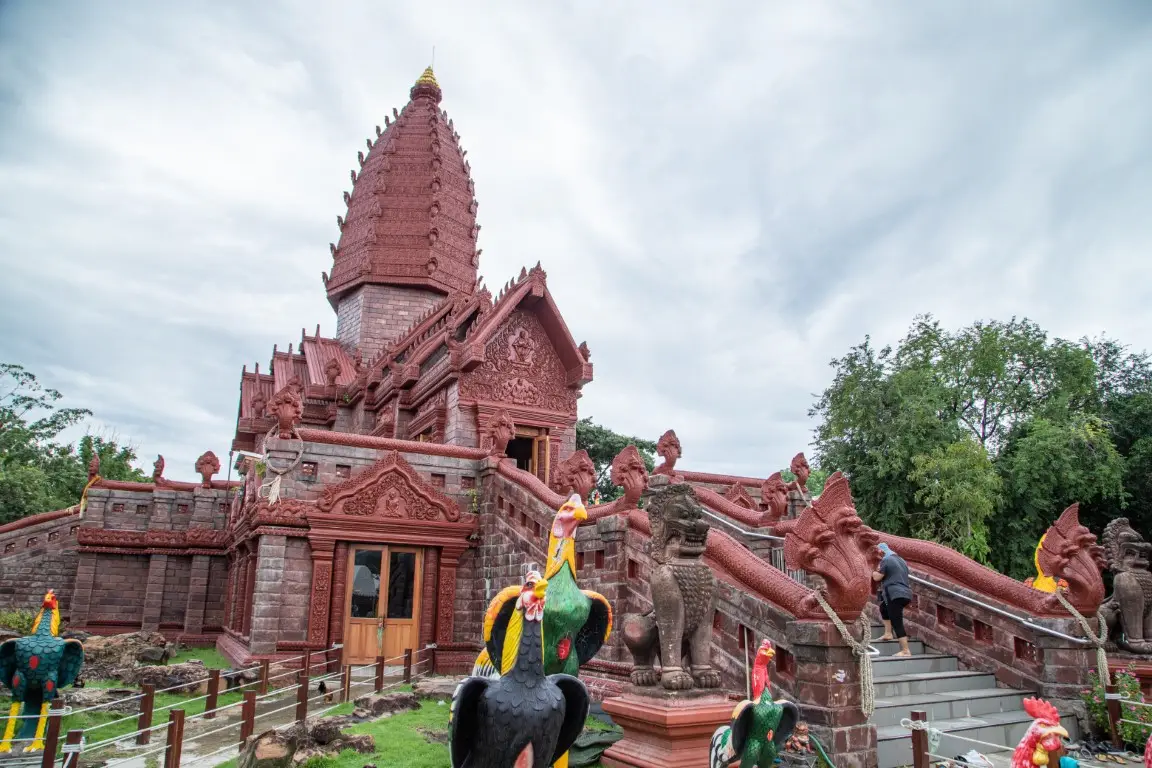
The most important architectural highlight of the temple is the Luang Pu Suang Castle-Like Mondop. Built with red brick and designed in a form inspired by Khmer-style sacred architecture, the building rises prominently within the temple grounds. Its tower, layered rooflines, carved details, and red surfaces make it the visual landmark of Wat Phrai Phatthana. The Khmer-inspired form is especially appropriate in this region because southern Si Sa Ket has long been shaped by ancient Khmer art, local Khmer-speaking communities, and borderland cultural exchange.
Inside the mondop is the glass coffin containing the body of Luang Pu Suang. This is the spiritual heart of the temple. Visitors enter the sacred area to bow, offer flowers, candles, garlands, robes, or donations, and pay respect with quiet attention. Many devotees also pass beneath the glass coffin as an act of faith and as a request for auspiciousness. This practice should be done calmly and respectfully, without rushing, crowding, or treating the ritual as entertainment. For devotees, the act is a personal expression of reverence for a teacher whose life continues to inspire them.
Around the temple grounds, visitors will notice many rooster statues. These are offerings made by devotees, often connected with vows and gratitude toward Luang Pu Suang. The rooster statues have become one of the most recognizable visual features of the temple. They express the language of popular devotion and show how local faith takes visible form. For international visitors, this area helps explain how Thai temple culture often combines formal Buddhist worship with local symbolic offerings and personal acts of gratitude.
Wat Phrai Phatthana is an active local Buddhist temple under the Dhammayuttika tradition. The current abbot is Phra Khru Kosol Sikkhakit, also known as Luang Pho Phut Wayamo. He also serves as the ecclesiastical chief of Phu Sing District in the Dhammayuttika order. Under his care, the temple continues to develop as a place of worship, education, pilgrimage, and community activity. The temple is not only a memorial site for Luang Pu Suang but also an active religious institution with resident monks and ongoing Buddhist work.
The temple also supports Buddhist education through Kosol Sikkhakit Witthaya Buddhist Scripture School at Wat Phrai Phatthana. This school provides education for monks and novices, making the temple important not only as a pilgrimage destination but also as a place for religious learning. The presence of a monastic school gives the temple an educational role and connects Luang Pu Suang’s legacy with the training of future generations in Buddhist discipline, Pali study, and moral development.
Wat Phrai Phatthana received its royal boundary, or Wisungkham Sima, in 2007. Over time, the temple developed important structures such as the ordination hall, large hall, monks’ residences, classrooms, and areas for receiving visitors. These buildings support monastic ceremonies, public merit-making, Dhamma activities, and large gatherings of devotees. During major festivals, the temple must accommodate a large number of visitors, and its facilities reflect the continuing strength of public devotion to Luang Pu Suang.
Relics of the Buddha have also been enshrined within the Luang Pu Suang mondop. This gives the sacred building an additional layer of Buddhist meaning. Visitors come to pay respect both to the Buddha relics and to the preserved body of a revered monk. For Buddhists, such worship is not only a request for worldly blessings. It is also an opportunity to reflect on the Buddha, the Dhamma, the Sangha, and the value of moral practice.
The devotion to Luang Pu Suang is distinctive because his memory exists between biography, local legend, and personal religious experience. Many details of his life remain part of oral tradition, yet his reputation rests strongly on his conduct. He was remembered as quiet, simple, austere, and compassionate. This is why people continue to come. They do not come only to see a temple building; they come to connect with a teacher whose way of life represents renunciation, spiritual discipline, and deep compassion for ordinary people.
One of the most important annual events at the temple is the Songkran-period ceremony of bathing and changing the robe of Luang Pu Suang. Devotees gather to honor their teacher, make merit, and express gratitude. The ceremony reveals the living power of discipleship in Thai Buddhist culture. For those who visit during this period, the temple becomes especially lively, with offerings, chanting, crowds of devotees, and a strong sense of shared reverence.
Another important part of the temple environment is Wat Phrai Phatthana Market, a community market located within the temple area. This market connects pilgrimage with local livelihood. Visitors who come to worship can also buy local products, food, offerings, and community goods. The market helps distribute income to local residents and strengthens the relationship between temple tourism and grassroots economy. It also makes the temple area feel like a living community space rather than a detached monument.
Wat Phrai Phatthana is close to several important borderland attractions. Many visitors combine the temple with Pha Phaya Kupri Viewpoint, Suksamran Beach at Huai Samran Reservoir, Chong Sa-ngam border market and checkpoint, Wat Phra Phutthabat Phu Sing, Pha Mo I Daeng, and Khao Phra Wihan National Park. The temple is therefore a natural starting point for a route that combines pilgrimage, mountain scenery, local markets, and the Thai-Cambodian border landscape.
The location in Phu Sing District gives the temple a strong sense of place. This area includes mountains, rubber plantations, agricultural villages, forested slopes, Khmer-speaking communities, and border routes. The temple is not an urban temple separated from its landscape. It stands in a borderland where Buddhism, local identity, historical memory, and nature meet. This makes Wat Phrai Phatthana especially meaningful for travelers who want to experience Lower Isan beyond the better-known provincial capital.
Travel from Si Sa Ket city to Wat Phrai Phatthana is best done by private car or hired vehicle. The route heads south through Wang Hin and Khukhan before entering the Phu Sing area. Depending on the chosen roads, the trip is about 90 to 100 kilometers. From Khun Han, the temple is about 35 to 40 kilometers away. The temple can also be combined with the route to Chong Sa-ngam and the Phanom Dong Rak mountain area. Visitors should allow enough time for driving because the temple is located in a border district rather than near the provincial city.
Getting There by private car is the most practical option. Visitors from Si Sa Ket city should travel south and follow the route toward Phu Sing District and Phrai Phatthana Subdistrict. Those who want a full-day itinerary can start at Wat Phrai Phatthana in the morning, continue to Pha Phaya Kupri Viewpoint, visit Suksamran Beach or Chong Sa-ngam, and then return through Khun Han or Khukhan. Visitors who prefer a slower trip may stay overnight in Phu Sing or Khun Han.
The best time to visit is in the morning or early evening. Morning is suitable for worship, walking through the temple market, and paying respect inside the mondop with less heat. Late afternoon gives beautiful natural light on the red-brick mondop. Visitors who want to take photographs should do so respectfully, especially inside sacred areas. The temple is a place of devotion, and photography should never disturb worshippers or monks.
There is no fixed tourist admission fee at Wat Phrai Phatthana. Visitors may enter during opening hours to pay respect, worship Luang Pu Suang, walk through the temple market, and admire the red-brick mondop. Offerings, flowers, garlands, candles, robes, and donations are voluntary according to personal faith. This open access makes the temple available to local residents, pilgrims, Thai travelers, students, and international visitors.
Proper etiquette is essential. Visitors should dress modestly, remove shoes where required, keep quiet inside the mondop, avoid touching the glass coffin or sacred objects without permission, avoid blocking the path of devotees passing beneath the coffin, avoid climbing on temple structures or rooster statues, and keep the temple clean. Since many people come with deep faith, all visitors should behave with respect and restraint.
For visitors who wish to pass beneath the glass coffin, the practice should be done in an orderly and calm manner. It is a devotional act connected with auspiciousness and respect for Luang Pu Suang. Visitors should follow temple instructions, wait for their turn, avoid pushing, and leave space for others after completing the act of worship. Respectful behavior preserves the sacred atmosphere inside the mondop.
For international travelers, Wat Phrai Phatthana is a powerful introduction to Lower Isan spirituality. It presents an active Thai Buddhist temple, devotion to a revered monk, Khmer-inspired sacred architecture, local offerings, a community market, and a borderland cultural landscape. It shows that Thai Buddhism is not only found in famous royal temples or urban monuments. It also lives strongly in border temples where local people carry memory, faith, and gratitude across generations.
Wat Phrai Phatthana is therefore one of the most important pilgrimage destinations in Si Sa Ket Province. The Luang Pu Suang mondop is its architectural heart. The glass coffin is its devotional heart. The temple market is its community heart. The rooster offerings are its popular-faith image. The Phu Sing-Chong Sa-ngam landscape is its geographical context. Together, these elements create a temple experience that is religious, cultural, local, and deeply memorable.
In summary, Wat Phrai Phatthana, or Wat Ban Phrai Phatthana Luang Pu Suang, is a major sacred destination in Phu Sing District. It preserves the memory of Luang Pu Suang, the earth-walking angel of Lower Isan, and continues to serve as a living temple, pilgrimage center, monastic education site, community market, and gateway to borderland attractions. Visitors come here for blessing, reflection, cultural learning, and a deeper understanding of faith in southern Si Sa Ket.
| Place Name | Wat Phrai Phatthana, Si Sa Ket / Wat Ban Phrai Phatthana Luang Pu Suang |
| Related Names | Wat Phrai Phatthana, Wat Luang Pu Suang, Luang Pu Suang Mondop, Luang Pu Suang The Earth-Walking Angel, Wat Phrai Phatthana Market |
| Place Type | Local Buddhist Temple, Dhammayuttika Monastery, Pilgrimage Site, Meditation Place, Community Market Area, And Major Faith-Based Destination In Phu Sing District |
| Location | 111 Moo 10, Phrai Phatthana Subdistrict, Phu Sing District, Si Sa Ket Province 33140, Thailand |
| Coordinates | 14.465792, 104.071762 |
| Distance From Key Points | About 90 - 100 km from Si Sa Ket city by road, about 35 - 40 km from Khun Han town, and located on the Phu Sing - Chong Sa-ngam borderland travel route |
| Significance | A major temple dedicated to Luang Pu Suang, the revered monk known as the earth-walking angel of Lower Isan. The temple enshrines his preserved body in a glass coffin inside the Luang Pu Suang Castle-Like Mondop. |
| Historical Summary | Wat Phrai Phatthana was once associated with Luang Pu Suang’s residence and practice. After he passed away in 1999, his body did not decay and was enshrined in a glass coffin inside the mondop for devotees to pay respect and receive blessings. |
| Important Figure | Luang Pu Suang, a revered monk and ascetic practitioner along the Thailand-Cambodia border, widely known as the earth-walking angel or angel who walked on earth of Lower Isan |
| Abbot / Caretaker | Phra Khru Kosol Sikkhakit, also known as Luang Pho Phut Wayamo, Abbot Of Wat Phrai Phatthana and Ecclesiastical Chief Of Phu Sing District in the Dhammayuttika order, together with resident monks, Luang Pu Suang Foundation, disciples, and the Phrai Phatthana community |
| Resident Monks | 5 Resident Monks |
| Main Sacred Objects | The preserved body of Luang Pu Suang in a glass coffin, Buddha relics inside the mondop, Luang Pu Suang images, the Luang Pu Suang Castle-Like Mondop, and worship areas within the temple |
| Architectural Highlight | The red-brick Luang Pu Suang Castle-Like Mondop, inspired by Khmer-style sacred architecture, with a prominent tower, ornate details, and a strong devotional atmosphere |
| Current Status | Active Buddhist temple and faith-based destination where visitors can worship Luang Pu Suang, pay respect at the glass coffin, walk through the temple market, and see the red-brick mondop during opening hours |
| Open Days | Daily |
| Opening Hours | 06.00 - 20.00 |
| Admission Fee | Free Admission. Donations, flowers, garlands, candles, robes, and merit-making offerings are voluntary according to personal faith. |
| Main Annual Traditions | Songkran-period ceremony for bathing and changing the robe of Luang Pu Suang, merit-making ceremonies honoring the teacher, Kathin, robe-offering events, and devotional activities of Luang Pu Suang’s disciples |
| Main Areas / Zones | 1. Luang Pu Suang Castle-Like Mondop Zone 2. Luang Pu Suang Glass Coffin Zone 3. Auspicious Passing Beneath The Glass Coffin Zone 4. Buddha Relic Worship Zone Inside The Mondop 5. Luang Pu Suang Image And Offering Zone 6. Rooster Offering Zone 7. Wat Phrai Phatthana Market / Community Market Zone 8. Ordination Hall And Main Hall Zone 9. Kosol Sikkhakit Witthaya Buddhist Scripture School Zone 10. Temple Courtyard And Merit-Making Area 11. Monks’ Residence And Monastic Area 12. Red-Brick Mondop Photo Zone |
| Facilities | Parking area, worship areas, mondop, main hall, temple market, flower and offering points, toilets, waiting areas, temple courtyard, and basic community services in Phrai Phatthana Subdistrict |
| Related Contact | Wat Phrai Phatthana / Luang Pu Suang Foundation, Tel. 081-265-9154, 081-394-1813, 098-586-0507, 099-625-3859 Huai Tik Chu Subdistrict Administrative Organization, Tel. 045-608021, 045-608112 |
| Travel Information | From Si Sa Ket city, travel south through Wang Hin and Khukhan toward Phu Sing District, using Highways 220, 24, 2201, 4001, and 2341. The road distance is about 90 - 100 km. Private car, van, or hired local transport is recommended. |
| Visitor Etiquette | Dress modestly, keep quiet, remove shoes where required, do not touch the glass coffin or sacred objects without permission, do not climb temple structures or rooster statues, do not block devotees passing beneath the coffin, respect monks and worshippers, and keep the temple clean. |
| Nearby Tourist Attractions | 1. Wat Phrai Phatthana Market, inside the temple, about 0 km 2. Pha Phaya Kupri Viewpoint, about 8 km 3. Suksamran Beach / Huai Samran Reservoir, about 9 km 4. Chong Sa-ngam New Town, about 12 km 5. Chong Sa-ngam Permanent Border Checkpoint, about 13 km 6. Wat Phra Phutthabat Phu Sing, about 18 km 7. Pha Mo I Daeng / Khao Phra Wihan National Park, about 25 km 8. Wat Pa Maha Chedi Kaew / Million Bottle Temple, about 42 km, Tel. 084-524-3770 9. Samrong Kiat Waterfall / Namtok Pisat, about 45 km, Tel. 063-565-9399 10. Si Sa Ket City, about 90 - 100 km |
| Nearby Restaurants | 1. Wood-Fired Pizza, Phrai Phatthana, about 1 km, Tel. 086-440-7603 2. The Yard - Suksamran, about 9 km, Tel. 094-542-3292 3. Pongsin Resort & Restaurant, Phran Subdistrict, about 18 km, Tel. 088-375-5199 4. BJ Coffee House, Khun Han, about 38 km, Tel. 098-214-6024 5. Cho Cher Coffee & Bakery, Khun Han, about 38 km, Tel. 091-014-0622 6. MOMOCHA Taiwanese Bubble Tea Khun Han, about 38 km, Tel. 064-959-0476, 062-441-9235 7. Baan Nom Sod Khun Han, about 38 km, Tel. 094-287-2058 8. Pornsawan Cafe, Khun Han, about 39 km, Tel. 063-497-7625, 088-192-3166 |
| Nearby Accommodations | 1. Honeymoon Resort, Phu Sing, about 10 km, Tel. 093-567-1285 2. Pungluang Resort, Phu Sing, about 12 km, Tel. 092-992-9952 3. Pongsin Resort & Restaurant, Phran Subdistrict, about 18 km, Tel. 088-375-5199 4. Huai Sun Resort, about 22 km, Tel. 045-781-844, 045-781-845, 089-844-8185 5. Peace Pool Resort, Khun Han, about 38 km, Tel. 081-879-5822 6. Rerawadi Resort & Spa, Khun Han, about 38 km, Tel. 087-128-0095 7. B2 Sisaket Boutique & Budget Hotel, Mueang Si Sa Ket, about 95 km, Tel. 052-009-161, 088-263-2897 |
Frequently Asked Questions (FAQ)
Q: Where is Wat Phrai Phatthana or Wat Ban Phrai Phatthana Luang Pu Suang located?
A: Wat Phrai Phatthana is located in Phrai Phatthana Subdistrict, Phu Sing District, Si Sa Ket Province. It is a major temple associated with Luang Pu Suang and lies on the Phu Sing - Chong Sa-ngam borderland travel route.
Q: What are the opening days and hours?
A: Wat Phrai Phatthana is open daily from 06.00 to 20.00. Visitors can worship Luang Pu Suang, see the mondop, walk through the temple market, and make merit during these hours.
Q: Is there an admission fee?
A: There is no admission fee. Donations, flowers, garlands, candles, robes, and merit-making offerings are voluntary according to personal faith.
Q: Why is Luang Pu Suang important?
A: Luang Pu Suang was a revered monk and ascetic practitioner along the Thailand-Cambodia border. He is deeply respected in Lower Isan as the earth-walking angel or angel who walked on earth.
Q: Who is the current abbot of Wat Phrai Phatthana?
A: The current abbot is Phra Khru Kosol Sikkhakit, also known as Luang Pho Phut Wayamo. He is also the ecclesiastical chief of Phu Sing District in the Dhammayuttika order and oversees the temple with resident monks, the Luang Pu Suang Foundation, disciples, and the local community.
Q: What are the main highlights inside the temple?
A: Main highlights include the Luang Pu Suang Castle-Like Mondop, the glass coffin containing Luang Pu Suang’s preserved body, the auspicious passing-beneath-the-coffin area, Buddha relics, Luang Pu Suang images, rooster offerings, Wat Phrai Phatthana Market, the ordination hall, the main hall, and the Buddhist scripture school.
Q: How can visitors get to Wat Phrai Phatthana?
A: From Si Sa Ket city, travel south through Wang Hin and Khukhan toward Phu Sing District. The distance is about 90 - 100 km by road. Private car, van, or hired local transport is the most convenient option.
Q: What nearby places can be visited on the same trip?
A: Nearby places include Pha Phaya Kupri Viewpoint, Suksamran Beach, Chong Sa-ngam New Town, Chong Sa-ngam Permanent Border Checkpoint, Wat Phra Phutthabat Phu Sing, Pha Mo I Daeng, Khao Phra Wihan National Park, Wat Pa Maha Chedi Kaew, and Samrong Kiat Waterfall.
 Category: ●Places of Worship
 Group: ●Temple
Last Update : 2 MonthAgo
 Last Update : 2 MonthAgo
 Click to Access the Navigation Map GPS
Wat Phrai Phatthana Map

 Art, Culture and Heritage
 Historical Sites and Monuments(12)
 Landmarks and Memorials(1)
 Art, Craft Centres, Tradition(8)
Temple(13)
Art, Craft Centres, Tradition(8)
Temple(13)
 Other Sacred Sites(3)
 Suburban Living
 Village, Community(2)
 Nature and Wildlife
 National Parks and Marine Reserves(2)
 Dam, Reservoir, Lake(7)
 Waterfalls(5)
 River, Canal(5)
 Bays and Beaches(2)
 Entertainment and Agricultural
 Zoos and Aquariums(1)
 Farms, Parks and Ecotourism(3)


