
lovethailand home >Northeastern Travel Attractions >Si Sa Ket Travel Attractions >Huai Thap Than >Huai Thap Than > Ancient Castle
TL;DR: Ancient Castle is located at Wat Prasat Phanaram, Ban Prasat, Prasat Subdistrict, Huai Thap Than District, Si Sa Ket Province, open Daily, hours 08.30 – 16.30.
Ancient Castle
Open Days: Daily
Opening Hours: 08.30 – 16.30
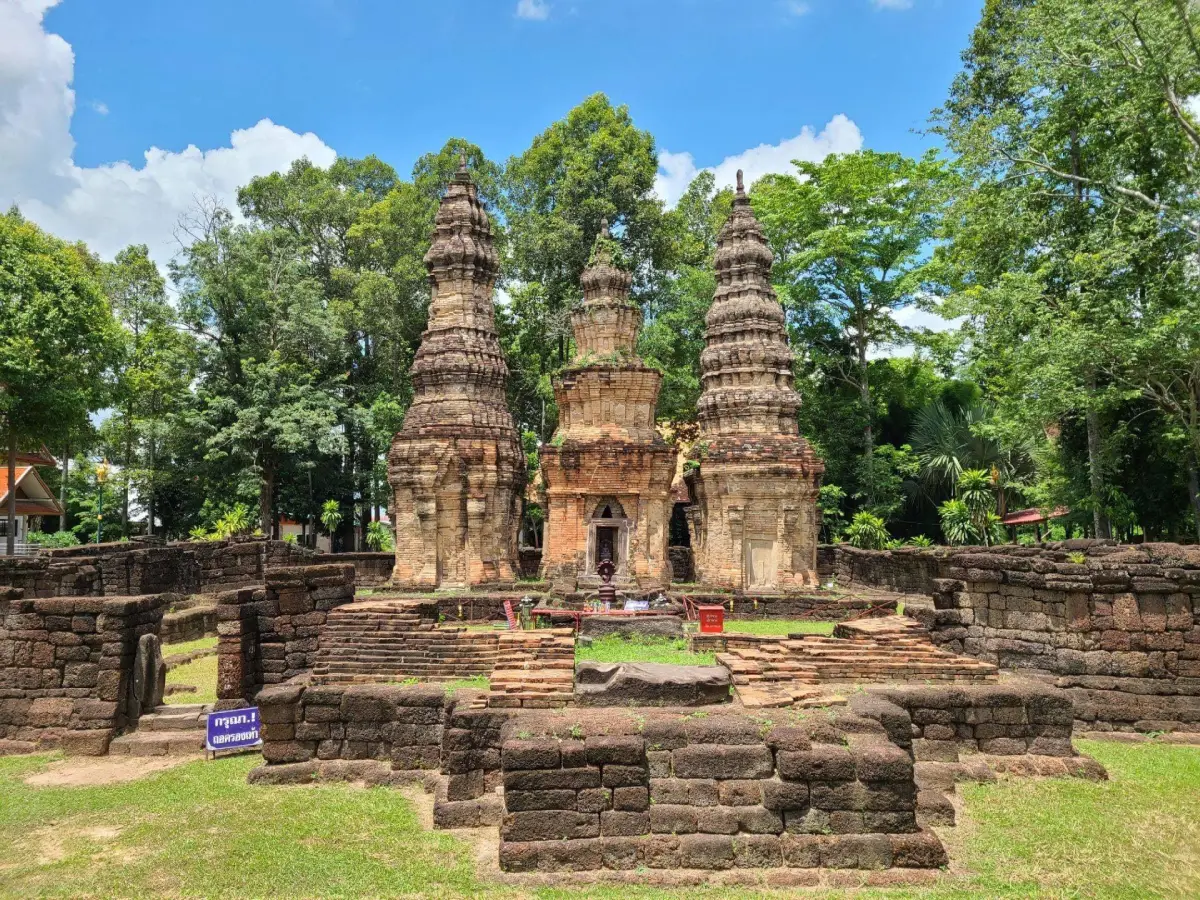
Prasat Boran Si Sa Ket in this article refers to Prasat Ban Prasat, also known as Prasat Huai Thap Than or Prasat Ban Non That, an ancient Khmer sanctuary located inside Wat Prasat Phanaram at Ban Prasat, Prasat Subdistrict, Huai Thap Than District, Si Sa Ket Province. The monument was originally a Brahmanical-Hindu sanctuary in ancient Khmer art, dating to around the 16th–17th Buddhist centuries. It consists of 3 brick sanctuary towers standing on the same laterite base, aligned along a north-south axis and facing east. The site is enclosed by a laterite boundary wall, with gopura gateway remains that mark the sacred precinct. Today, Prasat Ban Prasat remains open to visitors and continues to function as both an archaeological site and a living sacred place within the local temple community.
The most distinctive feature of Prasat Ban Prasat is its group of 3 brick towers. Their overall form is still clearly visible, although parts of the monument were modified and repaired in later periods. The upper sections of the towers were altered into a form that closely resembles Prasat Sikhoraphum in Surin Province, especially in the layered roof structure. This later modification gives the monument a unique identity. Visitors can see not only the original Khmer sacred plan but also the way later communities reused, repaired, and reinterpreted the ancient structure within a continuing religious landscape.
Because the sanctuary stands inside Wat Prasat Phanaram, the site has both archaeological and contemporary religious meaning. Visitors encounter an ancient Khmer monument within an active Buddhist temple, where local people continue to worship, make vows, and participate in community religious events. This living setting makes Prasat Ban Prasat different from isolated ruins. It remains part of the spiritual life of Ban Prasat village and continues to hold meaning for the local community.
The site is known by several names. Prasat Ban Prasat refers to the village where the monument stands. Prasat Huai Thap Than connects it with Huai Thap Than District, while Prasat Ban Non That is another local name found in tourism and community information. These names show that the monument is remembered through several layers of identity: archaeological, administrative, local, religious, and cultural. Rather than creating confusion, the different names reveal the long relationship between the monument and the people who live around it.
The architectural plan is one of the main reasons to visit. The 3 brick towers stand on a shared laterite platform and are aligned from north to south. All 3 towers face east, which is the sacred direction of sunrise, renewal, light, and ritual entry in ancient Khmer religious architecture. Approaching the sanctuary from the eastern side allows visitors to understand the main ritual axis of the site. The eastern approach connects the entrance, the laterite base, the central tower, and the sacred interior of the monument.
The central tower is the principal sanctuary. It is slightly larger than the flanking towers and has a square plan with indented corners. The indented-corner plan creates depth, shadow, and vertical rhythm, giving the structure a more dynamic appearance than a simple square tower. The entrance opens only on the eastern side and is framed by sandstone. Although the upper section of the tower was modified in later periods, the surviving body of the tower still preserves the sacred architectural language of an ancient Khmer shrine.
The lintel above the entrance of the central tower is one of the most important artistic elements of the site. It shows a standing figure above a kala face, with garland motifs and additional standing figures within ornamental niches. The carving was not fully completed, so the identity of the central figure cannot be stated definitively. However, the kala face, garland, and niche composition clearly belong to the symbolic vocabulary of Khmer art. The kala motif served as a powerful protective sign at the threshold of sacred space, while garlands and shrine-like framing enhanced the ritual meaning of the doorway.
The unfinished carving is especially valuable because it allows visitors to see traces of the working process of ancient artisans. Many monuments show only completed works, but at Prasat Ban Prasat the lintel preserves signs of composition, rough shaping, and incomplete detail. For travelers interested in Khmer stone carving, this makes the site a practical open-air lesson in how sacred images were planned and carved in sandstone.
The northern and southern towers are similar in size and were heavily modified in later periods, especially at the roof and doorway sections. Their doorways were filled in with brick, leaving the towers sealed on all sides. Even so, sandstone door frames and architectural traces remain visible. These modified towers show that ancient monuments were not static objects. They were repaired, transformed, and reused by later communities according to changing religious and social needs.
In front of the southern tower lies a fragment of a lintel depicting the Churning of the Ocean of Milk. This is one of the great Hindu mythological scenes. It tells of gods and demons working together to churn the cosmic ocean in order to obtain amrita, the nectar of immortality. The theme represents cosmic renewal, divine power, cooperation between opposing forces, and the restoration of universal balance. Its presence at Prasat Ban Prasat strongly confirms the Brahmanical-Hindu meaning of the original sanctuary.
Based on its artistic features and architecture, Prasat Ban Prasat dates to around the 16th–17th Buddhist centuries and belongs to the Khleang-Baphuon artistic tradition of Khmer art. The Khleang style is known for structural strength and restrained elegance, while the Baphuon style is known for refined ornament and balanced religious imagery. This combination makes the monument an important example of the artistic development of Khmer culture in Lower Northeastern Thailand.
The sanctuary was built to enshrine the Trimurti according to Brahmanical-Hindu belief. The Trimurti represents the 3 major cosmic functions of Brahma, Vishnu, and Shiva: creation, preservation, and dissolution. The 3 towers standing on one shared base can be understood in relation to this sacred concept. The architectural layout is therefore not only a visual arrangement but also a religious statement expressed through space and structure.
A laterite enclosure wall surrounds the tower group, with gopura gateway remains forming ceremonial entrances into the sacred area. The enclosure wall marked the boundary between ordinary space and sacred space. The gopura was more than a practical gateway; it was a ritual passage into the sanctuary. Today, important remains are visible especially on the southern and eastern sides, allowing visitors to understand the original sacred organization of the site.
The materials used at Prasat Ban Prasat reveal the skill of ancient Khmer builders. Brick was used for the main body of the towers, laterite for the platform and enclosure wall, and sandstone for door frames, lintels, and carved elements. Each material had a specific function. Brick gave mass and shape to the towers. Laterite provided structural strength. Sandstone allowed detailed carving and sacred imagery. This careful selection of materials shows the technical and artistic sophistication of the builders.
The later modification of the tower roofs is another important part of the site’s story. The upper sections resemble the form of Prasat Sikhoraphum in Surin Province, showing how later builders adapted the sanctuary to suit changing religious or cultural contexts. Such modification should not be seen only as damage to the original form. It is also evidence that the site continued to be meaningful after the Khmer period and was incorporated into later sacred traditions.
Local faith remains strong at Prasat Ban Prasat. People in the community regard the monument as a sacred place where those facing hardship may come to make vows and ask for blessings. This continuing belief gives the site a living spiritual role. For foreign visitors, this is an important cultural point: many ancient monuments in Thailand are not treated only as archaeological remains. They continue to function as sacred places within living Buddhist and local belief systems.
The most important annual event at the site is the Phra That worship tradition held on the full moon day of the 3rd lunar month. The event brings local people together for merit-making, worship, and community participation. It connects the ancient Khmer monument, the Buddhist temple, and the faith of Ban Prasat village. Through this annual tradition, the monument remains part of living community memory rather than a silent ruin separated from local life.
A good walking route begins on the eastern side, where the 3 towers can be viewed together on the same laterite base. From there, visitors should move toward the central tower to examine the sandstone doorway and the lintel with the standing figure above the kala face. Then walk to the northern and southern towers to observe later modifications and sealed doorways. The lintel fragment of the Churning of the Ocean of Milk near the southern tower should be viewed carefully, followed by the laterite wall and gopura remains.
The main zones of interest include the eastern entrance area, central sanctuary tower, northern and southern flanking towers, shared laterite base, sandstone doorway, central lintel, Churning of the Ocean of Milk lintel fragment, laterite enclosure wall, gopura remains, Wat Prasat Phanaram temple area, and the space used for the annual Phra That worship event. Exploring these zones in sequence helps visitors understand the monument as a complete sacred landscape.
The atmosphere is calm, shaded, and suitable for slow cultural travel. The temple environment allows visitors to observe the monument closely without the intensity of a large tourist site. The old brick surfaces, laterite platform, sandstone door frames, and remaining carved elements are best appreciated through careful observation. This is not a place to rush through; its value lies in details, traces, and the relationship between ancient architecture and present-day community life.
For photography, the eastern front is the best angle for capturing the 3 towers together. Side views show the difference between the central tower and the flanking towers, as well as the later roof modifications. Close-up views of the laterite base, sandstone doorway, and carved fragments reveal the texture of the materials. Morning and late afternoon light are especially good for photographing the warm color of the brick and the weathered surface of the stone.
Traveling from Si Sa Ket city is straightforward by private car or rental vehicle. Take Highway 226 for about 39 km toward Huai Thap Than District, then turn right and continue for about 8 km to Wat Prasat Phanaram at Ban Prasat. The site can also be reached by train by getting off at Huai Thap Than Railway Station and continuing by local transport or hired vehicle to the temple.
Getting There by private vehicle is the most convenient option because travelers can combine the site with nearby attractions such as Wat Pa Pracha Rangsan, Huai Thap Than Railway Station, Prasat Wat Sa Kamphaeng Yai, Prasat Wat Sa Kamphaeng Noi, Ku Sombun, and Prasat Sikhoraphum in Surin Province. A half-day route can focus on Huai Thap Than, while a full-day route can connect several Khmer heritage sites across western Si Sa Ket and nearby Surin.
A normal visit takes around 30–60 minutes. Visitors who want to study the lintels, sandstone door frames, laterite enclosure, gopura remains, later modifications, and temple context should allow around 1–1.30 hours. The site is compact, but its meaning is best understood through slow observation of form, material, sacred orientation, and community use.
Respectful behavior is essential because the site is both an ancient monument and part of an active temple. Visitors should dress modestly, avoid climbing on the towers or base, avoid writing on brick or stone, avoid moving ancient fragments, avoid touching carvings unnecessarily, and keep the area clean. Respect for the site also means respecting monks, local worshippers, and community members who continue to care for the temple grounds.
As a learning site, Prasat Ban Prasat helps explain several important aspects of Khmer heritage in one place: the 3-tower sanctuary plan, east-facing orientation, use of brick, laterite, and sandstone, the protective meaning of the kala motif, the Churning of the Ocean of Milk myth, the Trimurti concept, and later architectural modification. Students, cultural travelers, and history enthusiasts can use the site as a clear example of how Khmer sanctuaries changed across time while remaining meaningful to local communities.
Compared with other Khmer monuments in Si Sa Ket, Prasat Ban Prasat has a distinctive identity. Prasat Wat Sa Kamphaeng Yai is known for its large scale and rich lintels. Prasat Wat Sa Kamphaeng Noi is known for its arokayasala hospital-chapel layout. Ku Sombun is known for its community sanctuary and horseshoe-shaped moat. Prasat Ban Prasat stands out for its 3 brick towers, modified roof forms, Trimurti association, and its continuing life inside Wat Prasat Phanaram.
At the community level, the monument shows how ancient heritage can remain active in modern life. Local people still make merit at the temple, join annual worship traditions, and preserve belief connected with the sanctuary. This makes Prasat Ban Prasat more than an archaeological site. It is a place where history, religion, local memory, and community identity continue to meet.
What makes Prasat Ban Prasat memorable is the combination of architecture, myth, and living faith. The 3 brick towers on one laterite base express sacred design. The central lintel with the kala motif preserves Khmer symbolic language. The Churning of the Ocean of Milk fragment connects the site with Hindu cosmology. The laterite wall and gopura remains show the boundary of sacred space. The temple setting keeps the monument spiritually active today.
Visiting Prasat Boran Si Sa Ket, or Prasat Ban Prasat, is therefore a journey into the layered cultural history of Lower Northeastern Thailand. Visitors encounter ancient Khmer art, Brahmanical-Hindu belief, later architectural modification, Buddhist temple life, and the faith of a local village community in one compact site. For foreign travelers seeking a deeper and quieter cultural experience in Si Sa Ket Province, this sanctuary offers a clear and meaningful encounter with the region’s Khmer heritage.
| Name | Prasat Boran Si Sa Ket / Prasat Ban Prasat / Prasat Huai Thap Than / Prasat Ban Non That |
| Location | Wat Prasat Phanaram, Ban Prasat, Prasat Subdistrict, Huai Thap Than District, Si Sa Ket Province |
| Address | Prasat Subdistrict, Huai Thap Than District, Si Sa Ket 33210, Thailand |
| Coordinates | 15.106944, 104.033333 |
| Highlights | Three brick Khmer towers on one laterite base, east-facing sacred orientation, lintel with a standing figure above a kala face, Churning of the Ocean of Milk lintel fragment, laterite enclosure wall, gopura remains, and later modified roof forms resembling Prasat Sikhoraphum |
| History | Ancient Khmer Brahmanical-Hindu sanctuary dating to around the 16th–17th Buddhist centuries in the Khleang-Baphuon artistic tradition, built to enshrine the Trimurti and later modified in subsequent periods |
| Name Origin | Prasat Ban Prasat relates to Ban Prasat village and Wat Prasat Phanaram. Prasat Huai Thap Than refers to Huai Thap Than District, while Prasat Ban Non That is another local name associated with the same monument. |
| Distinctive Features | Three east-facing brick towers aligned north-south on a shared laterite base. The central tower is slightly larger than the side towers and has an eastern sandstone doorway with a carved lintel. |
| Key Evidence | Shared laterite base, 3 brick towers, sandstone door frames, central lintel with a standing figure above a kala face, Churning of the Ocean of Milk lintel fragment, laterite enclosure, eastern and southern gopura remains, and evidence of later architectural modification |
| Travel Information | From Si Sa Ket city, take Highway 226 for about 39 km to Huai Thap Than District, then turn right and continue for about 8 km to Wat Prasat Phanaram at Ban Prasat. |
| Current Status | Open to visitors as an archaeological site inside Wat Prasat Phanaram and a sacred community landmark of Ban Prasat, Huai Thap Than District |
| Open Days | Daily |
| Opening Hours | 08.30 – 16.30 |
| Fees | Free Admission |
| Facilities | Parking inside the temple area, walking area around the archaeological site, Buddhist worship area, shaded temple surroundings, and road access from Huai Thap Than District |
| Main Areas / Zones | 1. Eastern entrance area 2. Central sanctuary tower 3. Northern and southern flanking towers 4. Shared laterite base 5. Sandstone doorway and lintel with a standing figure above a kala face 6. Churning of the Ocean of Milk lintel fragment 7. Laterite enclosure wall 8. Eastern and southern gopura remains 9. Wat Prasat Phanaram temple area 10. Annual Phra That worship event area |
| Local Festival / Cultural Event | Annual Phra That worship tradition on the full moon day of the 3rd lunar month, an important community faith event at Ban Prasat |
| Caretaker | Wat Prasat Phanaram and Ban Prasat community care for the temple area together with Prasat Subdistrict Administrative Organization. The ancient monument is under the Fine Arts Department through the 10th Regional Office of Fine Arts, Nakhon Ratchasima. |
| Local Contact | Prasat Subdistrict Administrative Organization, Tel. 045-826545 10th Regional Office of Fine Arts, Nakhon Ratchasima, Tel. 044-471518 CBT Thailand Tourism Information, Tel. 0-4451-4447 |
| Official Website / Official Page | Prasat Subdistrict Administrative Organization: prasat.go.th 10th Regional Office of Fine Arts, Nakhon Ratchasima: finearts.go.th/fad10 |
| Nearby Tourist Attractions | 1. Wat Prasat Phanaram, about 0 km 2. Wat Pa Pracha Rangsan, Huai Thap Than District, about 9 km 3. Huai Thap Than Railway Station, about 9 km 4. Prasat Wat Sa Kamphaeng Yai, Uthumphon Phisai District, about 18 km 5. Prasat Wat Sa Kamphaeng Noi, Uthumphon Phisai District, about 32 km 6. Ku Sombun, Bueng Bun District, about 33 km 7. Prasat Sikhoraphum, Surin Province, about 36 km |
| Nearby Restaurants | 1. Kai Yang Huai Thap Than, about 8 km, Tel. 045-699-197 2. 69 Menu, Huai Thap Than Branch, about 8 km, Tel. 085-555-7322 3. Kuai Jap Khun Nee Huai Thap Than, about 8 km, Tel. 086-382-4142 4. Ploensuk Cafe Jaew Hon + Moo Kratha, about 9 km, Tel. 089-669-4613, 083-992-8120 5. Raan Nong Ae Kai Yang, about 8 km, Tel. 045-699-155 6. Kuai Tiao Ruea Suea Yai, about 8 km, Tel. 083-706-4840 |
| Nearby Accommodations | 1. Chom Dao Resort Huai Thap Than, about 8 km 2. Ban Ai Din Resort Huai Thap Than, about 9 km, Tel. 045-699-301 3. Fahsai Resort Huai Thap Than, about 10 km, Tel. 089-941-2709 4. Onanong Resort, Uthumphon Phisai District, about 24 km, Tel. 081-910-7046, 089-012-7059 5. Tree House Hotel Si Sa Ket, about 47 km, Tel. 045-611-563, 080-477-7854 |
Frequently Asked Questions (FAQ)
Q: What is Prasat Boran Si Sa Ket in this article?
A: It refers to Prasat Ban Prasat, also known as Prasat Huai Thap Than or Prasat Ban Non That, an ancient Khmer sanctuary inside Wat Prasat Phanaram in Huai Thap Than District, Si Sa Ket Province.
Q: What are the opening hours of Prasat Ban Prasat?
A: The site is open daily from 08.30 to 16.30. Morning and late afternoon are the best times for walking and photographing the brick, laterite, and sandstone details.
Q: Is there an admission fee for Prasat Ban Prasat?
A: No. Admission is free. Visitors should dress respectfully and behave appropriately because the monument is located inside a temple area.
Q: Does Prasat Ban Prasat have other names?
A: Yes. It is also known as Prasat Huai Thap Than and Prasat Ban Non That. These names refer to the same Khmer monument in Ban Prasat, Huai Thap Than District.
Q: Why is Prasat Ban Prasat important?
A: It is an ancient Khmer Brahmanical-Hindu sanctuary dating to around the 16th–17th Buddhist centuries in the Khleang-Baphuon artistic tradition, built to enshrine the Trimurti and later modified in subsequent periods.
Q: What should visitors not miss at Prasat Ban Prasat?
A: Key highlights include the 3 brick towers on one laterite base, the lintel with a standing figure above a kala face, the Churning of the Ocean of Milk lintel fragment, the laterite enclosure, gopura remains, and the later modified roof forms.
Q: How can travelers get to Prasat Ban Prasat?
A: From Si Sa Ket city, take Highway 226 for about 39 km to Huai Thap Than District, then turn right and continue for about 8 km to Wat Prasat Phanaram at Ban Prasat.
Q: Does Prasat Ban Prasat have a local cultural event?
A: Yes. The annual Phra That worship tradition is held on the full moon day of the 3rd lunar month, connecting the Khmer monument, the temple, and the living faith of Ban Prasat community.
 Category: ●Art, Culture and Heritage
 Group: ●Historical Sites and Monuments
Last Update : 2 MonthAgo
 Last Update : 2 MonthAgo
 Click to Access the Navigation Map GPS
 Historical Sites and Monuments(12)
 Landmarks and Memorials(1)
 Art, Craft Centres, Tradition(8)
 Places of Worship
 Temple(13)
 Other Sacred Sites(3)
 Suburban Living
 Village, Community(2)
 Nature and Wildlife
 National Parks and Marine Reserves(2)
 Dam, Reservoir, Lake(7)
 Waterfalls(5)
 River, Canal(5)
 Bays and Beaches(2)
 Entertainment and Agricultural
 Zoos and Aquariums(1)
 Farms, Parks and Ecotourism(3)


