
lovethailand home >Northeastern Travel Attractions >Si Sa Ket Travel Attractions >Bueng Bun >Po > Ku Sombun
TL;DR: Ku Sombun is located at Ban Nong Khu Yai, Moo 7, Po Subdistrict, Bueng Bun District, Si Sa Ket Province, within Wat Pa Neranchara, open Daily, hours 08.00 – 17.00.
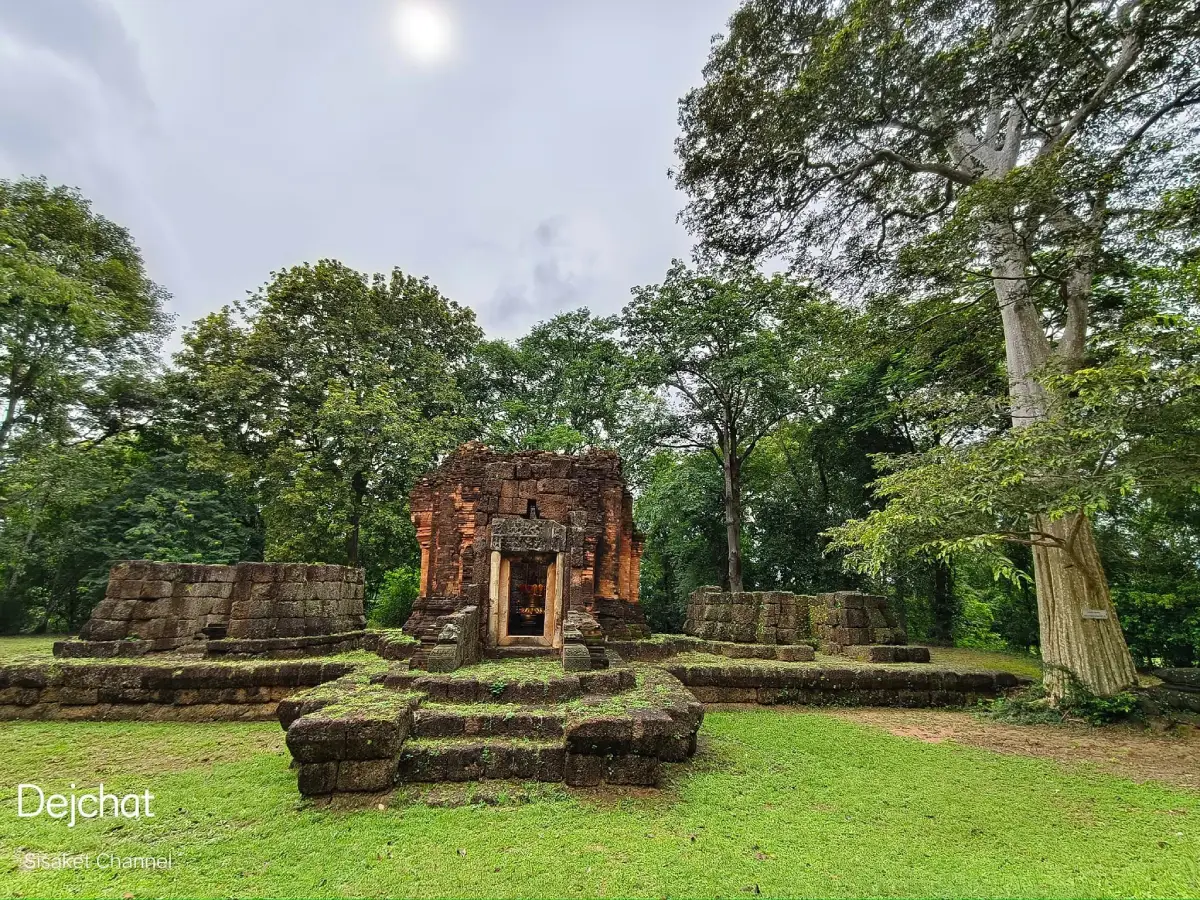
Ku Sombun
Open Days: Daily
Opening Hours: 08.00 – 17.00
Ku Sombun, also known as Prang Ku Sombun or Ku Ban Nong Khu, is an ancient Khmer archaeological site located at Ban Nong Khu Yai, Po Subdistrict, Bueng Bun District, Si Sa Ket Province. The site stands within the grounds of Wat Pa Neranchara and consists of 3 sanctuary towers built on the same laterite base. The towers were constructed with laterite, brick, and sandstone, and they face east according to the sacred orientation commonly found in ancient Khmer religious architecture. The entire monument is surrounded by a horseshoe-shaped moat with an entrance area on the southern side, making Ku Sombun a compact but meaningful example of a Khmer sacred landscape in a rural community of Lower Northeastern Thailand.
Ku Sombun is one of the important archaeological sites in Bueng Bun District. Although it is smaller and less monumental than Prasat Wat Sa Kamphaeng Yai or other major Khmer sanctuaries in Si Sa Ket, its value lies in the clarity of its layout and its continuing relationship with the local community. Visitors can still understand the original arrangement of the site: 3 towers on a common base, an east-facing axis, a central sanctuary chamber, a stone pedestal inside the main tower, an ancient moat, and a water landscape around the monument. These elements show that Ku Sombun was not an isolated ruin but a carefully arranged sacred place.
The name Ku Sombun reflects both local language and community memory. In Northeastern Thailand, the word “ku” is commonly used for ancient sanctuaries or sacred ruins. The alternative name Ku Ban Nong Khu links the monument directly with Ban Nong Khu Yai, the village in which it is located. These names show that the site belongs not only to archaeological history but also to the living memory of the community that has surrounded and preserved the place over many generations.
The monument stands inside Wat Pa Neranchara, which gives the visit both an archaeological and a contemporary Buddhist dimension. The temple is also known for its large warship-shaped religious building, often called Ruea Rop Phikhat Sangsarawat, a symbolic Dharma architecture designed to express the destruction of suffering and worldly attachment. This makes the area especially distinctive: visitors can see an ancient Khmer sanctuary and a modern Buddhist symbolic structure within the same temple landscape.
Architecturally, Ku Sombun consists of 3 sanctuary towers arranged on one laterite platform. The towers face east, a direction associated with sunrise, renewal, light, and ritual entry in Khmer sacred architecture. The shared laterite base gives the group a unified form and elevates the sacred structures above the surrounding ground. The central tower is the most important element of the complex and remains the clearest surviving part of the monument today.
The main materials used at Ku Sombun are laterite, brick, and sandstone. Laterite was commonly used in Khmer monuments across Northeastern Thailand because it was strong and suitable for structural elements such as bases, walls, and platforms. Brick was used for the body of the sanctuary towers, while sandstone was normally reserved for architectural pieces requiring clearer form or ritual importance. The combination of these materials shows the technical knowledge of ancient builders and the adaptation of Khmer construction to local resources.
The central sanctuary tower is built with laterite mixed with brick. Its inner wall is made of laterite, and inside the chamber is a square stone pedestal. This pedestal is one of the most important surviving elements of the site. It indicates that the chamber once held a sacred object such as a Shiva linga or a deity image. This helps identify Ku Sombun as a Hindu sacred site, or at least a sanctuary that functioned within the Brahmanical-Hindu religious world before later changes in local religious use.
The northern and southern towers are heavily damaged, leaving only traces, foundations, and earth mounds in some areas. Even in this condition, they remain important because they confirm that Ku Sombun was originally a 3-tower sanctuary rather than a single isolated tower. A careful visitor should look not only at the central tower but also at the remains on both sides, because the relationship between the 3 towers is essential to understanding the original layout.
The horseshoe-shaped moat surrounding the sanctuary is one of the most meaningful features of Ku Sombun. In Khmer sacred architecture, water was never just a practical resource. It symbolized purity, fertility, abundance, ritual protection, and the boundary between ordinary and sacred space. At Ku Sombun, the moat defines the religious precinct and helps create a sacred landscape around the sanctuary. The preserved entrance area shows how movement into the site was controlled and symbolically organized.
Although the sanctuary towers face east, the moat leaves an entrance area on the southern side. This detail makes the site especially interesting because it shows how sacred planning could be adapted to local topography, water management, and community access. Khmer architecture followed powerful symbolic principles, but local monuments often responded to the specific landscape in which they were built. Ku Sombun is a good example of that balance between sacred design and local geography.
The monument is generally dated to around the 16th–17th Buddhist centuries, a period when Khmer cultural influence was clearly visible across Lower Northeastern Thailand. During this period, many sanctuaries were connected with Brahmanical-Hindu belief, especially the worship of Shiva and other Hindu deities. The stone pedestal inside the central chamber and the layout of the sanctuary support the interpretation of Ku Sombun as a former sacred shrine rather than a purely commemorative structure.
Unlike some larger Khmer monuments, Ku Sombun does not preserve famous lintels or elaborate carved scenes in situ. Its importance comes from its plan, materials, moat, surviving pedestal, and community context. Visitors should appreciate the site through observation of structure rather than through individual sculptures. The laterite base, brick remains, stone pedestal, moat, and ancient water landscape all work together to tell the story of a small but meaningful Khmer sanctuary in rural Si Sa Ket.
Ku Sombun remains sacred to the local community. One of the important cultural events associated with the site is the annual ceremony to worship Ku Sombun and honor Khun Pu Yot Kaew. This ritual is held at Ku Sombun within Wat Pa Neranchara and reflects the way local belief, ancestral memory, and archaeological heritage continue to exist together. The site is therefore not simply an ancient ruin; it is a living cultural place where local people continue to gather, worship, and remember.
This annual worship ceremony gives the monument a continuing role in community life. Local people do not see Ku Sombun only as old stone and brick. They see it as a sacred place connected with protection, blessing, agriculture, ancestors, and local identity. For foreign travelers, this is an important point: many ancient sites in Thailand are not separated from present-day belief. They continue to live through rituals, festivals, temple activity, and community memory.
The atmosphere at Ku Sombun is peaceful and rural. The site is surrounded by trees, temple grounds, and village landscape. It is suitable for visitors who prefer quiet cultural travel and want to see a heritage site that is still connected to everyday local life. The monument is not highly commercialized, which allows travelers to walk slowly, observe the remains carefully, and understand the site through its setting rather than through crowds or large-scale tourist facilities.
A good way to explore Ku Sombun is to begin with the overall view of the 3-tower layout on the common laterite base. Then move closer to the central tower to observe the laterite-and-brick construction, the interior chamber, and the square stone pedestal. After that, walk around the remains of the northern and southern towers to understand the original 3-tower plan. Finally, walk toward the moat and ancient water features to appreciate how the sanctuary was placed within a sacred landscape.
The main areas of interest include the central sanctuary tower, the traces of the northern and southern towers, the shared laterite base, the stone pedestal inside the central chamber, the horseshoe-shaped moat, the ancient pond area, Wat Pa Neranchara temple grounds, and the warship-shaped Dharma building. Exploring these areas in sequence allows visitors to understand both the ancient and modern identities of the site.
For photography, the central tower and laterite base provide the strongest visual composition. Side angles help show the relationship between the 3 original towers, while wider views can include the moat and temple landscape. The contrast between the ancient Khmer remains and the modern Buddhist building at Wat Pa Neranchara also creates a distinctive photographic story. Morning and late afternoon light are best for showing the texture of laterite, brick, trees, and shadow.
Visitors should behave respectfully because Ku Sombun is both an ancient monument and part of a temple area. Climbing on the sanctuary, moving stones, touching fragile remains unnecessarily, writing on ancient materials, or leaving litter is inappropriate. Since monks, local worshippers, and community members use the temple grounds, modest dress and calm behavior are expected. Responsible travel helps protect the archaeological remains and respects the local community that continues to care for the place.
Travel to Ku Sombun is easiest by private car, rental car, or motorcycle. The site can be reached from the Sompoi-Rasi Salai route; at Hua Chang junction, turn toward the site for about 9 km. It is about 6 km from Bueng Bun District town and about 42 km from Si Sa Ket city. Travelers starting from Si Sa Ket city should allow at least about 1 hour, depending on road conditions and stops along the way.
Getting There by private vehicle is the most practical option because it allows visitors to combine Ku Sombun with other nearby places such as Wat Pa Neranchara, the warship-shaped Dharma building, Paninja Bueng Bun rafting, Wat Si Bueng Bun, and Ku Kaew Si Thit in Rasi Salai District. Travelers without private transport should first reach Bueng Bun town and then arrange local transport to Ban Nong Khu Yai because regular public transport directly to the site is limited.
The best time to visit is in the morning or late afternoon when the weather is cooler and the light is better for seeing the texture of laterite and brick. Visitors interested in local culture may also plan around the annual worship ceremony for Ku Sombun and Khun Pu Yot Kaew, organized in the area of Wat Pa Neranchara. Those who prefer a quiet visit should come on ordinary weekdays outside major local events.
A general visit takes about 30–60 minutes. Travelers who want to examine the moat, ancient water features, temple grounds, and the warship-shaped Dharma building should allow around 1–1.30 hours. The site is compact, but it is best understood through slow observation because much of its meaning lies in layout, traces, and landscape rather than in complete standing architecture.
Ku Sombun is also valuable as an outdoor learning site. Students, cultural travelers, photographers, and history enthusiasts can use it to understand how Khmer sanctuaries were built in local communities. It shows that Khmer heritage in Si Sa Ket is not limited to large or famous monuments. Smaller rural sanctuaries also preserve important evidence of settlement, belief, construction technique, and sacred geography.
In the wider heritage network of Si Sa Ket, Ku Sombun adds another dimension to the province’s Khmer archaeological landscape. Si Sa Ket contains large temple complexes, hospital-chapel sites, single brick sanctuaries, and small community shrines. Ku Sombun belongs to the latter group: a modest sanctuary that is historically valuable because it remains connected with a local temple, a village, water features, and community ritual.
The site also demonstrates why small monuments matter. Places like Ku Sombun may not contain famous sculptures or major tourist infrastructure, but they help complete the map of ancient Khmer presence in the Lower Northeast. The preservation and repair work by the Fine Arts Department, together with the care of the temple and local authorities, allows the site to remain visible and meaningful today.
For a half-day route, travelers can visit Ku Sombun and Wat Pa Neranchara first, then continue to restaurants or cafés in Bueng Bun town. For a one-day cultural route, the trip can include Paninja Bueng Bun rafting, Wat Si Bueng Bun, and Ku Kaew Si Thit in Rasi Salai District. This route is suitable for travelers who prefer quiet local culture, temple landscapes, and lesser-known Khmer archaeological places.
What makes Ku Sombun memorable is the depth hidden in its simplicity. The 3-tower plan reflects ancient sacred design. The laterite base reveals Khmer construction technique. The central stone pedestal points to ritual use. The horseshoe-shaped moat shows the sacred role of water. The annual worship ceremony shows living community belief. Together, these elements make Ku Sombun more than a small ruin; it is a cultural place where archaeology, faith, and local identity still meet.
Visiting Ku Sombun is therefore a journey into the local history of Bueng Bun District and the wider Khmer heritage of Si Sa Ket Province. The site allows travelers to see how an ancient Hindu sacred space became part of a modern Buddhist temple and local community landscape. For foreign visitors seeking a quieter and more authentic cultural experience in Lower Northeastern Thailand, Ku Sombun offers a compact but meaningful encounter with history, belief, architecture, and village memory.
| Name | Ku Sombun, also known as Prang Ku Sombun / Ku Ban Nong Khu |
| Location | Ban Nong Khu Yai, Moo 7, Po Subdistrict, Bueng Bun District, Si Sa Ket Province, within Wat Pa Neranchara |
| Address | Ban Nong Khu Yai, Po Subdistrict, Bueng Bun District, Si Sa Ket 33220, Thailand |
| Coordinates | 15.2900971369, 104.092355649 |
| Highlights | Three sanctuary towers on one laterite base, central laterite-and-brick tower, stone pedestal inside the sanctuary chamber, horseshoe-shaped moat, ancient pond landscape, and Wat Pa Neranchara with its warship-shaped Dharma building |
| History | Ancient Khmer archaeological site dated to around the 16th–17th Buddhist centuries, associated with a Brahmanical-Hindu sacred shrine tradition |
| Name Origin | “Ku” is a local term for an ancient sanctuary or sacred ruin, while Ku Ban Nong Khu connects the monument with Ban Nong Khu Yai, the village where it is located |
| Distinctive Features | Three east-facing sanctuary towers on one laterite base, built with laterite, brick, and sandstone, surrounded by a horseshoe-shaped moat with an entrance area on the southern side |
| Key Evidence | Shared laterite platform, central sanctuary tower, laterite inner wall, square stone pedestal inside the chamber, remains of northern and southern towers, horseshoe-shaped moat, ancient pond, and traces of the former sacred precinct |
| Travel Information | Use the Sompoi-Rasi Salai route, then turn at Hua Chang junction for about 9 km, or travel from Bueng Bun town toward Po Subdistrict and Ban Nong Khu Yai. The site is about 6 km from Bueng Bun town and about 42 km from Si Sa Ket city. |
| Current Status | Open to visitors as an archaeological site within Wat Pa Neranchara and a cultural landmark of Po Subdistrict, Bueng Bun District |
| Open Days | Daily |
| Opening Hours | 08.00 – 17.00 |
| Fees | Free Admission |
| Facilities | Parking inside the temple area, walking area around the archaeological site, shaded temple surroundings, Buddhist merit-making area, and access to the warship-shaped Dharma building |
| Main Areas / Zones | 1. Central sanctuary tower 2. Northern and southern tower remains 3. Shared laterite base 4. Stone pedestal inside the sanctuary chamber 5. Horseshoe-shaped moat 6. Ancient pond area 7. Wat Pa Neranchara temple area 8. Warship-shaped Dharma building |
| Local Festival / Cultural Event | Annual Ku Sombun worship ceremony honoring Khun Pu Yot Kaew, held at Ku Sombun within Wat Pa Neranchara as an important cultural activity of Po Subdistrict and Bueng Bun District |
| Caretaker | Fine Arts Department through the 10th Regional Office of Fine Arts, Nakhon Ratchasima, as the ancient monument authority, together with Wat Pa Neranchara and Po Subdistrict Administrative Organization as local caretakers of the area |
| Local Contact | Po Subdistrict Administrative Organization, Tel. 088-590-3670 10th Regional Office of Fine Arts, Nakhon Ratchasima, Tel. 044-471518 |
| Official Website / Official Page | Po Subdistrict Administrative Organization: poh.go.th 10th Regional Office of Fine Arts, Nakhon Ratchasima: finearts.go.th/fad10 |
| Nearby Tourist Attractions | 1. Wat Pa Neranchara / Warship-Shaped Dharma Building, about 0 km, Tel. 088-590-3670 2. Paninja Bueng Bun Rafting, about 8 km 3. Wat Si Bueng Bun, about 9 km 4. Wat Trai Samakkhi, about 18 km 5. Wat Pho Si That, about 20 km 6. Ku Kaew Si Thit, Rasi Salai District, about 32 km 7. Prasat Wat Sa Kamphaeng Yai, Uthumphon Phisai District, about 35 km |
| Nearby Restaurants | 1. De La Pla, about 7 km, Tel. 081-063-4881 2. Aloca Cafe’, about 7 km, Tel. 088-718-4408 3. Boontawee Home Cafe, about 8 km, Tel. 099-205-0448 4. Aree Phochana, about 7 km 5. Khao Man Kai Bueng Bun By Nong Pang Pond, about 7 km 6. Suan Ahan Tha Chom Khao, about 9 km |
| Nearby Accommodations | 1. Bueng Burapha Resort, about 7 km, Tel. 088-586-2124 2. Boontavee Resort Bueng Bun, about 8 km, Tel. 089-718-9012 3. Lertthavee Resort, about 8 km 4. Onanong Resort, Uthumphon Phisai District, about 34 km, Tel. 081-910-7046, 089-012-7059 5. Tree House Hotel Si Sa Ket, about 43 km, Tel. 045-611-563, 080-477-7854 |
Frequently Asked Questions (FAQ)
Q: Where is Ku Sombun located?
A: Ku Sombun is located at Ban Nong Khu Yai, Moo 7, Po Subdistrict, Bueng Bun District, Si Sa Ket Province, within Wat Pa Neranchara. It is about 6 km from Bueng Bun town and about 42 km from Si Sa Ket city.
Q: What are the opening hours of Ku Sombun?
A: Ku Sombun is open daily from 08.00 to 17.00. Morning and late afternoon are the best times for walking and photography.
Q: Is there an admission fee for Ku Sombun?
A: No. Admission is free. Visitors should dress respectfully and behave appropriately because the site is located within a temple area.
Q: Why is Ku Sombun important?
A: Ku Sombun is an ancient Khmer archaeological site with 3 sanctuary towers on one laterite base. It dates to around the 16th–17th Buddhist centuries and reflects the sacred shrine tradition of Brahmanical-Hindu belief in Lower Northeastern Thailand.
Q: What should visitors not miss at Ku Sombun?
A: Key highlights include the central sanctuary tower, shared laterite base, stone pedestal inside the sanctuary chamber, remains of the northern and southern towers, horseshoe-shaped moat, ancient pond, and the warship-shaped Dharma building at Wat Pa Neranchara.
Q: How can travelers get to Ku Sombun?
A: Travelers can use the Sompoi-Rasi Salai route and turn at Hua Chang junction for about 9 km, or travel from Bueng Bun town toward Po Subdistrict and Ban Nong Khu Yai. Private car or rental vehicle is the most convenient option.
Q: How long should travelers spend at Ku Sombun?
A: A general visit takes around 30–60 minutes. Travelers who want to see the moat, ancient pond, temple area, and warship-shaped Dharma building should allow around 1–1.30 hours.
Q: Does Ku Sombun have a local cultural event?
A: Yes. The annual Ku Sombun worship ceremony honoring Khun Pu Yot Kaew is held at Ku Sombun within Wat Pa Neranchara and remains an important cultural activity of Po Subdistrict and Bueng Bun District.
 Category: ●Art, Culture and Heritage
 Group: ●Historical Sites and Monuments
Last Update : 2 MonthAgo
 Last Update : 2 MonthAgo
 Click to Access the Navigation Map GPS
 Historical Sites and Monuments(12)
 Landmarks and Memorials(1)
 Art, Craft Centres, Tradition(8)
 Places of Worship
 Temple(13)
 Other Sacred Sites(3)
 Suburban Living
 Village, Community(2)
 Nature and Wildlife
 National Parks and Marine Reserves(2)
 Dam, Reservoir, Lake(7)
 Waterfalls(5)
 River, Canal(5)
 Bays and Beaches(2)
 Entertainment and Agricultural
 Zoos and Aquariums(1)
 Farms, Parks and Ecotourism(3)


