
lovethailand home >Northeastern Travel Attractions >Si Sa Ket Travel Attractions >Kan Thora Rak >La Lai > Huai Wang Yai Waterfall
TL;DR: Huai Wang Yai Waterfall is located at Ban Ko, Village No. 7, Lalai Subdistrict, Kantharalak District, Sisaket Province, open Daily, hours 08.00 – 17.00.

Huai Wang Yai Waterfall
Open Days: Daily
Opening Hours: 08.00 – 17.00
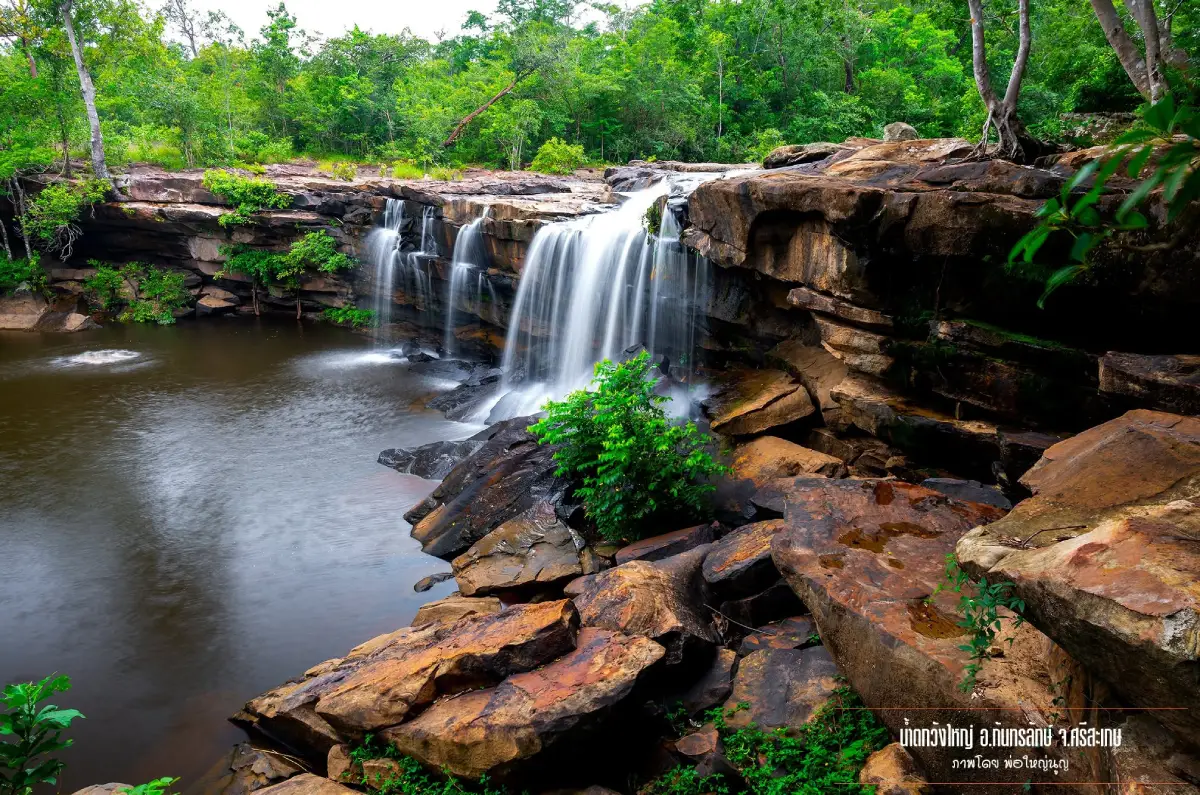
Huai Wang Yai Waterfall, Sisaket is an important natural waterfall in Kantharalak District, Sisaket Province. It is located within Phanom Dong Rak Wildlife Sanctuary, under Conservation Area Administration Office 9, Ubon Ratchathani, Department of National Parks, Wildlife and Plant Conservation. The waterfall area is located around Ban Ko, Village No. 7, Lalai Subdistrict, Kantharalak District. It is surrounded by forest, the Phanom Dong Rak mountain range, stone terraces, rock formations, natural pools, and large trees that provide shade and create a cool, refreshing atmosphere. The highlight of this waterfall is the stream flowing from Huai Khayung, whose headwaters originate from the Phanom Dong Rak mountains, cascading down a rock layer about 5 meters high into a wide pool below. The upper area has a shallow pool suitable for playing in the water and relaxing on the stone terrace, making it a natural attraction ideal for families, photographers, waterfall lovers, and travelers who want to experience the peaceful forest atmosphere of Phanom Dong Rak.
Huai Wang Yai Waterfall is charming because of its landscape, where streams, rock layers, forest, and the borderland terrain of the Phanom Dong Rak mountains come together naturally. The waterfall is not very high compared with large mountain waterfalls in other provinces, but it has beauty in the way the water gently spreads across the rock layers like a soft curtain. The lower pool is wide, surrounded by rock formations and shaded by a large banyan tree, creating a distinctive and shady natural scene. This waterfall gives visitors a genuine feeling of closeness to nature rather than the impression of an overly developed tourist area.
The waterfall area is formed by a stream flowing down from the Phanom Dong Rak mountain range, an important mountain range in lower northeastern Thailand and an area of high biodiversity. The water flows through rock layers and forest before reaching Huai Wang Yai Waterfall, making this area more humid than the surrounding landscape. This moisture supports various plant species and provides a habitat for many butterflies. Visitors who come during suitable weather may see butterflies flying around the stone terraces, along the water, and among the vegetation surrounding the waterfall, adding clear vitality to the natural scenery.
Huai Wang Yai Waterfall is best visited during the rainy season and the cool season because these are the periods when the water volume is good, the forest is fresh and green, and the atmosphere around the waterfall is moist and pleasant. During the rainy season, the waterfall becomes especially powerful and beautiful, while the cool season offers comfortable weather for nature walks, playing in the water, and relaxing beside the stream. Travelers should choose a day with good weather, no flash flooding, and clear skies in order to travel safely and see the waterfall at its most beautiful.
Although the waterfall can be visited throughout the year, extra caution is needed during periods of heavy rain because flash floods and strong currents can occur. Water levels in forested waterfall areas can change quickly, especially when rain falls in the upstream area. Visitors should observe the water color, current strength, and weather conditions before entering the water. If the water suddenly becomes unusually muddy, the current grows strong, or rain clouds begin to form, visitors should leave the water and move to a safe area immediately. The appropriate way to visit is to play only in safe areas, remain within adult supervision, and follow the advice of local officials.
The lower pool of Huai Wang Yai Waterfall is one of its most distinctive points because it is wide, deep, and surrounded by rock formations and a large banyan tree. The shade from the tree makes the lower area cool and pleasant, suitable for sitting, watching the stream, and taking nature photographs. The upper part of the waterfall has a shallower pool and a stone terrace that is more suitable for relaxing. Visitors can choose the area that best fits their activities. Families with children should choose shallow water and stone areas that are not slippery. Those who want to take photographs should choose angles that capture the water curtain, rock formations, and large trees in the same frame.
The height of about 5 meters makes the waterfall appear not too forceful during normal water conditions, while still retaining the beauty of water flowing broadly over the rock layers. The water falls in several curtain-like sections along the rock surface, making it suitable for both wide-angle and close-up waterfall photography. Interesting photo subjects include the waterfall curtain above the pool, large rock formations, the spreading banyan tree, the upper stone terrace, and butterflies flying around the moist areas near the waterfall.
Nature photographers will find many possible angles at Huai Wang Yai Waterfall. Morning is suitable for photographing the waterfall with soft light and tree shadows. Late morning to afternoon is good for capturing clear details of the rock layers and flowing water, while late afternoon gives the area a softer and quieter atmosphere. Photographers should stand only on firm ground, avoid walking on wet and slippery rocks, and avoid crossing the stream where the current is strong, as the beauty of the waterfall comes together with risks from slippery stones and changing water levels.
This waterfall is also a suitable site for studying the natural environment of the Phanom Dong Rak mountain range. The surrounding area contains many medicinal plants and a high diversity of vegetation. Walking slowly through the area allows visitors to observe riverside plants, forest trees, vines, moss on rock formations, and plant species that grow in the humid conditions near the waterfall. The area is therefore suitable for nature enthusiasts, students, and travelers who want to learn about forest ecology and waterfall ecosystems in lower northeastern Thailand.
The presence of many butterflies is an important charm of Huai Wang Yai Waterfall. Butterflies are often found in moist areas, on stone terraces beside the stream, and around places where minerals are present in the soil or rocks. Watching butterflies should be done calmly. Visitors should not catch them, chase them, or disturb the areas where they rest. These small acts of care help preserve the natural character of the place and allow future visitors to continue seeing butterflies in the forest atmosphere of Phanom Dong Rak.
Huai Wang Yai Waterfall is important as a natural tourist attraction of Lalai Subdistrict and Kantharalak District because it reveals another side of the district’s landscape. Kantharalak is not only home to Pha Mo I Daeng, Prasat Don Tuan, and historical sites; it also has waterfalls, forest, medicinal plants, and natural areas connected to the Phanom Dong Rak mountain range. Huai Wang Yai Waterfall therefore adds completeness to the Kantharalak travel route through nature, relaxation, and environmental learning.
The waterfall is located within Phanom Dong Rak Wildlife Sanctuary, making conservation more important here than in ordinary tourist areas. A wildlife sanctuary has the duty to protect wildlife, forest, watershed areas, and ecosystems. Visitors to Huai Wang Yai Waterfall should use the area respectfully by not littering, not making loud noise, not collecting forest plants, not catching animals, not disturbing wildlife, and not entering restricted areas. Responsible travel helps the waterfall remain beautiful and keeps it as a healthy natural area.
The atmosphere of Huai Wang Yai Waterfall is more suitable for relaxed travel than hurried sightseeing. Visitors should spend at least 1 – 2 hours here to walk around the waterfall, choose photography spots, sit on the stone terrace, and fully enjoy the sound of flowing water. With more time, the trip can be combined with Sida Waterfall, Kaeng Tat Hin, Prasat Don Tuan, or Pha Mo I Daeng, depending on weather conditions and the time of day.
For families, Huai Wang Yai Waterfall is a good place for children to learn about nature, but close supervision is necessary at all times. Children should play only in shallow and safe areas. They should not climb slippery rocks, approach deep pools, or play near strong currents. Adults should always stay near children because natural waterfalls offer both beauty and risk at the same time. Preparing non-slip shoes, spare clothes, towels, and waterproof bags for electronic devices will make the trip more convenient.
For travelers who want to play in the water, the upper part of the waterfall has a shallow pool and stone terrace that are more suitable for relaxing than the deeper lower pool. Playing in the water along the waterfall area should be done only when the water level is normal and the current is not strong. Visitors should avoid jumping from rocks, diving into pools of unknown depth, and using soap or shampoo in the stream because chemicals can affect the freshwater ecosystem and living organisms in the area.
For visitors seeking quiet relaxation, Huai Wang Yai Waterfall has stone terraces and shaded spaces under trees where they can sit and listen to the sound of flowing water. The air around the waterfall is cooler than in open areas because of the moisture from the stream and the shade of large trees. This kind of atmosphere is suitable for resting the mind, reading briefly, talking with family, or simply spending time in nature without needing many activities.
The travel route near Huai Wang Yai Waterfall includes several interesting places. Sida Waterfall is another natural waterfall that can be included in the same route. Kaeng Tat Hin features rock rapids and a natural stream. Prasat Don Tuan is an important archaeological site in Kantharalak District, while Pha Mo I Daeng is a border viewpoint and a famous attraction of Khao Phra Wihan National Park. Connecting these places in one route gives a Kantharalak trip a mix of waterfalls, forest, historical sites, and mountain viewpoints within one or two days.
For a half-day route, travelers can begin with Huai Wang Yai Waterfall in the morning, spend time relaxing and playing in the water, and then return to Kantharalak town for a meal or a café stop. For a full-day route, Prasat Don Tuan, Pha Mo I Daeng, or Kantharalak City Pillar Shrine can be added to the plan. Using a private car or rental car is the most convenient option because the waterfall is located in a natural area and some parts of the route lead deeper away from the community.
Restaurants suitable for a stop before or after visiting the waterfall are mostly located around Lalai Subdistrict communities and Kantharalak town. Examples include Somtam Inter Kantharalak in Lalai Subdistrict, Krua Fa Lang Fon - 24 Coffee, Attalak Coffee and Kantharalak Souvenirs, Café Lang Ban, and Dmilk Milo Dip Kantharalak Branch. Travelers should plan meals and drinking water in advance, especially when traveling with family or children, because the waterfall area is a natural site rather than a zone lined with shops.
For accommodation, travelers can stay in Kantharalak town for convenient access to the waterfall and nearby attractions. Accommodations with clear contact information in Kantharalak include Sabai Jai Resort Kantharalak, Phulada Resort Kantharalak, S.B. Hotel Kantharalak, Kantharalak Palace Hotel, and Kantharalak House Resort. Staying in town makes it easier to access restaurants, gas stations, convenience stores, and routes to Pha Mo I Daeng or Prasat Don Tuan.
Getting There to Huai Wang Yai Waterfall is most convenient by private car or rental car. Set the destination to Huai Wang Yai Waterfall, Ban Ko, Village No. 7, Lalai Subdistrict, Kantharalak District, Sisaket Province. From Sisaket city, head toward Kantharalak District, then continue to Lalai Subdistrict and follow the navigation system to the waterfall area. The final part of the route leads into a natural area, so drivers should proceed carefully, check the vehicle before departure, and avoid entering the area during heavy rain or near nightfall.
Travelers coming from Kantharalak town can make Huai Wang Yai Waterfall the main stop of the day. It is best to depart in the morning to allow enough time for walking, playing in the water, photography, and relaxation. Those who want to continue to Pha Mo I Daeng or Prasat Don Tuan should allow enough travel and visiting time for each place. Weather conditions should be the main consideration when traveling in Kantharalak because many attractions are natural sites located near mountain areas.
What makes Huai Wang Yai Waterfall different from ordinary waterfalls is the completeness of its natural elements. It has water from the Phanom Dong Rak mountains, a wide pool, rock formations, a large banyan tree, many butterflies, and medicinal plants in the forested area. These elements make the place more than a swimming spot; it is also an area for learning about ecosystems and the biodiversity of lower northeastern Thailand. A visit here offers freshness, relaxation, and a better understanding of the value of protected natural areas.
Huai Wang Yai Waterfall is suitable for travelers who want to experience Sisaket through forest, waterfalls, and the Phanom Dong Rak mountains. The beauty of the place lies in its natural authenticity. The stream is not staged, the rocks are not artificially arranged, and the large trees continue to provide full shade to the area. When visited at the right time, used carefully, and respected according to wildlife sanctuary rules, Huai Wang Yai Waterfall becomes a destination that offers a beautiful and memorable natural experience in Sisaket Province.
Overall, Huai Wang Yai Waterfall is a tourist attraction with value in many dimensions: the beauty of the waterfall, the shade of the forest, the importance of the Phanom Dong Rak mountain range, the diversity of medicinal plants, the butterflies, the freshwater ecosystem, and the role of protected areas under the Department of National Parks, Wildlife and Plant Conservation. This destination is suitable for travelers who want meaningful nature travel, genuine relaxation, real learning, and a chance to see a quieter side of Sisaket beyond the more popular tourist spots.
| Name | Huai Wang Yai Waterfall / Wang Yai Waterfall |
| Location | Ban Ko, Village No. 7, Lalai Subdistrict, Kantharalak District, Sisaket Province |
| Address | Lalai Subdistrict, Kantharalak District, Sisaket Province 33110 |
| Highlights | A natural waterfall in Phanom Dong Rak Wildlife Sanctuary, about 5 meters high, with natural pools, rock formations, a large banyan tree, many butterflies, and abundant medicinal plants |
| History / Significance | A natural attraction of Lalai Subdistrict and part of the Phanom Dong Rak mountain ecosystem within Phanom Dong Rak Wildlife Sanctuary |
| Name Origin | Named after Huai Wang Yai and the natural stream area flowing from the Phanom Dong Rak mountain range |
| Distinctive Features | A low and broad rock-layer waterfall; the lower area has a wide and deep pool with rock formations and a large banyan tree, while the upper area has a shallow pool and stone terrace for relaxing |
| Waterfall Height | About 5 meters |
| Best Time To Visit | Rainy season and cool season; caution is needed during heavy rain because of strong currents |
| Travel Information | Most convenient by private car or rental car. From Sisaket city, head toward Kantharalak District, then continue to Lalai Subdistrict and Ban Ko using a navigation system |
| Current Status | Open as a natural tourist attraction within Phanom Dong Rak Wildlife Sanctuary |
| Open Days | Daily |
| Opening Hours | 08.00 – 17.00 |
| Facilities | Natural swimming areas, stone terraces, resting areas beside the stream, nature-viewing access routes, and restaurants and accommodations in Kantharalak District |
| Main Areas / Zones | 1. Main waterfall and water curtain zone 2. Lower pool zone 3. Upper shallow pool zone 4. Stone terrace relaxation zone 5. Large banyan tree and rock formation zone 6. Butterfly-watching and medicinal plant study zone 7. Protected forest zone around the waterfall |
| Caretaker | Phanom Dong Rak Wildlife Sanctuary, Conservation Area Administration Office 9, Ubon Ratchathani, Department of National Parks, Wildlife and Plant Conservation |
| Main Contact Number | Conservation Area Administration Office 9, Ubon Ratchathani, Tel. 0-4531-1677, 0-4531-1682, 0-4531-1683 / Forest Protection Hotline 1362 |
| Official Website / Official Page | Department of National Parks, Wildlife and Plant Conservation / Conservation Area Administration Office 9, Ubon Ratchathani / Kantharalak Municipality |
| Nearby Tourist Attractions | 1. Sida Waterfall, about 18 km 2. Kaeng Tat Hin, about 24 km 3. Prasat Don Tuan, about 30 km 4. Pha Mo I Daeng, about 35 km 5. Pha Mo I Daeng Bas-Relief and Twin Stupas, about 35 km 6. Kantharalak City Pillar Shrine, about 36 km 7. Nong Kwang Deed Health Park, about 37 km |
| Nearby Restaurants | 1. Somtam Inter Kantharalak, about 18 km, Tel. 087-050-6661 2. Krua Fa Lang Fon - 24 Coffee, about 34 km, Tel. 087-245-5116 3. Attalak Coffee and Kantharalak Souvenirs, about 35 km, Tel. 094-525-1926 4. Café Lang Ban Kantharalak, about 35 km, Tel. 098-093-7878 5. Dmilk Milo Dip Kantharalak Branch, about 35 km, Tel. 090-249-1792 6. Zhen Zhu Café Kantharalak, about 36 km |
| Nearby Accommodations | 1. Sabai Jai Resort Kantharalak, about 34 km, Tel. 081-600-3300 2. Phulada Resort Kantharalak, about 35 km, Tel. 087-879-7245 3. S.B. Hotel Kantharalak, about 36 km, Tel. 045-663-103 4. Kantharalak Palace Hotel, about 36 km, Tel. 045-635-157 5. Kantharalak House Resort, about 35 km, Tel. 097-356-7414 |
Frequently Asked Questions (FAQ)
Q: Where is Huai Wang Yai Waterfall located?
A: Huai Wang Yai Waterfall is located at Ban Ko, Village No. 7, Lalai Subdistrict, Kantharalak District, Sisaket Province, within Phanom Dong Rak Wildlife Sanctuary.
Q: What are the opening hours of Huai Wang Yai Waterfall?
A: It is open daily from 08.00 to 17.00. Morning and late afternoon are the best times for enjoying nature, taking photos, and relaxing.
Q: What is interesting about Huai Wang Yai Waterfall?
A: Its highlights include water flowing from the Phanom Dong Rak mountains, a waterfall about 5 meters high, a wide natural pool, rock formations, a large banyan tree, many butterflies, and abundant medicinal plants in the forest area.
Q: Can visitors swim at Huai Wang Yai Waterfall?
A: Visitors can play in the water when the water level is normal. The upper area has a shallow pool and stone terrace suitable for relaxing, while heavy rain periods require caution because of strong currents.
Q: When is the best time to visit Huai Wang Yai Waterfall?
A: The rainy season and cool season are the best times to visit because the water volume is good, the forest is green, and the atmosphere is shady and refreshing. Visitors should avoid days with heavy rain or strong water flow.
Q: Which organization manages Huai Wang Yai Waterfall?
A: The waterfall is managed by Phanom Dong Rak Wildlife Sanctuary, Conservation Area Administration Office 9, Ubon Ratchathani, Department of National Parks, Wildlife and Plant Conservation.
Q: Are there attractions near Huai Wang Yai Waterfall?
A: Nearby attractions include Sida Waterfall, Kaeng Tat Hin, Prasat Don Tuan, Pha Mo I Daeng, the Pha Mo I Daeng Bas-Relief and Twin Stupas, and Kantharalak City Pillar Shrine.
Q: What should visitors be careful of when visiting Huai Wang Yai Waterfall?
A: Visitors should be careful of slippery rocks, deep water, strong currents, and flash floods after rain. They should avoid unsafe swimming areas, not litter, and avoid disturbing wildlife or plants in the protected area.
 Category: ●Nature and Wildlife
 Group: ●Waterfalls
Last Update : 2 MonthAgo
 Last Update : 2 MonthAgo
 Click to Access the Navigation Map GPS
Huai Wang Yai Waterfall Map

 Art, Culture and Heritage
 Historical Sites and Monuments(12)
 Landmarks and Memorials(1)
 Art, Craft Centres, Tradition(8)
 Places of Worship
 Temple(13)
 Other Sacred Sites(3)
 Suburban Living
 Village, Community(2)
 National Parks and Marine Reserves(2)
 Dam, Reservoir, Lake(7)
Waterfalls(5)
Dam, Reservoir, Lake(7)
Waterfalls(5)
 River, Canal(5)
 Bays and Beaches(2)
 Entertainment and Agricultural
 Zoos and Aquariums(1)
 Farms, Parks and Ecotourism(3)


