
lovethailand home >Northeastern Travel Attractions >Si Sa Ket Travel Attractions >Muang Chan >Muang Chan > Prasat Ban Mueang Chan
TL;DR: Prasat Ban Mueang Chan is located at Wat Ban Mueang Chan, Ban Mueang Chan, Mueang Chan Subdistrict, Mueang Chan District, Si Sa Ket Province, open Daily, hours 08.00 – 17.00.
Prasat Ban Mueang Chan
Open Days: Daily
Opening Hours: 08.00 – 17.00
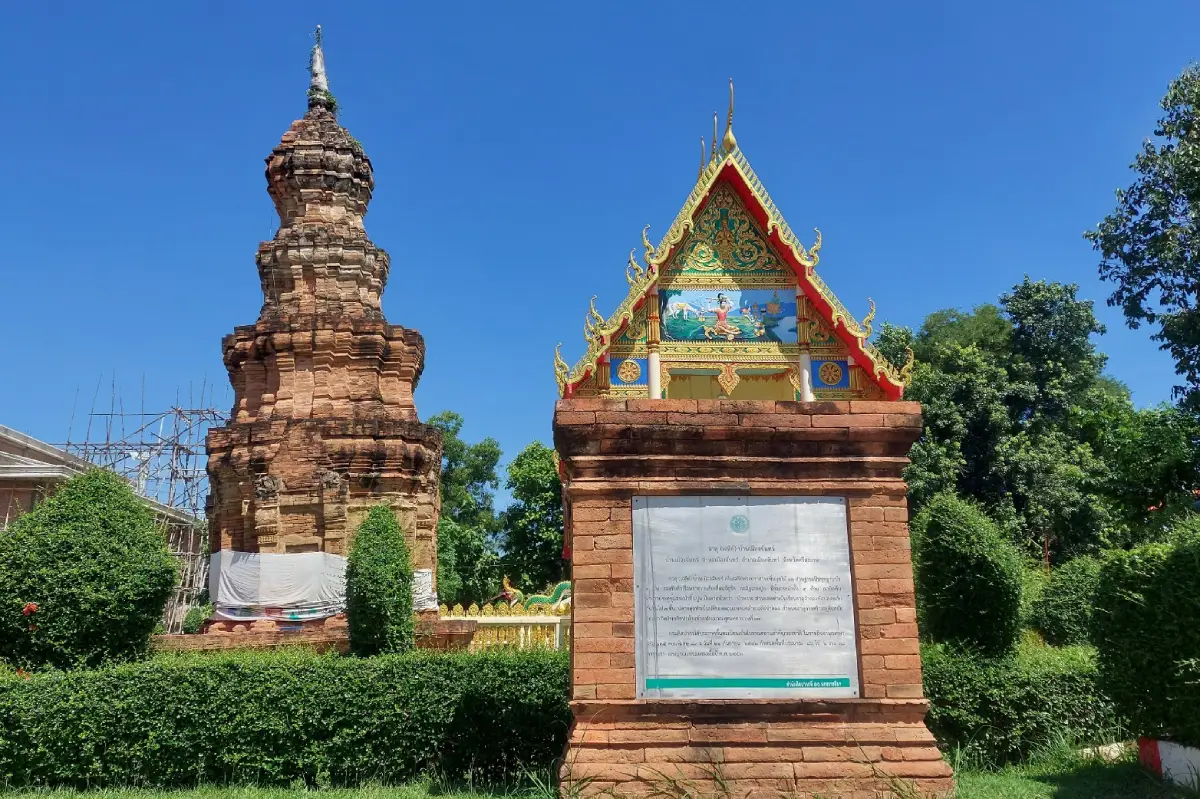
Prasat Ban Mueang Chan, also known as That Ban Mueang Chan or Prasat Mueang Chan, is an important local Buddhist heritage site located inside Wat Ban Mueang Chan, Mueang Chan Subdistrict, Mueang Chan District, Si Sa Ket Province. The monument stands within an old community landscape surrounded by traces of an ancient moat and earthen embankment. It is built of brick and mortar in the form of a prasat-shaped stupa, with a square indented base, a tall tapering body, symbolic false doorways, and a slender upper section. Open daily to visitors, Prasat Ban Mueang Chan is a meaningful destination for travelers who want to understand local Buddhist architecture, Lan Xang-influenced art, Kui or Suai community culture, and the living annual worship tradition of Mueang Chan.
Prasat Ban Mueang Chan is different from many large Khmer sanctuaries in Si Sa Ket. It is not a large stone temple, a Hindu shrine, or a Bayon-period hospital chapel. Instead, it is a local Buddhist stupa in a prasat-like form, preserving a layered cultural identity shaped by ancient settlement, local Buddhist devotion, Lan Xang artistic influence, and community ritual. This makes the site especially valuable for travelers who want to see how sacred architecture in Lower Northeastern Thailand continued to evolve after the classical Khmer period.
The monument stands inside Wat Mueang Chan, an active Buddhist temple that remains central to community life. This setting gives the site both historical and living religious meaning. Visitors do not encounter the ancient structure as an isolated ruin; they see it within a temple where local people continue to make merit, worship, organize ceremonies, and preserve cultural memory. The stupa, the temple, the old community, the wooden Buddha images, and the annual festival all form one connected cultural landscape.
Architecturally, the monument is a brick-and-mortar prasat-shaped stupa with an indented square plan. Local information describes the base as about 3.40 meters wide and the structure as about 15 meters high. The body rises in several tiers and ends in a slender pointed top. The 4 sides contain false doorways rather than functional entrances. This means the structure was not designed like a chambered Khmer sanctuary for entering and worshipping inside. It functioned more like a sacred stupa or reliquary monument, emphasizing symbolic presence, vertical form, and community devotion.
The false doorways on all 4 sides are important visual elements. They give the structure a balanced sacred appearance in every direction, while also echoing the symbolic vocabulary of older temple architecture. The body of the structure is solid, and its religious meaning lies in its form, location, and connection with sacred contents or community belief. This makes Prasat Ban Mueang Chan a useful example for understanding the difference between a Khmer sanctuary tower and a later local Buddhist stupa that adopted a prasat-like shape.
The shape and scale of the monument are often compared with Prasat Ban Non That or Prasat Huai Thap Than in Huai Thap Than District, Si Sa Ket Province. The main difference is that Prasat Ban Mueang Chan is a single tower, while Prasat Ban Non That consists of 3 towers. This comparison helps visitors understand a broader network of sacred architecture in Si Sa Ket, where Khmer memories, later Buddhist rebuilding, and local artistic forms continued to influence one another across nearby districts.
Archaeological interpretation places the monument in a later Buddhist context, possibly in the late Ayutthaya period or around the period when Prasat Ban Non That was restored or modified. The structure is therefore understood as a Buddhist monument rather than a Hindu shrine. It may have been built to enshrine relics of the Buddha, the remains of a respected monk, or the relics of an important person revered by the community. Its form, solid body, and temple setting all support this Buddhist interpretation.
The dating of Prasat Ban Mueang Chan is especially interesting because it reflects more than one layer of interpretation. Local traditions connect it with a Buddhist sacred structure of the late Ayutthaya period, while cultural heritage records describe it as a prasat-shaped stupa influenced by Lan Xang art around the 23rd Buddhist century. Taken together, the monument is best understood as a local Buddhist sacred structure of Lower Northeastern Thailand, shaped by older Khmer memories, Lan Xang artistic influence, and the devotional life of the Mueang Chan community.
The monument is located within the old Mueang Chan settlement, a community area surrounded by a circular or near-circular moat and earthen embankment. Such ancient settlement landscapes are important because they show long-term human occupation, water management, and community organization. The presence of the stupa within this old community setting means that Prasat Ban Mueang Chan should not be understood only as a single monument. It belongs to a wider cultural landscape that includes settlement, water, ritual, and local identity.
Stone boundary markers, or bai sema, carved with lotus bud motifs were found in the area. Bai sema are important evidence of Buddhist sacred space in Northeastern Thailand. They mark ritual boundaries and are closely linked to Buddhist ordination areas. The lotus motif represents purity, awakening, and devotion. The presence of bai sema at Mueang Chan strengthens the interpretation of the site as a Buddhist sacred area and connects it with the wider tradition of local Buddhist culture in the Northeast.
The site also reflects the way Buddhism in the Northeast interacted with local ancestral and spirit beliefs. Scholars have long noted that bai sema in Northeastern Thailand appear in many forms and often belong to a cultural environment where Buddhism, ancestor veneration, and local ritual practice existed together. Prasat Ban Mueang Chan fits well within this context. It is a Buddhist sacred place, but it is also a center of community memory, local ritual, and inherited belief.
Wat Ban Mueang Chan also contains ancient wooden Buddha images in local Lan Xang-influenced style. These images reflect the faith of villagers who created sacred objects using available local materials. They are not court-style royal sculptures; they are community devotional works. Their presence within the same temple as the stupa makes Wat Mueang Chan an important cultural site where architecture, sculpture, folk art, and living Buddhist practice can be understood together.
The community around Prasat Ban Mueang Chan includes many Kui or Suai people, an important ethnic group in the cultural landscape of Lower Northeastern Thailand. The Kui community preserves distinctive language, customs, rituals, and local identity. Because the stupa stands in the heart of this community, it is not only an archaeological or religious monument; it is also a cultural center connected with the identity and memory of the people of Mueang Chan.
The most important annual event at the site is the That Mueang Chan Worship Festival, held in April around the Songkran period. The event is also known as a family reunion merit-making festival in which people return home, worship That Mueang Chan, and pay respect to the large Buddha image locally known as Phra Phuttha Chao Yai or “Pha Chao Phuet.” The festival includes merit-making, local performances, community activities, and gatherings of families who return to their hometown during the Thai New Year season.
This annual festival keeps the monument alive in the present. Local people do not see the stupa merely as an old structure. They regard it as a sacred center of blessing, kinship, gratitude, and community identity. The Songkran-season gathering brings families together, strengthens local bonds, and connects personal memory with the sacred place of the village. For foreign travelers, this living ritual is one of the most meaningful aspects of the site.
Local belief also connects That Mueang Chan with nearby sacred sites, including the Phra That tradition of neighboring communities. These relationships show that the worship of sacred monuments in Si Sa Ket is not limited to one temple or one village. It forms a network of faith linking communities, families, and ritual obligations across nearby areas. Prasat Ban Mueang Chan therefore belongs to both a physical landscape and a spiritual network.
A good way to explore the site is to begin at the front of the stupa and observe the overall proportion of the base, body, and pointed top. Then walk around the monument to study the 4 false doorways, the indented plan, the brick-and-mortar construction, and the remaining lotus-petal stucco decoration. After that, visitors should continue to the old sim or chapel area, the wooden Buddha images, the large Buddha image, and the temple grounds used for the annual festival. This route gives a fuller understanding of the site than viewing the stupa alone.
The main zones of interest include the stupa or Prasat Ban Mueang Chan, the indented square base, the 4 false doorway zones, lotus-petal stucco decoration, bai sema and Buddhist boundary-marker evidence, the old sim or chapel, the ordination hall and ancient wooden Buddha images, the large Buddha image, the annual festival area, and the old Mueang Chan settlement landscape with moat and earthen embankment traces.
The atmosphere at Wat Mueang Chan is calm and local. Visitors should dress modestly, behave quietly, and respect both the ancient monument and the active Buddhist temple. Climbing on the structure, touching fragile stucco details unnecessarily, writing on surfaces, moving any objects, or leaving litter is inappropriate. Responsible travel helps preserve the monument and shows respect for the monks and community members who continue to care for the place.
The best time to visit is in the morning or late afternoon, when the light is softer and the brick-and-mortar surface of the stupa is easier to see. Visitors who want to experience the community festival should come during the annual worship event in April. Those who prefer a quiet cultural visit should come on ordinary weekdays outside the main festival period. Both experiences are valuable, but they offer different perspectives on the site.
Getting There from Si Sa Ket city is convenient by private car. Travel toward Uthumphon Phisai District and continue on the Uthumphon Phisai-Mueang Chan road into Mueang Chan District. The site is about 42 km from Si Sa Ket Provincial Hall and about 15 km from Prasat Wat Sa Kamphaeng Yai. A private car or rental car is the most practical option because visitors can combine Mueang Chan with nearby Khmer and Buddhist heritage sites in the same day.
Travelers coming from Uthumphon Phisai can continue toward Mueang Chan by local road. Public transport is limited, so visitors without private vehicles should first reach Uthumphon Phisai or Si Sa Ket city and then arrange local transport to Wat Ban Mueang Chan. A private vehicle also makes it easier to visit nearby places such as Prasat Wat Sa Kamphaeng Yai, Uthumphon Phisai town, and Prasat Wat Sa Kamphaeng Noi.
A normal visit takes around 30–60 minutes for walking around the stupa, taking photographs, and paying respect inside the temple. Visitors who want to examine the false doorways, bai sema, old chapel, wooden Buddha images, large Buddha image, and old settlement context should allow around 1–1.30 hours. The site is compact, but its meaning becomes clearer through slow observation of architecture, ritual space, and community context.
As an educational site, Prasat Ban Mueang Chan helps explain several important topics: local Buddhist stupa architecture, Lan Xang influence in Si Sa Ket, bai sema boundary markers, wooden Buddha images, Kui community culture, ancient settlement landscapes, and the continuation of sacred traditions through annual village festivals. It shows that the cultural heritage of Si Sa Ket is not limited to large Khmer stone temples. Local Buddhist monuments are equally important for understanding the province’s deeper historical identity.
When compared with Prasat Wat Sa Kamphaeng Yai and Prasat Ban Non That, Prasat Ban Mueang Chan serves as an important cultural link. Sa Kamphaeng Yai represents a large Khmer Hindu sanctuary. Ban Non That represents a 3-tower sacred form that was later modified. Ban Mueang Chan, by contrast, is a single stupa-like tower that expresses Buddhist devotion and local identity. Visiting these sites together gives travelers a clearer view of how sacred architecture in Si Sa Ket developed from Khmer religious forms into later local Buddhist traditions.
The value of Prasat Ban Mueang Chan lies in its quiet continuity. It may not contain large sandstone lintels or dramatic mythological carvings, but it preserves a meaningful combination of a prasat-shaped stupa, bai sema, wooden Buddha images, old settlement traces, Kui community faith, and an annual worship festival. These elements make the site an important living cultural landmark rather than a silent ruin.
Visiting Prasat Ban Mueang Chan is therefore a journey into the local history of Si Sa Ket through a place that remains active in community life. Visitors encounter Buddhist architecture, local art, old settlement evidence, ethnic culture, and annual ritual tradition in one temple landscape. For foreign travelers seeking a deeper and quieter cultural experience in Lower Northeastern Thailand, Prasat Ban Mueang Chan offers a meaningful encounter with the living heritage of Mueang Chan District.
| Name | Prasat Ban Mueang Chan / That Ban Mueang Chan / Prasat Mueang Chan |
| Location | Wat Ban Mueang Chan, Ban Mueang Chan, Mueang Chan Subdistrict, Mueang Chan District, Si Sa Ket Province |
| Address | Wat Ban Mueang Chan, Mueang Chan Subdistrict, Mueang Chan District, Si Sa Ket 33120, Thailand |
| Coordinates | 15.156948, 104.028336 |
| Highlights | Brick-and-mortar prasat-shaped stupa, indented square base, tapering upper section, 4 false doorways, lotus-petal stucco decoration, bai sema with lotus motifs, ancient wooden Buddha images, large Buddha image, and the annual That Mueang Chan worship festival |
| History | Local Buddhist sacred monument influenced by Lan Xang and Lower Northeastern Thai Buddhist art, associated with the late Ayutthaya period to around the 23rd Buddhist century, and preserved as a sacred stupa of the Mueang Chan community |
| Name Origin | The name Ban Mueang Chan is connected with the local community and temple, while That Ban Mueang Chan reflects the monument’s role as a sacred stupa or reliquary structure of the community |
| Distinctive Features | Single prasat-like stupa with a square indented base, about 3.40 meters wide and about 15 meters high, built of brick and mortar with a slender pointed top, 4 symbolic false doorways, and no enclosing wall like large Khmer sanctuaries |
| Key Evidence | Brick-and-mortar stupa, lotus-petal stucco decoration, bai sema with lotus bud motifs, old sim or chapel, ancient wooden Buddha images, and location within the old Mueang Chan settlement surrounded by moat and earthen embankment traces |
| Travel Information | From Si Sa Ket city, travel toward Uthumphon Phisai and continue on the Uthumphon Phisai-Mueang Chan road into Mueang Chan District. The site is about 42 km from Si Sa Ket Provincial Hall and about 15 km from Prasat Wat Sa Kamphaeng Yai. |
| Current Status | Open to visitors as an ancient sacred monument inside Wat Ban Mueang Chan and a living spiritual center of the Mueang Chan community |
| Open Days | Daily |
| Opening Hours | 08.00 – 17.00 |
| Facilities | Parking inside the temple area, walking area around the stupa, Buddhist worship area, large Buddha image, ordination hall, shaded temple grounds, and community festival area |
| Main Areas / Zones | 1. Prasat Ban Mueang Chan or stupa zone 2. Indented square base zone 3. Four false doorway zones 4. Lotus-petal stucco decoration zone 5. Bai sema and Buddhist boundary-marker zone 6. Old sim or chapel zone 7. Ordination hall and ancient wooden Buddha image zone 8. Large Buddha image zone 9. Annual That Mueang Chan worship festival area 10. Old Mueang Chan settlement and moat landscape zone |
| Local Festival / Cultural Event | Annual That Mueang Chan Worship Festival, a family reunion merit-making event to worship That Mueang Chan and pay respect to the large Buddha image, held in April each year |
| Abbot / Caretaker | Phra Khru Suwat Chanthakhun, abbot of Wat Mueang Chan, with Mueang Chan Subdistrict Municipality supporting local cultural activities in the area |
| Local Contact | Mueang Chan Subdistrict Municipality, Tel. 045-960-343 |
| Official Website / Official Page | Mueang Chan Subdistrict Municipality: muangchan.go.th |
| Nearby Tourist Attractions | 1. Large Buddha Image at Wat Mueang Chan, about 0 km 2. Old Mueang Chan Settlement And Moat Landscape, about 1 km 3. Prasat Wat Sa Kamphaeng Yai, Uthumphon Phisai District, about 15 km 4. Uthumphon Phisai District City Pillar Shrine, about 18 km 5. Uthumphon Phisai Railway Station, about 19 km 6. Prasat Wat Sa Kamphaeng Noi, Uthumphon Phisai District, about 34 km 7. Prasat Ban Prasat, Huai Thap Than District, about 37 km |
| Nearby Restaurants | 1. Duang Dee Restaurant, Uthumphon Phisai District, about 18 km, Tel. 045-691-399 2. Coffee House Ban Kafe, Uthumphon Phisai District, about 18 km, Tel. 095-621-4246 3. Jungle Cafe Uthumphon Phisai Branch, about 18 km, Tel. 063-751-1771 4. Ka-Fe Cha Uthumphon Phisai, about 19 km, Tel. 098-474-4458 5. Ko Ham Phochana 2nd Generation, Uthumphon Phisai District, about 18 km, Tel. 081-204-9524 |
| Nearby Accommodations | 1. Onanong Resort, Uthumphon Phisai District, about 24 km, Tel. 081-910-7046, 089-012-7059 2. Urai Resort, Uthumphon Phisai District, about 25 km, Tel. 095-962-8675 3. Banrai Phu Sabang Lake View Homestay & Resort, Uthumphon Phisai District, about 28 km, Tel. 081-762-3214 4. Kaewkwan Resort, Mueang Si Sa Ket District, about 42 km, Tel. 086-450-1859 5. Tree House Hotel Si Sa Ket, about 45 km, Tel. 045-611-563, 080-477-7854 |
Frequently Asked Questions (FAQ)
Q: Where is Prasat Ban Mueang Chan located?
A: Prasat Ban Mueang Chan is located inside Wat Ban Mueang Chan, Mueang Chan Subdistrict, Mueang Chan District, Si Sa Ket Province. It is about 42 km from Si Sa Ket Provincial Hall and about 15 km from Prasat Wat Sa Kamphaeng Yai.
Q: What are the opening hours of Prasat Ban Mueang Chan?
A: The site is open daily from 08.00 to 17.00. Morning and late afternoon are the best times for walking and photography.
Q: Why is Prasat Ban Mueang Chan important?
A: It is a local Buddhist prasat-shaped stupa influenced by Lan Xang and Lower Northeastern Thai Buddhist art. It is also connected with bai sema, wooden Buddha images, Kui community culture, and the annual That Mueang Chan worship festival.
Q: What should visitors not miss at Prasat Ban Mueang Chan?
A: Key highlights include the prasat-shaped stupa, indented square base, 4 false doorways, lotus-petal stucco decoration, bai sema with lotus motifs, ancient wooden Buddha images, large Buddha image, and the old Mueang Chan settlement landscape.
Q: Is Prasat Ban Mueang Chan a Khmer sanctuary?
A: The monument has a prasat-like form, but it is better understood as a local Buddhist stupa or sacred structure rather than a classical Khmer Hindu sanctuary. Its form reflects later Buddhist and Lan Xang-influenced local art.
Q: How can travelers get to Prasat Ban Mueang Chan?
A: From Si Sa Ket city, travel toward Uthumphon Phisai and continue on the Uthumphon Phisai-Mueang Chan road into Mueang Chan District. Private car or rental car is the most convenient option.
Q: How long should travelers spend at Prasat Ban Mueang Chan?
A: A general visit takes around 30–60 minutes. Travelers who want to see the stupa, bai sema, old chapel, wooden Buddha images, large Buddha image, and old community landscape should allow around 1–1.30 hours.
Q: Does Prasat Ban Mueang Chan have an annual festival?
A: Yes. The annual That Mueang Chan Worship Festival is held in April. It is a family reunion merit-making event to worship That Mueang Chan and pay respect to the large Buddha image at Wat Mueang Chan.
 Category: ●Art, Culture and Heritage
 Group: ●Historical Sites and Monuments
Last Update : 2 MonthAgo
 Last Update : 2 MonthAgo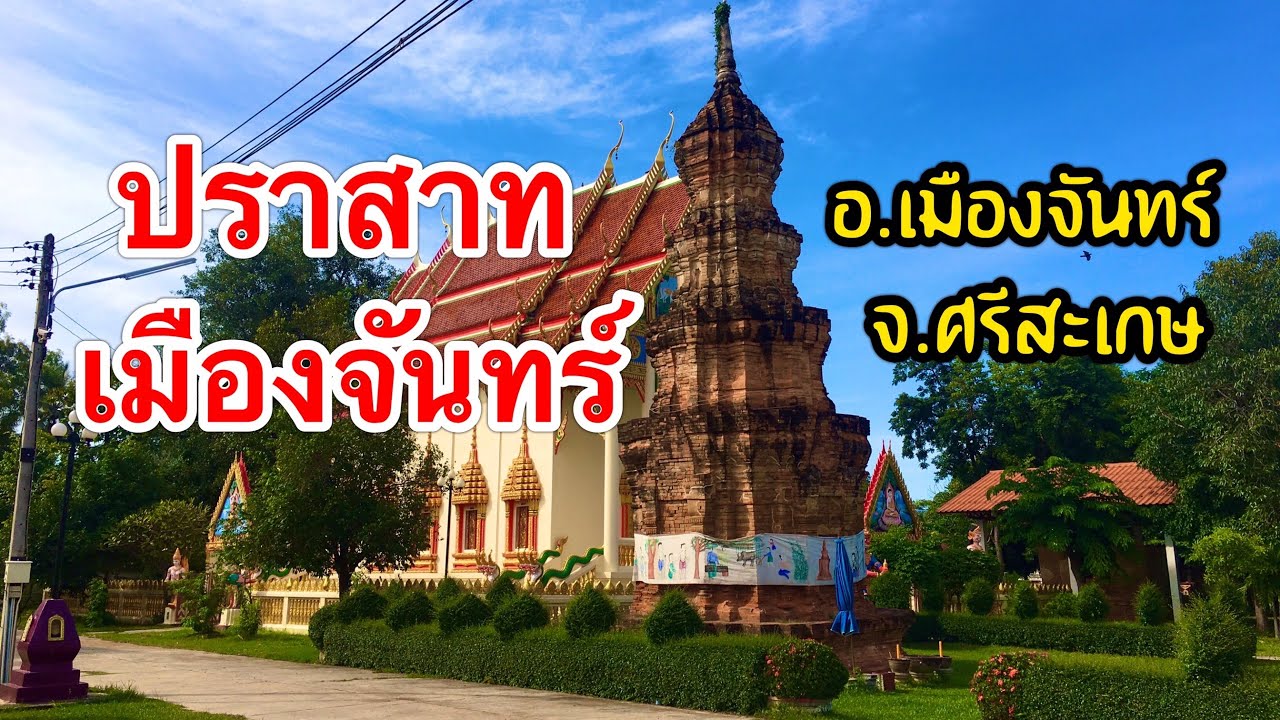
 Click to Access the Navigation Map GPS
Prasat Ban Mueang Chan Map
 Historical Sites and Monuments(12)
 Landmarks and Memorials(1)
 Art, Craft Centres, Tradition(8)
 Places of Worship
 Temple(13)
 Other Sacred Sites(3)
 Suburban Living
 Village, Community(2)
 Nature and Wildlife
 National Parks and Marine Reserves(2)
 Dam, Reservoir, Lake(7)
 Waterfalls(5)
 River, Canal(5)
 Bays and Beaches(2)
 Entertainment and Agricultural
 Zoos and Aquariums(1)
 Farms, Parks and Ecotourism(3)


