
lovethailand home >Northeastern Travel Attractions >Si Sa Ket Travel Attractions >Phai Bung >Prasat Yoe > Ban Prasat Yoe
TL;DR: Ban Prasat Yoe is located at Ban Prasat Yoe, Prasat Yoe Subdistrict, Phrai Bueng District, Si Sa Ket Province 33180, Thailand, open Daily, hours 08.00 - 17.00.
Ban Prasat Yoe
Open Days: Daily
Opening Hours: 08.00 - 17.00
Ban Prasat Yoe, Si Sa Ket, is located in Prasat Yoe Subdistrict, Phrai Bueng District, Si Sa Ket Province. It is an old Yoe ethnic village and one of the most meaningful cultural communities in Lower Isan. The village is known for Prasat Yoe, an ancient Khmer monument standing within the living community, and for the Yoe people who have preserved their language, rituals, weaving, food, agricultural way of life, Buddhist faith, and ancestral memory for generations. Ban Prasat Yoe is not only an archaeological site. It is a living village where ancient Khmer heritage, Buddhist temples, and Yoe ethnic identity continue to exist together in everyday life.
The name “Prasat Yoe” expresses the identity of the place clearly. “Prasat” refers to the ancient Khmer-style sanctuary in the village, while “Yoe” refers to the Yoe ethnic group that settled and developed the community. This combination makes the village special. Visitors can see both the remains of Khmer religious architecture and the living culture of the Yoe people in the same area. The village therefore functions as a cultural landscape rather than a single monument. Its value lies not only in the ruins but also in the people, temples, rituals, textiles, food, and farming life that still surround them.
The settlement history of the Yoe people is connected with migration from southern Laos. Community traditions describe Yoe groups moving from areas such as Attapeu, Saen Pang, and Champasak, traveling along the Mekong and Mun river systems before entering what is now Si Sa Ket Province. They first settled in the Mueang Khong or Mueang Khok area, now associated with Rasi Salai District, before some groups established Ban Prasat Yoe. This history makes the village a meaningful endpoint of migration, settlement, kinship, and cultural continuity.
Ban Prasat Yoe has existed for more than two centuries. Its age is not expressed only through dates. It is visible in the village’s social structure, ancestral rituals, temples, agricultural calendar, woven textiles, local dishes, oral memory, and the way villagers continue to live with the ancient monument at the heart of their community. The village is not a place where ruins stand apart from people. It is a place where the ruins, temples, houses, rice fields, and ritual life form one continuous cultural environment.
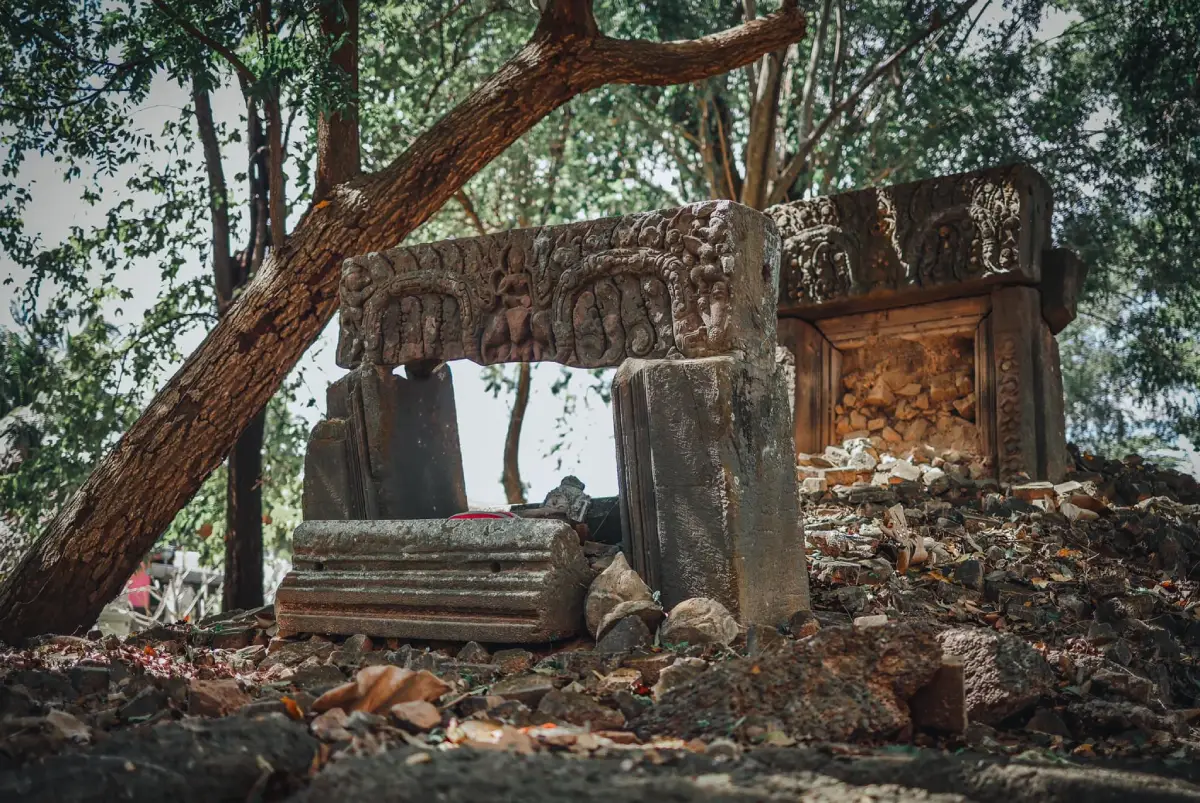
At the center of the village stands Prasat Yoe, an ancient Khmer monument built of brick on a laterite base, with sandstone door frames and carved sandstone lintels. The monument is located within the area of Wat Prasat Yoe Nuea. Although the structure is now damaged, the remaining brickwork, laterite base, sandstone frames, and lintel fragments still clearly reveal the sacred character of the original sanctuary. Prasat Yoe is a key archaeological trace showing the spread of Khmer religious and artistic influence across Si Sa Ket and the broader Lower Isan region.
Prasat Yoe is a single sanctuary built with smooth-surfaced brick without mortar and set on a laterite base. The surviving eastern entrance includes two large sandstone door frames. Above the inner frame is a sandstone lintel carved with a figure seated above a kala face that releases garland-like bands from both sides, with decorative pendant and foliage motifs. Another lintel depicts Indra riding the three-headed elephant Erawan. These carvings show the skill of Khmer stone craftsmen and preserve important religious symbolism associated with ancient sacred architecture.
Based on artistic and architectural style, Prasat Yoe dates to around 1550 - 1650 BE, corresponding to the 16th - 17th Buddhist centuries in Khmer art history. The use of laterite, brick, and sandstone is consistent with many ancient religious monuments in Si Sa Ket, Surin, and Buri Ram. The presence of this monument in a Yoe ethnic village reveals a layered cultural history: an ancient Khmer sacred site, followed by a later living ethnic community that built temples, settled permanently, and continued the sacred value of the place.
Local tradition says that Prasat Yoe was built during the reign of King Jayavarman VII and served as a dharmasala or roadside resting place along an ancient route. This story reflects the way local people understand the monument as part of a wider Khmer road and ritual network. The sanctuary was built with brick, laterite, and sandstone. Sandstone was used for the door frames, pillars, and lintels, while the surrounding area included brick, laterite, and an ancient pond located about 100 meters from the sanctuary. The pond shows how sacred space, water, and settlement were connected in the old landscape.
Today, Prasat Yoe remains in a ruined condition, with collapsed brick, laterite fragments, sandstone door frames, and carved lintels still visible. This condition makes respectful visitation especially important. Visitors should not climb the ruins, move stones or brick fragments, touch the lintels inappropriately, or litter around the monument. Every remaining piece is part of the historical evidence of the village. A ruined monument is not less meaningful than a fully restored one. It shows time, memory, fragility, and the importance of conservation.
Wat Prasat Yoe Nuea is the main temple associated with the ancient monument. It was formerly known as Wat Si Udom Borom Nimit and is located at 114 Moo 1, Prasat Yoe Subdistrict, Phrai Bueng District, Si Sa Ket Province. The temple belongs to the Mahanikaya order and includes an ordination hall, sermon hall, monks’ residences, a stupa, and a That Phanom-style chedi. It is both a community Buddhist temple and a caretaker space for Prasat Yoe, allowing the ancient monument to remain within an active religious environment.
Wat Prasat Yoe Nuea is especially important because of Luang Pho Mum Inthapanyo, also known as Phra Khru Prasat Khanthakhun, a highly revered monk of Si Sa Ket. Luang Pho Mum is remembered for his discipline, Buddhist work, temple development, community support, and strong influence on local faith. Many visitors come to Ban Prasat Yoe not only to see the Khmer monument but also to connect with the devotional memory of Luang Pho Mum. His legacy remains one of the spiritual foundations of the village.
The current abbot of Wat Prasat Yoe Nuea is Phra Maha Chan Di Panyawachiro, who has served from 2018 onward. He oversees the temple together with the monastic community and Ban Prasat Yoe villagers. The temple continues to support Buddhist holy days, ordination ceremonies, merit-making events, annual festivals, local gatherings, and the care of the ancient monument. Because the temple remains active, Prasat Yoe is not an abandoned ruin. It continues to be part of a living sacred landscape.
Wat Prasat Yoe Tai is another important temple of the village. It stands on the southern side of the community and functions together with Wat Prasat Yoe Nuea as a spiritual center for the people of Ban Prasat Yoe. The two temples reflect the growth of the village and the central role of Buddhism in local life. Visitors should understand these temples as connected parts of one village rather than as isolated attractions. Together, they support the community’s religious ceremonies, merit-making, social gatherings, and annual traditions.
The Yoe people of Ban Prasat Yoe preserve a distinctive cultural identity. Their identity appears in language, ancestral belief, ritual practice, textiles, food, and farming life. One of the most important ritual traditions is the Mae Sa-Eng dance ritual, also called Ram Cha-Eng in local usage. This ritual is related to healing, strengthening morale, ancestral spirits, and the restoration of balance within the community. It is not merely entertainment. It is a spiritual and social mechanism through which the community deals with illness, anxiety, misfortune, and emotional uncertainty.
The Mae Sa-Eng ritual often involves female ritual dancers and includes offerings, dress, music, movement, and participation from kin groups. It expresses the relationship between the living community, ancestors, and protective sacred powers. Visitors who have the chance to witness such a ritual should do so with respect. Photography or video recording should be done only with permission. The ritual belongs to the inner spiritual life of the Yoe people and should not be treated simply as a performance for outsiders.
Ban Prasat Yoe also maintains annual Buddhist and community traditions such as Songkran, Bun Khao Chi, Bun Phawet, Buddhist Lent, the end of Buddhist Lent, Loy Krathong, New Year merit-making, Kathin, robe-offering ceremonies, and annual temple events. These traditions bring villagers together, connect younger and older generations, support local temples, and maintain the rhythm of village life. Visiting during a festival reveals the lively side of the village, while visiting on an ordinary day gives a quieter experience that is suitable for learning history and local culture.
Daily life in Ban Prasat Yoe is closely connected with agriculture. Rice farming remains central to the local way of life, while cassava, corn, vegetable growing, household livestock, small trade, and wage work provide additional income. The agricultural calendar shapes the village’s social rhythm. Planting, harvesting, religious festivals, and family gatherings are connected with the cycle of seasons. Even when some villagers work outside the community, important ceremonies and family obligations continue to bring people back to their home village.
Weaving and clothing are also important expressions of Yoe identity. Women in the community have long preserved knowledge of silk weaving and local textiles. Patterns such as the luk kaeo pattern and dark ceremonial cloth with silver buttons carry meanings beyond beauty. They express ancestral respect, ritual roles, social identity, and the continuity of women’s skill. A woven cloth in Ban Prasat Yoe is therefore not merely a craft product. It is a cultural document made of thread, memory, and community knowledge.
Local food also reveals the character of the Yoe community. Ritual and merit-making occasions often include sticky rice, mushroom curry, chili pastes, boiled vegetables, cassia leaf curry, and other dishes prepared collectively by villagers. These foods reflect the agricultural environment, shared labor, hospitality, and kinship. Food in Ban Prasat Yoe is not only nourishment. It is part of ritual preparation, guest reception, family connection, and cultural continuity.
When viewed as a whole, Ban Prasat Yoe has several connected layers. The first layer is Prasat Yoe, the ancient Khmer monument. The second layer is Wat Prasat Yoe Nuea and Wat Prasat Yoe Tai, the Buddhist religious centers of the village. The third layer is the Yoe ethnic community with its language, rituals, textiles, food, and farming life. The fourth layer is the broader social space of courtyards, temple grounds, rice fields, ponds, and annual ritual routes. These layers make the village especially valuable for cultural travel.
Important places to see include the Prasat Yoe ruins, sandstone door frames, sandstone lintels, laterite base, ancient brick remains, ancient pond area, Wat Prasat Yoe Nuea, the That Phanom-style chedi, stupa, Luang Pho Mum devotional memory area, Wat Prasat Yoe Tai, the community cultural courtyard, Yoe village life, weaving, and agricultural surroundings. Visitors should move quietly and respectfully because the area includes a temple, a living community, and an archaeological site.
Ban Prasat Yoe is suitable for visitors who want to understand Lower Isan in detail. Archaeology visitors can see a Khmer monument embedded in a real village. Buddhist visitors can pay respect at the temples and learn about Luang Pho Mum. Cultural travelers can study Yoe language, rituals, textiles, and food. Photographers can capture sandstone frames, village scenes, temples, and rural landscapes. Community-learning travelers can observe how a temple, village, ancient monument, and rice fields remain connected.
Getting There from Si Sa Ket city is convenient by private car. Travel toward Phayu and Phrai Bueng District, then continue to Prasat Yoe Subdistrict. The distance from Si Sa Ket city is about 35 kilometers, and the village is about 8 kilometers from Phrai Bueng town. Visitors without private transportation should first reach Phrai Bueng town and continue by local hired transport to Ban Prasat Yoe.
A half-day route can begin in Si Sa Ket city, continue to Ban Prasat Yoe, pay respect at Wat Prasat Yoe Nuea, see Prasat Yoe, walk through the temple and village area, and then have a meal in Phrai Bueng town. Travelers with more time can continue to Phra That Wat Phrai Bueng, Wat Siriam Phuttharam or Wat Samrong Phlan, Prasat Wat Sa Kamphaeng Yai, Wat Maha Phuttharam, or Sisaket Aquarium. This route connects Yoe ethnic heritage, Khmer archaeology, Buddhist faith, and rural Lower Isan travel.
The best time to visit is in the morning or late afternoon. Morning light is suitable for worship, photography, and viewing the sandstone door frames. Late afternoon gives a quiet rural atmosphere for walking through the village and nearby fields. During heavy rain, visitors should take extra care because some areas around the monument may become slippery. Since the site is both sacred and archaeological, slow and respectful movement is always appropriate.
There is no fixed tourist admission fee at Ban Prasat Yoe. Visitors may enter during opening hours to pay respect at the temple and view the ancient monument. Donations, flowers, incense, candles, garlands, and merit-making offerings are voluntary according to personal faith. Because the area is a village, temple, and historic site, visitors should treat it with respect and avoid behavior that disturbs local life or damages ancient remains.
Visitor etiquette is important. Dress modestly, keep quiet, remove shoes in required temple areas, do not climb the ruins, do not touch or move ancient stones, do not write on stone or brick, do not litter, do not disturb monks or worshippers, and ask permission before photographing villagers. Respectful conduct allows tourism to support the community rather than burden it.
For international travelers, Ban Prasat Yoe is one of the clearest examples of cultural depth in Si Sa Ket Province. In one place, visitors can see an ancient Khmer monument, a Yoe ethnic community, active Buddhist temples, ancestral rituals, woven textiles, local food, and farming life. The village shows that Lower Isan is not only a region of major historical parks or famous temples. It is also a region of smaller living communities that preserve memory, faith, and heritage through everyday life.
The beauty of Ban Prasat Yoe does not come from perfect restoration or grand scale. It comes from the coexistence of past and present. Collapsed brick and sandstone frames tell the Khmer past. Yoe villagers tell the story of migration and ancestors. The two temples preserve present Buddhist faith. The Mae Sa-Eng ritual preserves local spiritual belief. Woven textiles preserve women’s knowledge. Rice fields and vegetable gardens preserve the agricultural life of the community. Together, these elements form a complete cultural landscape.
In summary, Ban Prasat Yoe is one of the important cultural destinations in Phrai Bueng District and Si Sa Ket Province. Prasat Yoe is the archaeological heart. Wat Prasat Yoe Nuea and Wat Prasat Yoe Tai are the religious heart. Luang Pho Mum is the devotional memory of the community. The Mae Sa-Eng ritual is the spiritual-cultural heart. The Yoe people are the living cultural heart of the village. A visit here gives travelers historical knowledge, quiet reflection, and a deeper understanding of Lower Isan’s ethnic and religious heritage.
| Place Name | Ban Prasat Yoe, Si Sa Ket / Prasat Yoe |
| Related Names | Ban Prasat Yoe, Prasat Yoe, Wat Prasat Yoe Nuea, Wat Prasat Yoe Tai, Yoe Ethnic Community, Luang Pho Mum Of Wat Prasat Yoe Nuea |
| Place Type | Ethnic Village, Cultural Destination, Ancient Khmer Monument, Community Buddhist Temples, And Yoe Cultural Learning Site In Lower Isan |
| Location | Ban Prasat Yoe, Prasat Yoe Subdistrict, Phrai Bueng District, Si Sa Ket Province 33180, Thailand |
| Coordinates | 14.8272612069, 104.372692076 |
| Distance From Key Points | About 8 km from Phrai Bueng town and about 35 km from Si Sa Ket city |
| Significance | An old Yoe ethnic village with an ancient Khmer monument at its center and two important Buddhist temples, Wat Prasat Yoe Nuea and Wat Prasat Yoe Tai, serving as community spiritual centers |
| Historical Summary | The Yoe people migrated from southern Laos, moved along the Mekong and Mun river systems, settled first in the Mueang Khong or Mueang Khok area of present-day Rasi Salai, and later established Ban Prasat Yoe, a community with more than 200 years of history. |
| Main Ethnic Group | Yoe people, an ethnic group in the Mon-Khmer linguistic family, known for language, ancestral rituals, weaving, food culture, and agricultural life |
| Main Ancient Monument | Prasat Yoe, an ancient Khmer monument built of brick on a laterite base with sandstone door frames and carved sandstone lintels, now preserved in a ruined but culturally important condition |
| Archaeological Period | Around 1550 - 1650 BE, corresponding to the 16th - 17th Buddhist centuries in Khmer art history |
| Artistic Features | Laterite base, smooth brickwork, two sandstone door frames, carved lintels with kala motifs, and a lintel depicting Indra riding the three-headed elephant Erawan |
| Historic Registration | Registered in the Royal Gazette, Volume 52 Part 75 on 8 March 1935 and Volume 99 Part 172 on 18 November 1982 |
| Main Temples In The Village | 1. Wat Prasat Yoe Nuea 2. Wat Prasat Yoe Tai |
| Abbot / Caretaker | Wat Prasat Yoe Nuea: Phra Maha Chan Di Panyawachiro Wat Prasat Yoe Tai: Wat Prasat Yoe Tai monastic community and Ban Prasat Yoe community Ancient Monument Area: Ban Prasat Yoe community, Wat Prasat Yoe Nuea monastic community, and Si Sa Ket Local Natural And Cultural Environment Conservation Unit |
| Important Devotional Figure | Luang Pho Mum Inthapanyo, also known as Phra Khru Prasat Khanthakhun, former abbot of Wat Prasat Yoe Nuea and a revered monk of Si Sa Ket |
| Main Traditions And Rituals | Mae Sa-Eng dance ritual, worship of ancestral spirits and celestial spirits, Songkran, Bun Khao Chi, Bun Phawet, Buddhist Lent, End Of Buddhist Lent, Loy Krathong, and annual temple merit-making events |
| Community Identity | Yoe language, ancestral belief, Mae Sa-Eng ritual, luk kaeo woven textile patterns, clothing with silver buttons, local foods such as cassia leaf curry, mushroom curry, chili paste with boiled vegetables, and rice-farming life |
| Current Status | Open as a cultural village, ethnic community, ancient monument area, and Buddhist worship destination centered around Wat Prasat Yoe Nuea and Wat Prasat Yoe Tai |
| Open Days | Daily |
| Opening Hours | 08.00 - 17.00 |
| Admission Fee | Free Admission. Donations, flowers, incense, candles, garlands, and merit-making offerings are voluntary according to personal faith. |
| Main Areas / Zones | 1. Prasat Yoe Ancient Khmer Monument Zone 2. Sandstone Door Frame And Lintel Zone 3. Laterite Base And Ancient Brick Ruin Zone 4. Wat Prasat Yoe Nuea Zone 5. Stupa And That Phanom-Style Chedi Zone 6. Luang Pho Mum Memorial Faith Zone 7. Wat Prasat Yoe Tai Zone 8. Ancient Pond Area Near The Sanctuary 9. Community Cultural Courtyard Zone 10. Yoe Ethnic Village Zone 11. Weaving And Agricultural Life Zone 12. Mae Sa-Eng Ritual Learning Route Zone |
| Facilities | Temple grounds, community courtyard, ancient monument walking area, worship area, parking arranged by the temple or community, and basic services in Phrai Bueng town |
| Related Contact | Si Sa Ket Local Natural And Cultural Environment Conservation Unit, Tel. 045-612-611, 065-121-4049 Prasat Yoe Subdistrict Non-Formal Education Center, Tel. 045-675-076, 098-197-1160 Phrai Bueng Subdistrict Municipality, Tel. 0-4567-5112 |
| Travel Information | From Si Sa Ket city, travel toward Phayu and Phrai Bueng District, then continue to Prasat Yoe Subdistrict. The distance is about 35 km from Si Sa Ket city and about 8 km from Phrai Bueng town. Private car, van, or hired local transport is recommended. |
| Visitor Etiquette | Dress modestly, keep quiet, do not climb on the ruins, do not touch or move ancient fragments, do not litter, do not disturb monks or worshippers, and ask permission before photographing local residents. |
| Nearby Tourist Attractions | 1. Prasat Yoe, inside the village, about 0 km 2. Wat Prasat Yoe Nuea, about 0 km 3. Wat Prasat Yoe Tai, about 1 km 4. Phra That Wat Phrai Bueng, about 9 km 5. Wat Siriam Phuttharam / Wat Samrong Phlan, about 12 km 6. Wat Ban Chan / Luang Pho Mum Route, about 15 km 7. Phrai Bueng Town, about 8 km 8. Prasat Wat Sa Kamphaeng Yai, about 32 km 9. Wat Maha Phuttharam / Luang Pho To, Mueang Si Sa Ket, about 35 km 10. Sisaket Aquarium, about 40 km, Tel. 045-612-686, 087-450-7484 |
| Nearby Restaurants | 1. Mee Mor Shabu & Grill, Phrai Bueng, about 8 km, Tel. 088-114-2610 2. Baan Ahan, Phrai Bueng, about 8 km, Tel. 082-598-1336 3. Waffle Dessert Shop, Phrai Bueng, about 9 km, Tel. 090-245-2614 4. Loft House Café, Khukhan, about 32 km, Tel. 086-364-9492 5. El Fante Cafe, Khukhan, about 32 km, Tel. 094-557-0578, 094-268-9666 6. Jiab Taban Tam, Khukhan, about 33 km, Tel. 061-034-9564 7. Restaurants In Si Sa Ket City, about 35 - 40 km |
| Nearby Accommodations | 1. Cheyenne Resort, Khukhan, about 32 km, Tel. 085-024-4829 2. Peace Pool Resort, Khun Han, about 36 km, Tel. 081-879-5822 3. Rerawadi Resort & Spa, Khun Han, about 36 km, Tel. 087-128-0095 4. B2 Sisaket Boutique & Budget Hotel, Mueang Si Sa Ket, about 38 km, Tel. 052-009-161, 088-263-2897 5. Boonsiri Boutique Hotel, Mueang Si Sa Ket, about 38 km, Tel. 045-622-222 6. Gallery Design Hotel, Mueang Si Sa Ket, about 39 km, Tel. 045-611-999 7. Tree House Hotel, Mueang Si Sa Ket, about 40 km, Tel. 045-611-563, 080-477-7854 |
Frequently Asked Questions (FAQ)
Q: Where is Ban Prasat Yoe located?
A: Ban Prasat Yoe is located in Prasat Yoe Subdistrict, Phrai Bueng District, Si Sa Ket Province. It is about 8 km from Phrai Bueng town and about 35 km from Si Sa Ket city.
Q: What are the opening days and hours?
A: Ban Prasat Yoe and Prasat Yoe are open daily from 08.00 to 17.00. Visitors can see the ancient monument, pay respect at Wat Prasat Yoe Nuea, and learn about the village during these hours.
Q: Is there an admission fee?
A: There is no fixed tourist admission fee. Donations, flowers, incense, candles, garlands, and merit-making offerings are voluntary according to personal faith.
Q: Why is Prasat Yoe important?
A: Prasat Yoe is an ancient Khmer monument in the village. It was built of brick on a laterite base with sandstone door frames and carved lintels, dating to around 1550 - 1650 BE. It is an important archaeological trace of Khmer culture in Si Sa Ket.
Q: Who is the abbot of Wat Prasat Yoe Nuea?
A: The abbot of Wat Prasat Yoe Nuea is Phra Maha Chan Di Panyawachiro, who oversees the temple together with the monastic community and Ban Prasat Yoe villagers.
Q: Which temples are located in Ban Prasat Yoe?
A: The village has two important temples: Wat Prasat Yoe Nuea, where Prasat Yoe is located and which is associated with Luang Pho Mum Inthapanyo, and Wat Prasat Yoe Tai, another community spiritual center.
Q: What are the distinctive cultural features of the Yoe people?
A: Yoe identity includes the Yoe language, ancestral belief, the Mae Sa-Eng ritual, luk kaeo woven textile patterns, silver-buttoned ritual clothing, local foods, and agricultural life tied to annual merit-making traditions.
Q: How can visitors get to Ban Prasat Yoe?
A: From Si Sa Ket city, travel toward Phayu and Phrai Bueng District, then continue to Prasat Yoe Subdistrict. The distance is about 35 km from Si Sa Ket city and about 8 km from Phrai Bueng town. Private car, van, or hired local transport is convenient.
 Category: ●Suburban Living
 Group: ●Village, Community
Last Update : 2 MonthAgo
 Last Update : 2 MonthAgo

 Art, Culture and Heritage
 Historical Sites and Monuments(12)
 Landmarks and Memorials(1)
 Art, Craft Centres, Tradition(8)
 Places of Worship
 Temple(13)
 Other Sacred Sites(3)
Village, Community(2)
Other Sacred Sites(3)
Village, Community(2)
 Nature and Wildlife
 National Parks and Marine Reserves(2)
 Dam, Reservoir, Lake(7)
 Waterfalls(5)
 River, Canal(5)
 Bays and Beaches(2)
 Entertainment and Agricultural
 Zoos and Aquariums(1)
 Farms, Parks and Ecotourism(3)


