
lovethailand home >Northeastern Travel Attractions >Si Sa Ket Travel Attractions >Muang Si Sa Ket >Muang Nuea > Naga Worship Tradition
TL;DR: Naga Worship Tradition, open Naga worship ceremonies are held according to religious occasions, annual, hours Phaya Sri Sattanakharat Riverside Shrine is generally visited from around 05.00.
Naga Worship Tradition
Open Days: Naga worship ceremonies are held according to religious occasions, annual festivals, Buddhist holy days, community ceremonies, and vow-fulfillment rituals. The main cultural reference point in this article, Phaya Sri Sattanakharat Riverside Shrine in Nakhon Phanom, is open daily for worship.
Opening Hours: Phaya Sri Sattanakharat Riverside Shrine is generally visited from around 05.00 to 20.00. Annual worship ceremonies, dance offerings, processions, and community events follow the official schedule announced by the province, temple, or host organizer.
Naga worship in Northeastern Thailand is one of the most powerful belief traditions in Isan culture, especially among communities along the Mekong River and other major waterways. In local belief, the Naga is not merely a mythical serpent. It represents water, fertility, protection, Buddhism, sacred geography, and the relationship between human life and nature. Many Isan communities honor the Naga as a guardian of rivers, underground waters, rainfall, temples, cities, and community well-being. Naga worship is therefore a cultural practice that combines devotion, blessing, vow fulfillment, river respect, ancestral memory, and the living identity of Mekong communities.
In the Isan worldview, the Naga and the Mekong River are closely connected. The Mekong is a lifeline, food source, route of travel, natural boundary, and sacred landscape shared by communities on both the Thai and Lao sides. Naga legends often explain the origin of rivers, sacred places, cities, relic shrines, and extraordinary events remembered by local people. For this reason, the Naga is not only an object of personal prayer but also a cultural symbol of how people understand the river that sustains their lives.
The belief in the Naga in Isan is rooted in Lan Xang legends, Buddhism, local folklore, and older water-related belief systems. Many communities see the Naga as a protector of Buddhism, sacred relics, temples, and towns. Stories of the Naga appear around major sacred sites such as Phra That Phanom and across many Mekong communities. This belief also appears in architecture and art: Naga stairways, temple railings, gateways, bridge decorations, stucco work, mural paintings, sculpture, and ritual objects across the Northeast.
Naga worship in Isan takes many forms. Individuals may pray at a shrine, offer flowers, light incense, or make personal vows. Families may prepare offerings at home. Communities may organize a large worship ceremony, Naga-themed Bai Sri, dance offering, or annual festival. The shared meaning is respect for the Naga as a protective and auspicious force. People commonly ask for safety, health, good fortune, business success, family stability, safe travel, and peace for the community.
In Mekong communities, Naga worship is deeply connected with seasonal water cycles. Farmers and fishermen have long depended on rainfall, river levels, fish, soil, and the stability of nature. The Naga, as a lord of water and the underworld, became a cultural symbol for explaining and respecting these forces. When rain, water, and harvests were abundant, communities understood it as a sign of blessing. When drought, flooding, or hardship occurred, people performed rituals to apologize, make offerings, and restore harmony with sacred powers.
Common offerings in Naga worship include Bai Sri trays, flowers, marigold garlands, jasmine garlands, incense, candles, clean water, fruit, Thai desserts, boiled eggs, betel, areca nut, and other items prepared according to local custom. Some ceremonies use multi-tiered Naga Bai Sri or offerings shaped with Naga-head symbolism. These offerings are not valued by price alone. Their meaning comes from purity, order, intention, and respect. A meaningful ritual is built from sincerity rather than extravagance.
Chanting, prayer, and formal invocation are important parts of the ceremony. The ritual leader may be a Brahmin-style officiant, local ritual specialist, community elder, or respected religious figure. The words spoken in the ceremony usually include apology, invitation, blessing, and respectful request. In some ceremonies, important Naga names such as Phaya Sri Sutho, Phaya Sri Sattanakharat, or local guardian Nagas are invoked. The purpose is to show reverence and to make the intention of the worshippers clear.
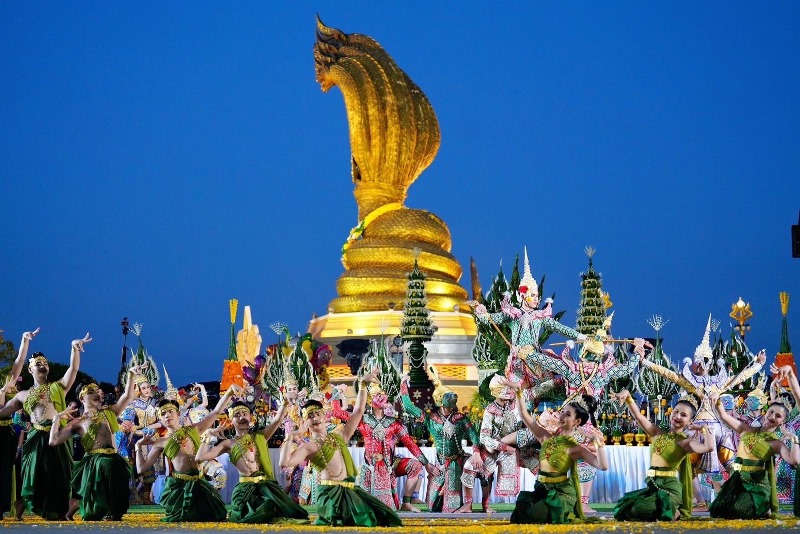
Dance offerings to the Naga have become a highly visible form of contemporary devotion. At major ceremonies such as the annual Phaya Sri Sattanakharat worship event in Nakhon Phanom, large groups of dancers perform along the Mekong River. The dance movements often imitate the fluid motion of the Naga and the river: curved arms, wave-like gestures, gentle turning, and coordinated group formations. The dance is both religious offering and cultural performance, expressing the grace, power, and sacredness of the Naga through human movement.
The Phaya Sri Sattanakharat worship event in Nakhon Phanom is one of the clearest contemporary examples of Naga devotion in Isan. The shrine stands on the Mekong Riverfront in the municipality of Nakhon Phanom and has become a spiritual landmark of the province. Visitors come throughout the year to pray, offer garlands, take photographs, and enjoy the Mekong view. The annual event includes ceremonial worship, dance offerings, Bai Sri contests, cultural performances, OTOP products, walking-street activities, and community participation from the Mekong cultural landscape.
For the people of Nakhon Phanom, Phaya Sri Sattanakharat is associated with protection of the city, the Mekong River, Buddhism, and auspicious life. Many visitors feel that worshipping at the riverside shrine gives emotional strength. The shrine combines the flowing river, the view of Laos, the open sky, local wind, and the majestic Naga sculpture in one sacred landscape. This is why the place carries cultural power beyond ordinary sightseeing.
Nong Khai Province is another important area of Naga belief, especially because of the Naga fireball tradition during the end of Buddhist Lent. The reddish fireballs rising from the Mekong are interpreted in local belief as offerings by the Nagas to the Buddha on the day of his return from Tavatimsa heaven. This tradition links Naga belief strongly with Buddhism. Large numbers of people travel to the Mekong to watch the phenomenon, make merit, join the Ok Phansa festival, and preserve the living memory of river communities.
Naga belief also appears in Bueng Kan, Udon Thani, Mukdahan, Amnat Charoen, Ubon Ratchathani, and other Isan provinces through temples, Naga shrines, riverfront rituals, sacred forests, lakes, canals, and local legends. Kham Chanot in Udon Thani is a well-known sacred site associated with Naga belief, while many Mekong temples use Naga images on stairways, bridges, gates, and railings. These forms show how deeply the Naga is embedded in the sacred landscape of the Northeast.
In Isan art and architecture, the Naga appears most commonly on temple stairways. The Naga stairway marks the passage from ordinary space into sacred Buddhist space. The long body of the Naga protects the path, while multi-headed Naga forms symbolize power, sacredness, and spiritual authority. Naga scales and curving bodies also evoke water and movement. In this way, the Naga is not only decoration but a symbolic guardian of the path to the Dhamma.
In folklore and literature, the Naga appears as creator, protector, tester, and sacred being. Stories of the underworld, marriage between humans and Nagas, guardianship of relics, formation of rivers, and the appearance of Nagas on Buddhist holy days make the Naga one of the most important figures in Isan imagination. These stories allow communities to explain their landscape, history, and sacred places in a language that is memorable and emotionally powerful.
Naga worship also has a strong psychological role. People often visit Naga shrines when they need courage, hope, or reassurance. They may come before beginning new work, before long travel, after a difficult period, or when facing an important family decision. Through ritual, prayer, and offering, people give form to their hopes. The belief creates calm, confidence, and a feeling of protection. This emotional function helps explain why Naga worship remains meaningful in contemporary Isan society.
At the same time, Naga worship should not be reduced only to fortune-seeking or lottery belief. Its deeper cultural meaning is connected with water, fertility, Buddhism, gratitude to nature, and community balance. A respectful ceremony should emphasize sincerity, cleanliness, moral intention, and awareness of the cultural roots of the place. People who worship the Naga should also do good, keep ethical conduct, respect the river, and care for the environment.
Proper etiquette is essential at Naga shrines, temples, and riverfront sacred spaces. Visitors should dress respectfully, remain calm, avoid climbing on the statue base, avoid touching areas that are restricted, avoid littering in the river, light incense only in designated areas, and avoid disturbing other worshippers. Because the Naga is associated with water and nature, keeping the riverfront clean is itself a meaningful act of worship.
The main ritual zones in Naga worship usually include the Naga statue or sacred point, the offering area, the incense and candle area, the invocation area, the dance-offering area, the vow-fulfillment area, and the public gathering area. In large festivals, there may also be cultural performance zones, local market zones, OTOP product areas, walking-street zones, photography areas, and Mekong-view zones. Organized zoning helps the ceremony remain orderly and respectful when many people attend.
At Phaya Sri Sattanakharat Riverside Shrine, visitors can begin by paying respect to the Naga statue, then observe the pedestal, multi-headed Naga form, coiled body, and water feature facing the Mekong. After worship, visitors can walk along the riverside promenade, enjoy the view across to Laos, visit the Naga tunnel and nearby old-town attractions, or join walking-street activities when available. Morning is ideal for sunrise and a quieter atmosphere, while evening is suitable for worship, photography, and riverside walking.
Getting to Phaya Sri Sattanakharat Riverside Shrine is straightforward because it is located on Sunthon Wichit Road in Nakhon Phanom city, directly by the Mekong River. Travelers staying in the city can walk, cycle, take local transport, or drive to the riverfront. The shrine can be combined with the Vietnamese Memorial Clock Tower, the former governor’s residence museum, Wat Maha That, Saint Anna Nong Saeng Church, Nakhon Phanom Freshwater Aquarium, and Wat Phra That Phanom.
Getting There for a cultural Naga route is best planned along the Mekong River. In Nakhon Phanom, travelers can begin at Phaya Sri Sattanakharat, walk along the Mekong promenade, visit the Naga tunnel, continue to old-town attractions, and later travel to Phra That Phanom. In Nong Khai, the route can connect with Naga fireball viewing areas during Ok Phansa. These routes show that Naga belief lives not only in statues but also in rivers, temples, towns, festivals, and collective memory.
The contemporary importance of Naga worship lies in its ability to keep local culture alive within present-day tourism and community economies. Large Naga worship events support local shops, hotels, food vendors, ritual specialists, dancers, Bai Sri makers, cultural performers, and community groups. When organized respectfully, the tradition becomes both a devotional ceremony and a living cultural festival that strengthens the identity of Mekong cities.
For international visitors, the Naga should be understood as a sacred water guardian rather than simply a “dragon” or “mythical snake.” The Isan Naga is linked with the Mekong River, Buddhism, the underworld, Lan Xang legends, sacred relics, and river-community life. Understanding this context helps visitors appreciate why people offer flowers, prepare Bai Sri trays, perform dance offerings, and travel long distances to pray at Naga shrines with sincere devotion.
Naga worship in Northeastern Thailand is therefore a living cultural heritage that brings together belief, water, ritual, art, landscape, and community life. From ancient river legends to modern riverside statues, from agricultural rain belief to large-scale dance offerings, the Naga remains a powerful symbol in the hearts of Isan people. The tradition is not only an old belief; it is a cultural language that expresses the bond between human beings, water, sacred protection, and hope along the Mekong River.
| Tradition Name | Naga Worship In Northeastern Thailand |
| Other Names | Naga Worship, Phaya Naga Worship, Naga Offering Ceremony, Naga Dance Offering, Phaya Sri Sattanakharat Worship Festival |
| Cultural Area | Northeastern Thailand, especially Mekong River communities such as Nakhon Phanom, Nong Khai, Bueng Kan, Mukdahan, Udon Thani, Ubon Ratchathani, and other Isan river communities |
| Main Cultural Reference Point | Phaya Sri Sattanakharat Riverside Shrine, Sunthon Wichit Road, Mekong Riverfront, Nai Mueang Subdistrict, Mueang Nakhon Phanom District, Nakhon Phanom Province |
| Coordinates | Approximately 17.4079, 104.7797 |
| Cultural Type | Intangible Cultural Heritage Related To Belief, Ritual, Buddhism, Performing Arts, River Life, Sacred Geography, And Mekong Community Devotion |
| Main Meaning | Respect for the Naga as a guardian of water, the underworld, Buddhism, cities, fertility, safety, auspiciousness, and community well-being |
| Ritual Period | Held according to devotional occasions, Buddhist holy days, Ok Phansa, full-moon periods, annual festivals, and vow-fulfillment ceremonies organized by host groups or local communities |
| Major Contemporary Event | The annual Phaya Sri Sattanakharat Worship Festival in Nakhon Phanom, scheduled in 2026 from 7–13 July, featuring dance offerings, Bai Sri contests, cultural performances, walking-street activities, OTOP products, and Mekong community participation |
| Ritual Components | 1. Naga statue or sacred worship point 2. Naga Bai Sri tray 3. Flowers, garlands, incense, candles, and clean water 4. Fruit, Thai desserts, boiled eggs, betel, areca nut, and offerings 5. Invocation or chanting 6. Ritual leader or officiant 7. Dancers or dance-offering group 8. Worshippers, host families, and community participants |
| Caretakers / Related Authorities | The Phaya Sri Sattanakharat area is within Nakhon Phanom Municipality, with provincial agencies, the municipality, cultural agencies, local communities, and private partners supporting annual worship activities according to the provincial schedule |
| Local Contact | Nakhon Phanom Municipality, Tel. 042-512005 Nakhon Phanom Provincial Commercial Office, Tel. 042-511117 National Broadcasting Services Of Thailand, Nakhon Phanom, Tel. 042-503569 |
| Current Status | Still actively practiced as a living belief and cultural tradition in Isan communities, especially along the Mekong River, and continues as a major form of faith-based and cultural tourism |
| Open Days | The tradition is held according to ritual occasions. Phaya Sri Sattanakharat Riverside Shrine is open daily for worship. |
| Opening Hours | Phaya Sri Sattanakharat Riverside Shrine is generally visited from around 05.00 to 20.00. Annual worship events follow the official schedule announced by the province or host organizer. |
| Fees | No fixed tourist admission fee. Flowers, garlands, offerings, and merit-making are voluntary according to personal faith. |
| Main Areas / Ritual Zones | 1. Naga statue or sacred point 2. Bai Sri and offering area 3. Incense, candle, and invocation area 4. Naga dance-offering area 5. Vow-fulfillment and garland-offering area 6. Mekong viewpoint area 7. Walking-street and OTOP area during festivals 8. Cultural performance and community activity area |
| Visitor Etiquette | Dress respectfully, remain calm, do not climb the statue base, do not litter in the river, light incense only in designated areas, avoid disturbing other worshippers, and follow site regulations during major events |
| Travel Information | Phaya Sri Sattanakharat Riverside Shrine is located on Sunthon Wichit Road in Nakhon Phanom Municipality. It is easily reached by private car, local transport, bicycle, or on foot from city hotels and Mekong riverfront areas. |
| Nearby Tourist Attractions | 1. Phaya Sri Sattanakharat Riverside Shrine, about 0 km 2. Nakhon Phanom Walking Street, about 0.3 km 3. Vietnamese Memorial Clock Tower, about 1 km 4. Former Nakhon Phanom Governor’s Residence Museum, about 2 km 5. Wat Maha That Nakhon Phanom, about 2 km 6. Saint Anna Nong Saeng Church, about 5 km 7. Nakhon Phanom Freshwater Aquarium, about 12 km 8. Wat Phra That Phanom Woramahawihan, about 55 km |
| Nearby Restaurants | 1. Naga Noodles Under Phaya Sri Sattanakharat, about 0 km, Tel. 090-981-1874 2. PunThai Coffee Phaya Sri Sattanakharat, about 0 km, Tel. 098-270-7445 3. Nu Lek Tam Yum Under Naga Landmark, about 0 km, Tel. 083-921-5040 4. Sabai Dee @ Nakhon Phanom, about 1 km, Tel. 042-064-200, 091-569-9662 5. Jaew Hon Pho Thong Nakhon Phanom, about 2 km, Tel. 042-511-885 6. Pen Pla Pen, Mueang Nakhon Phanom, about 7 km, Tel. 087-634-7467 7. Na Chok Kung Phao, Nakhon Phanom, about 12 km, Tel. 061-651-4289 |
| Nearby Accommodations | 1. Landmark Nakhonphanom Hotel, about 0.2 km, Tel. 091-740-3001 2. Fortune View Khong Hotel Nakhon Phanom, about 1 km, Tel. 083-989-1465 3. Fortune River View Hotel Nakhon Phanom, about 2 km 4. The River Hotel Nakhon Phanom, about 4 km, Tel. 042-522-999, 083-669-2999 5. U Home Hotel Nakhon Phanom, about 4 km 6. R2 Hotel Nakhon Phanom, about 5 km |
Frequently Asked Questions (FAQ)
Q: What is Naga worship in Northeastern Thailand?
A: It is a living belief and ritual tradition in which Isan communities honor the Naga as a guardian of water, the underworld, Buddhism, cities, fertility, safety, and auspicious life, especially along the Mekong River.
Q: How is the Naga connected with the Mekong River?
A: Mekong communities believe the Naga protects the river, underground waters, rainfall, sacred sites, and the well-being of river communities. Naga legends explain local landscapes, Buddhist relics, river life, and sacred events along the Mekong.
Q: Where is the Phaya Sri Sattanakharat worship event held?
A: It is held at Phaya Sri Sattanakharat Riverside Shrine on the Mekong Riverfront in Nakhon Phanom Province. The event includes dance offerings, Bai Sri contests, cultural performances, walking-street activities, and community participation.
Q: What offerings are commonly used in Naga worship?
A: Common offerings include Bai Sri trays, flowers, garlands, incense, candles, clean water, fruit, Thai desserts, boiled eggs, betel, areca nut, and other ritual items prepared according to local belief and personal faith.
Q: Is there an admission fee for Naga worship sites?
A: There is no fixed tourist admission fee for worship at public Naga shrines such as Phaya Sri Sattanakharat Riverside Shrine. Flowers, garlands, offerings, and donations are voluntary according to faith.
Q: What is the best time to visit Phaya Sri Sattanakharat Riverside Shrine?
A: Morning is suitable for sunrise, quiet worship, and Mekong views. Evening is ideal for prayer, photography, riverside walking, and walking-street activities when available.
Q: What does the Naga dance offering mean?
A: The dance offering expresses devotion to the Naga through graceful movement. The gestures often imitate flowing water and the movement of the Naga, making the dance both a sacred offering and a form of cultural performance.
Q: How should visitors behave at a Naga shrine?
A: Visitors should dress respectfully, remain calm, avoid climbing the statue base, avoid littering in the river, light incense only in designated areas, avoid touching other people’s offerings, and respect the beliefs of the host community.
 Category: ●Art, Culture and Heritage
 Group: ●Art, Craft Centres, Tradition
Last Update : 2 MonthAgo
 Last Update : 2 MonthAgo
 Historical Sites and Monuments(12)
 Landmarks and Memorials(1)
Art, Craft Centres, Tradition(8)
Landmarks and Memorials(1)
Art, Craft Centres, Tradition(8)
 Places of Worship
 Temple(13)
 Other Sacred Sites(3)
 Suburban Living
 Village, Community(2)
 Nature and Wildlife
 National Parks and Marine Reserves(2)
 Dam, Reservoir, Lake(7)
 Waterfalls(5)
 River, Canal(5)
 Bays and Beaches(2)
 Entertainment and Agricultural
 Zoos and Aquariums(1)
 Farms, Parks and Ecotourism(3)


