
lovethailand home >Northeastern Travel Attractions >Si Sa Ket Travel Attractions >Muang Si Sa Ket >Muang Nuea > Phi Mod Phi Meng And Ancestral Spirit Belief
TL;DR: Phi Mod Phi Meng And Ancestral Spirit Belief, open Held according to family lineage, host family, community occasion, hours Determined by ritual timing, the host, lineage elders, spirit mediums.
Phi Mod Phi Meng And Ancestral Spirit Belief
Open Days: Held according to family lineage, host family, community occasion, vow-fulfillment, healing rite, or cultural program; there is no fixed daily opening schedule like a permanent tourist attraction
Opening Hours: Determined by ritual timing, the host, lineage elders, spirit mediums, musicians, and relatives; the ceremony may last several hours or up to 2–3 days depending on local custom
Phi Mod Phi Meng And Ancestral Spirit Belief In Thai And Isan Culture is a cultural topic that requires accurate understanding. The name “Phi Mod Phi Meng” refers primarily to an ancestral spirit-dance ceremony of Lanna communities in Northern Thailand, while Northeastern Thailand or Isan has its own systems of ancestral and guardian-spirit rituals, including Phi Fa, Phi Thaen, Phi Pu Ta, Klae Mo, Ram Sa-Oeang, and other healing or vow-fulfillment ceremonies. The shared foundation is the belief that the living remain connected with ancestors, household spirits, village guardians, and sacred powers. Through offerings, dance, music, trance, apology, and communal gathering, families seek protection, healing, prosperity, and moral balance.
In traditional Thai society, the word “phi” does not refer only to frightening ghosts. It belongs to a broad spiritual worldview in which unseen beings, ancestors, guardian spirits, house spirits, village spirits, and sacred forces participate in human life. These beings are believed to protect families, regulate community morality, guard local territories, influence health, and maintain the balance between people and the places they inhabit. Spirit rituals therefore provide a cultural way to address uncertainty, illness, misfortune, broken promises, and the need to reconnect with ancestors. They are not merely supernatural practices; they are social mechanisms for care, memory, apology, and kinship solidarity.
Phi Mod Phi Meng is one of the most distinctive spirit rituals of Lanna culture. “Phi Mod” is commonly understood as an ancestral spirit associated with ordinary lineage groups, while “Phi Meng” is connected with the word “Meng,” a Lanna term associated with the Mon people and with remembered ancestral or noble spirit lineages in some traditions. The ceremony is performed within a kinship group that shares the same spirit lineage. Relatives gather at the host’s house, prepare offerings, invite the ancestral spirits, allow spirit possession through lineage members, perform dance as an offering, and ask the ancestors to protect the descendants from misfortune.
Although Phi Mod Phi Meng is a Lanna ceremony rather than a direct Isan tradition, its core meaning is close to many Isan ancestral-spirit practices. In Isan, families and villages also maintain rituals for ancestral spirits, village guardian spirits, Phi Fa, Phi Thaen, Phi Pu Ta, and other sacred beings. Illness, misfortune, agricultural difficulty, or family problems may be interpreted as signs that relationships with ancestors or guardian spirits must be repaired. Rituals are then performed to apologize, make offerings, fulfill vows, restore morale, and bring the family or community back into balance.
Comparable Isan practices include Ram Phi Fa, Ram Phi Thaen, Klae Mo, Ram Sa-Oeang, offerings to Phi Pu Ta, household-spirit ceremonies, and healing rites led by local ritual specialists. These practices vary across ethnic groups such as Thai-Lao, Khmer, Kui or Suai, and Yeu communities, but they share a common concern: human life is not separated from the unseen world. When people behave properly, the spirits protect them. When customs are neglected, ritual apology and restoration may be required. In this sense, Phi Mod Phi Meng helps readers understand a wider Thai pattern of ancestor-centered ritual life.
The history of Phi Mod Phi Meng is closely tied to kinship. It is not performed by every household but by families that belong to a specific spirit lineage. Some lineages perform the ceremony annually, while others do it every 2–3 years, depending on the convenience of relatives and the host family. If someone becomes ill and a vow is made to the ancestors, the family may hold a vow-fulfillment dance after recovery. The ceremony therefore brings dispersed relatives back together. It becomes an occasion to eat together, make offerings, dance, talk, renew kinship bonds, and confirm that they still belong to the same ancestral line.
This kinship function is also central to Isan culture. Merit-making, ancestor offerings, spirit appeasement, house blessings, healing rituals, weddings, ordinations, and village ceremonies all bring relatives back to the family and community. People cook together, prepare offerings, welcome guests, listen to elders, and remember the dead. Rituals make kinship visible and active. Whether in Lanna or Isan, ancestral-spirit ceremonies remind people that family identity extends beyond the living generation.
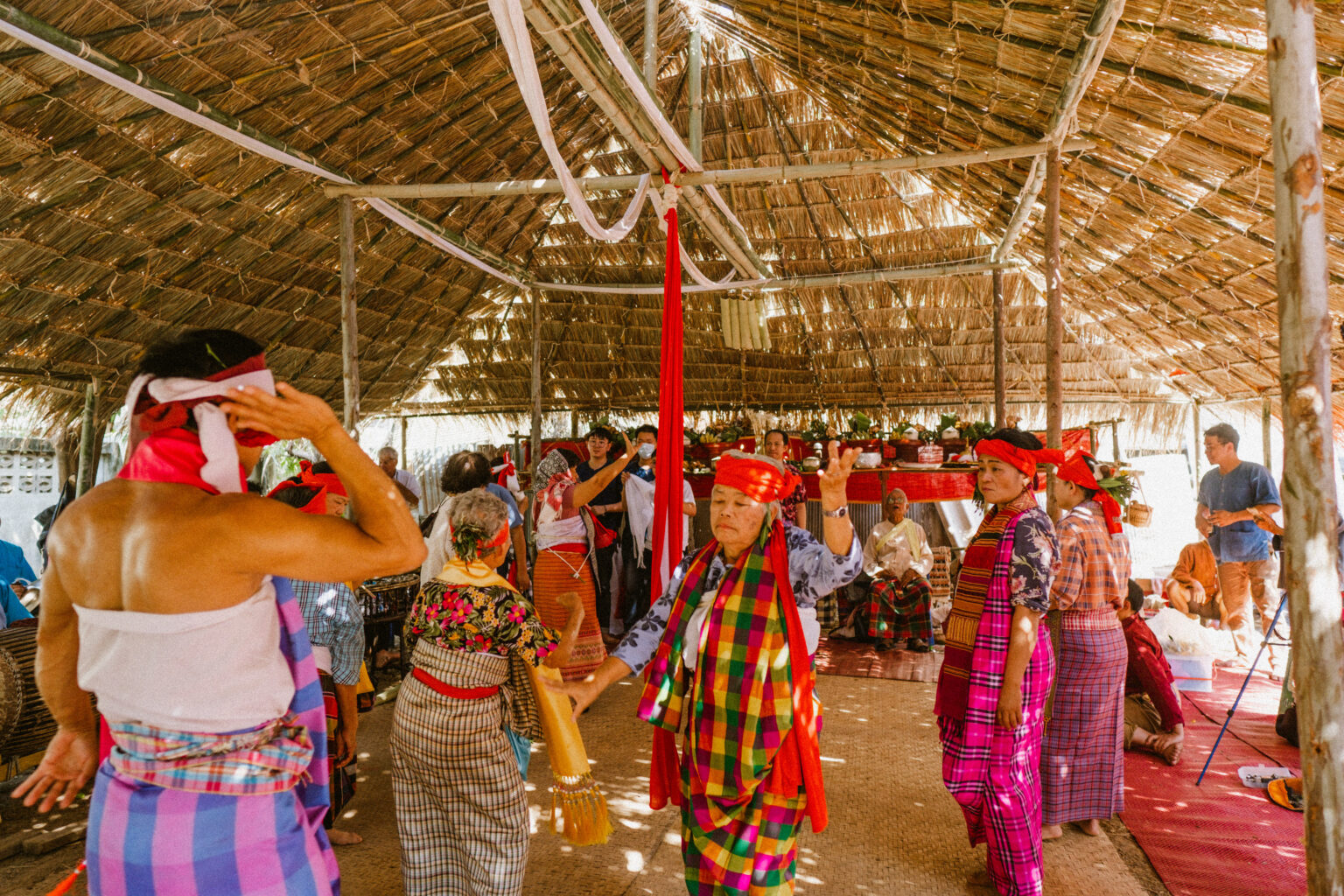
A Phi Mod Phi Meng ceremony begins with the construction of a ritual pavilion called a “pham” in the house yard. Inside the pavilion, a small spirit altar or raised platform is prepared for offerings. These offerings may include a pig’s head, whole boiled chicken, liquor, popped rice, flowers, incense, candles, sweets, bananas, sugarcane, coconut rice bundles, and other items required by the lineage. Cloths such as sarongs, head wraps, and shoulder cloths are also placed on a rack for those who will enter trance or dance. Through this preparation, an ordinary courtyard becomes a temporary sacred space for receiving the ancestral spirits.
In the Lanna ceremony, elderly women or senior female lineage leaders often play an important role. They lead descendants to the household spirit shrine, light incense and candles, inform the ancestors, and invite them to the ritual pavilion. This role is culturally significant because it shows that ritual knowledge is not held only by male religious authorities. Women elders preserve memory, lineage rules, ritual order, and proper conduct. Phi Mod Phi Meng therefore reveals the authority of senior women within the family’s spiritual system.
When the ancestral spirits are invited into the ritual space, possession may occur through lineage members. The spirit, believed to have entered a medium, may receive offerings, drink, speak with relatives, ask about the family’s condition, warn descendants about proper conduct, or give blessings. After the spirit has been received, relatives perform the spirit dance as an offering. Women or elder relatives often begin the dancing. Dancers put on the prepared cloths and move according to the ritual music. This is not stage entertainment; it is a devotional dance offered to the ancestors.
Music is central to Phi Mod Phi Meng. A ritual ensemble may include drums, gong circle, xylophone, reed instruments, cymbals, and other percussion used to guide the movement and atmosphere of the ceremony. In Northern terminology, an important drum may be known as “teng thing.” The music opens the sacred field, supports trance, organizes movement, and allows participants to enter the emotional rhythm of the ceremony. It is therefore a ritual language rather than background sound.
In Isan spirit rituals, music plays a similar role. Khaen, drums, gongs, cymbals, and local instruments guide Ram Phi Fa, Ram Phi Thaen, Klae Mo, Ram Sa-Oeang, and related practices. The sound creates ritual atmosphere, supports trance, and helps participants feel that the ceremony has entered a sacred state. In both Lanna and Isan, music becomes a bridge between the human world and the ancestral or spirit world.
Offerings in Phi Mod Phi Meng represent respect for the ancestors. Each item is not merely food but a sign of memory, apology, gratitude, and correct ritual practice. Pig’s head, chicken, liquor, popped rice, flowers, incense, candles, sweets, bananas, sugarcane, and coconut water may be prepared according to the lineage’s custom. In some traditions, Phi Meng is associated with specific offerings and food preferences. The correctness of the offering matters because it shows that descendants have not forgotten the inherited rules.
In Isan, offerings to ancestral or guardian spirits are equally important. In ceremonies for Phi Pu Ta, house spirits, Phi Fa, Phi Thaen, or Klae Mo, offerings may include cooked rice, food, liquor, chicken, pig’s head, flowers, candles, incense, betel, areca nut, and other items required by the ritual lineage. The value of offerings lies not in their price but in proper intention, correct preparation, and respect for the beings who are believed to protect family and community life.
The main meaning of Phi Mod Phi Meng is gratitude toward ancestors and solidarity among relatives. Those who belong to the same spirit lineage must observe inherited rules and prohibitions. Some traditions include restrictions against marriage within the same spirit group, or obligations to return for the ceremony at the proper time. Such rules are not only religious. They organize kinship, define social boundaries, and remind descendants of their responsibilities to the ancestral line.
In Isan, gratitude toward ancestors appears through many rituals, including merit-making for the dead, offerings to village guardian spirits, house-spirit ceremonies, Su Khwan, and vow-fulfillment rites. These practices show that the living owe respect to those who came before them. Life in the present is understood as resting on land, houses, knowledge, labor, and protection inherited from earlier generations. Spirit offerings are therefore a form of gratitude expressed through ritual action.
The key difference between Phi Mod Phi Meng and Isan spirit practices lies in ritual form. Phi Mod Phi Meng uses the Lanna spirit pavilion, lineage possession, Lanna-influenced clothing, the spirit dance, and Northern ritual music. Isan practices often involve khaen music, spirit-healing songs, mo tham, Phi Fa mediums, village guardian shrines, Klae Mo, Ram Sa-Oeang, or Phi Pu Ta ceremonies. The underlying value may be similar, but the ritual vocabulary is different. For this reason, Phi Mod Phi Meng should not be presented as a direct Isan tradition. It should be understood as a Lanna ceremony that can be compared with Isan ancestor-spirit traditions.
As a learning topic for Isan cultural writing, Phi Mod Phi Meng is valuable because it helps compare how different Thai regions maintain relationships with ancestors. Lanna uses the language of the spirit dance in the pham pavilion. Isan uses rituals such as Phi Fa, Phi Thaen, Phi Pu Ta, Klae Mo, and Ram Sa-Oeang. Both systems express respect for the dead, concern for family well-being, and the belief that unseen powers continue to shape human life. This comparison deepens understanding rather than confusing regional traditions.
Both Phi Mod Phi Meng and Isan ancestral rituals also express the relationship between humans and nature. Traditional communities depended on rain, soil, water, forests, animals, crops, and seasonal balance. Illness, disaster, crop failure, or unexpected trouble could be interpreted as signs that relationships with sacred powers had become disturbed. Spirit rituals were therefore not only personal appeals. They were ways to ask for safety, fertility, health, and harmonious life in the village landscape.
Today, Phi Mod Phi Meng has declined in many areas but continues in some Lanna communities and families that still preserve their spirit lineage. In Isan, ancestral-spirit rituals also continue in communities that maintain traditional healing, vow-fulfillment, village guardian ceremonies, and ethnic ritual practices. Some ceremonies are now presented through cultural demonstrations or educational programs. This public presentation must be handled with respect because real rituals involve families, illness, lineage rules, and sacred obligations. They are not merely performances detached from belief.
Anyone who wishes to observe ancestral-spirit rituals should distinguish between a real ceremony and a cultural demonstration. A real ceremony may take place in a family home, lineage ritual space, or village sacred area. It includes a host family, offerings, mediums, musicians, lineage elders, and specific taboos. Outsiders must ask permission before observing, photographing, or recording. They should not touch offerings, cross the ritual area, laugh at trance behavior, or treat the ceremony as spectacle. A demonstration, by contrast, is designed for education and public explanation.
For travelers who want to learn about ancestral-spirit belief in Isan, Si Sa Ket is a strong cultural starting point. The province includes Thai-Lao, Khmer, Kui or Suai, and Yeu communities, as well as Khmer ruins, Buddhist temples, spirit-healing traditions, and ethnic cultural knowledge. Visitors can begin with provincial cultural centers, community learning centers, temples, and local cultural programs before approaching private ritual contexts. Learning about Phi Mod Phi Meng together with Isan practices helps readers see Thai culture as interconnected yet regionally distinct.
As an educational subject, Phi Mod Phi Meng explains lineage ritual, women’s ritual authority, ancestor worship, trance, offerings, ritual music, and kinship obligations. Isan ancestral-spirit rituals explain Phi Pu Ta, Phi Fa, Phi Thaen, mo tham, khaen music, healing rites, and the relationship between ritual and agricultural life. Together, they show that spirit traditions in Thailand are not one uniform system. They are local bodies of knowledge shaped by language, ethnic history, landscape, and community memory.
The value of these rituals does not lie in mystery alone. Their social and emotional functions are equally important. They gather relatives, give roles to elders, create support around illness or misfortune, restore confidence, and remind younger generations of their roots. Even when modern people do not interpret spirit belief in the same way as earlier generations, they can still understand that these rituals preserve memory, gratitude, care, and social responsibility.
Writing about Phi Mod Phi Meng in an Isan context should therefore be done with precision. It is a Lanna ancestral spirit-dance ceremony, while Isan has related but distinct ancestral and healing rituals. Presenting this accurately respects both Lanna and Isan communities. Thai culture is rich because each region has its own ritual language while sharing deeper concepts such as ancestors, offerings, protection, vows, dance, music, and kinship gathering.
For international readers, the most important point is that “spirit” in Thai folk culture is often part of a moral and relational system. Spirits are not only beings to fear. They can be guardians, ancestors, protectors, healers, and witnesses to human conduct. A spirit ceremony may teach gratitude, family responsibility, respect for elders, and care for the vulnerable. When viewed with cultural sensitivity, Phi Mod Phi Meng and Isan ancestral rituals become windows into how communities care for suffering, uncertainty, memory, and belonging.
Phi Mod Phi Meng and ancestral-spirit beliefs in Thai and Isan culture therefore offer an important lesson in gratitude, kinship, and cultural diversity. Phi Mod Phi Meng belongs to the Lanna world of ancestor dance and lineage ritual. Isan has its own living traditions of Phi Fa, Phi Thaen, Phi Pu Ta, Klae Mo, Ram Sa-Oeang, and other healing or guardian-spirit ceremonies. Understanding both contexts allows readers to appreciate the depth of Thai ritual culture without confusing one region with another. Every ceremony has its own community, language, history, and sacred rules, and each deserves to be understood with respect.
| Topic Name | Phi Mod Phi Meng And Ancestral Spirit Belief In Thai And Isan Culture |
| Important Names | Phi Mod Phi Meng Spirit Dance, Phi Mod Dance, Phi Meng Dance, Ancestral Spirits, Grandparent Spirits, Phi Fa, Phi Thaen, Phi Pu Ta, Klae Mo, Ram Sa-Oeang |
| Main Cultural Area | Phi Mod Phi Meng is a Lanna ancestral spirit-dance ceremony of Northern Thailand. Isan has related ancestral and healing spirit traditions such as Phi Fa, Phi Thaen, Phi Pu Ta, Klae Mo, and Ram Sa-Oeang. |
| Cultural Type | Intangible Cultural Heritage Related To Religion, Ritual, Ancestral Spirit Belief, Folk Music, Dance, Kinship, Healing, And Community Memory |
| Main Meaning | Ancestor worship, vow fulfillment, ritual apology, protection for descendants, misfortune removal, kinship reunion, and preservation of lineage customs |
| Relationship With Isan Culture | Not a direct Isan ceremony, but comparable to Isan ancestral and guardian-spirit rituals that involve protection, healing, offerings, trance, village guardians, and family obligations |
| Ritual Period | Lanna Phi Mod Phi Meng is often held in May–June or the 6th–7th lunar months. Some lineages hold it annually, while others hold it every 2–3 years or after a vow has been fulfilled. Isan ancestral-spirit rituals are held according to local custom, vows, illness, village ceremonies, or community occasions. |
| Components Of Phi Mod Phi Meng | 1. Pham or ritual pavilion in the house yard 2. Spirit altar or raised offering platform 3. Offerings such as pig’s head, boiled chicken, liquor, popped rice, flowers, incense, candles, sweets, bananas, sugarcane, and lineage-specific foods 4. Sarongs, head cloths, shoulder cloths, and ritual costume pieces 5. Spirit medium from the lineage 6. Folk music ensemble 7. Relatives and descendants of the same spirit lineage |
| Comparable Isan Spirit-Ritual Components | 1. Phi Pu Ta shrine, household shrine, or village sacred area 2. Offerings such as food, liquor, boiled chicken, pig’s head, flowers, incense, candles, betel, and areca nut 3. Mo tham, Phi Fa medium, khaen musician, female ritual master, or elders 4. Patient, vow-maker, host family, or community members 5. Khaen, drums, gongs, or local ritual instruments 6. Dance, chant, trance, spirit communication, or ritual apology according to local custom |
| Ritual Leaders / Caretakers | Phi Mod Phi Meng is cared for by lineage elders, senior women, mediums, host families, and relatives of the same spirit line. Isan rituals are cared for by mo tham, Phi Fa mediums, khaen musicians, female ritual masters, elders, host families, and communities that preserve the ritual. |
| Current Status | Phi Mod Phi Meng continues in some Lanna communities and families that preserve spirit lineages. Isan ancestral-spirit rituals continue through village ceremonies, healing rites, vow-fulfillment rituals, Phi Pu Ta offerings, and cultural learning activities. |
| Open Days | No fixed daily opening schedule. The ritual is held according to lineage, host family, vow, healing need, community event, or cultural program. |
| Opening Hours | Determined by ritual timing, host family, ritual caretakers, musicians, and relatives. A ceremony may last several hours or several days depending on local practice. |
| Fees | No fixed tourist admission fee. Attendance at a real ceremony requires permission from the host family or community. Offerings and ritual costs are prepared by the host or lineage group. |
| Main Areas / Ritual Zones | 1. Pham or ritual pavilion zone 2. Spirit altar and offering zone 3. Medium or trance zone 4. Music and rhythm zone 5. Dancer and costume zone 6. Relative and descendant zone 7. Ancestor-invocation zone 8. Vow-fulfillment, blessing, and closing zone |
| Visitor Etiquette | Ask permission before observing, photographing, or recording. Dress respectfully, do not touch offerings, do not cross ritual space, do not disturb trance participants, do not mock the dance or spirit speech, and respect the host community’s belief. |
| Related Learning Sources | Provincial cultural centers, Princess Maha Chakri Sirindhorn Anthropology Centre, local ritual databases, Lanna communities preserving Phi Mod Phi Meng, Isan communities preserving Phi Fa, Phi Thaen, Phi Pu Ta, Klae Mo, Ram Sa-Oeang, and ethnic cultural learning centers in Lower Northeastern Thailand |
| Nearby Cultural Attractions In A Si Sa Ket Cultural Route | 1. Si Sa Ket Cultural Center, about 0 km 2. Si Sa Ket City Pillar Shrine, about 2 km 3. Khun Amphai Phanit Building, about 2 km 4. Wat Maha Phuttharam / Luang Pho To, about 2 km 5. Si Sa Ket Railway Station, about 2 km 6. Si Sa Ket Aquarium, about 5 km 7. Wat Phra That Rueang Rong, about 12 km |
| Nearby Restaurants In Si Sa Ket City | 1. The Wine Room Cafe, about 1 km, Tel. 082-678-7468 2. The Cup Cafe, about 2 km, Tel. 095-742-6323 3. Jiree Cafe, about 2 km, Tel. 080-799-1890 4. Mum Aroi Street Foods, about 2 km 5. Zapp Gyoza Sisaket, about 2 km 6. Churrería Café Mueang Si Sa Ket, about 2 km |
| Nearby Accommodations In Si Sa Ket City | 1. B2 Sisaket Boutique & Budget Hotel, about 2 km, Tel. 052-009-161, 088-263-2897 2. Boonsiri Boutique Hotel, about 2 km, Tel. 045-622-222 3. Prompiman Hotel, about 2 km, Tel. 045-612-677 4. The Impress Sisaket, about 3 km 5. Tree House Hotel Si Sa Ket, about 5 km |
Frequently Asked Questions (FAQ)
Q: Is Phi Mod Phi Meng an Isan tradition?
A: Phi Mod Phi Meng is a Lanna ancestral spirit-dance ceremony of Northern Thailand, not a direct Isan tradition. It can be compared with Isan ancestral and healing rituals such as Phi Fa, Phi Thaen, Phi Pu Ta, Klae Mo, and Ram Sa-Oeang because they share similar values of ancestor respect, protection, healing, and kinship solidarity.
Q: What is Phi Mod Phi Meng?
A: Phi Mod Phi Meng is a spirit-dance ceremony performed to honor, appease, or fulfill vows to ancestral spirits. It is held within a kinship group to ask ancestors to protect descendants, remove misfortune, support prosperity, and maintain lineage harmony.
Q: Why can Phi Mod Phi Meng be discussed with Isan culture?
A: It can be discussed as a comparative cultural topic because both Phi Mod Phi Meng and Isan ancestral-spirit rituals focus on ancestor gratitude, offerings, vow fulfillment, misfortune removal, healing, and the gathering of relatives around a sacred obligation.
Q: What Isan rituals are similar in meaning?
A: Similar Isan traditions include Ram Phi Fa, Ram Phi Thaen, Phi Pu Ta offerings, Klae Mo, Ram Sa-Oeang, household-spirit ceremonies, and healing or vow-fulfillment rituals practiced by local ethnic communities.
Q: What is the difference between Phi Mod and Phi Meng?
A: Phi Mod is generally understood as an ancestral spirit connected with ordinary lineage groups, while Phi Meng is associated with the Lanna term “Meng,” related to the Mon, and with ancestral or higher-status spirit memories in some belief systems.
Q: When is Phi Mod Phi Meng held?
A: It is often held in May–June or the 6th–7th lunar months. Some lineages hold it annually, some every 2–3 years, and some after a vow has been fulfilled following recovery from illness or family misfortune.
Q: How should visitors behave when observing a real ritual?
A: Visitors should ask permission before entering, photographing, or recording. They should dress respectfully, avoid touching offerings, avoid crossing ritual space, avoid disturbing mediums, and respect the host community’s belief.
Q: What is the main value of Phi Mod Phi Meng and ancestral-spirit rituals?
A: Their main value is the preservation of gratitude to ancestors, kinship solidarity, social healing, respect for elders, moral order, vow fulfillment, and the continuity of community memory.
 Category: ●Art, Culture and Heritage
 Group: ●Art, Craft Centres, Tradition
Last Update : 2 MonthAgo
 Last Update : 2 MonthAgo
 Historical Sites and Monuments(12)
 Landmarks and Memorials(1)
Art, Craft Centres, Tradition(8)
Landmarks and Memorials(1)
Art, Craft Centres, Tradition(8)
 Places of Worship
 Temple(13)
 Other Sacred Sites(3)
 Suburban Living
 Village, Community(2)
 Nature and Wildlife
 National Parks and Marine Reserves(2)
 Dam, Reservoir, Lake(7)
 Waterfalls(5)
 River, Canal(5)
 Bays and Beaches(2)
 Entertainment and Agricultural
 Zoos and Aquariums(1)
 Farms, Parks and Ecotourism(3)


