
lovethailand home >Northeastern Travel Attractions >Si Sa Ket Travel Attractions >Muang Si Sa Ket >Muang Nuea > Ram Phi Than and Ram Phi Faa Tradition
TL;DR: Ram Phi Than and Ram Phi Faa Tradition, open Held according to family, community, or ritual occasions; there is no fixed, hours Determined by the ritual timing, host family, ritual master, khaen musician.
Ram Phi Than and Ram Phi Faa Tradition
Open Days: Held according to family, community, or ritual occasions; there is no fixed daily opening schedule like a permanent tourist attraction
Opening Hours: Determined by the ritual timing, host family, ritual master, khaen musician, and community participants; the ceremony may last several hours or up to a full day
Ram Phi Thaen and Ram Phi Fa in Si Sa Ket are traditional Northeastern Thai spirit-healing rituals that express the deep relationship between human beings, sky spirits, ancestral spirits, family, and community. These ceremonies are not ordinary performances created only for entertainment. They are sacred ritual dances in which movement, music, sung verse, ritual offerings, and trance communication are used to ask forgiveness, seek protection, and appeal to powerful unseen beings according to local belief. The rituals are especially associated with illness, emotional distress, unexplained suffering, and situations in which a family believes that a person’s condition may be connected with ancestral spirits, Phi Fa, Phi Thaen, or a spiritual breach within the family line.
In the cultural worldview of Isan, the word “phi” does not simply mean a frightening ghost. It refers to a broad system of unseen forces, spirits, ancestors, guardians, and sacred powers that shape the relationship between people and the world around them. Phi Fa and Phi Thaen are regarded as high-ranking sky spirits or divine beings with the power to protect human life, restore balance, and bring relief from hardship. When an illness cannot be easily explained, the family may interpret it not only as a physical condition but also as a disruption in the relationship between the living, the ancestors, and the sacred order of the community. Ram Phi Thaen and Ram Phi Fa therefore function as healing ceremonies, acts of apology, and collective efforts to restore spiritual and social balance.
Phi Thaen or Phi Fa holds a high position in the Isan belief system. Thaen is connected with the sky, divine authority, rain, fertility, protection, and the moral order of life. The highest form is often called Thaen Luang, associated in local belief with Indra, the powerful deity of the heavens. This is why the ceremony must be performed with respect, proper offerings, appropriate music, and a ritual specialist who understands the inherited rules of the tradition. Instruments such as the khaen, drum, or ritual percussion are not merely musical tools. They help open the ritual space, invite sacred attention, guide the dancers, and create a soundscape through which communication with the spirits becomes possible.
Si Sa Ket Province gives this ritual tradition a particularly rich cultural character because the province is home to several ethnic and linguistic groups, including Thai-Lao, Khmer, Kui or Suai, and Yeu communities. In some areas of Si Sa Ket, Khmer language is used together with Isan or other local languages during the ritual. The songs, invocations, healing verses, spirit-calling phrases, and ritual dialogue therefore preserve the province’s multilingual cultural identity. Ram Phi Thaen and Ram Phi Fa in Si Sa Ket are not expressions of a single uniform tradition; they reflect the layered cultural landscape of Lower Northeastern Thailand.
Among Lao ethnic communities in Si Sa Ket, Ram Phi Fa is performed when a person suffers from an illness that does not improve or cannot be clearly explained. The family may believe that the illness is not ordinary but is connected with ancestral intention, spiritual displeasure, or the influence of Phi Fa. A ritual is then arranged to appeal to the spirit, ask for healing, and restore the patient’s relationship with the spirit world. When the patient recovers, that person may become a follower or disciple of Phi Fa and may be expected to join annual spirit-feeding ceremonies. In this way, healing does not end with one ceremony; it creates a long-term ritual relationship between the patient, the spirit lineage, the ritual master, and the community.
Among Kui or Suai communities in Si Sa Ket, related rituals may be called Ram Sa-oeang, Klae Sa-oeang, Klae Mo, or other local names depending on the area. The core meaning remains close: the ritual is performed to honor Thaen, ancestral spirits, or guardian spirits, to fulfill vows, to ask forgiveness, and to restore the health or well-being of a family member. Kui communities often maintain Buddhist practice together with beliefs in ancestral spirits, household guardians, sacred power, and ritual protection. These beliefs help explain why spirit-healing ceremonies continue to carry meaning in community life even as modern healthcare becomes the main system of medical treatment.
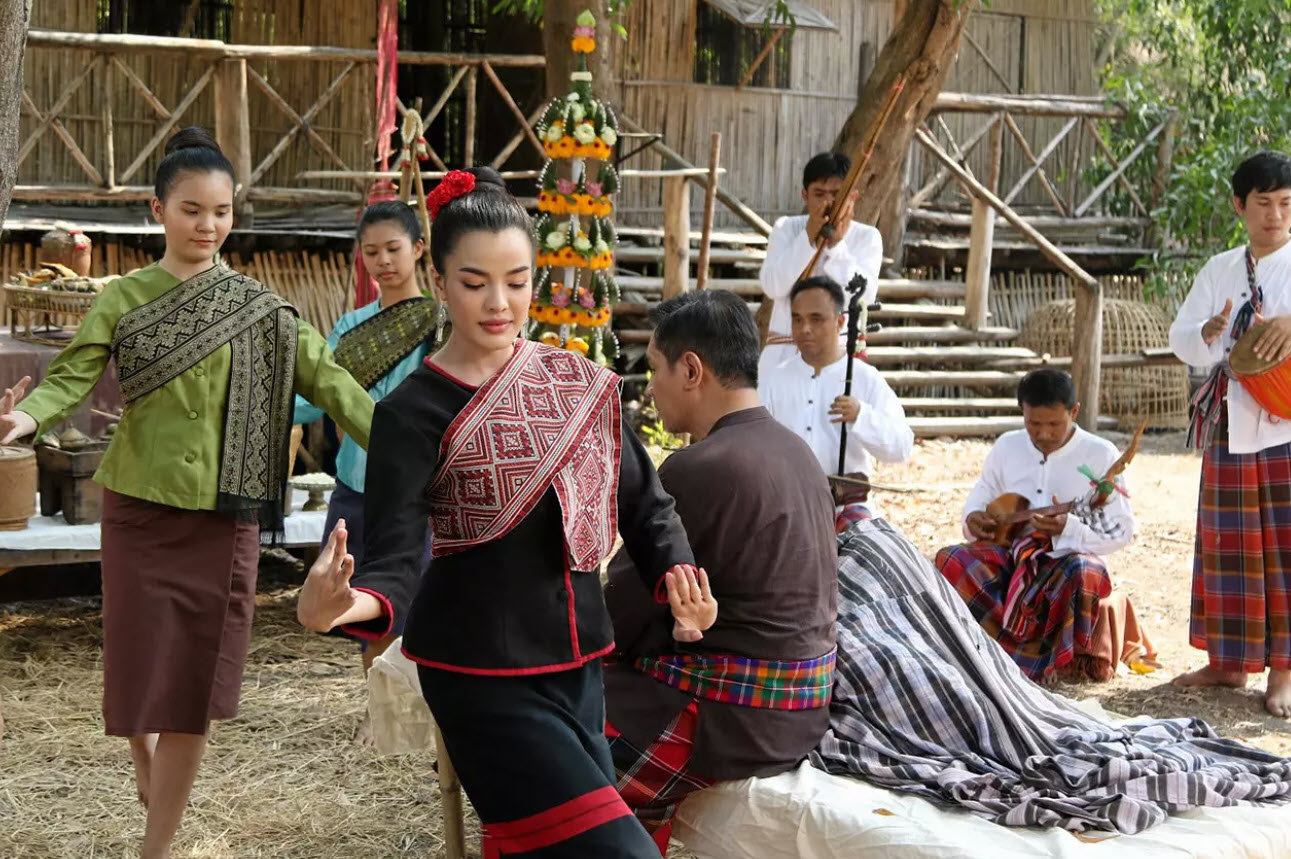
The ceremony has four key components: the ritual singer-medium or khru ba, the khaen musician or mo ma, the patient, and the ritual offering set known as khrueang khai or khrueang sen. The ritual singer-medium is the central specialist who communicates with Phi Fa, Phi Thaen, or ancestral spirits on behalf of the patient. This role is often inherited through family or spiritual lineage, and in many communities the ritual medium is a woman. She leads the ritual, chants or sings the ritual verses, negotiates with the spirits, interprets the cause of suffering, and guides the family through apology, offering, and blessing.
The khaen musician, sometimes called mo khaen or mo ma, provides the ritual rhythm and sound. The khaen is central to the atmosphere of the ceremony. It supports the dance, the trance state, the sung verses, and the emotional movement of the ritual. The musician must be experienced and patient because the ceremony may last for many hours. In the ritual context, the khaen is more than a musical instrument. Its sound helps connect the human world with the sacred world and gives structure to the movement of the medium, dancers, and participants.
The patient is the emotional and ritual center of the ceremony, but healing is never treated as an isolated individual matter. Family members, relatives, ritual specialists, musicians, and community participants all become part of the healing process. The patient may be someone suffering from long-term illness, weakness, unexplained symptoms, or emotional distress. Through the ritual, the patient’s suffering becomes visible to the family and community, and the ceremony offers a cultural language for care, explanation, and hope. This is one reason the ritual remains meaningful: it creates social support around suffering.
The ritual offerings, or khrueang khai, are offerings of respect to Thaen, Phi Fa, ancestral spirits, teachers, and sacred powers. They may include banana-leaf rice bundles, flower garlands, popped rice, flowers, incense, candles, betel, areca nut, rice, food, and other items required by the specific ritual lineage. The offerings must be prepared correctly because they express apology, reverence, and an invitation to the spirits. The ritual is not considered complete without proper respect for the inherited rules of the teacher lineage.
The ceremony usually begins with the preparation of the ritual space. A temporary pavilion or designated ritual area is arranged, offerings are placed in the correct position, incense and candles are lit, local guardian spirits are informed, and the teacher lineage is invited. The khaen or other instruments then begin to play, and the ritual master sings or chants the inherited verses. Participants may begin to dance. When Phi Fa or Phi Thaen is believed to enter the medium, the ritual enters its central phase, in which the spirit may be addressed, questioned, appeased, and asked to help the patient.
The dance in Ram Phi Fa and Ram Phi Thaen is not only artistic movement. It is a ritual language. Hand gestures, steps, body movement, facial expression, and rhythm can communicate invitation, apology, acceptance, protection, blessing, and the presence of specific spirits. Research on Ram Phi Fa in Si Sa Ket shows that meaning is communicated through makeup, clothing, ritual objects, dance gestures, and sung verses. The ceremony is therefore a layered system of ritual communication rather than a simple dance performance.
Clothing also carries ritual meaning. Participants may wear silk skirts, traditional wraps, ceremonial cloth, local textiles, or ornaments according to the custom of their ethnic group and ritual lineage. In some Kui communities, silk clothing or specific local dress identifies the participants as members of the ritual group and shows respect for the sacred occasion. Clothing marks the transition from ordinary daily life into the ritual space, where people behave under a different moral and spiritual order.
The sung verses are among the most important parts of the ceremony. They may invite the spirits, ask forgiveness, describe the patient’s condition, request healing, give advice to the family, and bless the participants. In Si Sa Ket, the use of Khmer language together with Isan or other local languages shows how the ritual preserves multilingual memory. The verses are often transmitted orally, making the ceremony an important living archive of local language, rhythm, memory, and spiritual knowledge.
The social role of the ceremony is as important as its spiritual meaning. It transforms the patient’s suffering into a shared concern of the family and community. Relatives gather, the ritual specialist leads, musicians provide the sound, and participants become witnesses to the healing process. The patient is no longer alone with illness. The ceremony gives cultural form to distress and turns it into an event of care, apology, reunion, and encouragement. In this sense, Ram Phi Fa functions as both spiritual healing and social healing.
The ritual also expresses gratitude toward ancestors. Some illnesses are interpreted as the result of neglecting, offending, or forgetting ancestral spirits. The ceremony allows the living to apologize, make offerings, and renew their relationship with those who came before them. The Isan saying “people may not see, but spirits see” expresses the moral lesson of the tradition. It reminds people that actions, promises, and obligations are not judged only by human eyes but also by the unseen guardians of the family line.
Ram Phi Thaen is also connected with agriculture, rain, and community well-being. Thaen is associated with the sky and seasonal order. In some communities, the ritual is performed not only for healing but also to ask for rain, agricultural fertility, protection from danger, and peace within the village. This reflects an Isan worldview in which human life is linked with the sky, earth, water, crops, ancestors, and sacred forces. The ritual is therefore part of a wider system of ecological and spiritual balance.
In Si Sa Ket, related rituals such as Ram Phi Thaen, Ram Phi Fa, Ram Sa-oeang, and Klae Mo show how local communities adapt a shared belief system to their own ethnic, linguistic, and historical contexts. Lao communities may emphasize Phi Fa worship and annual spirit-feeding. Kui communities may connect the ritual with ancestral spirits and family lineages. Khmer-speaking areas may include Khmer language and ritual elements. These differences do not weaken the tradition; they reveal the cultural depth of Si Sa Ket as a province where multiple worlds of belief meet.
At present, the tradition continues as an intangible cultural heritage recorded, studied, and transmitted through families, ritual lineages, community specialists, and cultural networks. It is not a daily attraction open like a museum. It appears when there is a host family, a patient, a vow to fulfill, a ritual obligation, or a cultural demonstration arranged with proper respect. The ceremony remains meaningful because it is connected with real community belief, not only staged performance.
Visitors who wish to observe Ram Phi Thaen or Ram Phi Fa should do so with respect. Because the ceremony may involve a patient and private family concerns, outsiders must ask permission before watching, photographing, or recording. They should not touch the offerings, cross the ritual area, laugh at trance behavior, interrupt the ritual specialist, or treat the ceremony as spectacle. Respectful observation is essential because the ritual belongs to the community and carries deep emotional and spiritual meaning.
The tradition is not fixed to only one tourist location. Cultural mapping records Ram Phi Fa in Ban Phong, Phrai Bueng District, and related practices are also associated with other communities in Si Sa Ket, including areas of Mueang Si Sa Ket, Prang Ku, Huai Thap Than, and other ethnic settlements in the Lower Northeast. It is best understood as a cultural landscape across the province rather than as a single site. Travelers should begin by learning from cultural centers, local communities, and public cultural events before seeking direct observation of a real ritual.
Learning from a demonstration should also be distinguished from witnessing a real healing ceremony. A demonstration may be arranged to teach the public about music, costume, movement, and ritual objects. A real ceremony, however, involves a patient, offerings, teacher lineage, vows, and family responsibility. Understanding this distinction protects the dignity of the ritual and helps outsiders avoid reducing sacred practice to a stage performance.
The value of Ram Phi Thaen and Ram Phi Fa lies not in exoticism but in the community’s ability to transform suffering into a shared act of care. Through music, ritual language, dance, family gathering, and ancestral respect, the ceremony addresses illness as a human, social, and spiritual condition. Even in a modern society where biomedical treatment is the main form of healthcare, the ritual continues to offer emotional support, kinship reconnection, and cultural meaning for those who believe in it.
Ram Phi Thaen and Ram Phi Fa should therefore not be reduced to superstition or folk entertainment. They preserve complex local knowledge about healing, ritual communication, music, dance, gender roles, teacher lineages, ancestor reverence, and community ethics. Many ritual specialists inherit their knowledge through practice rather than formal schooling. The ceremony survives through memory, apprenticeship, participation, and community recognition. Its continuity depends on respect for the living communities that maintain it.
In the context of Si Sa Ket, the tradition also reveals the province’s strong cultural borderland identity. Si Sa Ket is known for Khmer ruins, Buddhist temples, local crafts, and natural attractions, but it is also home to living rituals that preserve the voices of Lao, Khmer, Kui, and Yeu communities. Ram Phi Thaen and Ram Phi Fa are heard in the khaen, the ritual chant, the offering tray, the dance, and the gathering of relatives around a person in need. They show that cultural heritage is not only found in monuments; it also lives in ritual action, language, memory, and care.
Preserving this tradition requires more than recording images or placing it on a stage. It requires respect for the teacher lineage, the role of women ritual specialists, the local languages, the ritual offerings, the music, the family obligations, and the sacred context that gives the ceremony meaning. When understood properly, Ram Phi Thaen and Ram Phi Fa become one of the most important gateways into the cultural heart of Lower Northeastern Thailand.
Ram Phi Thaen and Ram Phi Fa in Si Sa Ket are therefore significant cultural heritage in the fields of community history, ethnicity, language, music, dance, spirituality, and healing. They show that Isan spirit belief is not separate from daily life. It is a system through which people honor nature, ancestors, family, moral responsibility, and community support. For travelers and readers who approach the tradition with respect, the ritual reveals how Isan communities have cared for suffering, uncertainty, and hope across generations.
| Tradition Name | Ram Phi Thaen And Ram Phi Fa In Si Sa Ket |
| Other Names | Ram Phi Fa, Ram Phi Thaen, Ram Thaen, Phi Fa Nang Thiam, Ram Sa-Oeang, Klae Sa-Oeang, Klae Mo, Ram Nang O |
| Cultural Area | Si Sa Ket Province, especially Thai-Lao, Khmer, Kui or Suai, and Yeu communities in areas such as Phrai Bueng, Mueang Si Sa Ket, Prang Ku, Huai Thap Than, and nearby Lower Northeastern communities |
| Cultural Type | Intangible Cultural Heritage Related To Religion, Ritual, Performing Arts, Traditional Music, Folk Dance, And Local Healing Belief |
| Highlights | Spirit-healing ceremony, apology to Phi Fa, Phi Thaen, and ancestral spirits, ritual khaen music, sung verse, dance movement, offering trays, trance communication, and community participation |
| Main Meaning | A ritual system connecting healing, family support, ancestral gratitude, faith in sky spirits, community care, and emotional restoration for the patient and relatives |
| Related Ethnic Groups | Thai-Lao, Khmer, Kui or Suai, Yeu, and other Lower Northeastern communities that preserve beliefs in Phi Fa, Phi Thaen, ancestral spirits, and ritual healing |
| Languages Used | Isan, Khmer, local community languages, and Thai in some contexts. Si Sa Ket is distinctive because Khmer language may appear in some ritual performances. |
| Ritual Components | 1. Ritual singer-medium or khru ba 2. Khaen musician or mo ma 3. Patient or person seeking healing 4. Ritual offering set, including rice bundles, flower garlands, popped rice, flowers, incense, candles, betel, areca nut, rice, food, and other lineage-specific offerings |
| Ritual Caretakers | Female ritual masters, Phi Fa mediums, mo tham, khaen musicians, lineage elders, host families, and community members who preserve the ritual rules, offerings, songs, and teacher lineage |
| Current Status | Preserved as living intangible cultural heritage in Si Sa Ket communities and recorded in cultural learning and cultural mapping sources; performed according to family, ritual, or community occasions |
| Open Days | No fixed daily opening schedule. The ritual is held according to host families, ritual lineages, healing needs, vows, or community cultural events. |
| Opening Hours | Determined by ritual timing and community agreement. A ceremony may last several hours or up to a full day depending on local practice. |
| Fees | No fixed tourist admission fee. Attendance at a real ritual depends on permission from the host family and community. Ritual offerings are prepared by the host according to the lineage rules. |
| Main Areas / Ritual Zones | 1. Ritual pavilion or central ceremony area 2. Offering tray area 3. Ritual master or Phi Fa medium area 4. Khaen musician and instrument area 5. Patient and family area 6. Dancers and ritual followers area 7. Singing, dancing, and trance communication area 8. Apology, blessing, and closing ritual area |
| Visitor Etiquette | Ask permission before observing, photographing, or recording. Dress respectfully, do not touch the offerings, do not cross the ritual area, do not disturb trance participants, and treat the host community’s belief with respect. |
| Cultural Learning Sources | Culturio by Princess Maha Chakri Sirindhorn Anthropology Centre, Cultural Mapping Thailand, Si Sa Ket cultural agencies, ritual-keeping communities, and ethnic cultural learning sources in Lower Northeastern Thailand |
| Nearby Cultural Attractions In A Si Sa Ket Cultural Route | 1. Si Sa Ket Cultural Center, about 0 km from the city cultural route base 2. Si Sa Ket City Pillar Shrine, about 2 km 3. Khun Amphai Phanit Building, about 2 km 4. Wat Maha Phuttharam / Luang Pho To, about 2 km 5. Si Sa Ket Aquarium, about 5 km 6. Wat Phra That Rueang Rong, about 12 km 7. Prasat Wat Sa Kamphaeng Yai, Uthumphon Phisai District, about 30 km |
| Nearby Restaurants In Si Sa Ket City | 1. The Wine Room Cafe, about 1 km, Tel. 082-678-7468 2. The Cup Cafe, about 2 km, Tel. 095-742-6323 3. Jiree Cafe, about 2 km, Tel. 080-799-1890 4. Sri Surak Restaurant, about 2 km, Tel. 061-021-7269 5. Slow Life Cafe & Bistro, about 15 km, Tel. 064-086-5529 |
| Nearby Accommodations In Si Sa Ket City | 1. B2 Sisaket Boutique & Budget Hotel, about 2 km, Tel. 052-009-161, 088-263-2897 2. Boonsiri Boutique Hotel, about 2 km, Tel. 045-622-222 3. Prompiman Hotel, about 2 km, Tel. 045-612-667, 045-612-696, 045-612-150 4. The Impress Sisaket, about 3 km, Tel. 045-961-566 5. Tree House Hotel Si Sa Ket, about 5 km, Tel. 045-611-563, 080-477-7854 |
Frequently Asked Questions (FAQ)
Q: What are Ram Phi Thaen and Ram Phi Fa in Si Sa Ket?
A: They are Northeastern Thai spirit-healing rituals that use dance, khaen music, sung verses, ritual offerings, and communication with Phi Fa, Phi Thaen, or ancestral spirits to seek healing, protection, apology, and emotional support for the patient and family.
Q: Are Ram Phi Thaen and Ram Phi Fa the same tradition?
A: They share a similar belief system centered on Phi Fa or Thaen, high-ranking sky spirits in Isan belief. Names and details vary by community, ethnic group, and ritual lineage, including Ram Thaen, Ram Phi Fa, Ram Sa-Oeang, Klae Sa-Oeang, and Klae Mo.
Q: What is the main purpose of the ritual?
A: The main purpose is to ask forgiveness from Phi Fa, Phi Thaen, or ancestral spirits, request healing for a patient, protect the family, strengthen community support, and restore moral and spiritual balance.
Q: Who performs the ritual?
A: The ritual is led by a ritual singer-medium, female ritual master, khru ba, or mo tham, supported by khaen musicians, the patient, relatives, the host family, and followers of the same ritual lineage.
Q: What offerings are used in the ritual?
A: Offerings may include banana-leaf rice bundles, flower garlands, popped rice, flowers, incense, candles, betel, areca nut, rice, food, and other items required by the ritual lineage. The offerings express respect, apology, and invitation to the spirits.
Q: What makes the Si Sa Ket version distinctive?
A: Si Sa Ket is culturally diverse, with Thai-Lao, Khmer, Kui or Suai, and Yeu communities. Some rituals use Khmer language together with Isan or other local languages, reflecting the province’s Lower Northeastern cultural identity.
Q: Can tourists observe Ram Phi Fa or Ram Phi Thaen?
A: Observation of a real ritual requires permission from the host family or community because the ceremony may involve private illness, family matters, and sacred belief. Public cultural demonstrations may be open according to the organizer’s conditions.
Q: How should visitors behave when observing the ritual?
A: Visitors should dress respectfully, ask before taking photos or recording, avoid touching offerings, avoid crossing the ritual space, avoid disturbing trance participants, and treat the host community’s belief with respect.
 Category: ●Art, Culture and Heritage
 Group: ●Art, Craft Centres, Tradition
Last Update : 2 MonthAgo
 Last Update : 2 MonthAgo
 Historical Sites and Monuments(12)
 Landmarks and Memorials(1)
Art, Craft Centres, Tradition(8)
Landmarks and Memorials(1)
Art, Craft Centres, Tradition(8)
 Places of Worship
 Temple(13)
 Other Sacred Sites(3)
 Suburban Living
 Village, Community(2)
 Nature and Wildlife
 National Parks and Marine Reserves(2)
 Dam, Reservoir, Lake(7)
 Waterfalls(5)
 River, Canal(5)
 Bays and Beaches(2)
 Entertainment and Agricultural
 Zoos and Aquariums(1)
 Farms, Parks and Ecotourism(3)


