
lovethailand home >Northeastern Travel Attractions >Sakon Nakhon Travel Attractions >Muang Sakon Nakhon >That Choeng Chum > Sra Phang Thong
TL;DR: Sra Phang Thong is located at Inside Somdet Phra Srinagarindra Park, beside Nong Han Lake, That Choeng Chum Subdistrict, Mueang Sakon Nakhon District, Sakon Nakhon, open Daily, hours 05.00 – 21.00.
Sra Phang Thong
Open Days: Daily
Opening Hours: 05.00 – 21.00
Sra Phang Thong in Sakon Nakhon is a large ancient pond located on the eastern side of the city, now forming the central water landscape of Somdet Phra Srinagarindra Park beside Nong Han Lake. It is an important public recreation area, a venue for Loy Krathong, long-boat racing, fish-release ceremonies, and local events, and a cultural water site connected with Khmer baray concepts, the sacred Phu Nam Rot well at Wat Phra That Choeng Chum, and the historic water-management landscape of Sakon Nakhon.
Sra Phang Thong in Sakon Nakhon is a large ancient pond with significance in history, urban landscape, local culture, and public life. It is located on the eastern side of Sakon Nakhon city, near Nong Han Lake and Wat Phra That Choeng Chum Worawihan. Today, the pond lies within Somdet Phra Srinagarindra Park, one of the most important public parks in Sakon Nakhon. Local people use the surrounding area for relaxation, walking, exercise, photography, festivals, and community gatherings. For foreign travelers, Sra Phang Thong offers a clear view of how an ancient water site can remain meaningful in a modern provincial city.
Sra Phang Thong is not merely a decorative pond in a park. It is part of the historic water landscape of Sakon Nakhon. The pond is close to Nong Han, one of the major freshwater lakes of northeastern Thailand. Because the area is near a large natural water body, the groundwater level is not as deep as in drier inland zones. This made the area suitable for creating a water-retention pond that could support people during the dry season. The pond therefore reflects practical knowledge of water management, settlement planning, and adaptation to the local environment.
In local historical knowledge, Sra Phang Thong is explained as a pond created according to Khmer concepts of water management. The Thai word phang in the name is connected with traphang, which has roots in the Khmer word trapang, meaning a dug pond or water basin. This linguistic connection gives the site cultural depth. The name itself preserves traces of language, water engineering, and Khmer influence in the Sakon Nakhon area.
The concept of a baray is central to understanding the cultural meaning of Sra Phang Thong. In Khmer civilization, a baray was a large water reservoir used for irrigation, ritual, settlement planning, and symbolic purposes. Khmer communities were highly skilled in water management, particularly in regions where storing water for the dry season was essential. Sra Phang Thong is therefore often understood within this cultural framework: an ancient pond that was not only functional, but also connected with sacred geography and urban life.
The pond is closely connected with Wat Phra That Choeng Chum Worawihan, the most revered religious site in Sakon Nakhon. Local tradition links Sra Phang Thong with Phu Nam Rot or Phu Nam Lot, a sacred well inside Wat Phra That Choeng Chum. The story describes a connection between the sacred well and the pond through an underground water passage. A local tale says that if a bucket or container fell into the sacred well, it could be found at Sra Phang Thong. Whether understood as a historical water system, a sacred story, or a memory of older water management, this connection gives the pond a strong cultural identity.
The story of the underground water passage also relates to the Khmer concept of water channels, sometimes described in local knowledge as lalom. Similar water-management ideas can be found in parts of southern Isan, especially around Khmer monuments and ancient reservoirs. Around Prasat Mueang Tam in Buriram Province, for example, large baray-like water bodies form part of the historic landscape. When viewed in this wider regional context, Sra Phang Thong becomes more than a local pond. It becomes part of a broader heritage of water, ritual, and Khmer-influenced settlement planning in northeastern Thailand.
Sakon Nakhon contains several traces of Khmer cultural influence, including Phra That Narai Cheng Weng, Phra That Phu Phek, Phra That Dum, Khmer bridges, and Khmer sites such as the monument at Ban Phan Na in Sawang Daen Din District. These places show that the region has deep historical layers. Sra Phang Thong belongs to this same cultural landscape, not as a tower or stone sanctuary, but as a water feature that helps explain how ancient communities organized land, water, religion, and daily life.
Local accounts also refer to later changes in the old city landscape. Some laterite stones and ancient structural remains in the Sakon Nakhon area were moved, reused, or damaged over time, especially during periods when their historical value was not widely understood. This makes Sra Phang Thong especially important because it remains visible and usable today. It is a surviving landscape element that allows present-day visitors to sense the depth of the city’s history without entering an archaeological excavation.
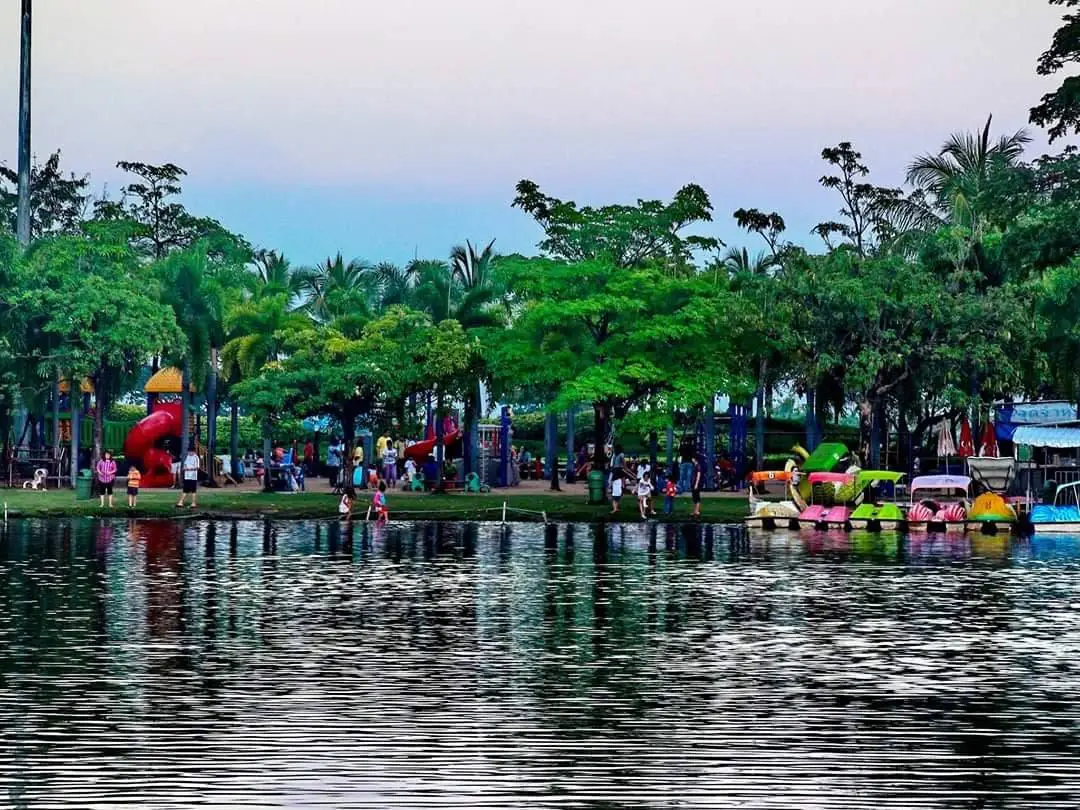
Today, Sra Phang Thong forms the central water body of Somdet Phra Srinagarindra Park. The park covers about 120 rai beside Nong Han Lake and was created to honor Somdet Phra Srinagarindra Boromarajajonani. Her Royal Highness presided over the official opening ceremony on 9 November 1987. The park includes ornamental flower gardens, woodland areas, water gardens, rock gardens, exercise areas, walking and jogging paths, and a fountain rising about 69 meters high. In this setting, the ancient pond continues to serve a modern public function.
The present-day view of Sra Phang Thong has several layers of meaning. The first layer is natural and scenic: a large body of water that cools the park and creates reflections of trees, sky, and fountain spray. The second layer is historical: a pond associated with Khmer baray concepts, Phu Nam Rot, and Wat Phra That Choeng Chum. The third layer is social: a public space used daily by local people. The fourth layer is cultural: a venue for local festivals, rituals, and community events. These layers make Sra Phang Thong one of the most meaningful urban spaces in Sakon Nakhon.
The atmosphere around the pond is especially pleasant in the morning and late afternoon. In the morning, the air is cooler and local residents come to walk, jog, stretch, and exercise. The light is gentle and the pond surface often appears calm. In the late afternoon, the park becomes livelier as families, students, workers, and visitors come to relax. The evening light over the water, the fountain, the trees, and the movement of people give the site a warm and local character.
Sra Phang Thong reflects the deep relationship between Sakon Nakhon people and water. Water in this city is not only a physical resource. It is connected with food, farming, fishing, religious practice, festivals, public life, and local identity. Because the ancient pond remains in active public use, modern visitors can experience water heritage directly rather than only reading about it in historical texts.
During Loy Krathong, Sra Phang Thong becomes one of the important public spaces for the festival. The pond, lights, floating krathong, and crowd activity create a memorable atmosphere. The festival allows the pond to continue its ritual function in a contemporary form. People come to express gratitude to water, spend time with family, and take part in one of Thailand’s most recognized cultural traditions. The pond therefore remains an active cultural stage, not a silent relic.
Sra Phang Thong and the surrounding park are also used for long-boat racing, fish-release ceremonies, and festive events. This ability to support many roles makes the pond highly valuable to the city. On ordinary days, it is a quiet recreation area. During festivals, it becomes a gathering place for culture, sport, and public celebration. Few urban water sites can carry both everyday calm and ceremonial energy so effectively.
The visual landscape of the pond is one of its main attractions. The water reflects trees, the sky, and the fountain. Walking paths around the pond allow visitors to see the site from different angles. Some viewpoints show the fountain clearly, while others show shaded paths, people exercising, or the connection between the park and Nong Han Lake. The beauty of Sra Phang Thong comes not only from the water itself, but from the way water, trees, people, and city space interact.
For travelers interested in history, Sra Phang Thong is an excellent starting point for understanding Sakon Nakhon’s older cultural layers. A visit can begin with a walk around the pond and park, then continue to Wat Phra That Choeng Chum to see the province’s most sacred stupa and the Phu Nam Rot sacred well. The route can also extend to Phra That Narai Cheng Weng, Phra That Dum, Phu Phan Museum, or other sites connected with the province’s cultural and religious landscape.
Sra Phang Thong is also suitable for families. The area is open, easy to walk, and located close to important city landmarks. Children can learn about water, ancient ponds, irrigation, Khmer cultural influence, public parks, and civic space from a real location. Parents can explain that a single pond can serve many purposes: storing water, supporting ritual, shaping public life, and preserving historical memory. This makes a simple walk educational and meaningful.
For older visitors and people seeking a relaxed place, the pond is suitable for gentle walking and resting. The park offers paths, shade, and a calm water view. Morning and evening are the most comfortable times. The space encourages light exercise and slow movement rather than rushed sightseeing. This makes Sra Phang Thong one of the most accessible wellness spaces in central Sakon Nakhon.
For photographers, Sra Phang Thong offers several strong compositions. Morning light creates soft reflections. Late afternoon light adds warmth to the water surface. The fountain provides vertical movement. The trees and walking paths frame the scene naturally. During festivals, lights and floating krathong add color and cultural atmosphere. Photographers can capture both peaceful everyday life and vibrant ceremonial moments in the same location.
Getting There is easy because Sra Phang Thong is located in central Sakon Nakhon inside Somdet Phra Srinagarindra Park, That Choeng Chum Subdistrict, Mueang Sakon Nakhon District. Travelers can go by private car, motorcycle, local taxi, or on foot from nearby areas. In a navigation app, set the destination to Sra Phang Thong Sakon Nakhon or Somdet Phra Srinagarindra Park Sakon Nakhon. The site is close to Wat Phra That Choeng Chum and can be combined easily with other city attractions.
Visitors arriving from Sakon Nakhon Airport can take local transport or a rental car into the city and continue to the park. Those staying in central Sakon Nakhon can visit the pond in the morning or evening without complex planning. During major festivals, visitors should allow extra time for traffic and parking because the area can be busy. Parking in suitable locations and walking into the park is often more convenient during events.
Recommended preparation includes comfortable walking shoes, drinking water, sun protection, a camera, and clothing suitable for outdoor walking. Families with children should supervise them near the water. Visitors who come for exercise should share the paths politely with walkers, joggers, and local residents. The site is open and easy to enjoy, but basic care near the water is always important.
Good public-space etiquette is essential. Visitors should keep the area clean, avoid littering into the pond, not damage plants, not pick flowers, keep noise at a reasonable level, and avoid feeding aquatic animals in a careless way. Sra Phang Thong is an ancient water site, a public park, and a festival venue, so responsible use helps preserve its beauty and value for everyone.
Overall, Sra Phang Thong brings together multiple values in one place: an ancient baray-like water landscape, local Khmer-influenced cultural memory, the sacred story of Phu Nam Rot, a public park beside Nong Han Lake, a health and recreation area, and a venue for important community events. It shows that Sakon Nakhon is not defined only by temples or museums, but also by living water heritage that continues to serve the city.
Sra Phang Thong is therefore an excellent destination for travelers who want to understand Sakon Nakhon more deeply. Visitors can see water, trees, a fountain, walking paths, local life, Khmer-related water heritage, the story of Phu Nam Rot, and the connection with Wat Phra That Choeng Chum in one visit. The pond is more than a scenic park feature. It is a place where history, nature, faith, and everyday life meet gracefully.
In conclusion, Sra Phang Thong is an ancient pond that remains alive in the modern city. It is the central water feature of Somdet Phra Srinagarindra Park, a public recreation space, a festival venue, and a trace of older water-management wisdom linked with Khmer cultural concepts. Travelers visiting Sakon Nakhon should take time to walk around the pond, rest under the trees, observe the fountain, learn the story of Phu Nam Rot, and continue to Wat Phra That Choeng Chum. Together, these places reveal Sakon Nakhon through water, faith, history, and local life.
| Name | Sra Phang Thong, Sakon Nakhon |
| Location | Inside Somdet Phra Srinagarindra Park, beside Nong Han Lake, That Choeng Chum Subdistrict, Mueang Sakon Nakhon District, Sakon Nakhon Province |
| Address | Somdet Phra Srinagarindra Park Area, Rueang Sawat Road / Makhalai Road, That Choeng Chum Subdistrict, Mueang Sakon Nakhon District, Sakon Nakhon 47000, Thailand |
| Highlights | A large ancient pond in Somdet Phra Srinagarindra Park, connected with Khmer baray concepts, Phu Nam Rot sacred well, Wat Phra That Choeng Chum, Nong Han Lake, and major local festivals |
| History / Background | Sra Phang Thong is an ancient pond on the eastern side of Sakon Nakhon city. Local historical knowledge explains it as a Khmer-style baray used for dry-season water management and connected with the Phu Nam Rot story at Wat Phra That Choeng Chum |
| Name Origin | The word Traphang has roots in the Khmer word Trapang, meaning a dug pond or water basin. The name Sra Phang Thong preserves linguistic and cultural memory of ancient water sites |
| Cultural Importance | A public recreation site and venue for Loy Krathong, long-boat racing, fish-release ceremonies, festive events, and community activities in Sakon Nakhon |
| Connection With Wat Phra That Choeng Chum | The pond is connected with the local story of Phu Nam Rot or Phu Nam Lot, a sacred well at Wat Phra That Choeng Chum, and the story of an underground water passage leading to Sra Phang Thong |
| Distinctive Features | A large pond inside a lakeside public park, with a fountain, walking paths, exercise areas, shaded spaces, and a calm water landscape in central Sakon Nakhon |
| Travel Information | Travel by private car, motorcycle, local taxi, or on foot from nearby city areas. Set the destination to Sra Phang Thong or Somdet Phra Srinagarindra Park in That Choeng Chum Subdistrict |
| Current Status | Open as a public recreation area, viewpoint, exercise space, and festival venue in Sakon Nakhon city |
| Open Days | Daily |
| Opening Hours | 05.00 – 21.00 |
| Fees | No Admission Fee |
| Facilities | Walking paths, jogging paths, exercise areas, resting areas, ornamental gardens, woodland gardens, water garden, rock garden, fountain, pondside areas, toilets in the park area, and nearby parking areas where permitted |
| Main Areas / Zones | Sra Phang Thong Pond Area Fountain Area Walking And Jogging Path Area Ornamental Flower Garden Area Woodland Garden Area Water Garden Area Rock Garden Area Exercise Garden Area Festival And City Event Area |
| Caretaker | Sakon Nakhon City Municipality |
| Main Contact Number | Sakon Nakhon City Municipality, Tel. 0-4271-1203 |
| Official Website / Official Page | www.skc.go.th |
| Nearby Tourist Attractions | 1. Somdet Phra Srinagarindra Park, about 0 km 2. Wat Phra That Choeng Chum Worawihan, about 0.4 km 3. Khram Walking Street, about 0.5 km 4. Chao Pho Mahesak Shrine, about 0.7 km 5. Somdet Chao Fa Galyani Vadhana Garden, about 1 km 6. Phu Phan Museum, about 1.4 km 7. Wat Pa Sutthawat, about 2.5 km 8. Koh Don Sawan Yai, about 3 km from Sra Phang Thong Pier |
| Nearby Restaurants | 1. A-raina, about 0.2 km, Tel. 099-160-5801 2. Khao Kaeng Jaeng Sra Phang Thong, about 0.3 km, Tel. 080-400-8836 3. Jok Aroi Sra Phang Thong, about 0.4 km, Tel. 064-326-6262 4. Wise Cafe, about 0.4 km, Tel. 081-167-9728 5. Joi Pla Phao Na Sra Phang Thong, about 0.5 km, Tel. 099-025-7515 6. II Small, Sai Sawang Road, about 1 km, Tel. 095-172-7945, 083-341-6653 7. Krua Burin Sakon Nakhon, about 1 km, Tel. 082-954-2949 8. Green Corner Restaurant, about 3 km, Tel. 063-595-6151 9. Saban Nga, about 4 km, Tel. 042-733-428, 088-983-1282 |
| Nearby Accommodations | 1. @Sakon Hotel, about 1.1 km, Tel. 042-713-234 2. The Majestic Sakon Nakhon Hotel, about 1.5 km, Tel. 042-733-771 3. NH Elegant Hotel, about 2 km, Tel. 042-713-338, 085-680-9155 4. Imperial Sakon Hotel, about 2.5 km, Tel. 042-711-119 5. Sakon Grand Palace Hotel, about 3 km, Tel. 042-714-886 6. Iyara Hotel, about 3 km, Tel. 042-711-645 |
Frequently Asked Questions (FAQ)
Q: Where is Sra Phang Thong in Sakon Nakhon located?
A: Sra Phang Thong is located inside Somdet Phra Srinagarindra Park beside Nong Han Lake in That Choeng Chum Subdistrict, Mueang Sakon Nakhon District, Sakon Nakhon Province. It is close to Wat Phra That Choeng Chum Worawihan and the old city area.
Q: What are the opening hours of Sra Phang Thong?
A: It is open daily from 05.00 to 21.00.
Q: Is there an admission fee?
A: No. There is no admission fee. Sra Phang Thong is a public area inside Somdet Phra Srinagarindra Park.
Q: Why is Sra Phang Thong historically important?
A: Local historical knowledge explains Sra Phang Thong as an ancient pond connected with Khmer baray concepts, dry-season water management, and the story of Phu Nam Rot sacred well at Wat Phra That Choeng Chum.
Q: What does the word Traphang mean?
A: The word Traphang has roots in the Khmer word Trapang, meaning a dug pond or water basin. The name reflects linguistic and cultural memory of ancient water management in Sakon Nakhon.
Q: What festivals or events are held around Sra Phang Thong?
A: The pond and surrounding park are used for Loy Krathong, long-boat racing, fish-release ceremonies, festive events, and other public activities in Sakon Nakhon.
Q: What is the best time to visit Sra Phang Thong?
A: Morning is suitable for walking and exercise, while late afternoon and evening are good for photography, fountain views, and relaxing beside the pond.
Q: What nearby attractions can be combined with a visit?
A: Nearby places include Wat Phra That Choeng Chum Worawihan, Khram Walking Street, Chao Pho Mahesak Shrine, Phu Phan Museum, Wat Pa Sutthawat, Nong Han Lake, and Koh Don Sawan Yai.
 Category: ●Entertainment and Agricultural
 Group: ●Farms, Parks and Ecotourism
Last Update : 3 WeekAgo
 Last Update : 3 WeekAgo
 Click to Access the Navigation Map GPS
Sra Phang Thong Map
Recommend

 Art, Culture and Heritage
 Historical Sites and Monuments(9)
 Landmarks and Memorials(2)
 Royal Palace(1)
 Art, Craft Centres, Tradition(8)
 Museums(3)
 Educational Places
 Educational Gardens, Farm(2)
 Places of Worship
 Temple(18)
 Church(2)
 Other Sacred Sites(4)
 Research and Development
 Royal Project(3)
 Suburban Living
 Village, Community(7)
 Nature and Wildlife
 National Parks and Marine Reserves(4)
 Mountain (Doi)(3)
 Dam, Reservoir, Lake(14)
 Waterfalls(4)
 Caves(4)
 River, Canal(9)
 Bays and Beaches(1)
 Islands(1)
 Other natural attractions(5)
 Zoos and Aquariums(1)
Farms, Parks and Ecotourism(4)
Zoos and Aquariums(1)
Farms, Parks and Ecotourism(4)
 Outdoor and Adventure Activities(1)


