
lovethailand home >Northeastern Travel Attractions >Roi Et Travel Attractions >Muang Roi Et >Nai Muang > Saket Nakhon Gate
TL;DR: Saket Nakhon Gate is located at In front of Bueng Phlan Chai, Mueang Roi Et District, Roi Et Province, open Daily, hours 08.00 – 17.00.
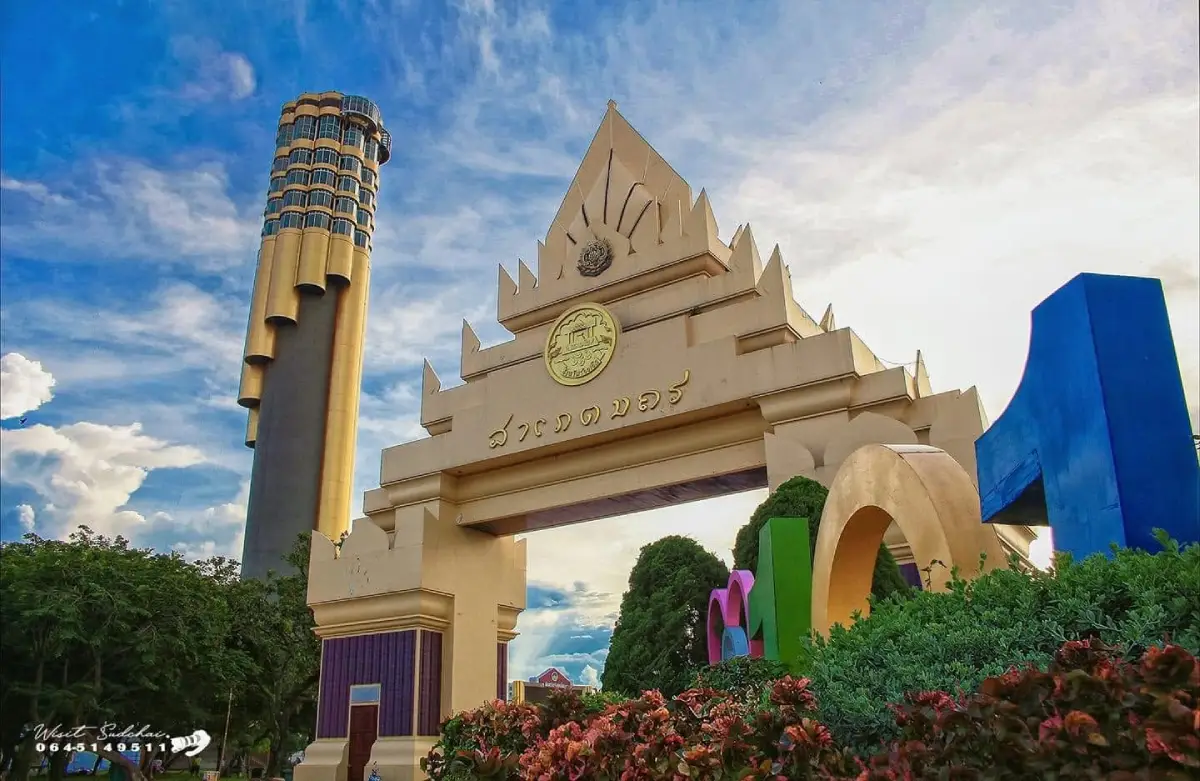
Saket Nakhon Gate
Open Days: Daily
Opening Hours: 08.00 – 17.00
Saket Nakhon Gate stands in front of Bueng Phlan Chai in Mueang Roi Et District, Roi Et Province. It is one of the most recognizable city landmarks in Roi Et, serving as a symbolic gateway that connects the city’s historic identity with its living cultural traditions. For travelers, this gate is an easy and meaningful first stop before exploring Bueng Phlan Chai, Ho Wot 101 Tower, Roi Et National Museum, Wat Bueng Phlan Chai, and Wat Buraphaphiram in the heart of the city.
Saket Nakhon Gate is a public landmark designed for sightseeing, photography, and cultural orientation. Its location makes it highly convenient for visitors because it sits beside the central lake area of Roi Et, where local residents walk, exercise, relax, and gather for community activities. A short visit to the gate gives travelers a clear impression of the city’s atmosphere: a place where old names, Buddhist traditions, public space, and modern urban landmarks exist close together.
The gate was built as a symbolic city gate of Roi Et and as the ceremonial entrance to Sivi City in the tenth chapter, known as Nakhon Khand, of the Bun Phawet Roi Et tradition. Bun Phawet is one of the most important merit-making traditions in the northeastern region of Thailand. It is associated with the recitation of the Vessantara Jataka and the story of Prince Vessantara. In this cultural context, Saket Nakhon Gate is not simply an ornamental structure but part of the ceremonial landscape of the city.
Historically, Saket Nakhon Gate was constructed in 1998 on Sunthorn Thep Road, southeast of Bueng Phlan Chai, and was officially opened on February 20, 1999. The design reflects the old identity of Roi Et as Saket Nakhon, a name connected with local history, legends, and the memory of a prosperous ancient settlement in the central part of the Isan region. The gate therefore works as an architectural reminder of the city’s cultural depth.
The name “Saket Nakhon” is important for understanding Roi Et. It is connected to the older identity of the city and to the way local people remember their historical roots. Seeing the name displayed on the gate allows visitors to understand that Roi Et is not only a provincial city with a lake and modern tower, but also a place shaped by older cultural narratives, religious traditions, and regional memory.
One of the most distinctive features of the gate is its design inspiration from the stone boundary markers of Fa Daet Song Yang in Kamalasai District, Kalasin Province. These boundary markers are associated with ancient Buddhist art and the Dvaravati cultural landscape in northeastern Thailand. By adapting this inspiration into a city gate, Roi Et connects its public architecture with a wider regional history of Buddhism, sacred space, and ancient artistic forms.
The inscriptions on both sides of the gate are written in Thai Noi and Tai Yai scripts and read “Saket Nakhon.” This detail gives the gate additional cultural value. Thai Noi script is closely linked to the written heritage of the Mekong region and northeastern Thailand. The use of these scripts turns the gate into a small but meaningful learning point for travelers who are interested in local language, identity, and cultural memory.
From a distance, Saket Nakhon Gate appears elegant and ceremonial. Its high arched form, layered upper structure, and Thai-inspired architectural lines make it stand out at the entrance to the Bueng Phlan Chai area. During the day, the gate is clear and bright against the city background. In the evening and after sunset, lighting gives the structure a warmer and more dramatic appearance, making it a popular photography point for both visitors and local residents.
The gate’s location in front of Bueng Phlan Chai is one of its strongest advantages. Bueng Phlan Chai is the central lake and public park of Roi Et, with walking paths, green areas, exercise space, and scenic corners around the water. Travelers who stop at Saket Nakhon Gate can continue directly into the lake area, making the gate a practical starting point for a relaxed city walk.
The surrounding area also connects easily to Ho Wot 101 Tower, a modern landmark inspired by the wot, a traditional musical instrument of Isan. The combination of Saket Nakhon Gate, Bueng Phlan Chai, and Ho Wot 101 creates a strong visual identity for Roi Et. In one compact area, visitors can see a symbolic city gate, a historic central lake, a public park, and a contemporary observation tower.
For travelers visiting Roi Et for the first time, Saket Nakhon Gate is a useful orientation point. It helps visitors understand the city before moving on to other attractions. A typical route can begin with photos at the gate, continue with a walk around Bueng Phlan Chai, then proceed to Ho Wot 101 Tower for city views, Roi Et National Museum for local history, and Wat Buraphaphiram for one of the city’s most important Buddhist landmarks.
The best time to visit the gate is in the morning or late afternoon. Morning light is suitable for clear photos and a quieter walk around the lake. Late afternoon and early evening are ideal for seeing local life around Bueng Phlan Chai, when residents come out to exercise, walk, and relax. The gate is also attractive at dusk, when the city lights begin to change the mood of the area.
Although the gate is located in an open public area, travelers should pay attention to safety while taking photos. The structure stands near an active road and city traffic. Visitors should avoid standing in unsafe traffic areas, blocking vehicles, climbing on the structure, or touching parts of the gate unnecessarily. Respectful and careful behavior helps keep the landmark safe and pleasant for everyone.
Saket Nakhon Gate becomes especially meaningful during city events and festivals. The nearby Saket Nakhon Plaza, Somdet Phra Srinagarindra Roi Et Park, and Bueng Phlan Chai area are used for public activities, ceremonies, and cultural events. During festivals, the gate becomes more than a sightseeing stop; it becomes a ceremonial frame for the city, welcoming people into shared cultural space.
The connection with Bun Phawet Roi Et gives the gate a deeper cultural role. Bun Phawet is both a Buddhist merit-making tradition and a community festival. In the context of the Nakhon Khand chapter, the gate represents the entrance to Sivi City. This symbolic role helps visitors understand why the gate is important to local identity and why it remains a significant landmark in the city’s cultural landscape.
For travelers interested in architecture and cultural interpretation, Saket Nakhon Gate is a good example of how a modern city can use traditional references to express identity. The gate combines an ancient city name, Buddhist artistic inspiration, local scripts, and festival meaning into one public monument. It shows that urban landmarks can function as cultural storytelling devices, not just as decorative structures.
The area around the gate also reveals the everyday character of Roi Et. The city center is compact and easy to explore. A lake, a public park, temples, a museum, restaurants, cafes, and hotels are all located within a short distance. This makes the gate suitable for travelers who prefer slow city exploration without complicated transportation.
Families can use the gate as a simple cultural learning stop. Children can see the word “Saket Nakhon” on the gate, observe its unusual shape inspired by stone boundary markers, and then continue walking around Bueng Phlan Chai. This makes the visit more meaningful than a quick photo stop because it introduces the city’s history and culture in a visual and accessible way.
For photography lovers, the gate offers several useful angles. The front view emphasizes the symmetry of the arch and the inscription. A wider angle can include the surrounding lake and park area. Evening shots capture the warm lighting of the gate, while a composition that includes Ho Wot 101 Tower can show the relationship between Roi Et’s traditional identity and its modern urban landmark.
When visiting during festival periods, travelers should allow more time for traffic and parking. The area around Bueng Phlan Chai and Saket Nakhon Plaza can become busy during public events. Visiting with extra time allows travelers to enjoy the atmosphere comfortably and see how the gate functions as part of the city’s living cultural space.
The gate is also convenient for combining sightseeing with local dining. Around Bueng Phlan Chai, visitors will find restaurants, cafes, noodle shops, dessert shops, and lakeside dining options. This makes it easy to plan a short trip: take photos at the gate, walk by the lake, stop for coffee or a meal, and then continue to nearby attractions.
Accommodation around central Roi Et is also convenient for travelers who want to stay near the lake area. Several hotels are located within a short distance of Saket Nakhon Gate and Bueng Phlan Chai, ranging from budget hotels to business-style stays. Staying in the city center makes it easy to visit the gate early in the morning or return in the evening for night photography.
Getting There is straightforward. Travelers with private cars can navigate to Bueng Phlan Chai or Ho Wot 101 Tower and then continue to Sunthorn Thep Road, where the gate is clearly visible. Those arriving by public transport can reach Roi Et city center and continue by local taxi, tuk-tuk, or other local transport to Bueng Phlan Chai. From Roi Et Airport, visitors can travel into the city and use the lake area as the main point of orientation.
Saket Nakhon Gate works well as part of a one-day Roi Et city route. Start at the gate, walk around Bueng Phlan Chai, visit Ho Wot 101 Tower for views, explore Roi Et National Museum to understand the province’s history, and then continue to Wat Buraphaphiram or Wat Bueng Phlan Chai. This route gives travelers a balanced view of the city through public space, architecture, history, Buddhism, and local life.
In terms of city identity, Saket Nakhon Gate functions like Roi Et’s cultural signature. It is easy to recognize, easy to access, and rich in meaning. The gate combines the old name of the city, inspiration from ancient boundary markers, local scripts, and the Bun Phawet tradition. For foreign travelers who want to understand Roi Et beyond a quick stop, this landmark offers a concise but meaningful introduction.
Visitors should remember that the gate is a shared public landmark. Keeping the area clean, avoiding unsafe photo behavior, respecting traffic, and being mindful of local events are simple ways to travel responsibly. This helps preserve the pleasant atmosphere of the area for local residents and future visitors.
Saket Nakhon Gate is therefore more than a city entrance in front of Bueng Phlan Chai. It is a gateway into the story of Roi Et: its old name, its Buddhist artistic references, its local scripts, its Bun Phawet tradition, and its modern life around the central lake. For travelers who want a meaningful first impression of Roi Et, this is one of the best places to begin.
| Name | Saket Nakhon Gate |
| Location | In front of Bueng Phlan Chai, Mueang Roi Et District, Roi Et Province |
| Address | Sunthorn Thep Road, Nai Mueang Subdistrict, Mueang Roi Et District, Roi Et 45000, Thailand |
| Coordinates | 16.055715, 103.653055 |
| Highlights | Symbolic city gate of Roi Et, major photo point in front of Bueng Phlan Chai, and a landmark connected with the Bun Phawet Roi Et tradition |
| History | Built in 1998 and officially opened on February 20, 1999 |
| Name Origin | Saket Nakhon is connected with the older identity of Roi Et in local history and legends, representing the prosperous image of the ancient city |
| Distinctive Features | The gate design was inspired by the stone boundary markers of Fa Daet Song Yang and includes Thai Noi and Tai Yai script reading “Saket Nakhon” |
| Travel Information | Travel by private car to Bueng Phlan Chai or Ho Wot 101 Tower, then continue to Sunthorn Thep Road. Public-transport travelers can reach Roi Et city center and take local transport to Bueng Phlan Chai. |
| Current Status | Open for sightseeing and photography as an important public landmark of Roi Et city |
| Open Days | Daily |
| Opening Hours | 08.00 – 17.00 |
| Fees | No admission fee |
| Facilities | Photo area, walking paths around Bueng Phlan Chai, public park space, nearby restaurants, cafes, and city-center accommodations |
| Main Areas / Zones | 1. Saket Nakhon Gate 2. Saket Nakhon Plaza 3. Bueng Phlan Chai frontage area 4. Lakeside walking route 5. Connected area toward Ho Wot 101 Tower and Somdet Phra Srinagarindra Roi Et Park |
| Caretaker | Roi Et Municipality |
| Main Contact Number | Roi Et Municipality, Tel. 043-511222 |
| Official Website / Official Page | roietmunicipal.go.th |
| Nearby Tourist Attractions | 1. Bueng Phlan Chai, about 0 km 2. Ho Wot 101 Tower, about 0.2 km 3. Roi Et City Pillar Shrine, about 0.3 km 4. Roi Et National Museum, about 1 km 5. Wat Bueng Phlan Chai, about 1 km 6. Wat Buraphaphiram, about 1 km |
| Nearby Restaurants | 1. Lakeview Restaurant, about 0.3 km, Tel. 093-320-8126 2. Nai Chui Vintage Pork Noodle, about 0.3 km, Tel. 093-638-8323 3. Ting Ting Bingsu Nam Khing, about 0.4 km, Tel. 095-190-4554 4. Cozy Cafe & Bistro, about 0.4 km, Tel. 085-852-9237 5. Her Studio, about 0.5 km, Tel. 083-871-0824 6. Sit Rim, about 0.8 km, Tel. 098-278-4482 |
| Nearby Accommodations | 1. Saket Nakhon Hotel, about 0.7 km, Tel. 043-511-741 2. Rueanrimnam Hotel, about 0.8 km, Tel. 043-518-967 3. The Premium Residence, about 1 km, Tel. 043-518-655 4. Hop Inn Roi Et, about 1.4 km, Tel. 02-080-2222 5. The Rice Hotel, about 1.4 km, Tel. 043-519-999 6. Mai Thai Hotel, about 1 km, Tel. 043-522-777-8 |
Frequently Asked Questions (FAQ)
Q: Where is Saket Nakhon Gate located?
A: Saket Nakhon Gate is located in front of Bueng Phlan Chai on Sunthorn Thep Road, Nai Mueang Subdistrict, Mueang Roi Et District, Roi Et Province.
Q: What are the opening days and hours of Saket Nakhon Gate?
A: The gate is open daily from 08.00 to 17.00.
Q: Is there an admission fee to visit Saket Nakhon Gate?
A: No. Visitors can see the gate, take photos, and walk around the surrounding public area without an admission fee.
Q: Why is Saket Nakhon Gate important?
A: It is a symbolic city gate of Roi Et, connected with the old name Saket Nakhon and the Bun Phawet Roi Et tradition as the ceremonial entrance to Sivi City in the Nakhon Khand chapter.
Q: What inspired the design of Saket Nakhon Gate?
A: The design was inspired by stone boundary markers from Fa Daet Song Yang in Kalasin Province, and the gate includes Thai Noi and Tai Yai script reading “Saket Nakhon.”
Q: When is the best time to visit Saket Nakhon Gate?
A: Morning and late afternoon are the best times for comfortable walking and photography. Early evening is also attractive when the city lights begin to illuminate the area.
Q: What attractions can be visited near Saket Nakhon Gate?
A: Nearby attractions include Bueng Phlan Chai, Ho Wot 101 Tower, Roi Et City Pillar Shrine, Roi Et National Museum, Wat Bueng Phlan Chai, and Wat Buraphaphiram.
Q: Can I visit Saket Nakhon Gate without a private car?
A: Yes. Travelers can reach Roi Et city center by public transport and continue to Bueng Phlan Chai by local taxi, tuk-tuk, or other local transport.
 Category: ●Art, Culture and Heritage
 Group: ●Landmarks and Memorials
Last Update : 2 MonthAgo
 Last Update : 2 MonthAgo
 Click to Access the Navigation Map GPS
 Historical Sites and Monuments(3)
Landmarks and Memorials(5)
Historical Sites and Monuments(3)
Landmarks and Memorials(5)
 Art, Craft Centres, Tradition(2)
 Museums(1)
 Educational Places
 Educational Gardens, Farm(3)
 Places of Worship
 Temple(35)
 Other Sacred Sites(6)
 Suburban Living
 Village, Community(1)
 Local Market(1)
 Nature and Wildlife
 National Parks and Marine Reserves(1)
 Mountain (Doi)(2)
 Dam, Reservoir, Lake(8)
 Waterfalls(1)
 Flower Field(1)
 River, Canal(4)
 Entertainment and Agricultural
 Zoos and Aquariums(1)
 Stadium(1)
 Farms, Parks and Ecotourism(5)
 Shopping
 Shopping and Night Market(1)


