
lovethailand home >Northeastern Travel Attractions >Roi Et Travel Attractions >Phanom Phrai >Khok Sawang > Wat Charoen Rat
TL;DR: Wat Charoen Rat is located at Ban Nong Bua Yai, Moo 4, Khok Sawang Subdistrict, Phanom Phrai District, Roi Et Province 45140, Thailand, open Daily, hours 08.00 – 17.00.
Wat Charoen Rat
Open Days: Daily
Opening Hours: 08.00 – 17.00
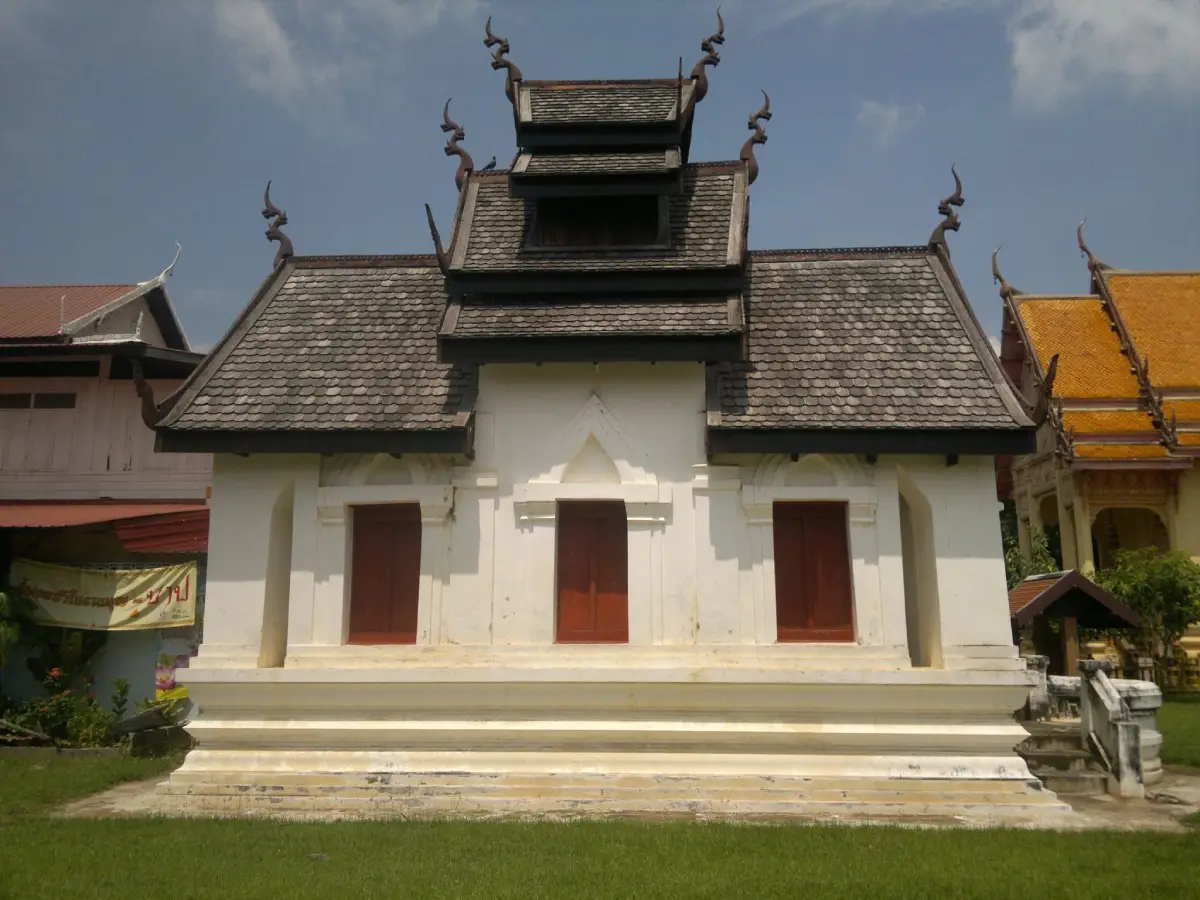
Wat Charoen Rat in Roi Et is an old community temple in Ban Nong Bua Yai, Moo 4, Khok Sawang Subdistrict, Phanom Phrai District, Roi Et Province. It is one of the most meaningful Buddhist and cultural sites in this rural part of northeastern Thailand. The temple is best known for its historic ordination hall, locally called a sim in the Isan region. This compact yet highly distinctive structure reflects the artistic identity of local temple architecture. It is a rectangular brick-and-plaster building with 3 bays, front and rear porches, projecting verandas, and stairways on both sides. Its roof is arranged in 5 receding tiers and covered with wooden shingle-like panels. The roofline is decorated with carved wooden chofa, bai raka, and hang hong elements, giving the building a graceful profile. Inside are sandstone and wooden Buddha images dating to around the 24th Buddhist century, making the temple not only a place of worship but also an important cultural landmark for travelers interested in Isan Buddhist art and local heritage.
Wat Charoen Rat is particularly suitable for travelers who prefer quiet cultural sites rather than large and heavily commercialized temples. Its value lies in its authenticity. The temple remains closely connected to the local community and preserves the atmosphere of a village temple in rural Roi Et. The historic sim shows how local craftsmen created a sacred structure that responded to ritual needs, local materials, and the cultural environment of the community. Although the building is not large, the layered wooden roof, the elegant proportions, and the carefully carved wooden details give it a strong architectural presence. The contrast between the pale plaster walls and the darker wooden roof makes the sim visually memorable, especially for those who appreciate understated beauty.
The temple is located in Ban Nong Bua Yai, a village whose history is linked to local migration and settlement. Local accounts tell of villagers who moved from Ban Khok Sawang and settled near a lotus-filled pond. The name Nong Bua Yai reflects that landscape, as “nong” refers to a pond and “bua” means lotus. A temple was established as the spiritual center of the settlement and was originally associated with the name Wat Ban Nong Bua. Over time, the temple developed and became known as Wat Charoen Rat. The present name carries a strong community meaning, suggesting prosperity and growth among the people. This relationship between the temple name, the village name, and the local landscape is one of the reasons the site is important beyond its architectural value.
The history of Wat Charoen Rat is tied to the development of Khok Sawang and Ban Nong Bua Yai. Around 1727, villagers settled in the area and established a temple for the community. The temple later became abandoned for a period between 1802 and 1807. In 1807, the villagers restored the temple under the leadership of Luang Pu Ratchawong, from the Noi Bua Thip family, who was the abbot of Wat Traiphum in Ban Khok Sawang. The restoration brought the temple back into active religious use. This episode is important because it shows how the temple was not merely built once and left unchanged, but revived through collective community effort. The temple therefore represents both Buddhist faith and the resilience of the local settlement.
Wat Charoen Rat was officially registered as an ancient monument in the Royal Gazette, Volume 119, Special Part 131 Ngor, dated 28 December 2002, with a protected area of 2 rai, 1 ngan, and 53 square wah. This registration confirms the temple’s cultural and historical significance. The old sim is not simply a religious building used by a village; it is also a protected heritage structure that helps explain the development of vernacular Buddhist architecture in central Isan. Its heritage value is connected to the artistic traditions of the Chi River basin, local Buddhist practice, and the long history of rural communities in Roi Et Province.
The sim is the most distinctive part of Wat Charoen Rat. In the Isan cultural context, a sim is the sacred boundary and building used for important monastic ceremonies, especially ordination and formal Sangha activities. Many Isan sim are smaller than central Thai ubosot buildings, but they often possess a strong local character. Wat Charoen Rat clearly demonstrates that character through its rectangular plan, front and rear porches, projecting verandas, twin stairways, and five-tiered wooden roof. The building is modest in scale but refined in detail. Its proportions allow visitors to understand that the beauty of Isan temple architecture often lies in balance, craftsmanship, and ritual meaning rather than grand size.
The five-tiered roof of the sim gives the building a dignified silhouette. The layered roof visually elevates the sacred space and distinguishes it from ordinary village structures. The use of wooden roof panels reflects a local building tradition in which timber played an important role in religious architecture. The carved wooden chofa, bai raka, and hang hong elements add movement to the roofline and demonstrate the skill of local artisans. Although these elements are also known in wider Thai Buddhist architecture, their use on a compact Isan sim creates a unique local expression. The result is an elegant temple building that feels both sacred and intimate.
Inside the sim, the sandstone and wooden Buddha images are among the temple’s most important sacred objects. The sandstone images suggest a preference for durable religious materials, while the wooden Buddha images reflect the close relationship between local craftsmanship and the natural environment. In rural Isan, wood was not only a practical material but also a medium for Buddhist devotion. These Buddha images make the interior more than a ritual space; they preserve layers of faith, artistry, and local memory. For visitors interested in religious art, the interior of the sim should be observed quietly and respectfully, as it is both an active sacred area and a cultural record of the community.
When walking around the sim, visitors should pay attention to the relationship between the building and its practical use. The front and rear porches give the structure depth and ceremonial orientation. The projecting verandas and side stairways make access more flexible and create visual rhythm around the building. The window openings and plaster walls are simple, yet their proportions support the calm character of the structure. The old wooden roof contrasts beautifully with the light-colored walls. Rather than overwhelming visitors with decoration, the sim invites careful looking. Its charm comes from details that reveal themselves gradually.
Wat Charoen Rat remains a functioning Buddhist temple under the Mahanikaya tradition. The temple compound includes religious buildings such as a sermon hall, monks’ residences, and a bell tower, which continue to support temple and community activities. This is important because the site is not a frozen monument disconnected from daily life. It still serves as a place for merit-making, Buddhist ceremonies, community gatherings, and local religious practice. The old sim therefore exists within a living temple environment, where heritage and faith continue side by side.
For cultural travelers, Wat Charoen Rat offers a valuable opportunity to experience a quieter side of Roi Et. The temple is not designed as a mass-tourism attraction. Instead, it rewards travelers who are willing to slow down and observe. The sim is small enough to be studied closely, and its architectural features can be appreciated from different angles. The best way to visit is to walk around the building slowly, look at the roofline, notice the carved wooden elements, and then enter or approach the interior respectfully according to temple rules. This kind of visit gives a clearer understanding of why old village temples are central to the cultural identity of Isan.
The surrounding landscape of Ban Nong Bua Yai and Khok Sawang adds meaning to the temple. The journey to the temple passes through a rural environment of local roads, agricultural areas, and village settlements. This landscape is part of the experience. The sim should not be viewed as an isolated object, but as a sacred building embedded in a community shaped by water sources, farming, migration, and Buddhist practice. When seen together with the village context, Wat Charoen Rat becomes more than an old building. It becomes a living cultural landscape.
Visitors should follow proper temple etiquette while exploring Wat Charoen Rat. Dress modestly, speak softly, avoid touching old Buddha images or carved wooden architectural parts, and respect areas that are not open to visitors. If taking photographs inside or near sacred objects, observe signs or ask a caretaker when possible. These simple actions help protect the ancient monument and show respect for the local community that continues to care for the temple.
The name history of the temple is also worth noting. The earlier names connected to Ban Nong Bua and Ban Nong Bua Yai show how closely the temple was tied to the village. The present name, Wat Charoen Rat, expresses a broader sense of community prosperity. Together, these names reflect different stages in the temple’s history: its origin in a village landscape, its restoration after abandonment, and its continued role as a recognized Buddhist and heritage site. The temple’s history of ordination boundaries, abbots, and restoration work also helps explain how religious administration and local community life developed together.
Wat Charoen Rat can be included in a cultural route through Phanom Phrai District and Khok Sawang Subdistrict. Nearby sites such as Prang Ku at Ban Khum Ngoen, the water-surrounded scripture hall at Wat Traiphum, Wat Traiphum itself, and Wat Klang Udom Wet in Phanom Phrai all help visitors understand the cultural depth of this area. This route combines Isan sim architecture, wooden religious buildings, old Buddhist sites, and Khmer-influenced remains. It is suitable for travelers who want to explore Roi Et beyond the provincial capital and major attractions.
The temple does not require a long visit, but it deserves an attentive one. Visitors who come mainly to see the sim should allow at least 30 minutes to 1 hour. Morning or late afternoon is a pleasant time for photography, as softer light makes the roof structure and wall surfaces easier to see. Midday can be hot in this part of Isan, so travelers should bring drinking water, a hat, or an umbrella. A quiet visit will allow the atmosphere of the temple to emerge naturally.
Getting There is most convenient by private car. From Phanom Phrai town, travel toward Khok Sawang Subdistrict and continue to Ban Nong Bua Yai via local roads. From Roi Et city, drive toward Phanom Phrai District and then continue into Khok Sawang. Because the temple is located in a village area, public transport may not reach the temple directly. Travelers using buses or shared transport should get off in Phanom Phrai and continue by local vehicle or hired transport to the temple. The site is suitable for a half-day or full-day cultural route combined with nearby temples and local restaurants.
The charm of Wat Charoen Rat lies in its quiet authenticity. It has not been reshaped into a commercial tourist venue. It remains a community temple with an ancient sim at its heart, old Buddha images inside, and a living relationship with local religious life. For foreign travelers, it offers a chance to see a form of Thai Buddhist heritage that is often overlooked: the small village temple that preserves local craftsmanship, community memory, and regional identity.
From an art-historical perspective, the sim at Wat Charoen Rat shows that Isan vernacular architecture has its own aesthetic logic. The building is not overloaded with decoration. Instead, it relies on proportion, roof layering, openings, material contrast, and sacred atmosphere. The wooden roof and carved wooden elements are especially valuable because old woodwork is vulnerable to time, weather, and repeated repair. Protecting the sim therefore means protecting not only a physical building, but also the knowledge of traditional craftsmanship that shaped it.
For local people, Wat Charoen Rat is part of the shared memory of Ban Nong Bua Yai. For travelers, it is a doorway into village-level Isan culture. For those interested in history, it is evidence of settlement, temple restoration, royal recognition of sacred boundaries, and official heritage registration. Its strength lies in the fact that it is a small place with many layers of meaning. The more carefully visitors read its history and observe its details, the more rewarding the visit becomes.
A visit to Wat Charoen Rat is therefore more than a simple temple stop. It is an encounter with a community that has preserved Buddhist faith across generations, from the early settlement near a lotus pond to the restoration led by Luang Pu Ratchawong, the continuation of temple leadership, and the modern recognition of the site as an ancient monument. These layers of history come together in one quiet temple compound, making Wat Charoen Rat an important destination for anyone interested in old temples, Isan architecture, and the cultural heritage of Roi Et Province.
| Name | Wat Charoen Rat |
| Location | Ban Nong Bua Yai, Moo 4, Khok Sawang Subdistrict, Phanom Phrai District, Roi Et Province 45140, Thailand |
| Address | No. 2, Moo 4, Ban Nong Bua Yai, Khok Sawang Subdistrict, Phanom Phrai District, Roi Et Province |
| Coordinates | 15.6445121844, 104.056199477 |
| Highlights | Historic Isan sim or ordination hall with a five-tiered wooden roof and carved wooden chofa, bai raka, and hang hong decorations |
| History | The temple was re-established around 1807 and is linked to the history of Ban Nong Bua Yai and Ban Khok Sawang. It received its consecrated boundary on 10 March 1972. |
| Name Origin | The temple was formerly associated with the village name Ban Nong Bua or Ban Nong Bua Yai before later becoming known as Wat Charoen Rat. |
| Distinctive Features | The sim is a rectangular brick-and-plaster structure with 3 bays, front and rear porches, projecting verandas, and stairways on both sides. Inside are sandstone and wooden Buddha images dating to around the 24th Buddhist century. |
| Key Evidence | Registered as an ancient monument in the Royal Gazette, Volume 119, Special Part 131 Ngor, dated 28 December 2002, with a protected area of 2 rai, 1 ngan, and 53 square wah. |
| Travel Information | Travel by private car from Phanom Phrai town toward Khok Sawang Subdistrict and Ban Nong Bua Yai. Public transport users should get off in Phanom Phrai and continue by local or hired vehicle. |
| Current Status | Open for merit-making and visits to the historic sim |
| Open Days | Daily |
| Opening Hours | 08.00 – 17.00 |
| Facilities | Temple compound, sermon hall, monks’ residences, bell tower, and parking space within or around the community area |
| Main Areas / Zones | Historic sim or ordination hall Area housing sandstone and wooden Buddha images Sermon hall Monks’ residences Bell tower Registered ancient monument zone |
| Abbot / Caretaker | Phra Palat Samai Panyatharo |
| Nearby Tourist Attractions | 1. Prang Ku, Ban Khum Ngoen, Khok Sawang Subdistrict, about 5 km 2. Water-Surrounded Scripture Hall at Wat Traiphum, Ban Khok Sawang, about 6 km 3. Wat Traiphum, Ban Khok Sawang, about 6 km 4. Wat Klang Udom Wet, Phanom Phrai District, about 12 km 5. Wat Chakkrawan Phumphinit or Wat Nong Muenthan, about 18 km |
| Nearby Restaurants | 1. Aileen Cafe’ and Bistro Phanom Phrai, about 12 km, Tel. 084-056-0129, 091-017-0371 2. PunThai Coffee Phinit Nontharat Road, Phanom Phrai, about 12 km, Tel. 061-025-8770 3. Rim Chi Riverside, about 13 km 4. Saranrom @ Baan Suan Siri, about 13 km 5. Coffee van by Baan Suan Suk Phodi, about 12 km |
| Nearby Accommodations | 1. Sanshine Place, about 12 km, Tel. 099-545-9938 2. PK Garden Hotel, about 18 km 3. Wetsawat Place Hotel, about 18 km |
Frequently Asked Questions (FAQ)
Q: Where is Wat Charoen Rat located?
A: Wat Charoen Rat is located in Ban Nong Bua Yai, Moo 4, Khok Sawang Subdistrict, Phanom Phrai District, Roi Et Province, Thailand.
Q: What is the main highlight of Wat Charoen Rat?
A: The main highlight is the historic Isan sim or ordination hall, a brick-and-plaster structure with a five-tiered wooden roof and carved wooden decorations.
Q: Is Wat Charoen Rat open every day?
A: Yes. The temple is open daily from 08.00 to 17.00 for merit-making and visits to the historic sim.
Q: Is Wat Charoen Rat a registered ancient monument?
A: Yes. Wat Charoen Rat was registered as an ancient monument in the Royal Gazette, Volume 119, Special Part 131 Ngor, dated 28 December 2002.
Q: What can visitors see inside the old sim?
A: Visitors can see sandstone and wooden Buddha images dating to around the 24th Buddhist century, together with the atmosphere of an old Isan ordination hall.
Q: How can travelers get to Wat Charoen Rat?
A: The most convenient way is by private car from Phanom Phrai town toward Khok Sawang Subdistrict and Ban Nong Bua Yai. Public transport users should continue from Phanom Phrai by local or hired vehicle.
Q: What nearby attractions can be combined with Wat Charoen Rat?
A: Nearby cultural stops include Prang Ku Ban Khum Ngoen, the water-surrounded scripture hall at Wat Traiphum, Wat Traiphum, Wat Klang Udom Wet, and Wat Chakkrawan Phumphinit.
 Category: ●Places of Worship
 Group: ●Temple
Last Update : 4 WeekAgo
 Last Update : 4 WeekAgo
 Click to Access the Navigation Map GPS
 Art, Culture and Heritage
 Historical Sites and Monuments(3)
 Landmarks and Memorials(5)
 Art, Craft Centres, Tradition(2)
 Museums(1)
 Educational Places
 Educational Gardens, Farm(3)
Temple(35)
Educational Gardens, Farm(3)
Temple(35)
 Other Sacred Sites(6)
 Suburban Living
 Village, Community(1)
 Local Market(1)
 Nature and Wildlife
 National Parks and Marine Reserves(1)
 Mountain (Doi)(2)
 Dam, Reservoir, Lake(8)
 Waterfalls(1)
 Flower Field(1)
 River, Canal(4)
 Entertainment and Agricultural
 Zoos and Aquariums(1)
 Stadium(1)
 Farms, Parks and Ecotourism(5)
 Shopping
 Shopping and Night Market(1)


