
lovethailand home >Northeastern Travel Attractions >Roi Et Travel Attractions >Muang Roi Et >Khon Kaen > Wat Khon Kaen Nuea
TL;DR: Wat Khon Kaen Nuea is located at Ban Khon Kaen Nuea, Moo 3, Khon Kaen Subdistrict, Mueang Roi Et District, Roi Et Province, open Daily, hours 08.00 – 17.00.
Wat Khon Kaen Nuea
Open Days: Daily
Opening Hours: 08.00 – 17.00
Wat Khon Kaen Nuea in Roi Et is located in Ban Khon Kaen Nuea, Moo 3, Khon Kaen Subdistrict, Mueang Roi Et District, Roi Et Province. It is a historic local Buddhist temple with outstanding value in Isan architecture, traditional mural painting, local craftsmanship, and community history. The temple’s most important feature is its old sim, or Isan-style ordination hall, with a Tai Noi inscription on the wall recording its construction in Chula Sakarat 1247, equivalent to 1885. For foreign travelers interested in local Buddhist art, this temple offers a rare and meaningful view of northeastern Thai religious architecture beyond large modern landmarks.
Wat Khon Kaen Nuea is a Maha Nikaya temple and a long-established community temple of Ban Khon Kaen Nuea. Temple history records its establishment in 1791 and the granting of its consecrated boundary on May 1, 1994. The temple land covers 7 rai, 2 ngan, and 90 square wah. These details show that the temple is not only a small local worship site but also a recognized Buddhist institution with deep community roots. Its importance lies in the way it combines living religious practice with a preserved historic sim and old mural paintings.
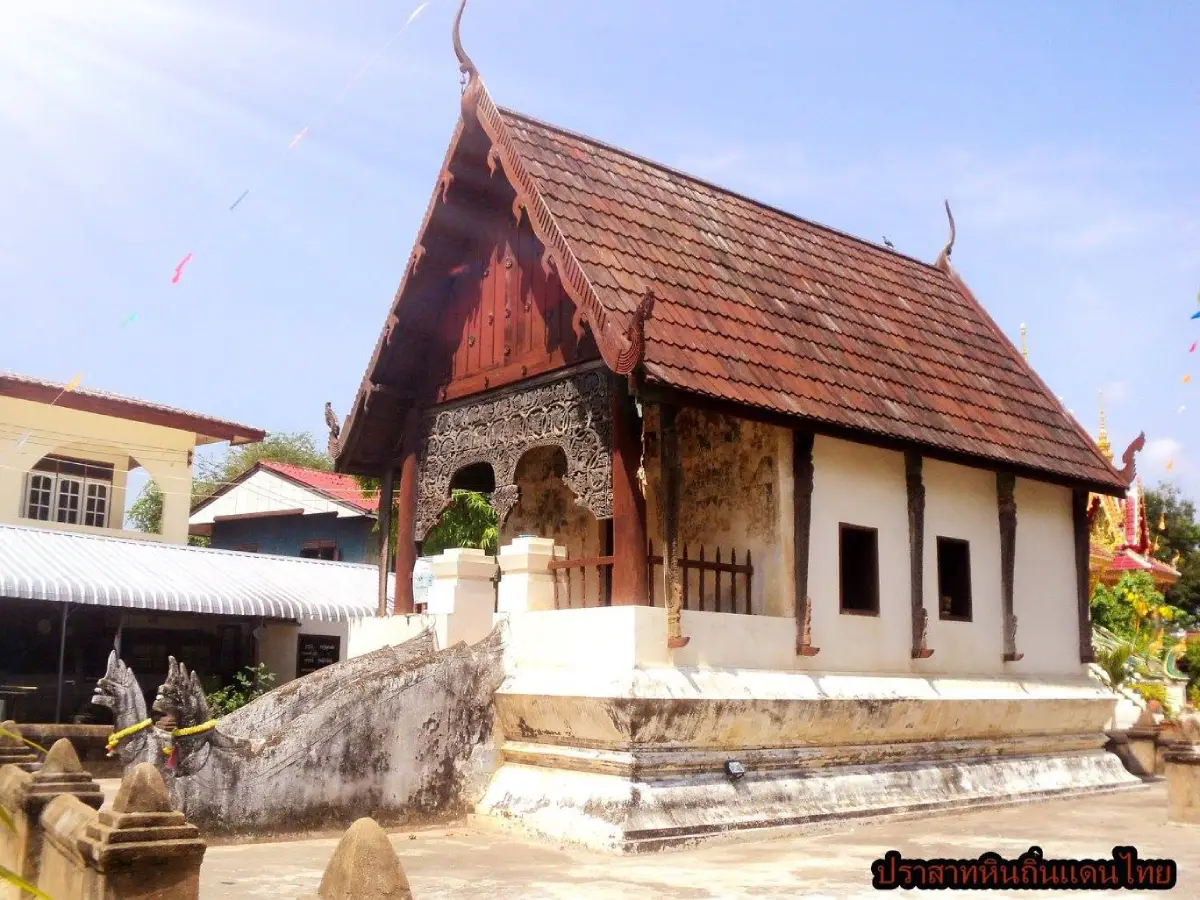
The word sim is used in the Isan region for an ordination hall or sacred monastic ceremony building. The sim at Wat Khon Kaen Nuea is a compact brick-and-mortar structure in the local Isan style. It is a closed three-room sim, about 8 meters long and 4 meters wide, standing on a low base. Its modest size is part of its charm. Instead of trying to impress through scale, the building speaks through proportion, craftsmanship, age, and the details of its decorated wooden elements and mural paintings.
The sim faces east. Its front side has a projecting veranda connected to a staircase decorated with naga forms. In Buddhist architecture, the naga often serves as a protective symbolic creature marking the transition from ordinary space to sacred space. As visitors approach the entrance, they can see how the staircase, veranda, whitewashed base, wooden gable, carved elements, and mural surfaces work together as a complete local religious building.
The roof is a single-tier gabled roof. It was originally covered with wooden sheets and decorated with carved wooden roof elements such as naga-like finials, lamyong, and hang hong forms. The front gable is arranged with vertical wooden boards and decorated with circular floral motifs. The carved honeycomb panel, or hang phueng, contains floral and vine patterns that twist and interlock beautifully. Colored glass in green and blue was used as decoration, adding a refined visual detail to the modest structure.
The carved brackets, or khan thuai, are decorated with kanok-style patterns. They support the roof and also function as artistic details. This combination of structural use and ornament is one of the most attractive features of traditional Isan religious buildings. The viewer should look closely at the gable, brackets, carved floral motifs, and old woodwork because these details reveal the skill of local craftsmen and the visual language of village Buddhist architecture in the nineteenth century.
The outer walls of the sim contain mural paintings, locally known as hup taem. The paintings appear from the front gable area above the doorway and present important Buddhist stories, especially the Buddha’s victory over Mara and his enlightenment under the Bodhi tree. These scenes are central to Buddhist meaning. The victory over Mara represents the overcoming of temptation, fear, and inner defilement, while the enlightenment scene represents the attainment of ultimate wisdom. The paintings therefore function as visual Dhamma, not merely decoration.
The murals also include scenes of local daily life. One notable detail is the image of a woman with hair tied in a bun, bare-chested, wearing a long sinh skirt, and holding an umbrella. Such images are highly valuable because they preserve visual evidence of clothing, hairstyle, posture, social customs, and local life at the time the paintings were created. For foreign visitors, this is one of the most important aspects of the temple: Buddhist stories and local community life appear together on the same sacred wall.
The murals at Wat Khon Kaen Nuea are important because they show how local artists interpreted Buddhism through their own cultural world. The painter did not separate sacred stories from village life. Instead, Buddhist narratives were placed in a visual environment that reflected the people, clothing, and imagination of the community. This makes the murals both religious and historical. They are a form of community memory painted on a temple wall.
The Tai Noi inscription on the sim wall is another essential feature. Tai Noi script was widely used in the cultural world of Isan and Laos for religious manuscripts, palm-leaf texts, inscriptions, and Buddhist records. The presence of Tai Noi script at Wat Khon Kaen Nuea connects the temple with the wider Mekong cultural region. It also shows that local Buddhist communities had their own systems of writing and recording sacred information before modern standardized Thai education became dominant.
The date Chula Sakarat 1247, equivalent to 1885, gives the sim a clear historical anchor. This period belongs to the late nineteenth century, when many local Isan communities still preserved distinctive architectural and artistic traditions. Wat Khon Kaen Nuea therefore represents an important moment before modern temple styles became more widespread. Its sim allows visitors to see an older form of local Buddhist architecture with unusually strong authenticity and detail.
The small scale of the building should not be underestimated. In many old Isan temples, compact scale was normal because the building served a local monastic and village community. The proportions of the sim, its low base, three-room plan, east-facing front, projecting veranda, and naga staircase all reflect practical local design. The result is a building that feels close to human scale, allowing visitors to observe details directly and understand how architecture served religious life in a village context.
Wat Khon Kaen Nuea is also important as a conservation site. Its sim, murals, carved wooden details, and inscription are all fragile cultural heritage. They have survived for more than a century and require careful treatment. Visitors should not touch the wall paintings, carved wood, inscription, or old plaster surfaces. These elements carry religious, artistic, and historical value for the community and for Roi Et Province as a whole.
The temple differs from many central Roi Et attractions. Bueng Phlan Chai and Ho Wot 101 Tower represent modern city identity. Wat Buraphaphiram is known for Luang Pho Yai, the giant standing Buddha image. Wat Klang Ming Mueang is known for its old ubosot and murals. Wat Bueng Phra Lan Chai is known for sacred water and Sra Chai Mongkhon. Wat Khon Kaen Nuea is distinctive because of its old Isan sim, Tai Noi inscription, and local mural art. Together, these sites show the cultural range of Roi Et.
The temple also continues to function as a community temple. It includes religious buildings such as a sermon hall, monks’ residences, multi-purpose hall, funeral hall, temple courtyard, and areas for Buddhist activities. These spaces show that Wat Khon Kaen Nuea is not only a historic site for visitors. It remains a living Buddhist temple serving the local community through merit-making, ceremonies, funerals, gatherings, and religious practice.
A meaningful visit should begin with the old sim. Visitors can first observe the front staircase and veranda, then look at the carved wooden gable, roof elements, brackets, and decorative panels. After that, the murals on the outer wall should be viewed slowly. Visitors should pay attention not only to the Buddhist stories but also to local lifestyle details. This slow observation helps reveal why the temple is valuable as an art and culture site.
Those interested in mural painting should spend time looking at the scenes above and around the entrance. The paintings of the Buddha defeating Mara and attaining enlightenment are central, while the inserted local figures provide a social record. The balance between Buddhist narrative and everyday imagery gives the murals their power. They allow viewers to understand how nineteenth-century local artists connected the sacred world with village life.
Getting There from Roi Et city is straightforward by private car or hired local transport. Travel toward Khon Kaen Subdistrict in Mueang Roi Et District and continue to Ban Khon Kaen Nuea, Moo 3. The temple is about 10 kilometers from the Bueng Phlan Chai and Ho Wot 101 area. Visitors can use the coordinates 16.02708, 103.60409 as a navigation reference. Private car travel is the most convenient option because the temple is located in a local community area outside the main city center.
The best time to visit is in the morning or early afternoon, when natural light makes it easier to see the form of the sim and the mural details. The temple is open daily from 08.00 to 17.00. Visitors should allow at least 45 minutes to 1 hour for a basic visit. Groups of students, art historians, architects, or travelers interested in Isan culture should allow more time for careful observation and explanation.
Wat Khon Kaen Nuea can be combined with nearby cultural and city attractions. A practical route can include Roi Et Agricultural Research and Development Center, Bueng Phlan Chai, Ho Wot 101 Tower, Roi Et National Museum, Wat Klang Ming Mueang, Wat Buraphaphiram, Wat Sra Thong, Wat Bueng Phra Lan Chai, and Wat Prachakhom Wanaram or Wat Pa Kung. This route allows travelers to experience local temple art, city landmarks, royal temples, sacred water sites, museums, and community religious life in one journey.
Visitors should dress respectfully and behave quietly because the temple is an active Buddhist site. They should not touch the murals, inscription, wooden carvings, old wall surfaces, or sacred structures. They should not lean on the old walls or climb onto architectural elements. Photography should be done respectfully and without disturbing monks or local worshippers. Small heritage temples are especially vulnerable, so careful behavior is essential.
For families and students, Wat Khon Kaen Nuea can serve as an outdoor classroom. Children can learn what an Isan sim is, what Tai Noi script means, how Buddhist stories were painted on temple walls, and what local lifestyle images can tell us about the past. Learning at the actual site makes art, history, religion, and local culture easier to understand than studying them only from books.
For foreign travelers, the temple is a strong example of local Buddhist heritage in northeastern Thailand. It shows that Thai temples are not only large golden structures or major tourist landmarks. Many of the most meaningful temples are modest community sites where local art, faith, language, and memory are preserved in small details. Wat Khon Kaen Nuea makes this point clearly through its compact sim, old murals, Tai Noi inscription, and traditional craftsmanship.
Overall, Wat Khon Kaen Nuea in Roi Et is an important cultural and religious site for travelers who want to understand Isan Buddhist art at a deeper level. Its highlights include the 1885 Isan-style sim, Tai Noi inscription, three-room brick-and-mortar structure, low base, naga staircase, single-tier gabled roof, carved wooden gable, floral motifs, colored glass decoration, kanok brackets, and murals of the Buddha’s life combined with local lifestyle scenes. The temple tells the story of Roi Et through architecture, mural painting, local craftsmanship, sacred writing, and community faith.
| Name | Wat Khon Kaen Nuea, Roi Et |
| Local Name | Wat Ban Khon Kaen Nuea / The 100-Year Ubosot Of Ban Khon Kaen Nuea |
| Temple Type | Local Buddhist Temple, Maha Nikaya Order, And Important Isan Sim Heritage Site In Roi Et Province |
| Location | Ban Khon Kaen Nuea, Moo 3, Khon Kaen Subdistrict, Mueang Roi Et District, Roi Et Province |
| Address | Wat Khon Kaen Nuea, Ban Khon Kaen Nuea, Khon Kaen Subdistrict, Mueang Roi Et District, Roi Et 45000, Thailand |
| Coordinates | 16.02708, 103.60409 |
| Highlights | Historic Isan-style sim, Tai Noi inscription, Buddhist mural paintings, carved wooden gable, naga staircase, floral woodwork, and local lifestyle scenes on the sim wall |
| Temple History | Wat Khon Kaen Nuea was established in 1791 as an old community temple of Ban Khon Kaen Nuea and received its consecrated boundary on May 1, 1994. |
| Key Evidence | A Tai Noi inscription on the sim wall records the construction of the sim in Chula Sakarat 1247, equivalent to 1885. |
| Sim / Ubosot Features | A closed three-room Isan-style sim, built of brick and mortar, about 8 meters long and 4 meters wide, standing on a low base with an east-facing veranda and naga staircase |
| Craftsmanship | Single-tier gabled roof, original wooden roofing tradition, carved wooden roof finials, vertical wooden gable boards, circular floral motifs, carved floral honeycomb panel, green and blue glass decoration, and kanok-style carved brackets |
| Murals / Hup Taem | Exterior wall paintings depict the Buddha’s victory over Mara and enlightenment under the Bodhi tree, together with local lifestyle scenes such as a woman with tied hair, long sinh skirt, and umbrella. |
| Artistic Value | An important example of Isan sim architecture, local wooden craftsmanship, hup taem mural painting, and Tai Noi writing culture in Roi Et Province |
| Temple Area | 7 rai, 2 ngan, and 90 square wah |
| Important Structures | Historic sim, sermon hall, monks’ residences, multi-purpose hall, funeral hall, temple courtyard, and religious activity areas |
| Travel Information | From Roi Et city, travel toward Khon Kaen Subdistrict and continue to Ban Khon Kaen Nuea, Moo 3. The temple is about 10 km from Bueng Phlan Chai and Ho Wot 101 Tower. |
| Current Status | Open as a community Buddhist temple, worship site, and learning place for Isan sim architecture and local mural art in Roi Et Province |
| Open Days | Daily |
| Opening Hours | 08.00 – 17.00 |
| Facilities | Temple courtyard, parking area, sermon hall, multi-purpose hall, funeral hall, monks’ residences, and nearby restaurants in Khon Kaen Subdistrict and Roi Et city |
| Main Areas / Zones | 1. Historic Sim Of Wat Khon Kaen Nuea 2. Tai Noi Inscription On The Sim Wall 3. Buddhist Hup Taem Mural Area 4. Naga Staircase And Front Veranda 5. Wooden Gable And Carved Woodwork 6. Low Base And Closed Sim Wall Area 7. Sermon Hall 8. Temple Courtyard And Religious Activity Area 9. Monks’ Residence Area 10. Ban Khon Kaen Nuea Community Area Around The Temple |
| Caretaker / Responsible Body | Wat Khon Kaen Nuea, Khon Kaen Subdistrict, Mueang Roi Et District, Roi Et Province, Maha Nikaya Order |
| Recorded Abbot History | Former abbots recorded in temple history include Phra Sa, Phra Lut, Phra Lot, Phra Bun, Phra Da, Phra Duean, Phra Mi, Phra Sing, Phra Ot, Phra Onsa Paripunno, and Phra Noi Kantadhammo. |
| Nearby Tourist Attractions | 1. Roi Et Agricultural Research And Development Center, about 6 km, Tel. 043-624161 2. Bueng Phlan Chai, about 10 km 3. Ho Wot 101 Tower, about 10 km, Tel. 043-511222 4. Roi Et National Museum, about 10 km, Tel. 043-514456 Ext. 101 5. Wat Klang Ming Mueang, about 10 km, Tel. 043-512400 6. Wat Buraphaphiram, about 11 km, Tel. 043-511374 7. Wat Sra Thong, about 10 km 8. Wat Bueng Phra Lan Chai, about 10 km, Tel. 043-511190 9. Wat Prachakhom Wanaram / Wat Pa Kung, about 22 km |
| Nearby Restaurants | 1. Koi Ahan Tam Sang Ban Khon Kaen, about 1 km, Tel. 061-602-5440 2. Som Tam Ying Zaep Roi Et, Chaeng Sanit Road, Nong Waeng, about 6 km, Tel. 083-889-6246 3. Boo Boo, Chaeng Sanit Road, Nong Waeng, about 6 km, Tel. 082-064-1271 4. Arpaporn Zaep Nua, Chaeng Sanit Road, Nong Waeng, about 6 km, Tel. 065-916-8397 5. Tom Tam Chaeng Sanit, about 8 km, Tel. 096-363-0527 6. Chan Mueang Restaurant, Chaeng Sanit Road, about 9 km, Tel. 043-514-776 7. Lakeview Restaurant, about 10 km, Tel. 093-320-8126 |
| Nearby Accommodations | 1. The Bed Hotel 101, about 10 km, Tel. 043-032-142 2. 101 Hotel Roi Et, about 10 km, Tel. 043-513-999, 065-119-6999 3. Boonbundal Hotel, about 10 km, Tel. 043-624-624 4. Le Park 23 Boutique Resort, about 11 km, Tel. 043-513-444 5. HOP INN Roi Et, about 11 km, Tel. 02-080-2222 6. The Rice Hotel, about 12 km, Tel. 043-519-999 |
Frequently Asked Questions (FAQ)
Q: Where is Wat Khon Kaen Nuea located?
A: Wat Khon Kaen Nuea is located in Ban Khon Kaen Nuea, Moo 3, Khon Kaen Subdistrict, Mueang Roi Et District, Roi Et Province, about 10 km from the Bueng Phlan Chai and Ho Wot 101 Tower area.
Q: What are the opening days and hours?
A: The temple is open daily from 08.00 to 17.00.
Q: What is the main highlight of Wat Khon Kaen Nuea?
A: The main highlight is the historic Isan-style sim with a Tai Noi inscription dating its construction to 1885, together with carved woodwork, naga staircase, floral gable decoration, and Buddhist mural paintings on the exterior wall.
Q: What is the sim at Wat Khon Kaen Nuea like?
A: It is a closed three-room Isan-style sim, built of brick and mortar, about 8 meters long and 4 meters wide, standing on a low base with an east-facing veranda and naga staircase.
Q: What do the murals at Wat Khon Kaen Nuea depict?
A: The murals depict the Buddha’s victory over Mara and enlightenment under the Bodhi tree, together with local lifestyle scenes such as a woman with tied hair, long sinh skirt, and umbrella.
Q: Who should visit Wat Khon Kaen Nuea?
A: The temple is suitable for travelers interested in Isan sim architecture, traditional mural painting, local craftsmanship, Tai Noi script, community history, and cultural tourism in Roi Et.
Q: How can visitors travel to Wat Khon Kaen Nuea?
A: From Roi Et city, travel toward Khon Kaen Subdistrict and continue to Ban Khon Kaen Nuea, Moo 3. Visitors can use the coordinates 16.02708, 103.60409 as a navigation reference.
Q: What nearby attractions can be combined with a visit?
A: Nearby places include Roi Et Agricultural Research and Development Center, Bueng Phlan Chai, Ho Wot 101 Tower, Roi Et National Museum, Wat Klang Ming Mueang, Wat Buraphaphiram, Wat Sra Thong, Wat Bueng Phra Lan Chai, and Wat Prachakhom Wanaram or Wat Pa Kung.
 Category: ●Places of Worship
 Group: ●Temple
Last Update : 4 WeekAgo
 Last Update : 4 WeekAgo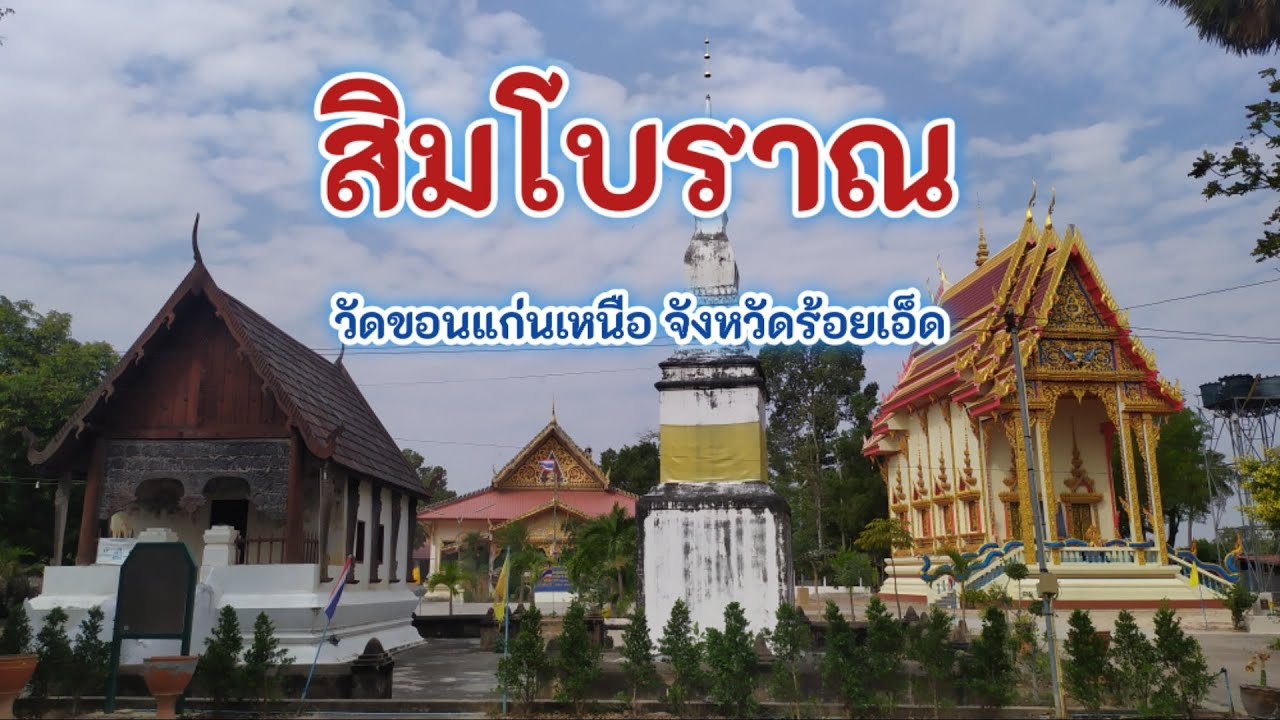
 Click to Access the Navigation Map GPS
Wat Khon Kaen Nuea Map
Recommend

 Art, Culture and Heritage
 Historical Sites and Monuments(3)
 Landmarks and Memorials(5)
 Art, Craft Centres, Tradition(2)
 Museums(1)
 Educational Places
 Educational Gardens, Farm(3)
Temple(35)
Educational Gardens, Farm(3)
Temple(35)
 Other Sacred Sites(6)
 Suburban Living
 Village, Community(1)
 Local Market(1)
 Nature and Wildlife
 National Parks and Marine Reserves(1)
 Mountain (Doi)(2)
 Dam, Reservoir, Lake(8)
 Waterfalls(1)
 Flower Field(1)
 River, Canal(4)
 Entertainment and Agricultural
 Zoos and Aquariums(1)
 Stadium(1)
 Farms, Parks and Ecotourism(5)
 Shopping
 Shopping and Night Market(1)


