
lovethailand home >Northeastern Travel Attractions >Roi Et Travel Attractions >Suwannaphum >Champa Khan > Phra That Champa Khan
TL;DR: Phra That Champa Khan is located at Ban Nong Mahia, Champa Khan Subdistrict, Suwannaphum District, Roi Et Province, open Daily, hours 08.00 – 17.00.
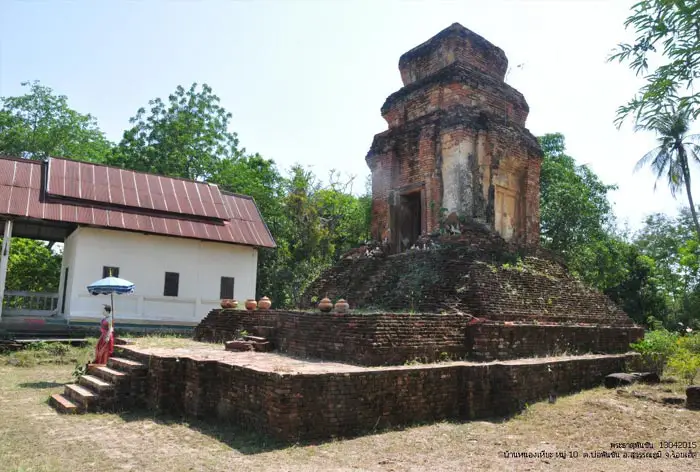
Phra That Champa Khan
Open Days: Daily
Opening Hours: 08.00 – 17.00
Phra That Champa Khan in Roi Et Province is an important ancient monument in Champa Khan Subdistrict, Suwannaphum District. It is closely connected with the historic landscape of Mueang Champa Khan, Bo Phan Khan, and the ancient cultural routes of the Thung Kula Rong Hai area. Local sources also refer to this monument by related names such as Phra That Phan Khan and Ku Wat That Phan Khan. The monument has a square form similar to ancient Khmer-style religious architecture, stands on a raised base, faces east, and preserves architectural traces that help visitors understand the depth of history in this part of Roi Et.
Phra That Champa Khan is not only a small local monument. It is part of a wider cultural landscape that includes an ancient town, moats, earthen embankments, sacred water sources, sandstone formations, salt production areas, and local Buddhist traditions. These elements show that the site was connected with religion, settlement, natural resources, and community life. A visit to the monument therefore gives travelers more than a view of an old stupa. It opens a window onto the layered history of northeastern Thailand.
The most distinctive feature of Phra That Champa Khan is its square ancient structure, similar to a Khmer-style prasat or ku. It stands on a high base and faces east, with one main entrance at the front and false-door features on the other sides. This layout reflects the sacred orientation commonly found in ancient religious architecture. Many decorative parts have disappeared through time, but the main structure still preserves the essential form of the monument and allows visitors to read its historical character clearly.
Local information describes the monument as a brick-built prasat with a principal tower measuring approximately 7 meters wide, 7 meters long, and 12 meters high. It may once have had two smaller flanking towers, of which only the base remains. Other descriptions mention laterite and Khmer-like construction features. Together, these details show that the monument belongs to the wider group of ancient brick, laterite, and sandstone religious sites in the Thung Kula Rong Hai region. Its form makes it especially valuable for understanding Khmer-influenced architecture in Roi Et.
Phra That Champa Khan is believed to have been built during a period when Khmer culture influenced parts of the central and southern Isan region. Its architectural style resembles other ancient sites in Suwannaphum District and nearby areas, including prasat, ku, and religious towers located around old communities. The monument demonstrates that this area was not isolated. It was part of a network of settlement, religion, craft, and cultural exchange that shaped the historical identity of Roi Et.
The surrounding area of Champa Khan and Bo Phan Khan adds depth to the meaning of the monument. Mueang Champa Khan is described as an ancient settlement with a rectangular town plan, earthen embankments, and moats. Within this cultural landscape is Bo Phan Khan, a natural freshwater spring on a red sandstone platform. The spring is famous in local belief because water emerges continuously even in a saline landscape. This combination of sacred water, ancient town remains, salt production, and religious architecture makes the area unusually rich in cultural meaning.
Bo Phan Khan helps explain why this landscape was important. The area contains a small natural freshwater well surrounded by salty soil and red sandstone. Local people have long regarded the water as sacred. The area was also connected with salt production, an important economic activity in the Thung Kula Rong Hai region. The presence of an ancient religious monument near a sacred water source and a salt-producing landscape suggests a deep relationship between belief, natural resources, and community settlement.
Artistically, Phra That Champa Khan preserves a strong image of Khmer-influenced architecture in Roi Et. Although many decorative elements have been lost, the raised base, east-facing entrance, square plan, and remaining roof profile still convey the form of an ancient sacred building. Seeing the monument today is like seeing several layers of time: the original construction, the long process of aging and ruin, and the modern restoration that allows the site to remain visible and meaningful.
The monument has been restored and maintained so that visitors can view it safely and local people can continue to use it as a sacred and cultural place. Restoration did not remove its historical value. Instead, it helps preserve the structure and makes it possible for new generations to study and respect the site. For cultural travelers, the monument is a clear example of how an ancient ruin can continue to function as both heritage and a living place of local faith.
Phra That Champa Khan is also important because it remains connected with local devotion. Although the monument has ancient roots and may once have been connected with earlier religious traditions, it has been absorbed into the Buddhist and local cultural life of the community. Villagers continue to respect the site, hold ceremonies, and maintain traditions connected with the stupa. This makes it a living cultural place rather than a silent archaeological ruin.
The most important annual tradition connected with the site is the Phra That Phan Khan worship festival, held on the full moon day of the fifth lunar month according to the Isan traditional calendar. Local people bring sacred water from Bo Phan Khan, invite Buddha images for ritual bathing, pour water in front of the stupa, carry sand into the temple, build sand pagodas, bathe Buddha images and monks, and walk around the stupa to sprinkle water three times. This ceremony connects water, faith, the stupa, the local community, and the seasonal cycle of Isan culture.
After the water rituals, a traditional rocket is launched to divine the coming rains. Local belief holds that if the rocket rises high, the year will bring good rainfall and agricultural abundance. If the rocket fails or breaks, the year may bring drought or unstable weather. This custom shows that the stupa is connected not only with worship but also with rice farming, rainfall, community planning, and seasonal hope. The annual festival is therefore both a religious event and an agricultural-cultural ceremony.
Visitors should look not only at the main tower but also at the wider setting. Seeing only the monument gives one impression of ancient architecture. Connecting it with Mueang Champa Khan, Bo Phan Khan, the local museum, salt production, and annual ritual gives a much fuller understanding. This is the best way to appreciate Phra That Champa Khan as part of a cultural system rather than as a single isolated structure.
The site is suitable for travelers interested in history, archaeology, Khmer-influenced art, ancient towns, and rural culture. A normal visit may take around 45 minutes to 1.5 hours. Visitors can observe the base, entrance, direction, remaining architectural form, and surrounding space. Those who want a deeper cultural route can continue to Bo Phan Khan and the Champa Khan local museum to understand how the monument fits into the ancient landscape.
Phra That Champa Khan is best visited in the morning or late afternoon, when the light is softer and the weather is more comfortable. The site is modest and peaceful, making it suitable for slow observation rather than rushed sightseeing. Visitors should not climb on the monument, scratch or touch ancient surfaces unnecessarily, remove any fragments, or leave litter in the area. Every remaining part of the monument is historical evidence and should be treated with care.
Getting There is convenient from Suwannaphum District. The site is about 15 km from Suwannaphum town. Travelers can use a private car, rental car, or local hired vehicle to reach Champa Khan Subdistrict and Ban Nong Mahia. When using a navigation app, search for Phra That Champa Khan, Phra That Phan Khan, or Wat That Phan Khan, because local sources use related names for the same cultural area.
A half-day route can include Phra That Champa Khan, Bo Phan Khan, the Champa Khan local museum, and Suwannaphum town. With more time, travelers can continue to Ku Phra Kona or return to Roi Et city for Bueng Phalan Chai, Roi Et Tower 101, and Wat Burapha Phiram. This route is suitable for visitors who want to understand Roi Et beyond the main city landmarks and see the province as a land of ancient settlements, Khmer-style monuments, sacred water, and local traditions.
For international travelers, Phra That Champa Khan helps explain that the history of northeastern Thailand is layered. It includes Dvaravati-era communities, Khmer cultural influence, salt-producing landscapes, sacred water beliefs, Buddhist adaptation, and living village ceremonies. The monument is therefore a valuable stop for anyone who wants to understand Isan heritage through architecture, landscape, and community tradition.
In summary, Phra That Champa Khan in Roi Et Province is a significant ancient monument with historical, artistic, religious, and cultural value. Its square Khmer-like form, connection with Mueang Champa Khan, relationship with Bo Phan Khan, and annual worship tradition make it one of the most meaningful cultural places in Suwannaphum District. For travelers seeking a deeper view of Roi Et, this site offers a direct encounter with ancient Isan history and the living faith of local people.
| Name | Phra That Champa Khan |
| Related Names | Phra That Phan Khan / Ku Wat That Phan Khan / Wat That Phan Khan |
| Location | Ban Nong Mahia, Champa Khan Subdistrict, Suwannaphum District, Roi Et Province |
| Address | Champa Khan Subdistrict, Suwannaphum District, Roi Et Province 45130, Thailand |
| Highlights | An ancient square stupa with Khmer-style influence, connected with Mueang Champa Khan, Bo Phan Khan, sacred water traditions, and the salt-producing landscape of Thung Kula Rong Hai |
| History | Connected with the ancient Champa Khan cultural landscape and Khmer-influenced religious architecture in Suwannaphum District |
| Name Origin | Champa Khan refers to the ancient local settlement, while Phan Khan is connected with Bo Phan Khan, the sacred freshwater spring believed to yield endless water |
| Architectural Features | A square raised tower facing east, with one main entrance, false-door features on other sides, and remaining traces of Khmer-style sacred architecture |
| Approximate Size | The principal tower is approximately 7 meters wide, 7 meters long, and 12 meters high |
| Important Sacred And Cultural Meaning | Ancient stupa, local worship area, Phra That Phan Khan annual festival, sacred water procession from Bo Phan Khan, ritual bathing of the stupa, and rain-divination rocket tradition |
| Travel Information | From Suwannaphum town, travel toward Champa Khan Subdistrict for about 15 km. Best reached by private car, rental car, or local hired transport. |
| Current Status | Open for visits and worship, with the ancient monument restored and maintained |
| Open Days | Daily |
| Opening Hours | 08.00 – 17.00 |
| Fees | No Admission Fee |
| Facilities | Worship Area, Walking Area Around The Ancient Monument, Nearby Community Area, And Route Connection To Champa Khan Cultural Sites |
| Main Areas / Zones | 1. Ancient Stupa Zone 2. Raised Base And Eastern Entrance Zone 3. Worship Area 4. Ancient Base And Possible Subsidiary Tower Area 5. Mueang Champa Khan Cultural Connection Zone 6. Route Connection To Bo Phan Khan And Champa Khan Museum |
| Responsible / Related Organizations | Champa Khan Community, Champa Khan Subdistrict Municipality, And Related Heritage Authorities |
| Local Contact Number | Champa Khan Subdistrict Municipality, Tel. 043-501574, 081-9661799 |
| Annual Ceremony | Phra That Phan Khan worship festival on the full moon day of the fifth lunar month, including sacred water procession, ritual bathing, sand pagoda making, and rocket launching for rain divination |
| Nearby Tourist Attractions | 1. Bo Phan Khan, About 5 km 2. Champa Khan Local Museum, About 3 km 3. Suwannaphum Market And Municipal Area, About 15 km 4. King Rama IX 80th Birthday Anniversary Park, Suwannaphum, About 16 km 5. Ku Phra Kona, About 35 km 6. Bueng Phalan Chai, Mueang Roi Et, About 80 km 7. Roi Et Tower 101, About 81 km |
| Nearby Restaurants | 1. Jae Tan Pla Op Ong, Suwannaphum Branch, About 15 km, Tel. 098-453-8953 2. Lemon Coffee & Restaurant, About 15 km, Tel. 088-495-3238 3. Khao Hom Made-To-Order Food, About 15 km, Tel. 089-524-3050 4. Mao-Nom Bar&Restaurant, About 15 km, Tel. 089-277-7976 5. Shabu Ruay Suwannaphum, About 16 km, Tel. 080-758-8541 6. Ban Ahan Phu Thanawan, About 16 km, Tel. 043-581-535 |
| Nearby Accommodations | 1. Wanmanee Resort Suwannaphum, About 15 km, Tel. 043-532699, 098-9058495, 089-9481677 2. The Premium Resort, About 16 km 3. Wanmanee Resort Suwannaphum, About 15 km 4. Home Room House Suwannaphum, About 16 km 5. Daily Rooms In Sa Khu, Suwannaphum Area, About 16 km |
Frequently Asked Questions (FAQ)
Q: Where is Phra That Champa Khan located?
A: Phra That Champa Khan is located in Ban Nong Mahia, Champa Khan Subdistrict, Suwannaphum District, Roi Et Province, about 15 km from Suwannaphum town.
Q: What are the opening days and opening hours of Phra That Champa Khan?
A: The site is open daily from 08.00 to 17.00.
Q: Is there an admission fee to visit Phra That Champa Khan?
A: No. Visitors can enter, pay respect, and walk around the ancient monument without an admission fee.
Q: Why is Phra That Champa Khan important?
A: It is an ancient monument with Khmer-style influence, connected with Mueang Champa Khan, Bo Phan Khan, sacred water traditions, and the historic cultural landscape of Thung Kula Rong Hai.
Q: Are Phra That Champa Khan and Phra That Phan Khan related names?
A: Yes. Local sources use related names such as Phra That Champa Khan, Phra That Phan Khan, and Ku Wat That Phan Khan for the same cultural area connected with Champa Khan and Bo Phan Khan.
Q: When is the annual Phra That worship festival held?
A: The Phra That Phan Khan worship festival is held on the full moon day of the fifth lunar month, with sacred water procession, ritual bathing, sand pagoda making, and rocket launching for rain divination.
Q: When is the best time to visit Phra That Champa Khan?
A: Morning and late afternoon are the best times because the weather is more comfortable and the light is suitable for viewing and photographing the ancient monument.
Q: What nearby places can be visited with Phra That Champa Khan?
A: Nearby and connected places include Bo Phan Khan, Champa Khan Local Museum, Suwannaphum Market, Ku Phra Kona, Bueng Phalan Chai, and Roi Et Tower 101.
 Category: ●Places of Worship
 Group: ●Other Sacred Sites
Last Update : 4 WeekAgo
 Last Update : 4 WeekAgo
 Click to Access the Navigation Map GPS
Phra That Champa Khan Map
Recommend

 Art, Culture and Heritage
 Historical Sites and Monuments(3)
 Landmarks and Memorials(5)
 Art, Craft Centres, Tradition(2)
 Museums(1)
 Educational Places
 Educational Gardens, Farm(3)
 Temple(35)
Other Sacred Sites(6)
Temple(35)
Other Sacred Sites(6)
 Suburban Living
 Village, Community(1)
 Local Market(1)
 Nature and Wildlife
 National Parks and Marine Reserves(1)
 Mountain (Doi)(2)
 Dam, Reservoir, Lake(8)
 Waterfalls(1)
 Flower Field(1)
 River, Canal(4)
 Entertainment and Agricultural
 Zoos and Aquariums(1)
 Stadium(1)
 Farms, Parks and Ecotourism(5)
 Shopping
 Shopping and Night Market(1)


