
lovethailand home >Northeastern Travel Attractions >Roi Et Travel Attractions >Nong Phok >Phu Khao Thong > Tham Soda Waterfall
TL;DR: Tham Soda Waterfall is located at Ban Non Sombun, Moo 9, Phu Khao Thong Subdistrict, Nong Phok District, Roi Et Province, open Daily, hours 08.00 – 17.00.
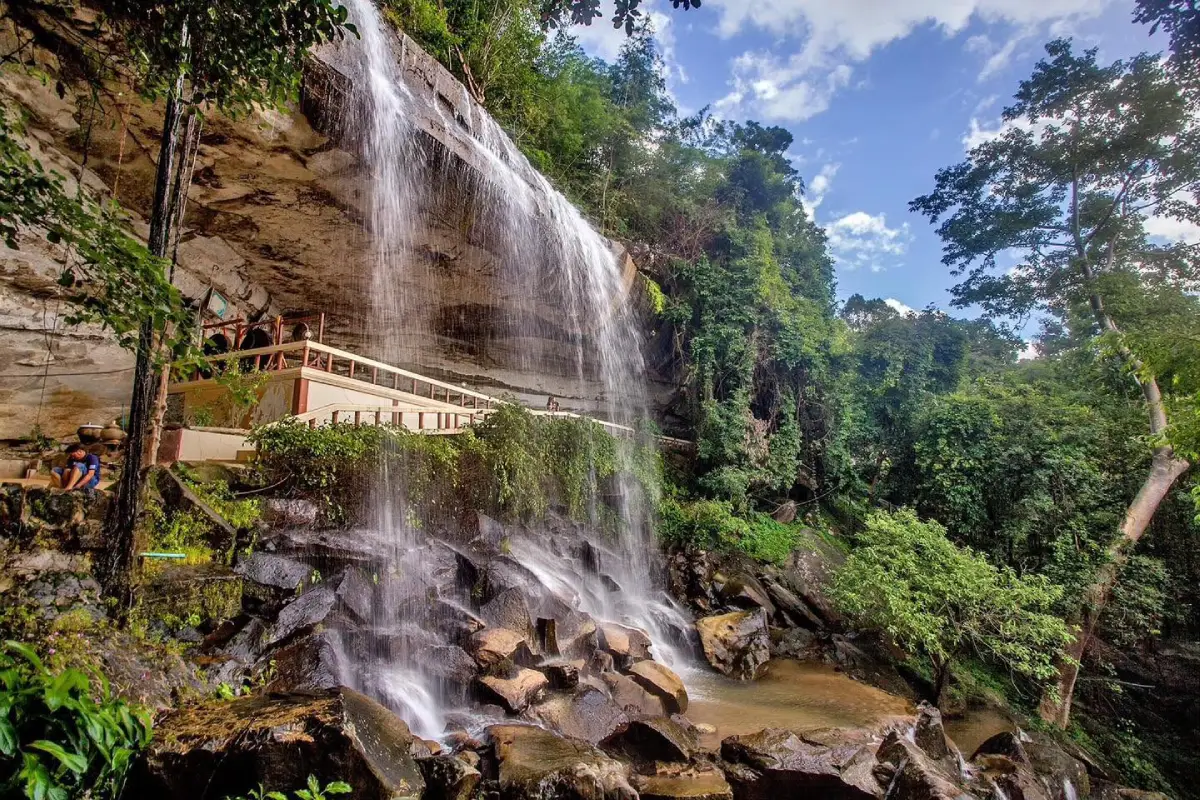
Tham Soda Waterfall
Open Days: Daily
Opening Hours: 08.00 – 17.00
Tham Soda Waterfall in Roi Et Province is a forest waterfall and Buddhist retreat area in Ban Non Sombun, Moo 9, Phu Khao Thong Subdistrict, Nong Phok District. It is one of the most distinctive natural attractions in Nong Phok because the waterfall drops from a large sandstone cliff about 50 meters high, forming a beautiful curtain of water. Behind the falling water is a recessed rock overhang that feels like a cave, allowing visitors to view the waterfall from both the front and the inner walkway behind the water curtain. The site combines forest scenery, sandstone formations, a Buddhist sanctuary, and local legend in one peaceful place.
Tham Soda Waterfall is located in the mountainous landscape of Phu Khao Thong Subdistrict, an area northeast of Nong Phok town known for hills, forests, reservoirs, and natural routes. This landscape gives the waterfall a stronger character than a small lowland cascade. The main cliff is broad and dramatic, the surrounding forest is shaded, and the sandstone formations create a deep natural atmosphere. During the rainy season, the water flow becomes stronger and the waterfall appears more impressive. During drier periods, the site remains attractive because of the cave, sandstone cliff, Buddhist setting, and quiet forest environment.
The name Tham Soda comes from a local story about a couple named So and Da. According to the story, the couple regularly went into the forest around Phu Khiao to collect wild food. When they became tired, they returned to rest in this cave. Villagers began calling the place Tham So-Da, after the names of the couple. Because a waterfall also flows through the same area, the site became known as Tham Soda Waterfall. The name therefore carries both a local legend and the physical identity of the cave and waterfall.
In 1997, the site was developed as a tourist attraction and Buddhist retreat area. Luang Pu Kal Paphakalo, a monk residing at the Tham Soda monastic retreat, is remembered as the person who initiated the development and care of the waterfall area. This history is important because it explains why the place is not only a waterfall in the forest but also a spiritual site where visitors can pay respect, rest quietly, and experience nature in a Buddhist atmosphere.
Inside the cave and monastic area, the Sakyamuni Gotama Buddha image is enshrined and respected by local people and visitors. Many visitors come here not only to see the waterfall but also to pay respect to the Buddha image and spend time in a calm setting. Because the area is connected with a Buddhist retreat, visitors should dress politely, speak softly, and use the space with respect. The site is suitable for both nature lovers and people seeking a quiet place for reflection.
The natural highlight of Tham Soda Waterfall is its large sandstone cliff. The rock layers, overhangs, boulders, and natural formations show the power of water and time in shaping the landscape. Some formations resemble natural stone pagodas, adding to the sacred feeling of the place. Visitors interested in geology can observe the sandstone layers, water erosion, and the way the forest, stream, and cliff interact. This makes the waterfall meaningful not only as a scenic site but also as a natural learning area.
The most memorable experience is walking behind the curtain of water. From the front, visitors see the waterfall falling from a high cliff into the rocky area below. From the inner walkway, visitors can stand behind the falling water and look out through the mist. This gives a rare viewpoint where water, light, stone, and forest come together at close range. It is the image most strongly associated with Tham Soda Waterfall and one of the main reasons travelers come to the site.
The waterfall is most beautiful from the rainy season into the early cool season, when the water volume is higher and the forest looks greener. The sound of falling water, wet rock, shaded trees, and cool air create a refreshing atmosphere. During the dry season, water may be lower, but visitors can still enjoy the cave, sandstone cliff, Buddha image, and quiet monastic surroundings.
Tham Soda Waterfall is open daily from 08.00 to 17.00. The general area has no admission fee, while donations for the monastic area are made voluntarily. Visiting during daylight hours is recommended because the site includes forest paths, wet rock, streams, steps, and natural surfaces. The area is safest and easiest to appreciate when visibility is good.
Getting There is easiest by private car, motorcycle, or local hired vehicle. From Nong Phok District, take the Nong Phok – Loeng Nok Tha route, the same general direction used for visiting Phra Maha Chedi Chai Mongkhon and Phu Khao Thong Subdistrict. After passing the Ban Lao Khum Man area, follow the local road into Phu Khao Thong Subdistrict and Ban Non Sombun. Signs to Wat Tham Soda or Tham Soda Waterfall appear along the route. Drivers should use moderate speed because some sections are rural and hilly.
Phu Khao Thong Subdistrict is about 24 km from Nong Phok town and is connected with several important natural attractions. Visitors to Tham Soda Waterfall can also include Huai Phung Yai Reservoir, Wang Nong Reservoir, Phra Maha Chedi Chai Mongkhon, Wat Pha Nam Thip Thep Prasit Wanaram, Pha Mok Mi Wai, Pha Phu Thai, and Tham Pha Nam Thip Non-Hunting Area in the same broader route. This makes the waterfall an excellent stop for a complete Nong Phok nature and cultural itinerary.
The site can be experienced through several zones. The first is the main waterfall cliff where visitors view the curtain of water from the front. The second is the walkway behind the waterfall, where the cave-like overhang creates a distinctive viewpoint. The third is the cave and Buddha-image zone. The fourth is the monastic retreat and meditation area. The fifth is the sandstone cliff and natural stone-pagoda zone. The sixth is the lower stream and boulder area. The seventh is the forest walking area. The eighth is the route connection to Huai Phung Yai Reservoir and nearby Nong Phok attractions.
Recommended activities include viewing the waterfall, walking behind the water curtain, paying respect to the Sakyamuni Gotama Buddha image, photographing sandstone formations, walking in nature, resting quietly, and playing in the water only where it is safe. Because the site is a Buddhist retreat as well as a natural attraction, visitors should avoid loud music, inappropriate dress, rough behavior, and anything that disturbs monks, practitioners, or other visitors.
Water safety is important. The lower stream area may be suitable for water play during certain periods, but the rocks can be slippery and the water level changes with rainfall. Visitors should not swim during heavy rain or immediately after strong rainfall. Children must be supervised closely. Visitors should avoid climbing high rocks, standing near cliff edges, or entering unsafe areas for photographs.
For photographers, Tham Soda Waterfall offers many strong subjects: the curtain of water, the behind-the-waterfall walkway, the Buddha image, sandstone layers, rock formations, forest shade, mist, and the quiet monastic atmosphere. Morning to late morning is suitable for softer light and cooler air. Late afternoon provides a calmer mood with more shadow in the forest. Photography should be done respectfully, especially around worship areas and people practicing meditation.
For families, the site is useful for both recreation and learning. Children can learn how water shapes sandstone cliffs, how forests preserve moisture, how streams form waterfalls, and how Buddhist spaces can exist in natural landscapes. The visit can be both enjoyable and educational, especially when adults explain water safety, environmental care, and respect for religious sites.
As a nature destination, Tham Soda Waterfall adds depth to the image of Nong Phok District. Nong Phok is widely known for Phra Maha Chedi Chai Mongkhon and Pha Nam Yoi, but it also has waterfalls, caves, reservoirs, cliffs, and forest routes. Tham Soda Waterfall helps show that Roi Et is not only a province of plains, temples, and city attractions. It also has a mountain-and-forest side that is valuable for travelers interested in natural landscapes.
Religiously, Tham Soda Waterfall is a peaceful place for contemplation. The sound of water, the forest shade, the cave, and the Buddhist image create a calm atmosphere. Visitors who come to pay respect can experience a different kind of Buddhist site: not a large city temple, but a natural retreat where faith and landscape are closely connected.
For international travelers, Tham Soda Waterfall can be understood as a forest waterfall temple in Roi Et Province. It has a large sandstone waterfall, a walkway behind the water curtain, a Buddha image inside the cave area, and a monastic retreat atmosphere. It clearly shows how nature and Buddhism can be connected in northeastern Thailand. This makes the destination valuable for travelers who want to see Roi Et beyond its urban landmarks.
Visitors should help keep the site clean. Do not litter, leave food waste, write on rocks or cave walls, pick plants, disturb wildlife, or throw anything into the stream. The waterfall is a natural water source, an ecosystem, and a religious area. Keeping it clean preserves the beauty of the water, rock, Buddha image, and forest atmosphere.
Clothing should be suitable for both walking in nature and entering a Buddhist site. Visitors should wear non-slip footwear and clothing that allows comfortable movement, while also dressing politely near the Buddha image, cave, and monastic area. Those who plan to play in the water should bring a change of clothes and remain respectful of the religious setting.
Food options near Tham Soda Waterfall include local food shops in Phu Khao Thong Subdistrict, floating food rafts around Huai Phung Yai Reservoir, and restaurants in Nong Phok town. Visitors who want a nature-focused meal can stop at Huai Phung Yai Reservoir, while those who want more restaurant and cafe choices can continue to Nong Phok town. The town works well as a food stop before or after visiting the waterfall.
Accommodation near the waterfall is mainly found in Nong Phok District and along the Pha Nam Yoi route. Travelers who want to stay close to nature can choose permitted camping areas or local accommodation in the Phu Khao Thong and Pha Mok Mi Wai route. Travelers who want restaurants and basic services should stay in Nong Phok town. Staying in Nong Phok is practical for visiting Tham Soda Waterfall, Huai Phung Yai Reservoir, Phra Maha Chedi Chai Mongkhon, and Pha Mok Mi Wai without rushing.
In summary, Tham Soda Waterfall in Roi Et Province is a distinctive forest waterfall and Buddhist retreat in Ban Non Sombun, Phu Khao Thong Subdistrict, Nong Phok District. Its name comes from the local story of So and Da, and the site was developed as a tourist and monastic area in 1997 by Luang Pu Kal Paphakalo. The waterfall is about 50 meters high, with sandstone cliffs, a cave-like space behind the water curtain, the Sakyamuni Gotama Buddha image, and a peaceful forest atmosphere. Open daily from 08.00 to 17.00 with no admission fee for the general area, it is suitable for nature viewing, worship, photography, geology learning, and experiencing Roi Et’s mountain landscape.
| Name | Tham Soda Waterfall |
| Related Names / Type | Tham Soda Waterfall / Wat Tham Soda / Tham Soda Monastic Retreat / Large Cave Waterfall / Buddhist Forest Site / Nong Phok Nature Attraction |
| Location | Ban Non Sombun, Moo 9, Phu Khao Thong Subdistrict, Nong Phok District, Roi Et Province |
| Address | Phu Khao Thong Subdistrict, Nong Phok District, Roi Et Province 45210, Thailand |
| Coordinates | 16.398612836697, 104.2802980818 |
| Highlights | A large cave waterfall about 50 meters high, with a front waterfall view, a walkway behind the water curtain, sandstone cliffs, natural stone-pagoda formations, the Sakyamuni Gotama Buddha image, and a shaded forest atmosphere |
| Name Origin | The name comes from a local story about a couple named So and Da who used the cave as a resting place while collecting wild food in the Phu Khiao area. The cave later became known as Tham So-Da, and the waterfall in the same area became Tham Soda Waterfall. |
| Development History | The area was developed as a tourist attraction and monastic retreat in 1997, with Luang Pu Kal Paphakalo remembered as the monk who initiated the development according to local history. |
| Important Buddha Image | Sakyamuni Gotama Buddha Image, respected by local people and visitors in the cave and monastic area |
| Importance | A natural attraction, sandstone and forest-ecosystem learning site, Buddhist retreat area, religious site, and route connection point for Phu Khao Thong and Nong Phok nature attractions |
| Recommended Activities | Viewing The Waterfall, Walking Behind The Water Curtain, Paying Respect To The Sakyamuni Gotama Buddha Image, Photographing Sandstone Cliffs, Nature Walking, Resting Quietly, Playing In The Water Only Where Safe, And Connecting With Huai Phung Yai Reservoir And Phra Maha Chedi Chai Mongkhon |
| Travel Information | From Nong Phok District, take the Nong Phok – Loeng Nok Tha route in the same direction as Phra Maha Chedi Chai Mongkhon, pass the Ban Lao Khum Man area, then turn toward Phu Khao Thong Subdistrict and Ban Non Sombun. Signs to Wat Tham Soda or Tham Soda Waterfall appear along the local route. |
| Distance From Nong Phok Town | About 24 km to Phu Khao Thong Subdistrict, then continue on local roads toward Ban Non Sombun |
| Current Status | Open for visits and still used as a natural attraction, Buddhist site, and monastic retreat area in Phu Khao Thong Subdistrict |
| Open Days | Daily |
| Opening Hours | 08.00 – 17.00 |
| Fees | No admission fee for the general area; donations for the monastic site are voluntary |
| Facilities | Waterfall Walkway, Railings In Some Areas, Monastic Hall, Worship Area, Natural Rest Areas, Parking Where Available, And Basic Services In Phu Khao Thong Subdistrict And Nong Phok Town |
| Main Areas / Zones | 1. Waterfall Cliff And Front Water-Curtain View Zone 2. Behind-The-Waterfall Walkway Zone 3. Cave And Sakyamuni Gotama Buddha Image Zone 4. Monastic Retreat And Meditation Hall Zone 5. Sandstone Cliff And Natural Stone-Pagoda Formation Zone 6. Lower Stream And Boulder Zone 7. Forest Walking And Nature Zone 8. Route Connection To Huai Phung Yai Reservoir And Nong Phok Attractions |
| Responsible / Related Organizations | Tham Soda Monastic Retreat, Phu Khao Thong Subdistrict Municipality, Tham Pha Nam Thip Non-Hunting Area, Related Forest And Conservation Authorities, And Ban Non Sombun Community |
| Historical Initiator | Luang Pu Kal Paphakalo, the monk remembered for initiating the development of the site in 1997 |
| Local Contact Number | Phu Khao Thong Subdistrict Municipality, Tel. 043-030-482 |
| Best Visiting Time | Rainy Season To Early Cool Season For Stronger Water Flow; Morning To Late Morning For Nature Walking And Photography; Late Afternoon For A Quiet Monastic Atmosphere |
| Visitor Etiquette | Dress Politely, Keep Noise Low, Do Not Litter, Do Not Write On Rocks Or Cave Walls, Do Not Climb Unsafe Areas, Avoid Water Play During Heavy Rain, Supervise Children Near Streams And Rocks, And Respect The Monastic Area |
| Nearby Tourist Attractions | 1. Ban Non Sombun And Phu Khao Thong Community Area, About 1 km 2. Huai Phung Yai Reservoir, About 3 km 3. Phra Maha Chedi Chai Mongkhon, About 8 km 4. Wat Pha Nam Thip Thep Prasit Wanaram, About 8 km 5. Wang Nong Reservoir / Huai Wang Nong Reservoir, About 12 km 6. Pha Mok Mi Wai, About 15 km 7. Pha Phu Thai, About 17 km 8. Tham Pha Nam Thip Non-Hunting Area, About 17 km 9. Nong Phok Market And Nong Phok Town Area, About 24 km |
| Nearby Restaurants | 1. Floating Raft Restaurants At Huai Phung Yai Reservoir, About 3 km 2. Local Food Shops In Ban Non Sombun, About 1 km 3. Bigboyz Coffee, Pha Nam Yoi Area, About 8 km, Tel. 083-948-0152 4. 29 Café Nong Phok, About 24 km, Tel. 088-324-3517 5. Big Seafood Nong Phok, About 24 km, Tel. 061-040-6854 6. Darun Phochana Korean Barbecue, Nong Phok, About 24 km, Tel. 043-579-170 7. Wali Land Garden Cafe, About 25 km, Tel. 087-221-1909 8. Today Coffee Nong Phok, About 25 km, Tel. 087-221-1909 |
| Nearby Accommodations | 1. Pha Mok Mi Wai Nature Area Accommodation, About 3 km 2. Permitted Camping Or Rest Areas Along The Phu Khao Thong Route, About 3 km 3. Meethip Hotel, Nong Phok District, About 13 km, Tel. 089-942-0701, 087-949-9119 4. Resort Baan Fahsai Dao Suay, About 28 km, Tel. 089-009-6439 5. Hanchana’s Sweet Home, About 28 km, Tel. 087-224-2867 6. Phu Dao Homestay, About 30 km, Tel. 065-293-5353 7. Por Palm Si Rung, About 30 km, Tel. 091-054-9815 |
Frequently Asked Questions (FAQ)
Q: Where is Tham Soda Waterfall located?
A: Tham Soda Waterfall is located in Ban Non Sombun, Moo 9, Phu Khao Thong Subdistrict, Nong Phok District, Roi Et Province. It is a large cave waterfall in a forest and Buddhist retreat setting.
Q: What are the opening days and opening hours of Tham Soda Waterfall?
A: Tham Soda Waterfall is open daily from 08.00 to 17.00.
Q: Is there an admission fee to visit Tham Soda Waterfall?
A: No. The general area has no admission fee. Donations for the monastic area are voluntary.
Q: Where does the name Tham Soda come from?
A: The name comes from a local story about a couple named So and Da who used the cave as a resting place while collecting wild food near Phu Khiao. Villagers called it Tham So-Da, which later became Tham Soda Waterfall.
Q: What is the main highlight of Tham Soda Waterfall?
A: The main highlight is the large cave waterfall about 50 meters high, with sandstone cliffs, a cave-like recess behind the water curtain, a walkway behind the waterfall, and the Sakyamuni Gotama Buddha image in the monastic area.
Q: What activities are suitable at Tham Soda Waterfall?
A: Suitable activities include viewing the waterfall, walking behind the water curtain, paying respect to the Buddha image, photographing sandstone cliffs, walking in nature, resting quietly, and playing in the water only where safe.
Q: How do visitors travel to Tham Soda Waterfall?
A: From Nong Phok District, take the Nong Phok – Loeng Nok Tha route, pass the Ban Lao Khum Man area, then turn toward Phu Khao Thong Subdistrict and Ban Non Sombun. Follow signs to Wat Tham Soda or Tham Soda Waterfall.
Q: What nearby places can be visited with Tham Soda Waterfall?
A: Nearby places include Huai Phung Yai Reservoir, Phra Maha Chedi Chai Mongkhon, Wat Pha Nam Thip Thep Prasit Wanaram, Wang Nong Reservoir, Pha Mok Mi Wai, Pha Phu Thai, Tham Pha Nam Thip Non-Hunting Area, and Nong Phok Market.
 Category: ●Nature and Wildlife
 Group: ●Waterfalls
Last Update : 2 MonthAgo
 Last Update : 2 MonthAgo
 Click to Access the Navigation Map GPS
Tham Soda Waterfall Map
Recommend

 Art, Culture and Heritage
 Historical Sites and Monuments(3)
 Landmarks and Memorials(5)
 Art, Craft Centres, Tradition(2)
 Museums(1)
 Educational Places
 Educational Gardens, Farm(3)
 Places of Worship
 Temple(35)
 Other Sacred Sites(6)
 Suburban Living
 Village, Community(1)
 Local Market(1)
 National Parks and Marine Reserves(1)
 Mountain (Doi)(2)
 Dam, Reservoir, Lake(8)
Waterfalls(1)
Dam, Reservoir, Lake(8)
Waterfalls(1)
 Flower Field(1)
 River, Canal(4)
 Entertainment and Agricultural
 Zoos and Aquariums(1)
 Stadium(1)
 Farms, Parks and Ecotourism(5)
 Shopping
 Shopping and Night Market(1)


