
lovethailand home >Northeastern Travel Attractions >Roi Et Travel Attractions >Phanom Phrai >Kut Nam Sai > Wat Sa Kut Nam Sai
TL;DR: Wat Sa Kut Nam Sai is located at Moo 9, Ban Klang, Kut Nam Sai Subdistrict, Phanom Phrai District, Roi Et Province, open Daily, hours 08.00 – 17.00.
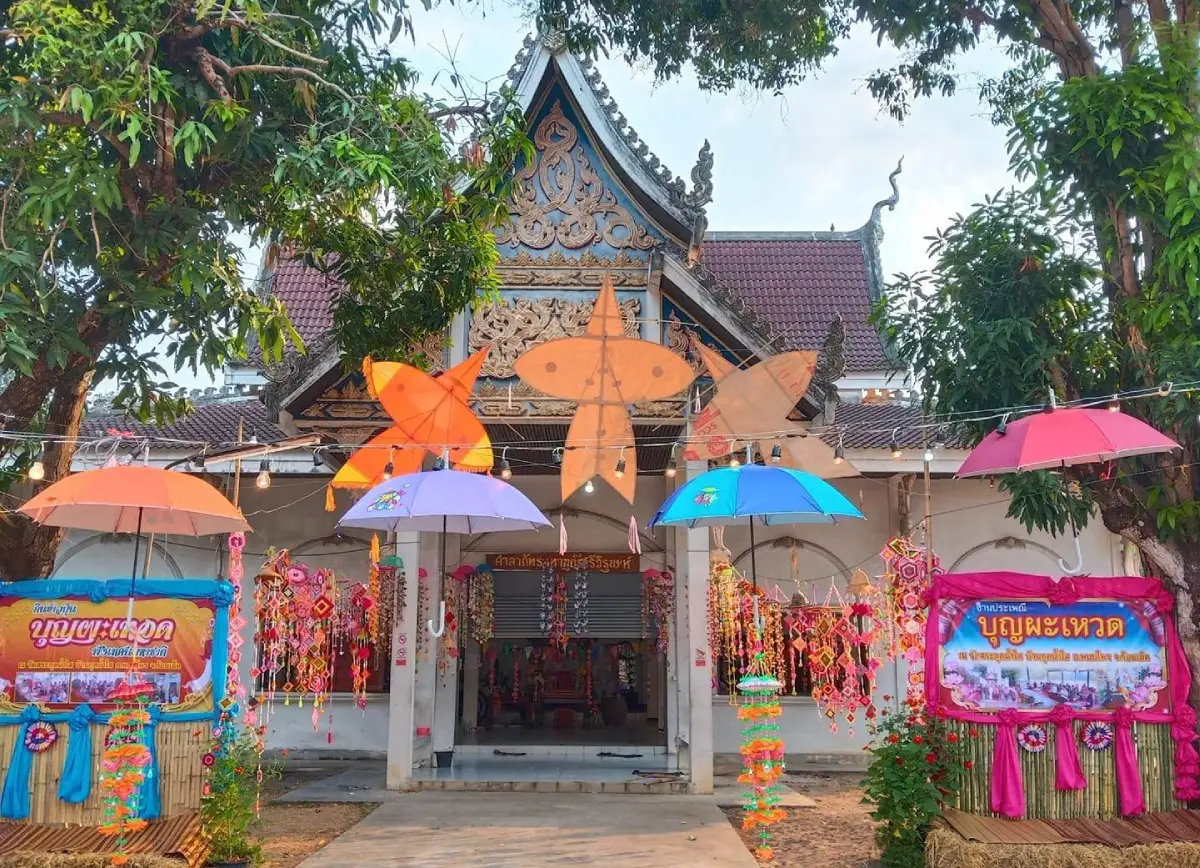
Wat Sa Kut Nam Sai
Open Days: Daily
Opening Hours: 08.00 – 17.00
Wat Sa Kut Nam Sai in Roi Et is located in Moo 9, Ban Klang, Kut Nam Sai Subdistrict, Phanom Phrai District, Roi Et Province. It is an old community Buddhist temple associated with local faith, sacred relic worship, a replica of the Buddha’s footprint, and an annual worship festival held on the 15th waxing moon of the fourth lunar month. The temple was established around 1857 and has long been respected by people of Kut Nam Sai Subdistrict and surrounding communities. Its main sacred area is the mandapa that enshrines relics of the Buddha, together with the replica Buddha footprint and various sacred objects. For travelers who want to understand local Buddhism in southern Roi Et, this temple offers a quiet view of village faith beyond the better-known city landmarks.
The name Wat Sa Kut Nam Sai reflects the landscape and memory of the local area. In Thai and Isan place names, sa means pond, while kut often refers to an old water channel, cut-off stream, or natural water basin. Nam sai means clear water. Together, the name suggests a place connected with water, settlement, fertility, and calmness. This connection between temple and water is meaningful because many Isan communities formed around reliable water sources, and temples often became the spiritual centers of those communities.
Wat Sa Kut Nam Sai stands in Phanom Phrai District, a southern district of Roi Et known for strong community traditions and Buddhist festivals. Phanom Phrai is associated with the sacred Phra Maha That of Wat Klang Udom Wet, the district’s Bun Bang Fai rocket festival, local agricultural life, and the cultural landscape of the Thung Kula Rong Hai region. Wat Sa Kut Nam Sai belongs to this same religious and cultural setting. It represents the smaller village level of faith, while larger district temples show the broader ceremonial identity of Phanom Phrai.
The temple’s founding around 1857 gives it a long history as a village Buddhist institution. Temples of this type usually developed through the combined faith of monks, village leaders, and local families. They were not built as tourist attractions. They grew from the practical and spiritual needs of the community: worship, merit-making, funerals, Buddhist holy days, annual festivals, moral teaching, and shared identity. Wat Sa Kut Nam Sai continues this role as a place where local people return to faith, memory, and community connection.
The most important sacred feature of the temple is the mandapa enshrining relics of the Buddha. In Buddhist culture, relics of the Buddha are among the highest objects of reverence because they remind devotees of the Buddha, his enlightenment, and the continuing presence of the Dhamma. For local worshippers, paying respect to the relics is a way to seek auspiciousness, cultivate faith, and remember the Buddha’s teaching. The mandapa therefore functions as the spiritual heart of the temple.
Visitors should approach the mandapa with calmness and respect. It is not simply a sightseeing spot or a place for photographs. It is a sacred space maintained by the community through faith. Worshippers usually come to pay respect, make offerings, bow before the relics, and sit quietly. A careful visit allows travelers to understand how Buddhist relic worship remains meaningful in local communities, far from major royal temples or famous pilgrimage destinations.
The replica Buddha footprint is another important sacred object at Wat Sa Kut Nam Sai. In Buddhist symbolism, the Buddha footprint represents the presence of the Buddha and the path of practice. Devotees bow before the footprint as a reminder to follow the Buddha’s way through moral conduct, mindfulness, wisdom, and compassion. This meaning makes the footprint more than a sacred image. It is a symbol of walking the path of Dhamma.
The combination of relics and the Buddha footprint gives the temple a clear devotional identity. The relics invite worshippers to remember the Buddha directly, while the footprint invites them to follow his path. Together, they create a spiritual experience that connects reverence with practice. Visitors can pay respect to the relics, then bow before the footprint as a quiet reminder that Buddhist faith is not only about asking for blessings, but also about living with mindfulness and goodness.
The temple also preserves sacred objects respected by local people. In village Buddhist life, sacred objects are often understood as reminders of faith, protection, merit, and moral strength. They are part of the relationship between monks, laypeople, and the temple. Visitors should view them with respect and avoid treating them as curiosities. For local devotees, these objects carry memory, offerings, and personal trust in the power of Buddhist merit.
The annual worship festival of Wat Sa Kut Nam Sai is held on the 15th waxing moon of the fourth lunar month. This is one of the most important times of the year for the temple. Local people and visitors come to worship the relics, pay respect to the Buddha footprint, make merit, offer donations, and join community activities. The festival helps maintain the connection between the temple and the people of Kut Nam Sai Subdistrict.
The timing of the festival has special meaning in the local seasonal rhythm. The fourth lunar month falls after the cool season and before the intense heat of the dry season. For rural communities, this is a period of renewal, gathering, and preparation before the next agricultural cycle. A temple festival at this time brings families together, strengthens faith, and begins the yearly rhythm with merit-making and communal unity.
During the annual festival, the temple becomes the center of community life. Elderly worshippers, families, children, relatives returning from other provinces, and villagers from nearby areas come together. This atmosphere shows the real role of a village temple in Isan. It is not separate from society. It is the place where people reconnect with family, ancestors, faith, and community identity through merit-making and worship.
Wat Sa Kut Nam Sai also serves the community through regular Buddhist activities. Local people use the temple for Buddhist holy days, alms-giving, Kathin, robe-offering ceremonies, funerals, memorial merit-making, and local traditions. These functions make the temple essential to village life. A community temple supports people not only during festivals but throughout the entire cycle of life, from ordinary merit-making to major family ceremonies.
Moo 9 Ban Klang in Kut Nam Sai Subdistrict offers a rural setting distinct from central Roi Et. Visitors traveling here will pass through local roads, village houses, fields, water sources, and quiet community landscapes. This makes the journey suitable for slow religious travel rather than hurried sightseeing. Wat Sa Kut Nam Sai is best appreciated by travelers who want to understand local Buddhist life in a real village context.
Culturally, the temple connects Buddhist faith with the memory of water. Water has always been essential to Isan life because it supports farming, settlement, seasonal rituals, and community survival. The name Kut Nam Sai reflects this relationship. A temple bearing such a name carries the memory of the landscape into religious life. This connection between water, village, and temple gives Wat Sa Kut Nam Sai a strong local identity.
A meaningful visit should begin at the mandapa enshrining the relics of the Buddha. Visitors can then pay respect to the replica Buddha footprint and continue to the merit-making area, temple courtyard, and other worship spaces. If monks or local caretakers are present, visitors may politely ask about proper worship practices. The most appropriate way to visit is quietly, with modest dress and respect for local worshippers.
For visitors interested in local history, Wat Sa Kut Nam Sai is a good example of a small community temple that preserves meaning through sacred objects and annual ritual rather than through large architecture. It may not have the scale of a major historic monument, but it has living cultural value. The relic mandapa, Buddha footprint, and annual festival show how Buddhist memory continues in local villages and how ordinary people preserve their sacred places through repeated acts of faith.
Wat Sa Kut Nam Sai can be combined with Wat Klang Udom Wet in Phanom Phrai town. Wat Klang Udom Wet is known for Phra Maha That and major district festivals, while Wat Sa Kut Nam Sai is known for the relic mandapa, the replica Buddha footprint, and the fourth-lunar-month worship festival. Visiting both temples gives travelers a fuller picture of Buddhist faith in Phanom Phrai: one at the district level and one at the subdistrict community level.
The route can also be extended to Nong Hi District, the Thung Kula Rong Hai area, Bo Phan Khan Rattana Sophon, Ku Ka Sing, or central Roi Et attractions such as Bueng Phlan Chai and Ho Wot 101 Tower. This makes Wat Sa Kut Nam Sai useful for travelers who want to build a deeper Roi Et itinerary that includes temples, rural landscapes, annual traditions, and local community sites.
Getting There from Roi Et city requires traveling toward Phanom Phrai District, about 70 kilometers by road, then continuing into Kut Nam Sai Subdistrict and Ban Klang, Moo 9. Private car or hired local transport is the most convenient option because the temple is located in a rural community area. Visitors can combine the trip with Wat Klang Udom Wet and local places in Phanom Phrai.
Travelers without private vehicles can travel to Phanom Phrai town area by local transport, then continue to Kut Nam Sai Subdistrict by hired vehicle or local transport. Return transport should be planned in advance, especially for visitors making a day trip from Roi Et city. During the annual festival, visitors should allow extra time for traffic, parking, and community event arrangements.
The temple is open daily from 08.00 to 17.00. The best time to visit is in the morning or early afternoon, when the weather is more comfortable and the temple atmosphere is calm. A basic visit usually takes around 45 minutes to 1 hour. Visitors who come during the annual worship festival on the 15th waxing moon of the fourth lunar month should allow more time because more people will be present.
There is no ticketed admission system. Visitors can enter during opening hours, pay respect to the relics, worship the Buddha footprint, walk around the temple, and make donations according to personal faith. Visitors should dress respectfully, speak quietly, avoid touching sacred objects inappropriately, keep the temple clean, and avoid entering monks’ residence areas without permission.
For families, Wat Sa Kut Nam Sai can serve as a meaningful outdoor classroom. Children can learn what Buddha relics are, why the Buddha footprint is respected, how an annual temple festival supports community life, and why village temples remain important in Thailand. Learning at the actual temple helps children understand Buddhism as a living tradition rather than only as a subject in books.
For foreign travelers, Wat Sa Kut Nam Sai is a strong example of a rural Isan Buddhist temple centered on relic worship, the Buddha footprint, and local community tradition. It shows that Thai Buddhism is not found only in large city temples or famous landmarks. It also lives in village monasteries where sacred objects, monks, families, annual festivals, and local memory come together.
Overall, Wat Sa Kut Nam Sai in Roi Et is an important community temple in Kut Nam Sai Subdistrict, Phanom Phrai District. Its main highlights are its establishment around 1857, the mandapa enshrining relics of the Buddha, the replica Buddha footprint, sacred objects respected by local people, the annual worship festival on the 15th waxing moon of the fourth lunar month, and its role as the spiritual center of Ban Klang and Kut Nam Sai community. The temple tells the story of Roi Et through faith, water-linked place memory, village Buddhism, and annual merit-making tradition.
| Name | Wat Sa Kut Nam Sai, Roi Et |
| Temple Type | Local Buddhist Temple, Maha Nikaya Order, And Important Sacred Site Of Kut Nam Sai Subdistrict |
| Location | Moo 9, Ban Klang, Kut Nam Sai Subdistrict, Phanom Phrai District, Roi Et Province |
| Address | Wat Sa Kut Nam Sai, Ban Klang, Moo 9, Kut Nam Sai Subdistrict, Phanom Phrai District, Roi Et 45140, Thailand |
| Highlights | Mandapa enshrining relics of the Buddha, replica Buddha footprint, sacred objects, annual worship festival on the 15th waxing moon of the fourth lunar month, and a calm rural temple atmosphere in Kut Nam Sai community |
| History | Established around 1857 as an old community temple of Ban Klang, Kut Nam Sai Subdistrict, and respected by local Buddhists and visitors through continuing worship traditions |
| Name Origin | The name relates to Kut Nam Sai, a place name suggesting a clear-water natural setting and the community’s connection with local water sources. |
| Important Sacred Objects | Buddha relics in the mandapa, replica Buddha footprint, and sacred objects respected by local devotees |
| Relic Mandapa | The main worship area of the temple, where relics of the Buddha are enshrined as the spiritual center of Kut Nam Sai community |
| Replica Buddha Footprint | A sacred object where visitors pay respect as a reminder of the Buddha’s presence and the path of Dhamma practice |
| Religious Importance | A place for relic worship, Buddha footprint veneration, Buddhist holy day merit-making, Kathin, robe-offering events, alms-giving, and the annual community worship festival |
| Annual Worship Festival | Held annually on the 15th waxing moon of the fourth lunar month, bringing local Buddhists and visitors to worship, make merit, and join temple activities |
| Community Role | A spiritual center of Ban Klang and Kut Nam Sai Subdistrict, used for Buddhist ceremonies, annual traditions, family merit-making, and local community gatherings |
| Travel Information | From Roi Et city, travel toward Phanom Phrai District, about 70 km by road, then continue to Kut Nam Sai Subdistrict and Ban Klang, Moo 9. Private car or hired local transport is the most convenient option. |
| Current Status | Open as a local Buddhist temple, worship site for Buddha relics and a replica Buddha footprint, and spiritual center of Kut Nam Sai community |
| Open Days | Daily |
| Opening Hours | 08.00 – 17.00 |
| Facilities | Temple courtyard, parking area, relic mandapa, Buddha footprint worship area, merit-making area, annual festival space, and nearby restaurants in Phanom Phrai and nearby subdistricts |
| Main Areas / Zones | 1. Buddha Relic Mandapa 2. Replica Buddha Footprint Worship Area 3. Sacred Object Area 4. Temple Courtyard And Merit-Making Area 5. Annual Worship Festival Area For The 15th Waxing Moon Of The Fourth Lunar Month 6. Buddhist Ceremony Area 7. Monastic Residence Area 8. Visitor Rest Area 9. Ban Klang Community Area Around The Temple 10. Local Route Connected With Kut Nam Sai Subdistrict |
| Related Traditions / Activities | Annual worship festival on the 15th waxing moon of the fourth lunar month, Buddhist holy day merit-making, Kathin, robe-offering events, alms-giving, offerings to monks, and local Buddhist activities |
| Caretaker / Responsible Body | Wat Sa Kut Nam Sai, Ban Klang, Kut Nam Sai Subdistrict, Phanom Phrai District, Roi Et Province, Maha Nikaya Order, with Kut Nam Sai community involvement in local activities |
| Monastic Figure Found In Sangha Records | Phra Khru Phairoj Thammaprayut of Wat Sa Kut Nam Sai, Kut Nam Sai Subdistrict, Phanom Phrai District, Roi Et Province, appears in Sangha records as a monastic figure connected with Kut Nam Sai Subdistrict. |
| Local Administrative Contact | Kut Nam Sai Subdistrict Administrative Organization, Tel. 043-669222 |
| Nearby Tourist Attractions | 1. Ban Klang Community, Kut Nam Sai Subdistrict, about 0 km 2. Kut Nam Sai Subdistrict Administrative Organization, about 3 km, Tel. 043-669222 3. Wat Klang Udom Wet, Phanom Phrai, about 8 km 4. Phanom Phrai District Office / Phanom Phrai Market Area, about 8 km, Tel. 043-591223 5. Phanom Phrai Municipality, about 8 km, Tel. 043-591221, 043-590039 6. Wat Pa Ampawan, Phanom Phrai, about 9 km 7. Ban Don Phra Chan Rocket Launching Area, about 12 km 8. Nong Hi District, about 22 km 9. Thung Kula Rong Hai Area, about 28 km 10. Bo Phan Khan Rattana Sophon, Nong Hi District, about 50 km |
| Nearby Restaurants | 1. Aileen Cafe & Bistro Phanom Phrai, about 8 km, Tel. 084-056-0129, 091-017-0371 2. PunThai Coffee, Phinit Nonsarat Road, Phanom Phrai, about 8 km, Tel. 061-025-8770 3. Bai Boon Coffee By Sam Cafe, about 8 km, Tel. 043-591-205 4. Popular Pizza & Coffee & Resort, about 10 km, Tel. 065-845-9785 5. Nam Lam Yai Phanom Phrai, about 8 km, Tel. 084-595-8246 6. L.Kor Hor Shabu Phanom Phrai, about 22 km, Tel. 097-945-4546 7. Thai101, Nong Hi District, about 25 km, Tel. 093-629-6844 |
| Nearby Accommodations | 1. Sanshine Place Phanom Phrai, about 8 km, Tel. 099-545-9938 2. Popular Pizza & Coffee & Resort Phanom Phrai, about 10 km, Tel. 065-845-9785 3. Horseview Resort Phanom Phrai, about 12 km, Tel. 043-030-536 4. Ban Pa Fun, Nong Hi District, about 25 km, Tel. 087-542-7426 5. Dan Sawan Park View / Dan Sawan Resort, Nong Khaen Subdistrict, about 35 km, Tel. 085-747-7639, 090-519-0079 6. Dara 2 Hotel, Bua Daeng Subdistrict, Pathum Rat District, about 40 km, Tel. 063-047-3221 7. Ruean Champa Garden Resort, Bua Daeng Subdistrict, about 42 km, Tel. 087-944-8819, 093-537-9755 |
Frequently Asked Questions (FAQ)
Q: Where is Wat Sa Kut Nam Sai located?
A: Wat Sa Kut Nam Sai is located in Moo 9, Ban Klang, Kut Nam Sai Subdistrict, Phanom Phrai District, Roi Et Province, about 70 km from Roi Et city by road.
Q: What are the opening days and hours?
A: The temple is open daily from 08.00 to 17.00.
Q: What is the main highlight of Wat Sa Kut Nam Sai?
A: The main highlights are the mandapa enshrining relics of the Buddha, the replica Buddha footprint, sacred objects, and the annual worship festival on the 15th waxing moon of the fourth lunar month.
Q: When is the annual worship festival held?
A: The annual worship festival is held on the 15th waxing moon of the fourth lunar month. Local Buddhists and visitors come to worship, make merit, and join temple activities.
Q: When was Wat Sa Kut Nam Sai established?
A: Wat Sa Kut Nam Sai was established around 1857 as an old community temple of Ban Klang, Kut Nam Sai Subdistrict, Phanom Phrai District.
Q: Is there an admission fee?
A: There is no ticketed admission system. Visitors can enter the temple, worship, and walk around during opening hours. Donations can be made according to personal faith.
Q: What areas should visitors see inside the temple?
A: Important areas include the Buddha relic mandapa, the replica Buddha footprint worship area, sacred object area, temple courtyard, merit-making area, and annual worship festival area.
Q: What nearby attractions can be combined with a visit?
A: Nearby places include Wat Klang Udom Wet, Phanom Phrai market area, Phanom Phrai Municipality, Wat Pa Ampawan, Ban Don Phra Chan rocket launching area, Nong Hi District, Thung Kula Rong Hai, and Bo Phan Khan Rattana Sophon.
 Category: ●Places of Worship
 Group: ●Temple
Last Update : 4 WeekAgo
 Last Update : 4 WeekAgo
 Click to Access the Navigation Map GPS
 Art, Culture and Heritage
 Historical Sites and Monuments(3)
 Landmarks and Memorials(5)
 Art, Craft Centres, Tradition(2)
 Museums(1)
 Educational Places
 Educational Gardens, Farm(3)
Temple(35)
Educational Gardens, Farm(3)
Temple(35)
 Other Sacred Sites(6)
 Suburban Living
 Village, Community(1)
 Local Market(1)
 Nature and Wildlife
 National Parks and Marine Reserves(1)
 Mountain (Doi)(2)
 Dam, Reservoir, Lake(8)
 Waterfalls(1)
 Flower Field(1)
 River, Canal(4)
 Entertainment and Agricultural
 Zoos and Aquariums(1)
 Stadium(1)
 Farms, Parks and Ecotourism(5)
 Shopping
 Shopping and Night Market(1)


