
lovethailand home >Northeastern Travel Attractions >Roi Et Travel Attractions >Muang Roi Et >Sa-at Sombun > Wat Sa Phang Thong
TL;DR: Wat Sa Phang Thong is located at Ban Don Thong, Moo 1, Sa-at Somboon Subdistrict, Mueang Roi Et District, Roi Et Province, open Daily, hours 08.00 – 17.00.
Wat Sa Phang Thong
Open Days: Daily
Opening Hours: 08.00 – 17.00
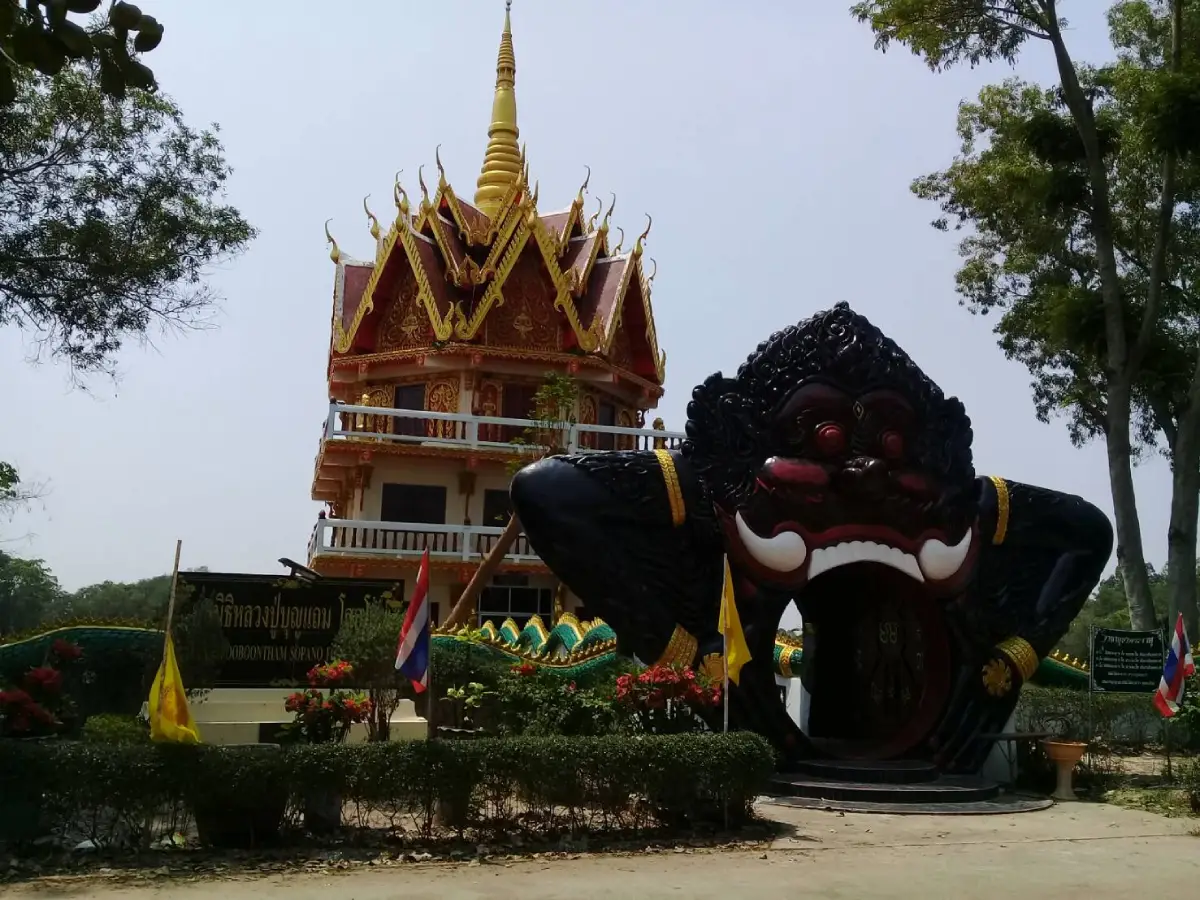
Wat Sa Phang Thong in Roi Et is an old community temple located in Ban Don Thong, Moo 1, Sa-at Somboon Subdistrict, Mueang Roi Et District, Roi Et Province. The temple is meaningful because it combines Buddhist worship, local history, old sacred objects, community traditions, a temple pond, and annual merit-making ceremonies in one place. Unlike the major city landmarks of Roi Et, Wat Sa Phang Thong offers visitors a quieter and more local view of Isan Buddhist life. It is a temple where religion, community gathering, education, remembrance, and everyday recreation exist together.
The temple is especially valuable for travelers who want to see how a rural community temple works in northeastern Thailand. It is not only a place where people come to worship. It is also a place where villagers meet, make merit, join annual traditions, preserve old objects, learn temple history, exercise around the pond, and use the temple grounds as a shared community space. This makes Wat Sa Phang Thong a practical example of how Buddhist temples continue to serve many social roles in Thai village life.
The name Wat Sa Phang Thong is closely connected with the landscape of water. The old area was known locally as Pa Sa Phang, a low-lying and overgrown area with a large pond at its center. The word “sa” refers to a pond, and the temple name preserves the memory of this water landscape. The pond and surrounding open space remain important to the temple atmosphere today. Local people use the area for relaxation, light exercise, and community activities, especially during temple fairs and annual merit-making events.
Temple history records that Wat Sa Phang Thong was established in 1939. The land was formerly connected with Wat Chonthan Udom as monastic land, and the area was once a low plain covered with forest and an old pond. In 1955, a monastic residence was developed at Pa Sa Phang to help preserve the monastic land and serve the Buddhist community. The support of villagers from Ban Don Thong and nearby Ban Don Si Wilai helped the temple grow from a small monastic site into an important local temple.
This history is important because it shows how community faith can transform a neglected landscape into a religious and social center. Wat Sa Phang Thong was not created as a grand royal monument. It developed through the devotion of monks and villagers. The temple’s growth reflects local cooperation, religious commitment, and the practical need for a place where people could make merit, gather, learn, and preserve Buddhist tradition.
The most distinctive architectural feature of the temple is its ubosot, or ordination hall. The building is about 8 meters wide and 12 meters long, designed in a four-sided form. Its roof is built with a stupa-like form inspired by Phra That Phanom, one of the most revered Buddhist monuments in northeastern Thailand. This design gives the ubosot a strong Isan identity and makes it one of the key structures visitors should observe carefully.
The ubosot received its consecrated boundary on October 16, 1985, with a consecrated area about 27 meters wide and 40 meters long. On December 16, 1988, a ceremony was held for the cutting of the boundary stones and the enshrinement of sacred relics in the ubosot-stupa. This marked an important moment in the temple’s development because the ordination hall became a fully consecrated monastic space for official Buddhist rites. For visitors, this explains why the ubosot is not only beautiful; it is spiritually and ritually central to the temple.
The temple’s important sacred objects include a principal Buddha image in the posture of subduing Mara, made of stucco, with a lap width of about 90 inches. There is also a Buddha footprint replica and a reclining Buddha image about 5 meters high and 12 meters long. These sacred objects form the main devotional points of the temple. Visitors can begin their visit by paying respect to the principal image, then continue to the Buddha footprint replica, the reclining Buddha, and other shrine areas.
Wat Sa Phang Thong also preserves old objects and local heritage materials for study. The presence of a museum building inside the temple shows that the temple is also a learning space. Old objects, temple records, sacred images, and architectural features all help tell the story of the community. For foreign travelers, this is useful because it shows that a Thai temple can function as a local archive as well as a religious site.
A significant monk in the history of the temple is Phra Khru Sophon Saraphiwat, also known as Boonthaem Sophano or Luang Pu Boonthaem Sophano. Temple history identifies him as a key figure in the development and administration of Wat Sa Phang Thong. His role is remembered by local devotees and is connected with the temple’s growth from a small monastic site to an established temple. His memory remains part of the temple’s spiritual identity.
The temple grounds include several important buildings and areas: the ubosot, sermon hall, chanting hall, monks’ residences, vihara, multi-purpose hall, funeral halls, and museum building. These structures show that the temple supports many types of religious and social activity. It can host merit-making ceremonies, sermons, funeral rites, community meetings, annual festivals, monastic activities, and educational programs. This makes the temple a central public space for the surrounding villages.
The sermon hall is about 24 meters wide and 32 meters long. It is used for religious gatherings, community events, and temple ceremonies. The chanting hall, about 12 meters wide and 18 meters long, supports monastic and devotional activities. The monks’ residences show that the temple continues to function as a living monastery. The vihara, multi-purpose hall, and funeral halls allow the temple to serve the community through different stages of life, from ordinary merit-making to major family rites.
The temple also has a history of Buddhist education. A Dhamma-study school was opened in 1969. This role is important because temples in Thailand have long served as places of learning. Monks, novices, and local learners could study Buddhist teachings, discipline, ethics, and religious practice within the temple setting. This educational role connects Wat Sa Phang Thong with the wider tradition of Thai temples as community learning centers.
The temple’s most important annual tradition is Bun Duean Sam, or the third lunar month merit-making festival, held between February and March each year. During this festival, villagers offer alms around the ubosot for 7 consecutive days. This practice creates a strong sense of shared merit, discipline, and community participation. For visitors, it is one of the best times to experience the living faith of Sa-at Somboon Subdistrict.
Bun Duean Sam is more than a religious schedule. It is a community rhythm. Villagers prepare offerings, come to the temple, join the alms-giving ceremony, and meet relatives and neighbors. The repeated alms-giving around the ubosot for 7 days emphasizes devotion and continuity. It also makes the ubosot the center of communal merit. This tradition helps preserve the connection between the temple and the people who support it.
Another important annual event is Bun Duean Hok, or the sixth lunar month merit-making tradition, held in May. During this event, people perform the water-pouring ceremony for Phra Sa Phang Thong and Phra Khodam, two important Buddha images associated with the temple tradition. The event also features food offered from different places for people to eat free of charge. This makes the festival both religious and social: a ceremony of reverence and a gathering of generosity.
The bathing ceremony for Phra Sa Phang Thong and Phra Khodam has deep cultural meaning. It represents respect, purification, blessing, and renewal. When people pour water over sacred images, they express devotion and ask for auspiciousness in life. At Wat Sa Phang Thong, this ritual is also tied to local identity. It shows how sacred images, temple tradition, water, and community generosity are joined together in one annual event.
The free food offered during Bun Duean Hok reflects the Isan spirit of sharing. Food is not only something to eat; it represents kindness, hospitality, and community cooperation. Visitors who come during this festival will see villagers preparing food, welcoming guests, making merit, and joining the temple event together. This atmosphere makes the festival one of the most meaningful ways to experience the temple.
The pond at Wat Sa Phang Thong is another important feature for visitors. It gives the temple a calm and open atmosphere. Local people use the pond area for relaxation and exercise, especially in the morning and late afternoon. The pond also reinforces the meaning of the temple name and connects the religious area with nature. For travelers, the pond makes the temple feel less formal and more connected with everyday community life.
Wat Sa Phang Thong is suitable for travelers interested in community temples, local Buddhist culture, annual festivals, old sacred objects, and peaceful rural surroundings. It is different from Roi Et city temples such as Wat Buraphaphiram or Wat Klang Ming Mueang. Those temples are closely linked with the city center and major landmarks. Wat Sa Phang Thong shows the quieter side of Roi Et, where temple life and village life continue together.
Getting There is easiest by private car. From central Roi Et, travel toward Sa-at Somboon Subdistrict and continue to Ban Don Thong, Moo 1. Visitors can use Yothathikan Ro. 2100 Road or the coordinates 16.003267, 103.604847 as a navigation reference. The temple is about 12 kilometers from the Bueng Phlan Chai and Ho Wot 101 area. Local taxis or hired transport from Roi Et city can also be used for visitors without private vehicles.
A practical trip can combine Wat Sa Phang Thong with central Roi Et attractions. Visitors may begin with the temple in the morning, then return to the city to visit Bueng Phlan Chai, Ho Wot 101 Tower, Roi Et National Museum, Wat Klang Ming Mueang, Wat Sra Thong, or Wat Buraphaphiram. This route gives travelers both a local village-temple experience and the main cultural attractions of Roi Et city in one day.
During Bun Duean Sam or Bun Duean Hok, visitors should allow more travel time because the temple may be busier than usual. These events are excellent opportunities to see local faith in action, but visitors should dress respectfully, walk carefully around ceremonial areas, and avoid disturbing monks or villagers during rituals. These are living traditions, not staged performances.
Temple etiquette is important. Visitors should dress modestly, speak quietly inside the ubosot and vihara, avoid touching sacred objects or old objects unnecessarily, and keep the pond area clean. Photography should be respectful, especially when people are making merit or praying. These simple practices help preserve the temple as both a sacred place and a community space.
For families and students, Wat Sa Phang Thong can be an outdoor classroom. Children can learn about the role of temples in village life, the meaning of an ordination hall, the importance of sacred relics, the function of a temple pond, and the social value of merit-making festivals. Learning from the actual temple environment makes Buddhist culture easier to understand than reading about it from a distance.
For foreign travelers, the temple explains an important point about Thailand: a Buddhist temple can be a monastery, school, museum, festival ground, community center, resting place, and spiritual refuge at the same time. Wat Sa Phang Thong demonstrates this clearly. It may not be a large tourist landmark, but it offers a rich and authentic view of how Buddhism is woven into local Isan life.
Overall, Wat Sa Phang Thong in Roi Et is a meaningful cultural and religious site for visitors who want to understand the province beyond major city landmarks. Its highlights include the four-sided ubosot with a Phra That Phanom-inspired stupa roof, the principal Buddha image, Buddha footprint replica, reclining Buddha, museum building, temple pond, Bun Duean Sam alms-giving tradition, and Bun Duean Hok water-pouring ceremony for Phra Sa Phang Thong and Phra Khodam. The temple tells the story of Roi Et through faith, water, community cooperation, old sacred objects, and living traditions.
| Name | Wat Sa Phang Thong, Roi Et |
| Temple Type | Local Buddhist Temple, Maha Nikaya Order |
| Location | Ban Don Thong, Moo 1, Sa-at Somboon Subdistrict, Mueang Roi Et District, Roi Et Province |
| Address | Wat Sa Phang Thong, Yothathikan Ro. 2100 Road, Sa-at Somboon Subdistrict, Mueang Roi Et District, Roi Et 45000, Thailand |
| Coordinates | 16.003267, 103.604847 |
| Highlights | Four-sided ubosot with a Phra That Phanom-inspired stupa roof, old sacred objects, principal Buddha image in the posture of subduing Mara, Buddha footprint replica, reclining Buddha image, museum building, temple pond, Bun Duean Sam tradition, and Bun Duean Hok water-pouring ceremony |
| History | The temple was established in 1939. The area was formerly a low and overgrown monastic land with a large pond at the center, known locally as Pa Sa Phang. In 1955, a monastic residence was developed and later expanded into an important community temple of Sa-at Somboon. |
| Name Origin | The name is connected with the old pond landscape called Sa Phang, which shaped the memory and identity of the temple area. |
| Ubosot | The ubosot is about 8 meters wide and 12 meters long, built in a four-sided form with a stupa-like roof inspired by Phra That Phanom. The temple received its consecrated boundary on October 16, 1985. |
| Important Sacred Objects | Principal Buddha image in the posture of subduing Mara, about 90 inches wide; Buddha footprint replica; reclining Buddha image about 5 meters high and 12 meters long; Phra Sa Phang Thong; and Phra Khodam, associated with the Bun Duean Hok water-pouring tradition |
| Learning Value | Old objects inside the temple, museum building, temple architecture, history of the temple, memory of Luang Pu Boonthaem Sophano, and local traditions of Sa-at Somboon community |
| Travel Information | From Roi Et city, travel toward Sa-at Somboon Subdistrict and Ban Don Thong, Moo 1. Visitors can use Yothathikan Ro. 2100 Road or the coordinates 16.003267, 103.604847. The temple is about 12 km from Bueng Phlan Chai and Ho Wot 101 Tower. |
| Current Status | Open as a community temple, worship site, local heritage learning place, and annual festival venue of Sa-at Somboon Subdistrict |
| Open Days | Daily |
| Opening Hours | 08.00 – 17.00 |
| Facilities | Ubosot, sermon hall, chanting hall, monks’ residences, vihara, multi-purpose hall, funeral halls, museum building, temple courtyard, pond area, exercise and relaxation area, and parking space around the temple |
| Main Areas / Zones | 1. Four-Sided Ubosot 2. Principal Buddha Image In The Posture Of Subduing Mara 3. Buddha Footprint Replica 4. Reclining Buddha Image 5. Vihara And Worship Area For Phra Sa Phang Thong And Phra Khodam 6. Museum Building And Old Object Area 7. Sermon Hall 8. Chanting Hall 9. Temple Pond And Relaxation Area 10. Temple Courtyard And Festival Area |
| Related Traditions / Activities | Bun Duean Sam between February and March, with 7 days of alms-giving around the ubosot, and Bun Duean Hok in May, with the water-pouring ceremony for Phra Sa Phang Thong and Phra Khodam, along with free food offered to the public |
| Educational Role | The temple has had a Dhamma-study school since 1969 and serves as a Buddhist learning space for the local community. |
| Caretaker / Responsible Body | Wat Sa Phang Thong, Sa-at Somboon Subdistrict, Mueang Roi Et District, Roi Et Province, Maha Nikaya Order |
| Important Former Abbot | Phra Khru Sophon Saraphiwat (Boonthaem Sophano) |
| Public Contact Number | 089-375-0592 |
| Nearby Tourist Attractions | 1. Wat Sa Phang Thong Pond, about 0 km 2. Bueng Phlan Chai, about 12 km 3. Ho Wot 101 Tower, about 12 km, Tel. 043-511222 4. Roi Et National Museum, about 12 km, Tel. 043-514456 Ext. 101 5. Wat Klang Ming Mueang, about 12 km, Tel. 043-512400 6. Wat Buraphaphiram, about 13 km, Tel. 043-511374 7. Wat Sra Thong, about 12 km 8. Prang Ku Roi Et, about 18 km |
| Nearby Restaurants | 1. Krua Somboon Khao Tom Jap Sen, about 9 km, Tel. 081-061-5665 2. Good Day Steak & Restaurant Roi Et, about 10 km, Tel. 083-182-6868 3. Cozy Cafe’ & Bistro, about 12 km, Tel. 085-852-9237 4. Her Studio Roi Et, about 12 km, Tel. 083-871-0824 5. Lakeview Restaurant, about 12 km, Tel. 093-320-8126 6. Sit Rim, about 12 km, Tel. 098-278-4482 7. 4U For You, Phloen Chit Road, about 12 km, Tel. 065-649-1999 |
| Nearby Accommodations | 1. The Bed Hotel 101, about 10 km, Tel. 043-032-142 2. 101 Hotel Roi Et, about 11 km, Tel. 043-513-999, 065-119-6999 3. Saket Nakhon Hotel, about 12 km, Tel. 043-511-741 4. Boonbundal Hotel, about 12 km, Tel. 043-624-624 5. HOP INN Roi Et, about 13 km, Tel. 02-080-2222 6. Le Park 23 Boutique Resort, about 14 km, Tel. 043-513-444 |
Frequently Asked Questions (FAQ)
Q: Where is Wat Sa Phang Thong located?
A: Wat Sa Phang Thong is located in Ban Don Thong, Moo 1, Sa-at Somboon Subdistrict, Mueang Roi Et District, Roi Et Province, about 12 km from the Bueng Phlan Chai and Ho Wot 101 Tower area.
Q: What are the opening days and hours?
A: The temple is open daily from 08.00 to 17.00.
Q: Is there an admission fee?
A: Wat Sa Phang Thong is a community Buddhist temple. Visitors can enter the temple, worship, and walk around the main areas during opening hours. Merit-making can be done according to personal faith.
Q: What is the main highlight of Wat Sa Phang Thong?
A: The highlights include the four-sided ubosot with a Phra That Phanom-inspired stupa roof, old sacred objects, principal Buddha image, Buddha footprint replica, reclining Buddha, museum building, temple pond, and the Bun Duean Sam and Bun Duean Hok traditions.
Q: When is Bun Duean Sam held at Wat Sa Phang Thong?
A: Bun Duean Sam is held between February and March each year. The main activity is alms-giving around the ubosot for 7 consecutive days.
Q: What happens during Bun Duean Hok?
A: Bun Duean Hok is held in May. The main activity is the water-pouring ceremony for Phra Sa Phang Thong and Phra Khodam, along with food offered from different places for the public to eat free of charge.
Q: What should visitors see inside the temple?
A: Visitors should see the four-sided ubosot, principal Buddha image, Buddha footprint replica, reclining Buddha, worship area for Phra Sa Phang Thong and Phra Khodam, museum building, sermon hall, temple pond, and festival courtyard.
Q: What nearby attractions can be combined with a visit?
A: Nearby places include Bueng Phlan Chai, Ho Wot 101 Tower, Roi Et National Museum, Wat Klang Ming Mueang, Wat Buraphaphiram, Wat Sra Thong, and Prang Ku Roi Et.
 Category: ●Places of Worship
 Group: ●Temple
Last Update : 4 WeekAgo
 Last Update : 4 WeekAgo
 Click to Access the Navigation Map GPS
Wat Sa Phang Thong Map
Recommend

 Art, Culture and Heritage
 Historical Sites and Monuments(3)
 Landmarks and Memorials(5)
 Art, Craft Centres, Tradition(2)
 Museums(1)
 Educational Places
 Educational Gardens, Farm(3)
Temple(35)
Educational Gardens, Farm(3)
Temple(35)
 Other Sacred Sites(6)
 Suburban Living
 Village, Community(1)
 Local Market(1)
 Nature and Wildlife
 National Parks and Marine Reserves(1)
 Mountain (Doi)(2)
 Dam, Reservoir, Lake(8)
 Waterfalls(1)
 Flower Field(1)
 River, Canal(4)
 Entertainment and Agricultural
 Zoos and Aquariums(1)
 Stadium(1)
 Farms, Parks and Ecotourism(5)
 Shopping
 Shopping and Night Market(1)


