
lovethailand home >Northeastern Travel Attractions >Roi Et Travel Attractions >Suwannaphum >Hua Thon > Wat Traiphum Khanachan
TL;DR: Wat Traiphum Khanachan is located at Ban Tak Daet, Hua Thon Subdistrict, Suwannaphum District, Roi Et Province, open Daily, hours 08.00 – 17.00.
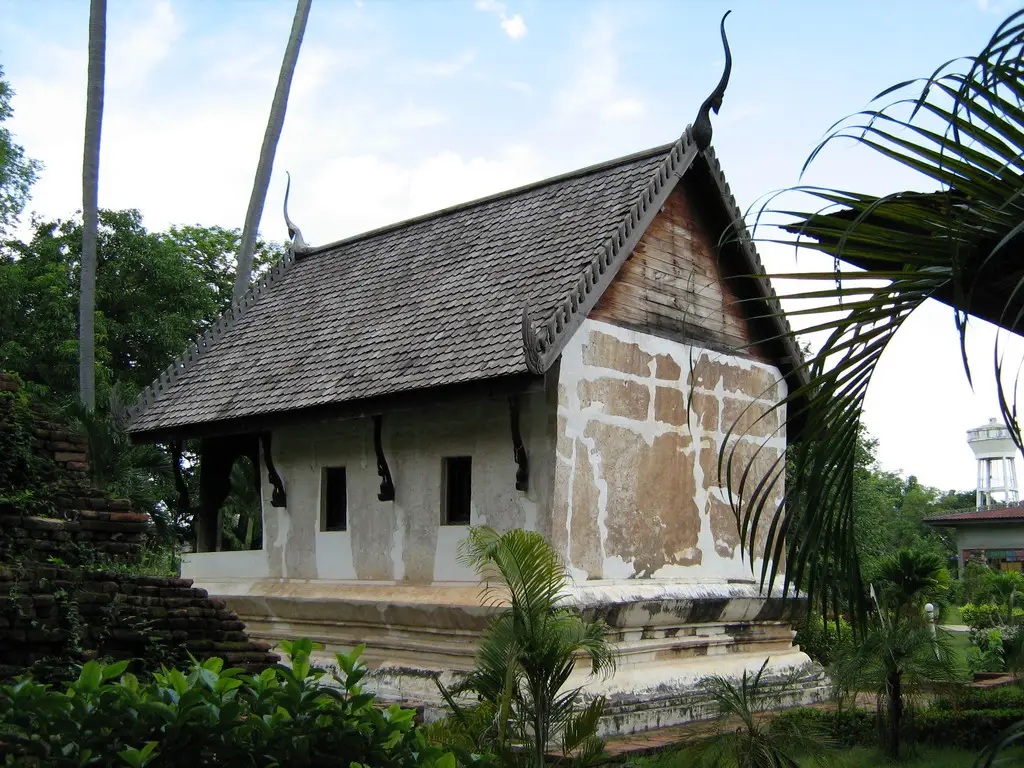
Wat Traiphum Khanachan
Open Days: Daily
Opening Hours: 08.00 – 17.00
Wat Traiphum Khanachan in Roi Et Province is a historic Buddhist monastery in Ban Tak Daet, Hua Thon Subdistrict, Suwannaphum District. Its most important structure is a small enclosed Isan ordination hall known locally as a sim. The building is protected as a registered historic monument and preserves finely carved timber ornament, naga-shaped brackets, a single-tiered gable roof, and surviving mural paintings known in the Isan language as hup taem. The temple grounds are open daily without an admission fee. However, the old sim may remain locked to protect its murals and sacred objects, so visitors wishing to see the interior should politely request permission from a monk or local caretaker.
The value of Wat Traiphum Khanachan does not depend on monumental scale or lavish decoration. Its importance lies in the way a modest rural building brings together vernacular architecture, Buddhist teaching, community memory, artistic exchange, and the history of monastic administration across the Mekong region. The sim records the craftsmanship of local builders who adapted ideas from central Thai art to the materials, climate, religious practices, and visual preferences of northeastern Thailand.
The temple stands in Ban Tak Daet, an old agricultural community in Hua Thon Subdistrict, approximately 5 kilometers from central Suwannaphum. The surrounding area retains the character of a rural Isan settlement, where the temple remains closely connected with everyday community life. It serves as a place for merit-making, sermons, Buddhist ceremonies, funerals, festivals, and village meetings. At the same time, the historic sim functions as an educational resource for younger generations studying masonry, timber construction, mural painting, religious symbolism, and local history.
The monastery was originally known as Wat Pa, meaning the Forest Temple, a name reflecting its early location away from a densely settled community. It later became known as Wat Traiphum Ban Tak Daet before receiving the present name Wat Traiphum Khanachan. The word Traiphum refers to the Buddhist concept of the three realms of existence: the sensual realm, the form realm, and the formless realm. Khanachan refers to a community of respected teachers. The complete name can therefore be understood as a monastery associated with venerable teachers and the Buddhist cosmology of the three worlds.
The temple’s history contains more than one chronological layer. A national historical register of Thai temples records the establishment of the monastery in 1798 and connects its foundation with Luang Pu Lak Kham and the local community. The Fine Arts Department, meanwhile, places the construction of the monastery and surviving sim within the reign of King Rama IV in the nineteenth century. These records can be understood by separating the history of the earlier religious settlement and community movement from the later construction or rebuilding of the sim that survives today.
The recorded history also describes a movement from an earlier southern temple following an epidemic. This older religious settlement was associated with the area of Wat Tai Wilai Tham in the same district. The relationship between the two temples remains visible through a large local-style Buddha image that was transferred to Wat Traiphum Khanachan. The movement of communities, monks, manuscripts, and sacred images shows that historic monasteries were connected through regional networks rather than developing as isolated institutions.
The most important religious figure associated with the monastery is Phra Khru Lak Kham. He resided at the temple and held an influential ecclesiastical position connected with Monthon Nakhon Ratchasima. His monastic responsibilities extended across northeastern Siam and associated territories, including Vientiane, Champasak, Battambang, and Sisophon. This role gave Wat Traiphum Khanachan an importance far greater than that of an ordinary village monastery. It was once connected with a broad network of Buddhist administration and religious education across the Mekong region.
The title Lak Kham was remembered locally as a designation for a monk of high learning and status. Oral traditions describe Phra Khru Lak Kham as exceptionally knowledgeable in palm-leaf manuscripts and capable of arranging manuscript bundles accurately. Whether heard as history or community memory, these accounts preserve the image of a monastery where monks served as teachers, manuscript custodians, moral leaders, and interpreters of Buddhist knowledge in a period before modern public education reached every village.
The historical temple compound covers approximately 11 rai, 3 ngan, and 2 square wah, with additional monastic land recorded separately. Structures from different periods include the old sim, a modern ordination hall, a preaching hall, monks’ residences, a merit-making pavilion, subsidiary chedis, and a pavilion containing sacred images. Together they show how the monastery developed over time. The small vernacular sim served the ritual requirements of the early community, while larger concrete buildings were later constructed to accommodate modern ceremonies and larger gatherings.
The Isan word sim refers to an ordination hall and derives from the Pali concept of sima, a formally designated boundary for monastic acts. Within this consecrated area, monks conduct ordinations, recite the monastic code, and perform formal Sangha ceremonies. Rural sims were generally small because they served a limited number of monks and were constructed through community labor. They often used locally available materials and relatively simple forms, while concentrating decoration on the most sacred and visually prominent parts of the building.
The sim at Wat Traiphum Khanachan is classified as an enclosed or solid-walled Isan sim. Unlike an open pavilion-style sim, its masonry walls completely enclose the ritual space. This construction provides protection from sun, rain, wind, and humidity, while also creating surfaces for mural painting. The building stands on a high molded base and follows a rectangular plan oriented toward the east, a common direction for Buddhist sacred buildings. Subsidiary chedis stand to the north and south, reinforcing the sacred character and balance of the ensemble.
The Fine Arts Department records the building as approximately 8.70 meters wide and 6.10 meters long. Its interior contains two bays forming the principal space for the Buddha image. Each side has only a limited number of windows, helping preserve structural strength and control natural light. The main entrance occupies the center of the eastern wall. A projecting porch stands in front of the entrance and is partly enclosed by a low wall, with a central opening providing access to the elevated interior.
The compact proportions create an immediate sense of intimacy and quietness. The sim was not intended to impress through the enormous scale of a royal temple. Its visual strength comes from the balanced relationship between the high base, masonry walls, roof, and entrance porch. The raised base protects the sacred floor from ground moisture while separating the monastic ritual area from the ordinary surface of the temple courtyard. The entrance steps therefore mark a symbolic transition into a consecrated space.
The principal structure uses load-bearing brick-and-plaster walls and columns to support a single gable roof. Round wooden columns are used at the front porch, combining timber construction with masonry. The roof was traditionally covered with small overlapping wooden shingles that shed rainwater efficiently. Its uncomplicated single-tier form and projecting eaves respond well to the hot and humid climate by shading the walls, limiting rain exposure, and creating a transitional sheltered space at the front.
Roof decoration includes the local equivalents of finials, naga-inspired bargeboards, and ornamental end pieces. These features introduce visual movement to an otherwise simple masonry structure. They also connect the building with religious imagery involving nagas, celestial creatures, and protectors of Buddhism. The curving lines lead the eye upward and transform the roof from a purely practical covering into an architectural symbol of sacred space.
The front gable is formed with vertically arranged timber boards, creating a strong rhythm and a textured contrast with the plaster walls below. Beneath the gable is an elongated carved panel known as the rang phueng, literally the honeycomb element. It extends downward to reduce the empty space above the porch. The panel is decorated with local interpretations of scrolling kanok foliage. Its carving is graceful but less rigid than court art, revealing how village craftsmen adapted established Thai motifs to their own tools, materials, and artistic judgment.
Timber brackets supporting the projecting eaves are carved in the form of nagas. Structurally, these brackets help carry the roof load. Symbolically, the naga protects the Buddhist sacred area and represents water, fertility, and spiritual guardianship. Naga imagery has deep significance throughout the Mekong region and appears in architecture, legends, textiles, and ritual traditions. Its use beneath the roof gives a functional building component an additional religious meaning.
A low sacred boundary wall surrounds the sim without blocking views of the building. It defines the consecrated area while allowing the architecture to remain visually connected with the courtyard and surrounding chedis. Visitors can walk around much of the exterior to observe the molded base, wall surfaces, windows, eaves, and timber details. Maintaining a respectful distance is important because it reduces accidental contact with historic plaster and carved wood.
Subsidiary chedis stand to the north and south of the sim. They may be associated with the remains of monks or significant community members and make the area an architectural ensemble rather than an isolated building. The Fine Arts Department restored the northern chedi in 1998 following conservation work on the sim. The project therefore addressed not only the main structure but also the surrounding elements that establish the historical and sacred setting.
The interior contains mural paintings known locally as hup taem. In the Isan language, hup means an image and taem means to paint or mark. Isan murals were often created with locally available pigments by community craftsmen rather than court-trained painters. Their power comes from direct drawing, lively lines, regional details, and narrative clarity. They preserve a visual language that differs significantly from the more formal and highly regulated murals of major royal monasteries.
The Fine Arts Department identifies the principal subject as the life of the Buddha. The composition reflects a clear influence from central Thai mural painting, particularly in the arrangement of figures, separation of narrative scenes, and use of black contour lines. The paintings nevertheless retain the personality of local craftsmen through proportions, gestures, clothing, and the treatment of empty space. They are therefore evidence of artistic transmission from the center to the region, followed by local reinterpretation.
The murals were not created simply to decorate the interior. They served as a visual method of Buddhist education when many members of the community could not read lengthy religious manuscripts. Monks could use painted scenes to explain the Buddha’s life, moral conduct, karma, generosity, and spiritual practice. Figures, houses, clothing, and everyday details could also reflect the social environment known to the painters, allowing later generations to study aspects of local life through a sacred narrative.
Many parts of the paintings have faded because of age, moisture, dust, temperature changes, and deterioration of the wall surface. Visitors should allow their eyes to adjust to the dim interior and then slowly observe surviving black lines, patches of pigment, figures, and narrative groups. The walls must not be touched, and flash photography should be avoided. Oils from hands, physical abrasion, and intense light at close range can further damage fragile paint layers.
Access to the inside of the sim should not be assumed simply because the temple grounds are open. The building contains old murals and sacred objects and may be locked to prevent theft, vandalism, and inappropriate use. Visitors with a serious interest in the paintings should politely approach a monk, caretaker, or community representative. Requesting permission allows education and conservation to continue together and demonstrates respect for the temple’s responsibility to protect the structure.
Behind the sim is a pavilion containing a large stucco Buddha image covered with lacquer and gold leaf. The image was transferred from Wat Tai Wilai Tham in the same district and represents a distinctive local Isan style. It is seated in the posture of subduing Mara, with a relatively round face, small pointed hair curls, a tall conical flame, long ears, open eyes, a broad nose, and thick lips with a slight smile. Its powerful local character differs from the refined proportions associated with court sculpture.
The Buddha wears the robe in the open mode, with a flat monastic shoulder cloth extending toward the navel. The image shares stylistic characteristics with the principal Buddha at Wat Pratu Chai, suggesting a regional artistic tradition in and around Suwannaphum. Its transfer from another monastery demonstrates how communities protected sacred images when an older site changed condition or could no longer provide adequate security and maintenance.
The historical register also records other important images. These include Phra Chao Yai, a brick-and-plaster Buddha in meditation posture with a lap width of approximately 50 inches and a height of about 75 inches; a sandstone Buddha sheltered by a naga; and a small green-stone or jade Emerald Buddha in meditation posture. The group brings together objects from different artistic and historical periods, demonstrating the continuity of local faith and the gradual accumulation of sacred heritage within the monastery.
The small Emerald Buddha was once kept inside the sim but was later transferred to a more secure building. Community traditions describe its ceremonial display during important festivals, particularly around Songkran and the full moon of the fifth lunar month. The image was associated with respect for Phra Khru Lak Kham and historical offerings of valuables, daily necessities, and monastic supplies. Such traditions show how sacred images operated within the social and ritual structure of the village.
The monastery once possessed a manuscript library built over water. Although the original structure no longer survives intact, references to the library and an inscribed timber element preserve the memory of its educational function. Libraries were commonly constructed in ponds to protect palm-leaf manuscripts from termites, ants, and other insects. Their collections could contain sermons, Jataka stories, medicine, literature, local history, and knowledge used jointly by monks and laypeople.
The relationship between the sim, murals, Buddha images, and palm-leaf manuscripts made the monastery a complete system of learning. The sim provided ritual space, the murals communicated through images, the Buddha images formed the devotional center, and the manuscripts preserved written knowledge. Wat Traiphum Khanachan can therefore be understood as a living cultural museum in which architecture remains connected with ceremony, memory, and contemporary community use.
The Fine Arts Department registered the historic monument and defined its protected land boundary in the Royal Gazette on 12 September 1997. The designated area covers approximately 1 rai, 2 ngan, and 30.57 square wah. Registration places the sim and related surroundings under legal protection. Repairs, alterations, excavation, or development that could affect the monument must follow professional conservation principles and the requirements of the responsible authorities.
Major conservation work on the sim was carried out in 1997, while the northern subsidiary chedi was restored in 1998. Some travel references describe the restoration generally as taking place in 1998, but the official record distinguishes between work on the sim and work on the northern chedi. Conservation was intended to stabilize the structure, preserve its historic form and materials, and prevent the old building from being transformed into a new-looking replica.
In 1998, the sim was recognized as an outstanding work of architecture by the Association of Siamese Architects under Royal Patronage. This recognition helped establish that vernacular village architecture deserves the same serious attention given to monumental temples and royal buildings. The sim’s historical character, balanced proportions, carved timber, mural paintings, and regional identity make it an important reference for the conservation of Isan architecture.
Architecturally, the sim succeeds because its form closely follows its function. The building is no larger than necessary. The roof protects the walls from the climate, the raised base reduces moisture, the limited openings preserve structural strength, and the porch mediates between the courtyard and the interior. Decoration is concentrated where worshippers first encounter the building: the gable, rang phueng, brackets, and roof finials. Beauty is created through careful use of limited resources rather than excessive ornament.
Its artistic value also lies in cultural adaptation. The carved foliage has roots in established Thai ornament but is simplified and reorganized for timber panels. The murals borrow compositional principles from central Thailand but use lines and proportions characteristic of local painters. The Buddha images preserve regional facial features and sculptural treatment. These elements demonstrate cultural exchange without the loss of local identity.
The temple remains socially important as a community religious center. It is used for Buddhist holy days, merit-making, funerals, seasonal festivals, and activities connected with the Isan annual ritual cycle. The exact organization of events may change from year to year, but the sim, sacred images, and memory of Phra Khru Lak Kham remain central to the identity of Ban Tak Daet.
Local accounts concerning Phra Khru Lak Kham, the Emerald Buddha, and ceremonial transfers of sacred images should be appreciated as community heritage. These narratives are not identical to archaeological evidence, but they explain how residents understand the monastery and its sacred objects. Holiness is expressed through memories of protection, respect for religious teachers, collective offerings, and stories passed from elders to younger generations.
A visit can begin in the main courtyard before entering the historic area. Observe the low boundary wall, subsidiary chedis, overall orientation, and proportions of the sim. Move closer to study the gable, rang phueng, naga brackets, and roof ornament. Walk around the building to see the molded base, windows, walls, and relationship with the surrounding space. When interior access is granted, remove shoes, remain quiet, and allow time for the murals. The large local Buddha behind the sim can be visited afterward.
Visitors should not climb the sacred boundary wall, lean against the plaster, or touch carved timber. Historic wood may be within easy reach, but perspiration and oils from hands accumulate and contribute to deterioration. Food and drinks should be kept away from the murals. Nothing should be moved, and parents should prevent children from running against the historic structure.
Modest clothing is appropriate. Shirts should cover the shoulders, while trousers or skirts should cover the knees. Hats should be removed inside religious buildings. Conversations should remain quiet, and monks or people participating in ceremonies should not be photographed at close range without permission. Visitors should also avoid posing in a manner that places their feet toward a Buddha image or treats the sacred interior as an ordinary photography studio.
Morning is one of the best times to visit. Temperatures are cooler, and eastern light illuminates the entrance, carved gable, and rang phueng. Late afternoon provides softer light across the walls and subsidiary chedis. Midday can be hot, particularly during the dry season. Hats and umbrellas may be used outside but should be removed when entering sacred buildings.
The cool season from approximately November to February is comfortable for combining the temple with nearby attractions. The rainy season brings green rice fields and lush rural scenery, although paths may be slippery and moisture levels are higher. During the hot season, an early visit is preferable. Songkran is culturally significant because local memory connects the festival period with the ceremonial veneration of important Buddha images.
Architectural photography should begin with a frontal view to record the porch, gable, rang phueng, and roofline. An oblique angle reveals the height of the base and depth of the building. Close views can record foliage carving, naga brackets, and aged timber surfaces. Equipment should never be placed on the boundary wall or historic fabric. Drone use within the temple should only occur with prior permission.
Wat Traiphum Khanachan is valuable for students, architects, designers, historians, and travelers interested in Isan culture. The site offers opportunities to study enclosed sim architecture, mixed masonry-and-timber construction, climatic adaptation, carved ornament, mural storytelling, central Thai artistic influence, and the role of rural monasteries in wider religious networks.
The sim demonstrates that cultural importance is not determined by physical size. A small building can preserve extensive information about social organization, artistic training, climate, religious practice, and community resources. Tool marks in timber, window proportions, the placement of murals, and the selection of materials all record decisions made by craftsmen and villagers. Preserving these details is more important than making the structure appear newly built.
The temple can be included in a broader route devoted to historic Isan sims in Roi Et. Related sites include Wat Saket, Wat Chakkrawan Phum Phinit or Wat Nong Muen Than, Wat Rasi Salai, and other village monasteries preserving local ordination halls. Visiting several sites reveals both shared Isan forms and the distinctive work of individual communities.
Wat Tai Wilai Tham is among the closest related destinations and is directly connected with the history of the large Buddha transferred to Wat Traiphum Khanachan. Visiting both monasteries helps travelers understand the movement of sacred objects and the shared artistic traditions of Suwannaphum. Wat Tai Wilai Tham also preserves religious architecture and murals associated with local craftsmanship.
Phra That Arahant Moggallana at Wat Klang, Ban Saeng Sura Museum, and the community learning center at Wat Charoen Rat are situated around central Suwannaphum. Ban Saeng Sura Museum presents local history and community objects, while the Moggallana stupa is associated with regional Buddhist faith and legend. These sites can be combined with Wat Traiphum Khanachan in a half-day itinerary.
Ku Phra Kona is an important Khmer monument consisting of three brick towers on a common base. Surviving lintels and carved images relate to Hindu deities and the Ramayana. Traveling from an Isan sim to Ku Phra Kona allows visitors to experience the extraordinary cultural range of the district, from ancient Khmer religion to Lao-Isan Buddhism and the artistic traditions of the Rattanakosin period.
Wat Saket at Ban Nam Kham is another worthwhile destination for vernacular architecture. It preserves historic religious buildings and provides a useful comparison in layout, roof form, timber ornament, and interior organization. Travelers with a full day may continue toward Ku Ka Sing or other archaeological sites associated with the Thung Kula Rong Hai region.
Most restaurants and cafes are located in central Suwannaphum, approximately 5 to 8 kilometers from the temple. Options include Hometown Sweet&Drink, Lemon Coffee & Restaurant, Sweetness, My Cafe, Ma Home Coffee Bar & Bistro, and COCO Cafe & Bistro. These businesses offer drinks, desserts, light meals, and Thai food. Opening days should be checked directly before travel.
Local accommodation includes Supatra Grand Hotel, Suwannaphum Hotel & Resort, Wanmanee Resort, Ruen Chomphu Resort, The Premium Resort, and Narisara Resort. Most are situated in Sa Khu Subdistrict or along roads around central Suwannaphum. Staying locally makes it easier to continue to Ku Phra Kona, Wat Saket, and other cultural destinations the following morning.
Getting There from Roi Et city involves following Highway 214 toward Kaset Wisai and Suwannaphum, then connecting with Highway 215. On reaching Suwannaphum, turn onto the road beside the district office and continue approximately 5 kilometers toward Ban Tak Daet. The complete road distance is approximately 55–60 kilometers and normally requires around 1 hour to 1 hour 15 minutes, depending on traffic.
Travelers arriving from Surin can follow Highway 214 through Rattanaburi toward Suwannaphum. From Yasothon, access is possible through Maha Chana Chai and Phanom Phrai. A private car or rental vehicle is the most convenient form of transport because the temple lies outside the district center and regular public transport does not continuously serve the temple entrance.
Visitors using public transport can travel to a bus stop in Suwannaphum and arrange local transport to Ban Tak Daet. The fare and return collection time should be agreed in advance, particularly for travelers who wish to visit several attractions or wait for permission to enter the sim. Local vehicles may become less available in the late afternoon.
The approximate coordinates are 15.693062, 103.813779. Online map users should search for both “Wat Traiphum Khanachan” and “Sim Wat Traiphum Khanachan.” Confirm that the selected location is in Hua Thon Subdistrict, Suwannaphum District, Roi Et Province, because temples with similar names exist elsewhere. Local road signs and directions from residents are useful when the navigation route enters smaller village roads.
Parking is available within the general temple courtyard, subject to current religious and community use. Vehicles should not block monks’ residences, ceremonial routes, or entrances to the preaching hall. The temple’s halls remain active spaces and should not be entered for photography during funerals, merit-making ceremonies, or monastic activities without permission. Weekday mornings are generally quieter than major festival periods.
Responsible tourism includes supporting Ban Tak Daet and nearby Suwannaphum businesses. Visitors can purchase food, drinks, and local products, use local transport, keep the temple clean, and avoid excessive noise. Economic and cultural benefits are most sustainable when they return to the people who maintain the site and preserve its traditions.
Conservation challenges include the age of timber and plaster, moisture, temperature variation, termites, insects, and human contact. Professional conservation should retain original material wherever possible, use compatible methods, and document the building before intervention. Painting over aged surfaces or replacing traditional material without careful study may make the sim look new while destroying irreplaceable historical evidence.
The murals require careful management of moisture, light, ventilation, and contact. Leaving the doors open continuously can introduce dust and humid air, while sealing the building too tightly can reduce ventilation. Controlled access led by a caretaker provides a balance between education and preservation. A locked door should therefore be understood as a protective measure rather than evidence that the monastery has permanently closed.
Wat Traiphum Khanachan also reveals the cultural relationship between northeastern Thailand and Laos. Sim architecture, naga symbolism, palm-leaf manuscripts, religious vocabulary, and the history of Phra Khru Lak Kham all belong to a wider Mekong cultural world. Modern political borders do not erase the long-standing connections of language, Buddhism, art, and community movement reflected in the building.
For international travelers, the sim offers an important contrast with the famous temples of Bangkok or Chiang Mai. It is not covered with extensive gold or mirrored mosaics. Its beauty comes from proportion, local material, restrained carving, and community craftsmanship. The base, walls, porch, roof, rang phueng, and brackets can be read clearly, demonstrating that Thai Buddhist architecture has many regional forms rather than one uniform national style.
The most important principle is to experience the sim as a sacred place still cared for by monks and villagers, not merely as an object in an open-air museum. The monastery remains active, local people continue to make merit, and memories of Phra Khru Lak Kham remain part of community identity. Respectful conduct is therefore as essential to understanding the temple as architectural observation.
Wat Traiphum Khanachan is particularly rewarding for travelers seeking a deeper view of Roi Et beyond its most familiar attractions. The temple brings together a registered Isan sim, delicate timber carving, murals reflecting artistic exchange, regional Buddha images, and the history of a major monastic teacher. Combined with Wat Tai Wilai Tham, Ban Saeng Sura Museum, Ku Phra Kona, and Wat Saket, it forms an important cultural route through Suwannaphum District.
| Name | Wat Traiphum Khanachan, Also Known as Wat Traiphum Ban Tak Daet |
| Location | Ban Tak Daet, Hua Thon Subdistrict, Suwannaphum District, Roi Et Province |
| Address | Ban Tak Daet, Hua Thon, Suwannaphum, Roi Et 45130, Thailand |
| Coordinates | 15.693062, 103.813779 |
| Current Status | An Active Monastery and Cultural Learning Site; the Historic Sim Is a Legally Protected Monument |
| Open Days | Daily |
| Opening Hours | 08.00 – 17.00; Permission May Be Required to Enter the Historic Sim |
| Fees | Free Admission; Voluntary Temple Donations Are Welcome |
| Former Names | Wat Pa and Wat Traiphum Ban Tak Daet |
| Historical Period | The Monastery Has Roots in the Early Rattanakosin Period; the Surviving Sim Is Associated with the Reign of King Rama IV and Artistic Traditions Extending from Ayutthaya to Early Rattanakosin |
| Important Historical Figure | Phra Khru Lak Kham, an Influential Ecclesiastical Leader Associated with Monastic Administration across Isan and the Mekong Region |
| Abbot Recorded in the Historical Temple Register | Phra Samuh Wikun Sappanyo, Recorded as Beginning His Tenure in 1986 |
| Architectural Type | Enclosed Vernacular Isan Sim, Constructed in Brick and Plaster on a High Molded Base with a Single Gable Roof |
| Sim Dimensions | Approximately 8.70 Meters Wide and 6.10 Meters Long, with Two Interior Bays |
| Distinctive Features | Entrance Porch, Round Timber Columns, Naga-Inspired Roof Ornament, Carved Rang Phueng Panel, Scrolling Foliage, and Naga-Shaped Brackets |
| Murals | Vernacular Isan Hup Taem Depicting the Life of the Buddha, with Central Thai Compositional Influence and Black Contour Lines |
| Important Buddha Images | A Large Gilded Stucco Buddha Transferred from Wat Tai Wilai Tham, Phra Chao Yai, a Sandstone Naga-Protected Buddha, and a Small Emerald Buddha |
| Historic Monument Registration | Registered on 12 September 1997 with a Protected Area of Approximately 1 Rai, 2 Ngan, and 30.57 Square Wah |
| Restoration | Major Sim Conservation in 1997 and Restoration of the Northern Subsidiary Chedi in 1998 |
| Award | Recognized as Outstanding Architecture by the Association of Siamese Architects under Royal Patronage in 1998 |
| Main Areas and Zones | 1. Historic Sim and Hup Taem Murals 2. Sacred Boundary Wall and Subsidiary Chedis 3. Pavilion Containing the Large Local Buddha Image 4. Modern Ordination Hall 5. Preaching Hall 6. Merit-Making Pavilion 7. Monks’ Residences and Community Activity Areas |
| Facilities | Temple Courtyard Parking, Preaching Hall, Sheltered Areas, and Spaces Used for Buddhist and Community Activities |
| Travel Information | From Roi Et City, Follow Highway 214 and Connect with Highway 215 toward Suwannaphum. Turn beside the District Office and Continue Approximately 5 km to Ban Tak Daet. Total Distance Is Approximately 55–60 km. |
| Local Tourism Information | Suwannaphum Subdistrict Municipality, Tel. 043-581-221 |
| Nearby Tourist Attractions | 1. Wat Tai Wilai Tham, Approximately 5.5 km 2. Phra That Arahant Moggallana at Wat Klang, Approximately 6 km 3. Ban Saeng Sura Museum, Approximately 6.2 km 4. King Bhumibol Adulyadej 80th Birthday Anniversary Park, Approximately 6.5 km 5. Ku Phra Kona, Approximately 11 km 6. Wat Saket at Ban Nam Kham, Approximately 12 km |
| Nearby Restaurants | 1. Hometown Sweet&Drink, Approximately 5.5 km, Tel. 092-394-9326 2. Lemon Coffee & Restaurant, Approximately 5.8 km, Tel. 088-495-3238 3. Sweetness, Approximately 6 km, Tel. 097-935-6898 4. My Cafe, Approximately 6.2 km, Tel. 088-063-0343 5. Ma Home Coffee Bar & Bistro, Approximately 6.5 km, Tel. 063-246-9741 6. COCO Cafe & Bistro, Approximately 6.8 km, Tel. 063-673-4175 |
| Nearby Accommodations | 1. Supatra Grand Hotel, Approximately 5.8 km, Tel. 043-580-416, 081-261-7818 2. Suwannaphum Hotel & Resort, Approximately 6.2 km, Tel. 043-580-871, 081-871-4162 3. Wanmanee Resort, Approximately 6.5 km, Tel. 043-532-699, 098-905-8495, 089-948-1677 4. Ruen Chomphu Resort, Approximately 7.2 km, Tel. 081-733-3567, 081-873-7303 5. The Premium Resort, Approximately 8.5 km, Tel. 043-581-627 6. Narisara Resort, Approximately 12 km, Tel. 043-624-955, 081-873-9218, 084-874-1881 |
Frequently Asked Questions (FAQ)
Q: Is Wat Traiphum Khanachan currently open?
A: Yes. It remains an active monastery and the temple grounds are open daily from 08.00 to 17.00.
Q: Is there an admission fee?
A: Admission is free. Visitors may make a voluntary donation toward temple maintenance.
Q: Can visitors always enter the historic sim?
A: The sim may be locked to protect its murals and sacred objects. Visitors should politely request permission from a monk or caretaker.
Q: What makes the sim architecturally important?
A: It is an enclosed vernacular Isan sim with a high molded base, a single gable roof, carved foliage, naga-shaped brackets, and historic mural paintings.
Q: When was Wat Traiphum Khanachan built?
A: The temple has roots in the early Rattanakosin period, while the surviving sim is associated with the architectural context of King Rama IV’s reign.
Q: Who was Phra Khru Lak Kham?
A: He was an influential monk who resided at the temple and held responsibility for monastic administration across Isan and associated Mekong territories.
Q: How can travelers reach the temple from Roi Et city?
A: Follow Highway 214 and connect with Highway 215 toward Suwannaphum, then turn beside the district office and continue about 5 km toward Ban Tak Daet.
Q: Which nearby attractions can be combined with the temple?
A: Nearby options include Wat Tai Wilai Tham, Phra That Arahant Moggallana, Ban Saeng Sura Museum, Ku Phra Kona, and Wat Saket at Ban Nam Kham.
 Category: ●Places of Worship
 Group: ●Temple
Last Update : 3 WeekAgo
 Last Update : 3 WeekAgo
 Click to Access the Navigation Map GPS
Wat Traiphum Khanachan Map
Recommend

 Art, Culture and Heritage
 Historical Sites and Monuments(3)
 Landmarks and Memorials(5)
 Art, Craft Centres, Tradition(2)
 Museums(1)
 Educational Places
 Educational Gardens, Farm(3)
Temple(35)
Educational Gardens, Farm(3)
Temple(35)
 Other Sacred Sites(6)
 Suburban Living
 Village, Community(1)
 Local Market(1)
 Nature and Wildlife
 National Parks and Marine Reserves(1)
 Mountain (Doi)(2)
 Dam, Reservoir, Lake(8)
 Waterfalls(1)
 Flower Field(1)
 River, Canal(4)
 Entertainment and Agricultural
 Zoos and Aquariums(1)
 Stadium(1)
 Farms, Parks and Ecotourism(5)
 Shopping
 Shopping and Night Market(1)


