
lovethailand home >Northeastern Travel Attractions >Nong Khai Travel Attractions >Muang Nongkhai >Mi Chai > First Thai–Lao Friendship Bridge
TL;DR: First Thai–Lao Friendship Bridge, Nong Khai attractions : Art, Culture and Heritage, Landmarks and Memorials.
First Thai–Lao Friendship Bridge
Open Days: Daily
Opening Hours: Thai-Side Viewpoint 06.00 – 18.00 / Border Checkpoint 06.00 – 22.00
The First Thai–Lao Friendship Bridge in Nong Khai Province is one of the most important cross-border landmarks in northeastern Thailand. Spanning the Mekong River, the bridge connects Mueang Nong Khai District in Thailand with the Tha Duea and Thanaleng areas of Lao PDR, which lead onward to Vientiane Capital. Today, the bridge remains open and active as both a tourist viewpoint and a major international border crossing. Visitors who only want to enjoy the scenery can view the bridge from the Thai side, while travelers heading to Laos must pass through the Nong Khai border checkpoint during official operating hours and prepare the required travel documents.
The bridge is more than a concrete structure across the Mekong. It is a powerful symbol of regional cooperation between Thailand, Laos, and Australia. Before the bridge was built, movement across this part of the Mekong relied heavily on river transport. The opening of the First Thai–Lao Friendship Bridge transformed Nong Khai into a strategic gateway for travel, trade, tourism, logistics, and cultural exchange between Thailand and Laos. For foreign travelers, it is one of the most practical and well-known land routes for traveling from Thailand to Vientiane.
The bridge is approximately 1,174 meters long and 12.7 meters wide. It carries two road traffic lanes and includes a railway alignment in the middle of the bridge, making it significant for both road and rail connectivity. This dual role gives the bridge a special identity. It serves everyday travelers, cross-border buses, private vehicles, freight transport, and rail-linked logistics. For this reason, the First Thai–Lao Friendship Bridge is not only a sightseeing point but also a vital piece of international infrastructure in the Greater Mekong region.
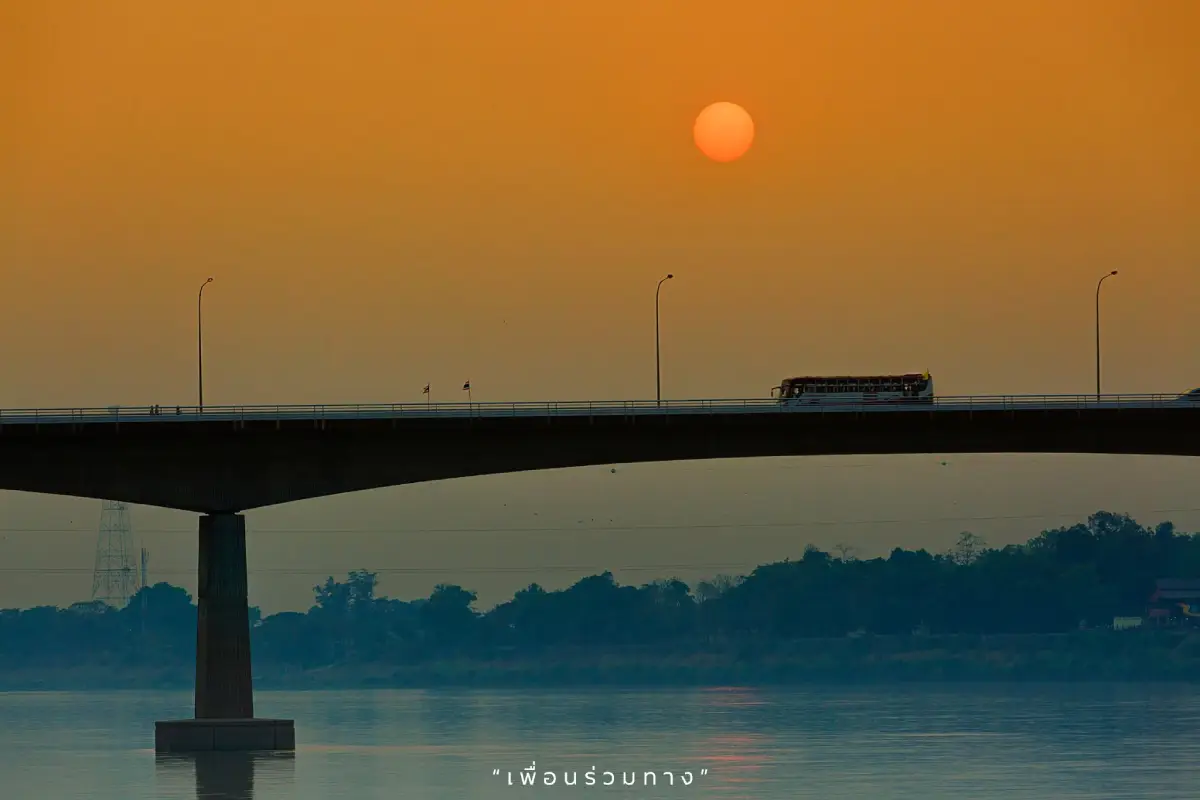
From the Thai side, the bridge stretches gracefully across the wide Mekong River. Its long concrete span, evenly spaced piers, and rows of lights create a distinctive riverside view. In the morning, the soft light reflects gently on the river surface, giving the area a calm border-town atmosphere. In the evening, the bridge becomes especially photogenic as the sky changes color and the lights along the span begin to glow. Many visitors stop here for photographs before continuing to Tha Sadet Market, Wat Pho Chai, Sala Keoku, or onward across the border to Vientiane.
The bridge officially opened on 8 April 1994 and quickly became a modern symbol of Thai–Lao friendship. Its opening strengthened Nong Khai’s role as one of Thailand’s most important border provinces. Vientiane is within convenient onward travel distance from the Lao side of the bridge, which makes this route popular among tourists who want to combine Thailand and Laos in one itinerary. A common route is to travel from Udon Thani to Nong Khai, cross the bridge through immigration, and continue by road into Vientiane.
Economically, the bridge is a major corridor for cross-border trade and transportation. It supports passenger movement, commercial vehicles, freight transport, and railway-related logistics. The connection has helped reduce travel time, increase transport reliability, and strengthen the economic relationship between Thailand, Laos, and the wider Mekong region. This explains why the bridge continues to be important not only to tourists but also to local residents, business operators, logistics companies, and government agencies on both sides of the border.
For travelers, there are 2 main ways to experience the First Thai–Lao Friendship Bridge. The first is to visit the Thai-side viewpoint, take photos, and enjoy the Mekong River scenery without crossing the border. This option is suitable for day visitors, families, and travelers exploring Nong Khai city. The second is to use the bridge as an international crossing into Laos. This requires entering the border checkpoint area, completing immigration procedures, and following the regulations of both Thailand and Lao PDR.
Travelers who plan to cross into Laos should prepare a passport, border pass, visa, or other documents according to their nationality and travel purpose. Visa rules and permitted length of stay in Laos vary by nationality and can change over time, so foreign visitors should check the latest entry requirements before departure. Those continuing to Vientiane by bus, taxi, private transfer, or rail-linked transport should also allow extra time for immigration, customs, and transfer procedures, especially during weekends and holiday periods.
The Nong Khai border checkpoint is an active official crossing, not an open recreational area. It contains immigration, customs, vehicle lanes, passenger areas, and operational zones managed by relevant authorities. Visitors should follow signs, use designated paths, and comply with instructions from officers. This is particularly important for travelers with vehicles, luggage, commercial goods, or onward reservations. Planning ahead will make the crossing smoother and reduce unnecessary delays.
The appeal of the bridge lies in how clearly it expresses the relationship between the 2 banks of the Mekong. On the Thai side is Nong Khai, a relaxed riverside province known for Isan culture, Mekong scenery, Vietnamese-influenced food, temples, and local markets. On the Lao side is the route toward Vientiane, with its temples, monuments, local markets, and colonial-era urban character. Standing on the Thai side and looking across the river, travelers can sense how geography, culture, trade, religion, language, and everyday life are closely connected along the Mekong.
The bridge also works well as the starting point for a cultural trip in Nong Khai. From the bridge area, travelers can continue to Wat Pho Chai to pay respect to Luang Pho Phra Sai, walk along the riverside at Tha Sadet Market, visit the large spiritual sculpture park at Sala Keoku, or explore the Nong Khai Aquarium at Khon Kaen University’s Nong Khai Campus. These nearby attractions make a visit to the bridge more complete, turning a simple photo stop into a meaningful route through history, belief, local life, and border-town identity.
Nong Khai is also a rewarding food destination. Around the bridge and in the city center, visitors will find Vietnamese restaurants, Isan food, Thai riverside restaurants, casual local eateries, and family-friendly dining options. The province is especially known for naem nueang and other Vietnamese-style dishes, reflecting the historical presence of Thai-Vietnamese communities in the area. Mekong fish dishes, grilled meats, papaya salad, and spicy local menus are also easy to find. A visit to the bridge can therefore be paired naturally with a local meal in town.
Accommodation options are available near the bridge, along Mittraphap Road, by the Mekong River, and in Nong Khai city center. Travelers who plan to cross the border early may prefer hotels close to the bridge or the main road to reduce travel time. Visitors who want a more relaxed riverside atmosphere may prefer to stay in the city center or near the Mekong promenade, where markets, restaurants, and evening walks are more accessible. Travelers using the railway should consider hotels with convenient access to Nong Khai Railway Station.
The best times to visit the bridge for sightseeing are early morning and late afternoon. These periods provide softer light, cooler temperatures, and better conditions for photography. Midday is more practical for border crossing than for scenic viewing, as the weather can be hot. During the rainy season, the Mekong appears broader and more powerful, while the cool season offers comfortable weather for walking around Nong Khai, visiting temples, exploring riverside markets, and viewing the bridge at sunset.
Traveling to the First Thai–Lao Friendship Bridge from Nong Khai city is straightforward. Visitors can use private cars, local taxis, tuk-tuks, or transport services heading toward the border checkpoint. The main access is via Mittraphap Road and local roads in the Mi Chai and Nong Kom Ko areas of Mueang Nong Khai District. From Nong Khai Railway Station or the bus terminal, the bridge and checkpoint are within a short local transfer. Travelers coming from Udon Thani can drive or take public transport north to Nong Khai and continue directly to the bridge area.
Getting There is easiest by private car or local transport from Nong Khai city. Visitors who only want to take photos should head to the Thai-side viewpoint or the area near the border checkpoint and park only in permitted areas. Travelers crossing into Laos should go directly to the Nong Khai border checkpoint, prepare documents in advance, and allow enough time for immigration, customs, vehicle procedures, shuttle transfers, or onward transportation to Vientiane. Extra time is recommended during long weekends and public holidays.
As a travel destination, the First Thai–Lao Friendship Bridge is ideal for visitors interested in border towns, modern history, international relations, and Mekong River travel. Its attraction is not based on entertainment facilities but on its story, scenery, and significance. It is a place where visitors can understand how one bridge can influence tourism, trade, transport, and cross-cultural contact between neighboring countries. Travelers who appreciate context will find that the bridge is far more meaningful than a simple river crossing.
For families and senior travelers, visiting the Thai-side viewpoint is a light and easy activity that does not require much time. It can be combined with Tha Sadet Market, Wat Pho Chai, and lunch in Nong Khai city within half a day. For foreign travelers, the bridge is especially useful as a practical route between Thailand and Laos. It is one of the best-known land crossings to Vientiane and is supported by transport services, border facilities, and nearby accommodation options.
Culturally, the bridge reflects the close relationship between people on both sides of the Mekong. Nong Khai and Vientiane have long been connected by trade, family visits, Buddhist traditions, food, language, and river life. The Mekong is not only a border; it is also a shared cultural landscape. The bridge makes that relationship visible, turning geography into movement and friendship into a daily reality for residents and travelers alike.
A visit to the First Thai–Lao Friendship Bridge is best understood through 3 perspectives: as a Mekong riverside landmark, as a symbol of international cooperation, and as a gateway to Laos. Travelers with limited time can stop for photos within 30 minutes to 1 hour. Those who want a deeper experience should combine the bridge with Nong Khai’s temples, markets, museums, restaurants, and cross-border travel planning. This approach reveals why Nong Khai remains one of Thailand’s most distinctive and meaningful border destinations.
In summary, the First Thai–Lao Friendship Bridge is a must-see landmark in Nong Khai for anyone interested in the Mekong River, Thai–Lao connections, or overland travel to Vientiane. It remains open and active, offers a memorable viewpoint from the Thai side, and functions as one of the region’s most important international crossings. Visitors should check operating hours, prepare documents if crossing the border, and plan nearby attractions to make the most of their time in Nong Khai.
| Name | First Thai–Lao Friendship Bridge |
| Thai Name | สะพานมิตรภาพไทย-ลาว แห่งที่ 1 |
| Location | Mueang Nong Khai District, Nong Khai Province, Thailand, connecting with the Tha Duea / Thanaleng area of Vientiane Capital, Lao PDR |
| Thai-Side Address | Nong Khai Border Checkpoint area, Mittraphap Road, Mi Chai / Nong Kom Ko area, Mueang Nong Khai District, Nong Khai 43000, Thailand |
| Coordinates | Latitude 17.8737, Longitude 102.7093 |
| Highlights | A major Mekong River bridge connecting Nong Khai and Vientiane, serving as an important landmark, border crossing, trade route, and symbol of Thai–Lao friendship |
| History | Built through cooperation between Thailand, Laos, and Australia; officially opened on 8 April 1994 |
| Distinctive Features | Approximately 1,174 meters long and 12.7 meters wide, with 2 road lanes and a central railway alignment for international rail connectivity |
| Name Origin | The name reflects friendship and cooperation between Thailand and the Lao People’s Democratic Republic |
| Travel Information | Accessible from Nong Khai city via Mittraphap Road or local riverside routes. Travelers can use private cars, local taxis, tuk-tuks, or transport services heading to the border checkpoint. |
| Current Status | Open and active as a permanent border crossing and important viewpoint in Nong Khai Province |
| Open Days | Daily |
| Opening Hours | Thai-Side Viewpoint: 06.00 – 18.00 Border Checkpoint: 06.00 – 22.00 |
| Fees | No admission fee for the Thai-side viewpoint. Border-crossing costs depend on travel documents, vehicle type, transport service, and regulations on the travel date. |
| Facilities | Border checkpoint, immigration, customs, bus and vehicle lanes, passenger waiting areas, designated parking areas, restrooms, and nearby local transport services |
| Main Areas / Zones | 1. Thai-side bridge viewpoint and Mekong riverside area 2. Nong Khai Border Checkpoint building 3. Immigration and customs areas 4. Vehicle, bus, and freight lanes 5. Central railway alignment on the bridge 6. Bridge approach and connecting roads to Nong Khai city |
| Caretaker | Nong Khai Customs Office, Nong Khai Immigration, and relevant border checkpoint authorities |
| Main Contact Number | Regional Customs Office 2 Tel. 042-411715 / Tourism Information Tel. 042-247950-2 |
| Official Website / Official Page | Immigration Bureau, Nong Khai Customs Office, CBT Thailand / DASTA |
| Nearby Tourist Attractions | 1. Thai-Side Friendship Bridge Viewpoint, about 1 km 2. Nong Thin Public Park, about 4 km 3. Tha Sadet Market, about 5 km 4. Prap Ho Monument, about 5 km 5. Wat Pho Chai and Luang Pho Phra Sai, about 6 km 6. Sala Keoku, about 10 km 7. Nong Khai Aquarium, about 14 km, Tel. 042-415623 |
| Nearby Restaurants | 1. Hug Paeng Nong Khai, about 1 km, Tel. 087-457-1819 2. Refill Bar & Restaurant, about 2 km, Tel. 097-302-6090, 098-296-0728 3. Daeng Namnuang Nong Khai, about 6 km, Tel. 042-421-202 4. Macky’s Riverside Kitchen, about 6 km, Tel. 097-109-1022 5. Chai Khong Restaurant, about 6 km, Tel. 042-412-308 |
| Nearby Accommodations | 1. Panlaan Boutique Resort Nongkhai, about 1 km, Tel. 080-408-7289 2. Royal Nakhara Hotel & Convention Centre Nongkhai, about 2 km, Tel. 042-422-889 3. Park & Pool Resort, about 4 km, Tel. 088-568-2300 4. HOP INN Nong Khai, about 5 km, Tel. 042-413-599 5. Amanta Hotel Nongkhai, about 6 km, Tel. 042-412-899 6. Royal Jomanee Heritage Hotel, about 7 km, Tel. 042-465-777 |
Frequently Asked Questions (FAQ)
Q: Is the First Thai–Lao Friendship Bridge still open?
A: Yes. The bridge and border checkpoint remain active. The border checkpoint operates daily from 06.00 to 22.00, while the Thai-side viewpoint is open from 06.00 to 18.00.
Q: Is there an admission fee to visit the bridge viewpoint?
A: No. There is no admission fee for viewing the bridge from the Thai side. However, border-crossing costs may apply depending on travel documents, transport services, vehicles, and regulations on the travel date.
Q: What areas does the First Thai–Lao Friendship Bridge connect?
A: It connects Mueang Nong Khai District in Nong Khai Province, Thailand, with the Tha Duea / Thanaleng area of Lao PDR, which leads onward to Vientiane Capital.
Q: What documents are needed to cross into Laos?
A: Travelers need a passport, border pass, visa, or other required documents according to their nationality and travel purpose. Foreign travelers should check the latest Lao entry requirements before departure.
Q: What makes the First Thai–Lao Friendship Bridge important?
A: It is important as a Mekong River landmark, a major international border crossing, a road and rail connection, and a symbol of Thai–Lao cooperation in travel, trade, society, and culture.
Q: When is the best time to visit the bridge?
A: Early morning and late afternoon are best for sightseeing and photography because the weather is cooler and the light is softer, especially around sunset when the bridge lights reflect on the Mekong River.
Q: What attractions can be combined with a visit to the bridge?
A: Travelers can combine the bridge with Tha Sadet Market, Wat Pho Chai, Prap Ho Monument, Sala Keoku, Nong Thin Public Park, and Nong Khai Aquarium.
 Category: ●Art, Culture and Heritage
 Group: ●Landmarks and Memorials
Last Update : 2 MonthAgo
 Last Update : 2 MonthAgo
 Click to Access the Navigation Map GPS
First Thai–Lao Friendship Bridge Map
Recommend

 Historical Sites and Monuments(1)
Landmarks and Memorials(2)
Historical Sites and Monuments(1)
Landmarks and Memorials(2)
 Art, Craft Centres, Tradition(1)
 Educational Places
 Educational Gardens, Farm(1)
 Places of Worship
 Temple(16)
 Mosque(1)
 Other Sacred Sites(8)
 Suburban Living
 Village, Community(3)
 Local Market(4)
 Nature and Wildlife
 National Parks and Marine Reserves(2)
 Dam, Reservoir, Lake(2)
 Waterfalls(4)
 River, Canal(8)
 Bays and Beaches(1)
 Entertainment and Agricultural
 Farms, Parks and Ecotourism(2)
 Shopping
 Shopping and Night Market(1)


