
lovethailand home >Northeastern Travel Attractions >Nong Bua Lamphu Travel Attractions >Na Klang >Na Klang > Tak Bat Devo Rohana
TL;DR: Tak Bat Devo Rohana, Nong Bua Lamphu attractions : Art, Culture and Heritage, Art, Craft Centres, Tradition.
Tak Bat Devo Rohana
Open Days: The temple is open daily for worship / The Tak Bat Devo ceremony is held annually on the 1st waning day of the 11th lunar month, one day after the End of Buddhist Lent
Opening Hours: The main almsgiving ceremony usually begins in the morning, around 07.00 onward
Tak Bat Devo Rohana in Nong Bua Lam Phu is one of the province’s most meaningful Buddhist merit-making traditions. The ceremony is especially associated with Wat Santi Tham Banphot, also known as Wat Phu Noi, in Na Klang District. This hilltop temple provides a natural setting that fits the symbolic meaning of the event: the descent of the Buddha from the heavenly realm back to the human world. When monks walk down from Phu Noi to receive alms from devotees waiting below, the landscape itself becomes part of the ritual. The ceremony is held on the 1st waning day of the 11th lunar month, one day after the End of Buddhist Lent, and is dedicated to honoring the Buddha’s virtues and commemorating the moment when he returned from Tavatimsa Heaven after teaching the Dhamma to his mother.
The term “Devo Rohana” means descent from the heavenly world. In Buddhist tradition, it refers to the episode in which the Buddha descended from Tavatimsa Heaven after spending the rainy season there and teaching the Dhamma to his mother. Devotees celebrate this return by offering alms to monks as an act of faith and gratitude. For this reason, Tak Bat Devo is not just an ordinary morning almsgiving. It is a ritual filled with Buddhist narrative, symbolism, procession, and collective devotion. The images of a Buddha statue, monks, celestial figures, and laypeople waiting respectfully with offerings all help turn a doctrinal story into a living cultural experience.
In Nong Bua Lam Phu, Wat Santi Tham Banphot or Wat Phu Noi is one of the most distinctive places to witness this tradition. The temple stands on Phu Noi, a small hill in Na Klang District, with stairs and pathways that allow the ceremony to recreate the image of monks descending from above. This physical setting gives the event a vivid ceremonial quality. Visitors do not only see monks walking along a flat road; they see a symbolic descent from a sacred hill, echoing the Buddhist belief in the Buddha’s descent from heaven. The relationship between the ceremony and the landscape is what makes the Nong Bua Lam Phu version especially memorable.
Wat Santi Tham Banphot is also culturally important because it contains a sacred footprint and ancient sandstone boundary stones. These features show that the site has long carried religious and cultural significance. The boundary stones, or sema stones, mark sacred space in Buddhist tradition and connect the temple area with older layers of religious history. When the Tak Bat Devo ceremony takes place in this setting, the event gains additional depth. It is not simply a modern religious gathering, but a ceremony performed in a place where Buddhist devotion, archaeology, local memory, and community identity overlap.
The main purpose of the ceremony is to remember the Buddha’s compassion and spiritual greatness. According to Buddhist belief, the Buddha did not teach only human beings. He also taught celestial beings and his mother in heaven. His return to the human world was therefore a moment of joy for humans and deities alike. Buddhists commemorate this event by offering food and other necessities to monks. The act of giving becomes a form of gratitude to the Buddha, respect for the Dhamma, and support for the Sangha. It also reminds participants of generosity, gratitude, humility, and the continuity of Buddhist faith.
The day is sometimes called the day when the Buddha opened the worlds. In Buddhist imagination, the descent from heaven is connected with the opening of the three worlds, allowing beings in different realms to perceive one another. This idea gives the ceremony a powerful spiritual atmosphere. People who come to offer alms are not simply making merit for personal benefit. They are joining a ritual that recalls a cosmic moment in Buddhist tradition, when the Buddha’s radiance connected heaven, earth, and other realms.
The ceremony usually begins with the preparation of a Buddha statue procession. A standing Buddha image, especially the posture of holding an alms bowl, is preferred because it corresponds with the meaning of almsgiving and descent from heaven. The image may be placed on a ceremonial vehicle, carried on a palanquin, or respectfully carried by lay devotees. This Buddha image leads the procession, followed by monks and sometimes by participants dressed as celestial beings, Indra, and heavenly attendants. The procession transforms the story of the Buddha’s descent into a visible ritual that people of all ages can understand.
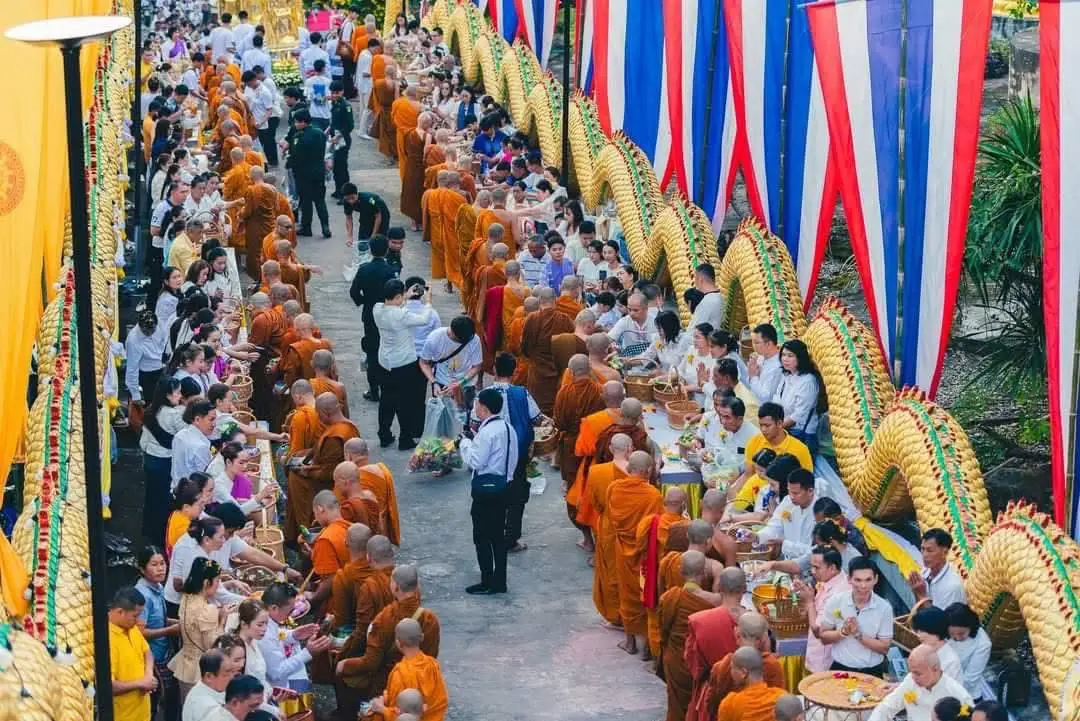
After the Buddha image procession, monks walk down from the upper area of Phu Noi to receive alms. This descent is the central visual moment of the ceremony. Devotees line the path or gather in the almsgiving area below, holding rice, dried food, water, fruit, sweets, and symbolic offerings. In Nong Bua Lam Phu, the stairs and slope of Wat Phu Noi help create the feeling of a sacred descent. The movement of the monks from the hilltop to the lower courtyard gives the ritual a strong sense of place and meaning.
One of the most important symbols of Tak Bat Devo is khao tom luk yon, a small parcel of sticky rice wrapped in leaves. Traditionally, because crowds gathered in large numbers and not everyone could stand close to the monks, these small rice parcels could be offered by tossing them carefully into the alms bowls or toward the procession. Over time, khao tom luk yon became a distinctive symbol of the ceremony throughout Thailand. In Nong Bua Lam Phu, preparing these rice parcels is also part of family and community practice. Elders pass down the method of wrapping them, while younger generations learn the meaning of the tradition through participation.
The food prepared for almsgiving usually includes rice, dried food, cooked dishes, fruit, drinking water, sweets, and useful items for monks. However, the deeper value of the ceremony lies in the devotion behind the offerings. Many families prepare their alms the night before. Some wrap khao tom luk yon together at home. Others prepare flowers, garlands, and simple offerings. People wake early, dress respectfully, and travel to the temple together. Through these actions, the ceremony becomes more than an individual act of merit. It becomes a shared religious experience involving families, neighbors, monks, and the wider community.
Dhamma preaching is also an important part of the event. After the almsgiving, devotees may listen to a sermon explaining the meaning of the End of Buddhist Lent, the Buddha’s descent from heaven, generosity, gratitude, and moral practice. This helps the ceremony move beyond the physical act of giving food. Participants are invited to reflect on the Dhamma and apply Buddhist teachings in daily life. In this sense, Tak Bat Devo combines generosity, ethical discipline, and spiritual reflection.
The Buddhist narrative procession is one of the most memorable features of the Nong Bua Lam Phu ceremony. Participants may dress as celestial beings, Indra, and attendants, while the Buddha image is carried down from Phu Noi. These elements are not merely decorative. They help communicate the Buddhist story visually, especially to children and young visitors. Instead of learning only from a text, they see the story represented in movement, costume, sound, and space. This is one reason the tradition remains powerful as a form of cultural education.
At the community level, the ceremony brings together many groups. The temple, Ban Phu Noi community, Na Klang Municipality, local administrative organizations, government officers, village leaders, merchants, devotees, and visitors all take part. Each group has a role in preparing the area, organizing the procession, arranging the monks’ route, managing almsgiving lines, welcoming participants, and preserving order. The large number of participants shows that Tak Bat Devo is not only a religious ritual but also an expression of community unity.
The ceremony also supports cultural tourism in Nong Bua Lam Phu. Visitors who attend the event can experience Buddhist devotion, the hilltop landscape of Wat Phu Noi, ancient sema stones, a sacred footprint, and the atmosphere of Na Klang during the Buddhist Lent season. A visit to the ceremony can be combined with nearby attractions, local food, and accommodation in Na Klang or Nong Bua Lam Phu town. This makes the tradition meaningful for both pilgrims and cultural travelers.
Phu Noi itself is an important part of the experience. It is a small hill in Ban Phu Noi, Na Klang Subdistrict, with steps leading up to the temple area. On ordinary days, walking up the stairs feels like a simple pilgrimage route. On the morning of Tak Bat Devo, the same stairs become the ceremonial path of descent. As monks and the Buddha image procession move down from the hill, the space becomes a living symbol of the Buddha’s return from heaven. This direct relationship between ritual and landscape is what gives the ceremony its special identity.
The ancient sandstone sema stones at Phu Noi add a historical layer to the visit. In Buddhist tradition, sema stones mark sacred boundaries. Their presence at Wat Santi Tham Banphot indicates that the area has long been connected with religious practice and sacred space. Visitors who attend the almsgiving ceremony and then walk to see these traces can understand the temple as more than a modern ritual site. It is a cultural landscape with historical depth.
Visitors should arrive early because the main ceremony is usually held in the morning. Arriving before the procession begins allows enough time to prepare offerings, choose a suitable place to stand, and observe the atmosphere respectfully. Clothing should be modest and appropriate for a religious site. White or simple-colored clothing is suitable. Offerings should be easy to place into the alms bowls and should not spill or break easily. Families traveling with children or elderly visitors should choose a safe and less crowded position.
Respectful behavior is essential. Do not walk across the monks’ path, do not push forward in the almsgiving line, do not place offerings in a disorderly way, and do not disturb people who are praying. Visitors should avoid using flash photography too close to monks or ritual participants. Trash should be disposed of properly, and instructions from temple staff or local officers should be followed. Because the ceremony attracts many people, order and patience help preserve the beauty of the event.
Photography is possible, but it should be done with cultural sensitivity. Good viewpoints include the stairs where monks descend, the almsgiving area where people line up with offerings, the Buddha image procession, and the wider scene of the temple and hill. The best photographs are those that show calmness, faith, and community participation. Avoid inappropriate poses or obstructing the procession. A respectful approach will produce images that represent the ceremony well.
Getting There to Wat Santi Tham Banphot or Wat Phu Noi is most convenient by private car. From Nong Bua Lam Phu town, take Highway 210 toward Na Klang District. From Na Klang town, continue to Ban Phu Noi and the temple area, about 2 km from the district center. On the ceremony day, allow extra time for traffic, parking, and walking to the almsgiving area because many devotees arrive early. Travelers coming from Udon Thani, Loei, or nearby provinces can also use Highway 210 to reach Nong Bua Lam Phu and Na Klang.
Those who plan to attend the ceremony should consider staying in Na Klang the night before, especially if they want to arrive before the procession. Staying near the district center makes it easier to reach the temple in the morning. Travelers who prefer more accommodation options may stay in Nong Bua Lam Phu town and drive to Na Klang early. After the ceremony, nearby cultural stops such as the Phu Noi archaeological area, Wat Tham Pha Cho, Wat Phra That Mueang Phin, and other local attractions can be added to the itinerary.
There is no mandatory admission fee for the Tak Bat Devo ceremony. Participants may prepare food, dried goods, khao tom luk yon, offerings, or donations according to their faith. Personal expenses may include food, drinks, local products, or transport. The ceremony itself is a public merit-making event centered on Buddhist devotion and community participation.
The event area can be understood in several zones: the upper Phu Noi temple area where the procession begins, the stairway and descent route used by monks, the lower almsgiving area, the Buddha image procession zone, the area for worshipping the sacred footprint and ancient sema stones, the sermon and merit-making area, and service zones such as parking, information points, food stalls, or community product areas depending on each year’s arrangement. Understanding these zones helps visitors move respectfully and avoid blocking the procession.
The main caretakers of the tradition include Wat Santi Tham Banphot, Ban Phu Noi community, Na Klang Municipality, and local government agencies in Na Klang District. Public information identifies Phra Athikan Patonrit Khamphirapanyo, also known as Phra Ajarn Nueng, as the abbot of Wat Santi Tham Banphot. Group visitors should contact the temple or Na Klang Municipality in advance to confirm the annual schedule, parking arrangements, and practical instructions for the ceremony.
Restaurants are available mainly in Na Klang town, only a short drive from Wat Phu Noi. After the morning ceremony, visitors can stop at nearby cafés and restaurants such as Ohana Cafe at Naklang, Ao Thai Naklang Seafood, In-chan Pizza, Somtam Pak Pla Daek, Marada Naklang, or Racha Bamee Kwangtung Na Klang Branch. Since restaurant hours may change during holidays or festivals, travelers should check directly before visiting.
Accommodation near Na Klang includes small resorts and local stays. Sakaethong Resort and Sabaidee Resort are practical choices for visitors who want to stay close to the ceremony area. Travelers who prefer more accommodation options may stay in Mueang Nong Bua Lam Phu at places such as Ruean Thong Resort, 39000 Resort, or Phu Fa Resort, then drive to Na Klang early in the morning. The best choice depends on whether the priority is being close to the ceremony or having more city facilities.
For foreign visitors, Tak Bat Devo Rohana in Nong Bua Lam Phu can be understood as a Buddhist almsgiving ceremony held after the End of Buddhist Lent. Its special feature is the hilltop setting of Wat Phu Noi, where monks descend from the temple above to receive alms from people below. This makes the meaning of the ceremony visible even for those unfamiliar with Thai Buddhist tradition. The ceremony combines faith, community, local culture, and landscape in a way that is easy to observe and deeply meaningful.
In summary, Tak Bat Devo Rohana in Nong Bua Lam Phu is one of the most memorable religious traditions in the province. It offers visitors the chance to make merit, observe a living Buddhist ceremony, see a symbolic procession, learn about khao tom luk yon, and experience the cultural importance of Wat Santi Tham Banphot. With early arrival, respectful behavior, and enough time to observe both the ceremony and the temple landscape, the event becomes a meaningful experience of Buddhist faith and local culture in northeastern Thailand.
| Tradition / Main Venue | Tak Bat Devo Rohana, Nong Bua Lam Phu, at Wat Santi Tham Banphot (Wat Phu Noi) |
| Location | Ban Phu Noi, Na Klang Subdistrict, Na Klang District, Nong Bua Lam Phu Province |
| Address | Wat Santi Tham Banphot (Wat Phu Noi), Na Klang Subdistrict, Na Klang District, Nong Bua Lam Phu Province 39170 |
| Coordinates | 17.295413, 102.187742 |
| Period | The 1st waning day of the 11th lunar month every year, one day after the End of Buddhist Lent |
| Ceremony Time | Morning ceremony, usually from around 07.00 onward |
| Admission Fee | No mandatory admission fee; visitors may prepare alms, offerings, or donations according to their faith |
| Significance | A Buddhist merit-making ceremony commemorating the Buddha’s descent from Tavatimsa Heaven after teaching the Dhamma to his mother |
| Main Rituals | 1. Buddha image procession leading the monks 2. Use of a standing Buddha image, especially the posture of holding an alms bowl 3. Monks descend from Phu Noi to receive alms 4. Devotees offer rice, dried food, and khao tom luk yon 5. Dhamma preaching and Buddhist merit-making activities |
| Highlights | Symbolic Buddha image procession, monks descending from Phu Noi, khao tom luk yon offerings, and a hilltop temple setting with a sacred footprint and ancient sema stones |
| Current Status | Still held as an annual Buddhist tradition of Wat Phu Noi and Na Klang District, with strong participation from the community, local authorities, and devotees |
| Travel Information | From Nong Bua Lam Phu town, take Highway 210 toward Na Klang District, then continue from Na Klang town to Ban Phu Noi and Wat Santi Tham Banphot, about 2 km from the district center |
| Main Areas / Zones | 1. Upper Phu Noi temple area and procession starting point 2. Stairway and descent route from Phu Noi 3. Lower almsgiving courtyard 4. Buddha image and Buddhist narrative procession zone 5. Sacred footprint and ancient sema stone worship area 6. Dhamma preaching and merit-making area 7. Parking, information, and community service areas |
| Caretakers | Wat Santi Tham Banphot, Ban Phu Noi community, Na Klang Municipality, and local government agencies in Na Klang District |
| Abbot | Phra Athikan Patonrit Khamphirapanyo (Phra Ajarn Nueng) |
| Main Contact Numbers | Wat Santi Tham Banphot Tel. 084-175-3613 Na Klang Municipality Tel. 0-4235-9044 Nong Bua Lam Phu Local Natural and Cultural Environment Conservation Unit Tel. 084-775-2716 |
| Nearby Tourist Attractions | 1. Phu Noi Archaeological Area / Ancient Sema Stones at Wat Santi Tham Banphot, about 0 km, Tel. 084-175-3613 2. Na Klang Municipality Tourist Service Center, about 2 km, Tel. 0-4235-9044 3. Tham Pha Cho, about 9 km 4. Wat Phra That Mueang Phin, about 18 km 5. Shrine of King Naresuan the Great, Nong Bua Lam Phu, about 39 km 6. 150-Million-Year-Old Shell Fossil and Dinosaur Museum at Non Than, about 45 km |
| Nearby Restaurants | 1. Ohana Cafe at Naklang, about 3 km, Tel. 081-423-8667 2. Ao Thai Naklang Seafood, about 3 km, Tel. 089-002-1717 3. In-chan Pizza, about 3 km, Tel. 098-208-4331, 084-428-3255 4. Somtam Pak Pla Daek, about 4 km, Tel. 083-358-7956 5. Marada Naklang, about 4 km, Tel. 096-319-4954 6. Racha Bamee Kwangtung Na Klang Branch, about 3 km, Tel. 093-328-8779 |
| Nearby Accommodations | 1. Sakaethong Resort, Na Klang District, about 4 km, Tel. 089-861-4433, 083-328-6744 2. Sabaidee Resort, Na Klang District, about 5 km, Tel. 083-407-4953 3. Ruean Thong Resort, Mueang Nong Bua Lam Phu District, about 40 km, Tel. 089-572-4880 4. 39000 Resort, Mueang Nong Bua Lam Phu District, about 41 km, Tel. 042-313-109 5. Phu Fa Resort, Mueang Nong Bua Lam Phu District, about 42 km, Tel. 042-311-866 |
Frequently Asked Questions (FAQ)
Q: When is Tak Bat Devo Rohana in Nong Bua Lam Phu held?
A: It is held on the 1st waning day of the 11th lunar month every year, one day after the End of Buddhist Lent. The main ceremony usually begins in the morning around 07.00 onward.
Q: Where is the main venue?
A: The main venue is Wat Santi Tham Banphot, also known as Wat Phu Noi, in Ban Phu Noi, Na Klang Subdistrict, Na Klang District, Nong Bua Lam Phu Province.
Q: Why is Tak Bat Devo Rohana important?
A: It commemorates the Buddha’s descent from Tavatimsa Heaven after teaching the Dhamma to his mother and preserves an important Buddhist tradition of merit-making and gratitude.
Q: What is khao tom luk yon?
A: Khao tom luk yon is a small sticky-rice parcel wrapped in leaves. It is a symbolic offering associated with Tak Bat Devo and is traditionally prepared for almsgiving during the ceremony.
Q: Is there an admission fee?
A: No mandatory admission fee is required. Visitors may prepare food, dried goods, khao tom luk yon, offerings, or donations according to their faith.
Q: What should visitors wear?
A: Visitors should dress modestly and respectfully. Comfortable footwear is recommended because the temple area includes stairs and hill paths.
Q: What makes the Wat Phu Noi ceremony distinctive?
A: The distinctive feature is the sight of monks descending from Phu Noi to receive alms, together with a symbolic Buddha image procession, a Buddhist narrative procession, a sacred footprint, and ancient sema stones.
Q: What nearby places can be visited after the ceremony?
A: Nearby places include the Phu Noi archaeological area, Tham Pha Cho, Wat Phra That Mueang Phin, the Shrine of King Naresuan the Great, and the 150-Million-Year-Old Shell Fossil and Dinosaur Museum at Non Than.
 Category: ●Art, Culture and Heritage
 Group: ●Art, Craft Centres, Tradition
Last Update : 2 MonthAgo
 Last Update : 2 MonthAgo
 Historical Sites and Monuments(4)
 Landmarks and Memorials(1)
Art, Craft Centres, Tradition(1)
Landmarks and Memorials(1)
Art, Craft Centres, Tradition(1)
 Museums(3)
 Places of Worship
 Temple(10)
 Other Sacred Sites(6)
 Suburban Living
 Village, Community(3)
 Nature and Wildlife
 National Parks and Marine Reserves(3)
 Mountain (Doi)(5)
 Dam, Reservoir, Lake(5)
 Waterfalls(1)
 Caves(6)
 River, Canal(2)
 Bays and Beaches(1)
 Other natural attractions(3)
 Travel Articles, Recipes
 Travel Review, Food Review(1)


