
lovethailand home >Northeastern Travel Attractions >Nong Bua Lamphu Travel Attractions >Muang Nong Bua Lamphu >Ban Kham > Wat Phra That Han Thao
TL;DR: Wat Phra That Han Thao is located at Ban That Han Thao, Ban Kham Subdistrict, Mueang Nong Bua Lam Phu District, Nong Bua Lam Phu Province, open Daily, hours 08.00 – 17.00.
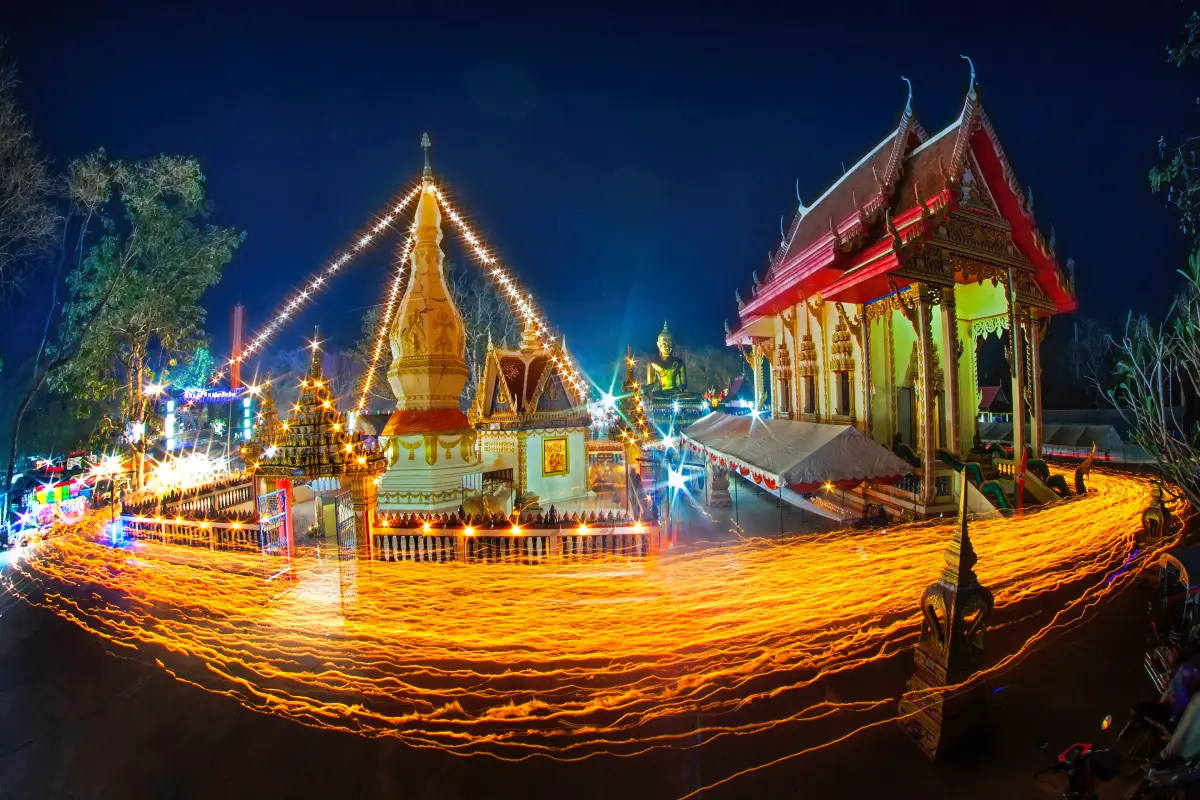
Wat Phra That Han Thao
Open Days: Daily
Opening Hours: 08.00 – 17.00
Wat Phra That Han Thao in Nong Bua Lam Phu Province is a historic Buddhist temple in Ban That Han Thao, Ban Kham Subdistrict, Mueang Nong Bua Lam Phu District. The temple is deeply respected by the local community and is known for its octagonal brick-and-stucco stupa, ancient brick remains, and the annual Phra That Han Thao worship tradition held on the full moon day of the third lunar month. This temple is suitable for travelers who want to pay respect to a local sacred stupa, learn about a registered historic site, and experience the quiet spiritual life of a community temple in northeastern Thailand.
Wat Phra That Han Thao is located in Ban That Han Thao, Ban Kham Subdistrict, Mueang Nong Bua Lam Phu District, Nong Bua Lam Phu Province, 39000. The temple stands within a local community that has long been connected with the sacred stupa. From Mueang Nong Bua Lam Phu, the temple can be reached by car within a short trip and can be included in a cultural route together with Wat Tham Klong Phen, King Naresuan Shrine, Wat Si Khun Mueang, Thao To Waterfall Forest Park, and the 150 Million Year Old Stone Shell Museum. The temple is not a large commercial tourist attraction; its value lies in the continuity of local faith, archaeological remains, sacred architecture, and living tradition.
The central feature of the temple is the octagonal Phra That stupa. The stupa is built of brick and covered with stucco. Its base is octagonal, followed by high lotus moulding layers. The central body rises in an octagonal conical form and continues into an octagonal upper section. The whole stupa is finished in a soft pale yellow tone and decorated with low-relief stucco patterns, including floral motifs, traditional kanok designs, and garland forms painted in white. This form gives the stupa a distinctive appearance and reflects local craftsmanship that combines structure, symbolism, and sacred ornamentation.
The history of Wat Phra That Han Thao goes back to around B.E. 2328. It was originally a Dhammayut temple, but after a period without proper care, it became abandoned. Later, Phra Maha Sutan Sutano restored the temple and re-established it as a Mahanikaya temple around B.E. 2460, naming it Wat That Han Thao. This restoration allowed the sacred site to return to its role as a center of worship for the local community. The temple’s history shows how a sacred place can pass through periods of decline and revival, yet continue to remain meaningful through community faith and monastic care.
The name Han Thao is closely connected with Ban That Han Thao and the sacred stupa itself. The temple name therefore reflects the relationship between the village, the temple, and the Phra That. For the local community, the temple is not simply a religious compound; it is a landmark of collective memory and devotion. The name Wat Phra That Han Thao or Wat That Han Thao points directly to the sacred stupa that has shaped the spiritual identity of the village for generations.
The registered historic elements of the temple include the octagonal stupa and ancient brick remains. The site was officially registered and its historic boundary was defined in the Royal Gazette, Volume 116, Special Section 7 Ngor, dated 22 January B.E. 2542, covering an area of approximately 4 rai and 2 square wah. This registration gives Wat Phra That Han Thao formal significance as a historic site of Nong Bua Lam Phu Province. It is therefore not only a local temple for worship, but also an important cultural and archaeological site that deserves careful preservation.
The ancient brick remains inside the temple compound add another layer of historical meaning. They suggest older phases of religious use, construction, repair, and transformation. Visitors should treat these remains with respect. They should not climb, touch, move, or disturb ancient materials. These remains are not decorative objects; they are evidence of the temple’s past and part of the cultural memory of Ban Kham and Nong Bua Lam Phu.
The octagonal form of the Phra That is especially interesting for travelers who enjoy Buddhist architecture. Its octagonal base, rising lotus mouldings, conical body, pale stucco surface, and decorative motifs create a balanced sacred form. Walking slowly around the stupa allows visitors to see how the structure changes from each angle. The details are modest but meaningful. The floral and kanok stucco patterns show how local artisans used decorative language to express beauty, devotion, and sanctity.
Wat Phra That Han Thao is also important because it remains a place of worship for the local people. Every year, the community holds the Phra That Han Thao worship festival on the full moon day of the third lunar month. This annual event is a major religious tradition of Ban Kham Subdistrict. Local people come to pay respect to the sacred stupa, make merit, offer worship, and take part in the community’s inherited religious customs. The event transforms the quiet temple into a living center of faith, memory, and local identity.
The annual worship tradition reflects the Isan way of making merit in the third lunar month. The atmosphere combines Buddhist devotion, local gathering, offerings, and respect for the sacred stupa. Visiting on an ordinary day gives travelers a peaceful experience, while visiting during the annual festival shows the temple at its most active and communal. The festival is one of the clearest signs that Wat Phra That Han Thao is not merely an old monument, but a living sacred place that continues to shape community life.
The temple has undergone several important restoration efforts. In B.E. 2514, the temple repaired the wall around the stupa using brick and stucco and laid tiles around the stupa area. In B.E. 2530, Chao Athikan Bunna Tantikaro, the abbot named in the restoration record, repaired the stupa itself. These restoration works helped preserve the sacred monument so that local people could continue to worship and hold annual ceremonies around it. Without such care, the stupa and its surrounding area would not have retained the role they still have today.
A visit to Wat Phra That Han Thao connects travelers with both devotion and heritage preservation. The temple functions on several levels at once. It is a place for worship, a site of Buddhist art, a registered historic site, a space for annual tradition, and a symbol of the Ban That Han Thao community. Understanding these roles makes the visit more meaningful. The temple is best appreciated not as a quick photo stop, but as a compact cultural site where faith, history, and local identity are closely linked.
Important areas inside the temple include the octagonal Phra That stupa, the ancient brick remains, the open area around the stupa, the religious activity area, and the space used during the annual worship festival. Visitors should begin by paying respect to the stupa, then walk slowly around the area to observe the octagonal form, stucco patterns, and brick remains. Because the temple remains a sacred place for the community, all walking and photography should be done respectfully.
The atmosphere of Wat Phra That Han Thao is calm, simple, and local. It does not rely on grand scale or heavy decoration to impress visitors. Its charm comes from its sincerity as a community temple and the long continuity of faith surrounding the Phra That. Morning and late afternoon are good times to visit because the light makes the form of the stupa easier to see and the temperature is more comfortable for walking around the compound.
For travelers interested in local history, the temple offers a valuable example of how Buddhist sacred places in rural Isan can change over time. Wat Phra That Han Thao began as an old temple, became abandoned, and was later restored into an active Mahanikaya temple. This pattern reveals the changing life of community temples in northeastern Thailand. Some temples do not remain unchanged forever. They may flourish, decline, become deserted, and return again through the effort of monks and villagers. Wat Phra That Han Thao is an important example of that continuity.
Visitors should dress modestly when entering the temple. Shirts with sleeves and appropriate trousers or skirts are recommended. Hats should be removed in worship areas, and visitors should avoid loud voices. It is important not to climb on the stupa, touch stucco ornaments, or disturb ancient remains. The temple is still used by the community for religious activities, especially during the annual festival, so respectful behavior helps protect both the sacred atmosphere and the historic fabric of the site.
Getting There is convenient by private car from Mueang Nong Bua Lam Phu. Travelers can follow the route to Ban Kham Subdistrict and use the temple name or the coordinates 17.135825, 102.449524 in a navigation app. Those coming from Udon Thani can enter Nong Bua Lam Phu town first and continue toward Ban Kham. Travelers coming from Loei or nearby provinces can also use Mueang Nong Bua Lam Phu as the main starting point before heading to the temple. The route is suitable for a half-day cultural visit or for combining with other attractions in the district.
A good one-day itinerary can begin with Wat Phra That Han Thao in the morning, allowing enough time to worship the stupa and observe its architecture. From there, travelers can continue to Wat Tham Klong Phen or King Naresuan Shrine, then have lunch in Mueang Nong Bua Lam Phu. In the afternoon, the route can continue to the 150 Million Year Old Stone Shell Museum or Thao To Waterfall Forest Park. This combination gives visitors a balanced experience of Buddhist heritage, local history, natural scenery, and provincial culture.
The best time to visit is in the morning or late afternoon. The temple is open daily from 08.00 to 17.00. For travelers who want to experience the living tradition of the temple, the full moon day of the third lunar month is especially important because it is the time of the annual Phra That Han Thao worship festival. During the festival, the temple becomes more active, with local people gathering to make merit and pay respect to the sacred stupa.
Wat Phra That Han Thao is suitable for merit-making travelers, history lovers, photographers interested in local Buddhist architecture, families, students, and visitors who want to learn about community traditions in Nong Bua Lam Phu. Its strength is not size, but depth. Within a compact temple compound, travelers can find a revered stupa, registered ancient remains, local craftsmanship, community faith, and an annual festival that continues to connect people with the sacred site.
From an educational point of view, the temple is a strong example of how belief and archaeology can exist together. The stupa is a sacred object of worship, but it is also a work of Buddhist art with a clear architectural form. The brick remains are archaeological evidence. The annual worship festival is living cultural heritage. Together, these three dimensions make Wat Phra That Han Thao valuable for travelers who want to understand Isan temples beyond surface-level sightseeing.
Visitors should help maintain the cleanliness and peacefulness of the temple. Food and drinks should be kept away from ancient remains. Litter should not be left anywhere in the temple compound. During festival days, visitors should be especially mindful of crowds, religious activities, and community space. Respectful behavior ensures that the temple remains a place of worship, learning, and cultural continuity for both local people and visitors.
In summary, Wat Phra That Han Thao is one of the meaningful cultural and spiritual sites of Ban Kham Subdistrict and Nong Bua Lam Phu Province. It has a history dating back to around B.E. 2328, was restored around B.E. 2460, underwent later restoration works in B.E. 2514 and B.E. 2530, and was registered as a historic site in B.E. 2542. Its octagonal stupa, ancient brick remains, local worship tradition, and annual third-lunar-month festival make it an important destination for travelers seeking a deeper understanding of Nong Bua Lam Phu’s Buddhist heritage.
| Name | Wat Phra That Han Thao |
| Location | Ban That Han Thao, Ban Kham Subdistrict, Mueang Nong Bua Lam Phu District, Nong Bua Lam Phu Province |
| Address | Ban Kham Subdistrict, Mueang Nong Bua Lam Phu District, Nong Bua Lam Phu Province 39000, Thailand |
| Coordinates | 17.135825, 102.449524 |
| Highlights | Octagonal Phra That stupa, ancient brick remains, low-relief stucco decoration, and the annual Phra That Han Thao worship festival on the full moon day of the third lunar month |
| History | The temple dates back to around B.E. 2328. It was originally a Dhammayut temple, later became abandoned, and was restored by Phra Maha Sutan Sutano as a Mahanikaya temple around B.E. 2460 |
| Name Origin | The name is linked with Ban That Han Thao and the sacred Phra That stupa, reflecting the community’s devotion to this important religious landmark |
| Distinctive Features | Brick-and-stucco octagonal stupa with a conical body, pale yellow surface, white stucco motifs, floral designs, kanok patterns, and garland decoration |
| Registered Historic Elements | 1. Octagonal Phra That stupa 2. Ancient brick remains |
| Historic Registration | Registered and its historic boundary defined in the Royal Gazette, Volume 116, Special Section 7 Ngor, dated 22 January B.E. 2542, covering about 4 rai and 2 square wah |
| Travel Information | Accessible from Mueang Nong Bua Lam Phu by private car, local transport, or hired vehicle. Use the temple name or coordinates 17.135825, 102.449524 for navigation |
| Current Status | An active sacred site and registered cultural heritage location respected by the local community, with an annual Phra That Han Thao worship festival |
| Open Days | Daily |
| Opening Hours | 08.00 – 17.00 |
| Facilities | Temple courtyard, worship area around the stupa, religious activity space, parking area, and walking points for observing the historic remains |
| Main Areas / Zones | 1. Octagonal Phra That stupa 2. Ancient brick remains 3. Courtyard around the stupa 4. Religious activity area 5. Area used for the annual Phra That Han Thao worship festival |
| Abbot Information Found in Restoration Records | Chao Athikan Bunna Tantikaro is named in the record of the stupa restoration in B.E. 2530 |
| Important Tradition | Annual Phra That Han Thao worship festival, held on the full moon day of the third lunar month |
| Official Website / Related Page | Wat That Han Thao, Mueang Nong Bua Lam Phu Facebook page |
| Nearby Tourist Attractions | 1. Wat Tham Klong Phen, about 10 km 2. King Naresuan Shrine, about 12 km 3. Nong Bua Lake and Old Town Area, about 12 km 4. Wat Si Khun Mueang, about 13 km 5. Thao To Waterfall Forest Park, about 15 km 6. 150 Million Year Old Stone Shell Museum and Non Than Dinosaur Park, about 20 km |
| Nearby Restaurants | 1. Som Tam Boonrod, about 12 km, Tel. 042-312-930 2. Da Nang Pate Breakfast Restaurant, Nong Bua Lam Phu Branch, about 13 km, Tel. 093-690-7999 3. Parinya Kitchen & Restaurant, about 13 km, Tel. 092-558-6442 4. Tam Zaap Nong Bua Lam Phu, about 13 km, Tel. 080-462-6334 5. Tree Bar & Restaurant, about 14 km, Tel. 089-419-1959 6. Wagyu Sushi Burn Makro Nong Bua Lam Phu, about 14 km, Tel. 098-296-0228 |
| Nearby Accommodations | 1. Ruean Chor Fa Hotel, about 11 km, Tel. 095-658-5544, 042-311-139 2. Nattapong Grand Hotel, about 13 km, Tel. 086-459-8744 3. Nong Bua Green View Hotel, about 13 km, Tel. 042-312-449, 099-468-7999 4. Phuthanwa Grand View Hotel, about 13 km, Tel. 081-545-3594 5. Mueang Nang Thani Grand Nong Bua Lam Phu, about 14 km, Tel. 088-986-5858 |
Frequently Asked Questions (FAQ)
Q: Where is Wat Phra That Han Thao located?
A: Wat Phra That Han Thao is located in Ban That Han Thao, Ban Kham Subdistrict, Mueang Nong Bua Lam Phu District, Nong Bua Lam Phu Province.
Q: What are the opening days and hours of Wat Phra That Han Thao?
A: The temple is open daily from 08.00 to 17.00.
Q: What is the main highlight of Wat Phra That Han Thao?
A: The main highlight is the octagonal brick-and-stucco Phra That stupa, together with ancient brick remains, low-relief stucco decoration, and the annual worship festival.
Q: What is the history of Wat Phra That Han Thao?
A: The temple dates back to around B.E. 2328. It was originally a Dhammayut temple, later became abandoned, and was restored by Phra Maha Sutan Sutano as a Mahanikaya temple around B.E. 2460.
Q: When is the annual Phra That Han Thao worship festival held?
A: The annual worship festival is held on the full moon day of the third lunar month every year.
Q: Is Wat Phra That Han Thao a registered historic site?
A: Yes. The octagonal stupa and ancient brick remains were registered and their historic boundary was defined on 22 January B.E. 2542.
Q: What should visitors wear when visiting the temple?
A: Visitors should dress modestly, behave respectfully, avoid loud noise, and should not climb on or touch the stupa, stucco decoration, or ancient remains.
Q: What nearby places can be visited together with Wat Phra That Han Thao?
A: Nearby places include Wat Tham Klong Phen, King Naresuan Shrine, Wat Si Khun Mueang, Thao To Waterfall Forest Park, and the 150 Million Year Old Stone Shell Museum.
 Category: ●Places of Worship
 Group: ●Temple
Last Update : 3 MonthAgo
 Last Update : 3 MonthAgo
 Click to Access the Navigation Map GPS
 Art, Culture and Heritage
 Historical Sites and Monuments(4)
 Landmarks and Memorials(1)
 Art, Craft Centres, Tradition(1)
 Museums(3)
Temple(10)
Museums(3)
Temple(10)
 Other Sacred Sites(6)
 Suburban Living
 Village, Community(3)
 Nature and Wildlife
 National Parks and Marine Reserves(3)
 Mountain (Doi)(5)
 Dam, Reservoir, Lake(5)
 Waterfalls(1)
 Caves(6)
 River, Canal(2)
 Bays and Beaches(1)
 Other natural attractions(3)
 Travel Articles, Recipes
 Travel Review, Food Review(1)


