
lovethailand home >Northeastern Travel Attractions >Nong Bua Lamphu Travel Attractions >Non Sang >Nikhom Phatthana > Wat Phra Phutthabat Phu Kao
TL;DR: Wat Phra Phutthabat Phu Kao is located at Ban Dong Bak, Nikhom Phatthana Subdistrict, Non Sang District, Nong Bua Lam Phu Province, open Daily, hours 08.00 – 17.00.
Wat Phra Phutthabat Phu Kao
Open Days: Daily
Opening Hours: 08.00 – 17.00
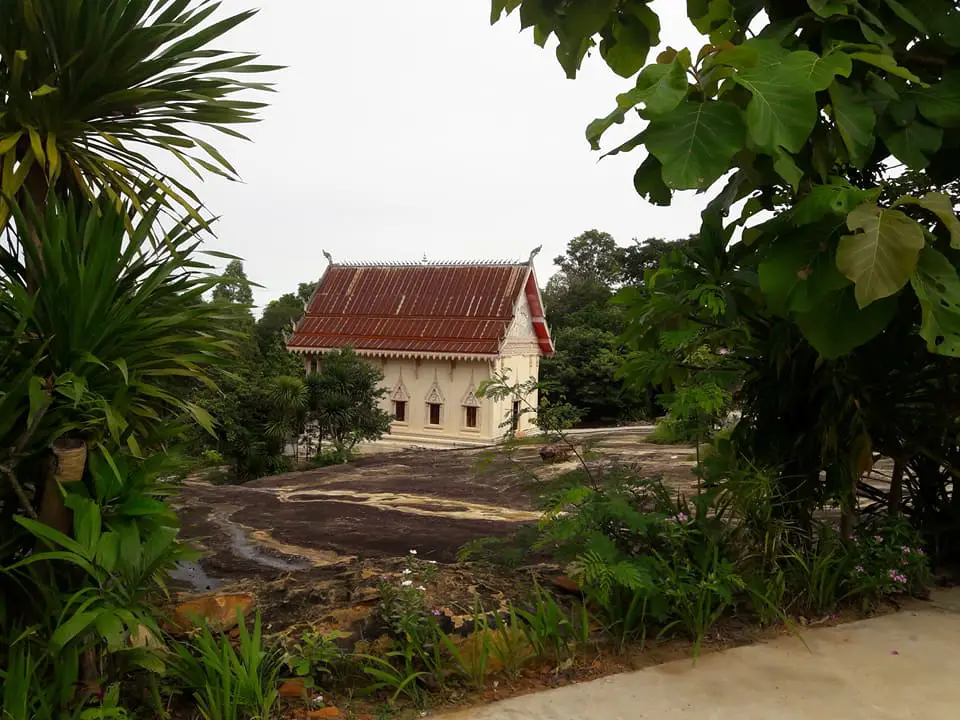
Wat Phra Phutthabat Phu Kao in Nong Bua Lam Phu Province is an old hill temple in Non Sang District, located within the wider Phu Kao landscape of Phu Kao – Phu Phan Kham National Park. The temple is important for Buddhist worship, local legend, prehistoric archaeology, forest landscape, and Isan cultural memory. Its main highlights include the sacred Buddha footprint, large footprints resembling those of a human and a dog carved on stone, and the local tale of “Phra Suphrom Wimokha and the Nine-Tailed Dog.” The temple is also associated with Tham Muem and Tham Ajarn Sim, or Tham Luang Pu Sim, where prehistoric paintings and rock carvings appear on cave walls. Wat Phra Phutthabat Phu Kao is open daily from 08.00 to 17.00 and is suitable for travelers who want to worship, study local folklore, explore prehistoric cave art, and experience the sandstone mountain environment of Phu Kao.
Wat Phra Phutthabat Phu Kao is located in Ban Dong Bak, Nikhom Phatthana Subdistrict, Non Sang District, Nong Bua Lam Phu Province. It is a local temple that functions as a gateway to one of the most meaningful cultural landscapes in the province. The site brings together a Buddhist temple, a sacred footprint, a legendary stone-footprint area, prehistoric cave art, hill paths, sandstone formations, and forest surroundings. This combination makes the temple more than a religious stop. It is a place where visitors can see how faith, nature, archaeology, and community memory exist together in one mountain setting.
Phu Kao is a complex sandstone mountain range. Its name refers to 9 hills: Phu Fang, Phu Khum Pun, Phu Han, Phu Moei, Phu Kho Mo, Phu Chan, Phu Phro, Phu Luak, and Phu Wat. The landscape has been described as resembling an upturned pan, with a relatively flatter central area surrounded by mountain ridges. This geography creates caves, rock shelters, stone platforms, natural viewpoints, and walking routes. Wat Phra Phutthabat Phu Kao is part of this landscape. The mountain is not merely a scenic background to the temple; it is part of the temple’s cultural meaning, its legends, and its archaeological significance.
The central act of visiting the temple is paying respect to the Buddha footprint. In Thai Buddhist culture, a Buddha footprint is a powerful symbol of remembrance, devotion, and the path of the Dhamma. It reminds worshippers of the Buddha’s presence through his teachings and encourages them to follow the path of spiritual practice. Reaching a Buddha footprint on a mountain adds another layer of meaning. Visitors physically ascend to a higher place while turning the mind toward respect, mindfulness, and calmness. This makes the visit both a religious and symbolic experience.
Another major feature of Wat Phra Phutthabat Phu Kao is the pair of large stone footprints known locally as the hunter’s footprint and the dog’s footprint. One resembles a large human footprint, while the other resembles the foot of a large dog. Local tradition connects these marks with the folk tale of Phra Suphrom Wimokha and the Nine-Tailed Dog. This makes the site unique because it connects real rock features with a living story preserved by the community. The footprints are not only objects to look at; they are cultural markers that allow visitors to understand how local people interpret landscape through story, belief, and moral teaching.
The tale of Phra Suphrom Wimokha and the Nine-Tailed Dog carries moral meaning. It tells of devotion, loyalty, hardship, and sacrifice, with the nine-tailed dog playing an important role as a faithful companion. When this story is connected with the carved marks on stone at Phu Kao, the landscape becomes a narrative space. Visitors do not encounter the tale only through written text or oral storytelling. They stand in front of stone traces that the community has long associated with the story. The place therefore gives form to memory, transforming folklore into something that can be experienced directly.
Tham Muem is one of the most important archaeological features associated with the temple and Phu Kao. The site consists of a large rock formation about 100 meters long, with a cave-like hollow on the eastern side. The cave mouth is about 8 meters wide and about 4 meters deep, rising approximately 2.5 meters above the rock floor. Inside the cave, prehistoric paintings and carvings appear on the ceiling and walls. The lower wall near the cave entrance contains a large carved surface about 2 meters high and 11 meters long. These details make Tham Muem a highly significant rock-art site.
The paintings and carvings at Tham Muem show that people used the Phu Kao landscape long before the present temple period. Rock art is not merely decoration. It can reflect communication, ritual, belief, memory, and the human relationship with the natural environment. At Phu Kao, prehistoric rock art appears in the same broad landscape as Buddhist worship and local legend. This allows visitors to see several time layers at once: prehistoric human activity, folk memory, and present-day Buddhist devotion.
Tham Ajarn Sim, also known as Tham Luang Pu Sim, is another important cave in the Phu Kao area. The name connects the cave with the tradition of meditation and forest practice, while the cave itself contains prehistoric paintings and carvings. This makes it meaningful from both religious and archaeological perspectives. A cave is not only a natural formation. In this context, it is a place of shelter, silence, spiritual practice, and ancient expression. Visitors who come to the temple should understand that these caves are fragile cultural heritage sites and should be treated with great care.
Wat Phra Phutthabat Phu Kao is best visited slowly. Each point has a different meaning. The Buddha footprint is the center of worship. The hunter’s footprint and dog’s footprint open the door to local legend. Tham Muem and Tham Ajarn Sim reveal prehistoric human expression. The sandstone mountain provides the physical landscape that holds all these meanings together. The present temple allows modern visitors to access these layers of faith, memory, archaeology, and nature in one place.
Tham Muem has been studied by archaeologists and researchers over several decades. Survey work includes studies by Wilhelm G. Solheim in B.E. 2506, later archaeological surveys involving the Fine Arts Department and the University of Hawaii in B.E. 2512, additional work by the Northeastern Archaeology Project in B.E. 2525, and further publication and analysis of cave art in northeastern Thailand. This history of research shows that Phu Kao is not simply a local attraction. It is part of the wider study of rock art and prehistoric human activity in Thailand.
Phu Kao now lies within Phu Kao – Phu Phan Kham National Park, which extends across Nong Bua Lam Phu, Udon Thani, and Khon Kaen. The park includes both natural and historical attractions such as Ubol Ratana Dam, reservoir viewpoints, Tad Fa Waterfall, Ho Sawan, Ham Tang Stone Formation, the hunter’s footprint, the dog’s footprint, Tham Chan Dai, Tham Suea Tok, Tham Phlan Hai, Non Nok Tha archaeological site, and Don Klang. Wat Phra Phutthabat Phu Kao is therefore part of a larger route that combines religion, archaeology, forest, rock formations, and reservoir scenery.
The natural environment around the temple includes dry dipterocarp forest, mixed deciduous forest, sandstone ridges, hill slopes, and streamside vegetation. Important tree species include teng, rang, hiang, phluang, phayom, kradon, daeng, pradu, makha tae, krabok, and bamboo in some areas. The forest setting gives the temple a quiet and natural character. Visitors should respect this environment by keeping noise low, avoiding littering, and staying on appropriate paths. A visit to the temple is also a visit to a sensitive mountain and national park landscape.
The temple is also suitable for quiet reflection and meditation. Mountain temples often create a slower rhythm than temples in town. At Wat Phra Phutthabat Phu Kao, the climb, the forest, the stone paths, the caves, and the sacred footprint all encourage visitors to move with more awareness. Those who want to practice meditation should contact the temple in advance and follow temple rules. Even for ordinary visitors, walking respectfully through the area can become a quiet form of mindfulness.
Phra Athikan Uan Papaso is identified as the abbot of Wat Phra Phutthabat Phu Kao. The abbot and the monastic community play an important role in maintaining the temple, supporting religious activities, and helping manage a site that is closely connected with national park land and archaeological resources. The temple’s setting requires cooperation between monks, local people, and public agencies. Care must balance worship, tourism, nature protection, and preservation of fragile cultural evidence.
A good visit should begin at the temple area and the Buddha footprint. After making merit and paying respect, visitors can continue to the hunter’s footprint and dog’s footprint to understand the local legend. Those with enough time can continue toward Tham Muem and Tham Ajarn Sim, where prehistoric cave art can be seen. Travelers with a full day can add nearby sites such as Ho Sawan, Ham Tang Stone Formation, Tad Fa Waterfall, or scenic points in Phu Kao – Phu Phan Kham National Park. This sequence gives a complete understanding of the area.
Visitors must be especially careful around caves and rock art. Prehistoric paintings and carvings are fragile. Do not touch cave walls, add marks, use heat-producing equipment close to the images, climb on rock surfaces, or move any objects in the area. Even small pieces of stone, pottery, or other material may be important in archaeological context. Leaving everything in place helps preserve the site for researchers, local people, and future visitors.
There is no clearly stated general temple admission fee for ordinary worship at Wat Phra Phutthabat Phu Kao. However, areas within Phu Kao – Phu Phan Kham National Park are subject to national park entrance fees. The listed rates are 20 baht for Thai adults, 10 baht for Thai children, 100 baht for foreign adults, and 50 baht for foreign children. Visitors planning to enter park-managed caves, viewpoints, or natural areas should prepare for these fees and follow current national park instructions.
Getting There from Mueang Nong Bua Lam Phu begins on Highway 2146 toward Ban Thin Subdistrict in Non Sang District for about 27 km. At Ban Thin, turn right toward Phu Kao and Ban Dong Bak in Nikhom Phatthana Subdistrict. Continue for about 11 km to Ban Dong Bak, then turn left for about 400 meters. The entrance road to Phu Kao and Wat Phra Phutthabat Phu Kao appears on the right. Continue uphill for about 2.7 km to reach the temple. A private car or hired local vehicle is the most convenient option.
Travelers should allow enough time. A short visit to the temple, Buddha footprint, and legendary footprints may take 1 to 2 hours. A more complete visit that includes Tham Muem, Tham Ajarn Sim, and nearby natural points should be planned as a half-day or full-day trip. Morning is the best time because the weather is cooler, the light is comfortable for walking and photography, and there is enough time to continue to other places in Non Sang District.
The best visiting hours are morning and late afternoon. The area includes mountain paths, rocks, cave access points, and open spaces, so midday heat can be tiring. During the rainy season, paths and rocks may become slippery. During the hot season, visitors should bring drinking water, sun protection, and shoes suitable for walking on uneven surfaces. Respectful clothing is important because the site is both a Buddhist temple and a sacred cultural area.
Proper conduct is essential. Visitors should dress modestly, avoid loud noise, keep the area clean, and avoid stepping on sacred footprints or fragile archaeological features. They should not touch paintings, carvings, cave walls, or any ancient remains. Photography should be done with care and should never damage or disturb the site. The best way to appreciate Wat Phra Phutthabat Phu Kao is to move slowly, observe carefully, and treat every point as part of a sacred and historical landscape.
The temple is suitable for many types of travelers. Buddhist visitors can pay respect to the sacred footprint. History and archaeology lovers can study cave paintings and rock carvings. Cultural travelers can learn the story of Phra Suphrom Wimokha and the Nine-Tailed Dog. Nature-oriented visitors can connect the trip with Ho Sawan, Ham Tang, Tad Fa Waterfall, and other park attractions. Families and students can use the site as a real learning space for archaeology, conservation, religion, folklore, and geography.
A half-day itinerary can begin with Wat Phra Phutthabat Phu Kao in the morning. Visitors can pay respect to the Buddha footprint, view the legendary stone footprints, and continue to one of the nearby cave-art sites if conditions are suitable. After descending from Phu Kao, they can have a meal in Non Sang District or continue toward Non Yao Beach. A full-day itinerary can add Ho Sawan, Ham Tang Stone Formation, Tad Fa Waterfall, Phu Kao – Phu Phan Kham National Park, and the Phu Aen Skywalk area.
For travelers interested in folklore, the hunter’s footprint and dog’s footprint deserve more than a quick photograph. They are a strong example of how a local community uses landscape as a cultural text. The marks on stone allow the tale of the Nine-Tailed Dog to remain attached to place. Standing before the footprints, visitors can understand how story, morality, landform, and memory come together. This is one of the most distinctive cultural experiences at Phu Kao.
For travelers interested in cave art, Tham Muem should be treated as a major highlight. It contains both painted and carved imagery, with the carved wall surface recognized as especially important. The coexistence of painted and engraved techniques in the same area makes the cave highly valuable for understanding prehistoric expression. Visitors should look carefully but never interfere with the images. The value of the cave lies in preservation, not in physical contact.
Wat Phra Phutthabat Phu Kao also helps visitors understand the broader meaning of Phu Kao. The mountain is not only a natural attraction. It has been used by people for expression, worship, storytelling, meditation, and travel over a long period. Prehistoric people left images on cave walls. Local communities connected stone footprints with legend. Buddhists continue to climb the mountain to pay respect to the sacred footprint. These layers make the site one of the richest cultural landscapes in Nong Bua Lam Phu.
The best experience at Wat Phra Phutthabat Phu Kao begins with quiet attention. Visitors should walk slowly, read available signs, observe the rocks and forest, listen to the natural surroundings, and respect those who come for worship or meditation. The temple is not valuable only because of its photo points. It is valuable because Buddhism, nature, archaeology, and folklore overlap here in a way that creates a strong identity for Nong Bua Lam Phu.
In summary, Wat Phra Phutthabat Phu Kao is one of the most important cultural and spiritual places in Non Sang District, Nong Bua Lam Phu Province. It combines a sacred Buddha footprint, legendary human and dog footprints connected with the tale of Phra Suphrom Wimokha and the Nine-Tailed Dog, Tham Muem, Tham Ajarn Sim, prehistoric paintings and carvings, and the natural setting of Phu Kao – Phu Phan Kham National Park. Visitors should allow enough time, respect both the temple and the archaeological sites, and experience the place as a deep meeting point of faith, nature, history, and local culture.
| Name | Wat Phra Phutthabat Phu Kao |
| Location | Ban Dong Bak, Nikhom Phatthana Subdistrict, Non Sang District, Nong Bua Lam Phu Province |
| Address | Moo 10, Ban Dong Bak, Nikhom Phatthana Subdistrict, Non Sang District, Nong Bua Lam Phu 39140, Thailand |
| Highlights | Sacred Buddha footprint, large human and dog footprints on stone, the folk tale of Phra Suphrom Wimokha and the Nine-Tailed Dog, Tham Muem, Tham Ajarn Sim, prehistoric paintings, and rock carvings |
| History / Period | A local hill temple within the Phu Kao landscape, associated with prehistoric cave paintings and carvings at Tham Muem and Tham Ajarn Sim |
| Name Origin | The temple name refers to the Buddha footprint, while Phu Kao refers to the 9 hills of the area: Phu Fang, Phu Khum Pun, Phu Han, Phu Moei, Phu Kho Mo, Phu Chan, Phu Phro, Phu Luak, and Phu Wat |
| Distinctive Features | A mountain temple combining Buddhist worship, local legend, prehistoric cave art, natural forest, and attractions within Phu Kao – Phu Phan Kham National Park |
| Important Elements | 1. Buddha Footprint 2. Hunter’s Footprint And Dog’s Footprint 3. Tham Muem 4. Tham Ajarn Sim Or Tham Luang Pu Sim 5. Prehistoric Paintings And Rock Carvings 6. Phu Kao Trails And Nearby Viewpoints |
| Travel Information | From Mueang Nong Bua Lam Phu, take Highway 2146 toward Ban Thin for about 27 km, turn right toward Phu Kao and Ban Dong Bak for about 11 km, turn left for about 400 meters, then continue uphill for about 2.7 km to Wat Phra Phutthabat Phu Kao |
| Current Status | An active local temple, Buddhist pilgrimage site, cultural attraction, and access point to archaeological and natural sites in the Phu Kao area |
| Open Days | Daily |
| Opening Hours | 08.00 – 17.00 |
| Fees | No general temple admission fee for ordinary worship. Phu Kao – Phu Phan Kham National Park entrance fees: Thai adult 20 baht, Thai child 10 baht, foreign adult 100 baht, foreign child 50 baht |
| Facilities | Worship area, temple grounds, uphill road to Phu Kao, Buddha footprint area, legendary footprint area, cave and archaeological walking areas, and basic park services at opened points |
| Main Areas / Zones | 1. Temple And Worship Area 2. Buddha Footprint Area 3. Hunter’s Footprint And Dog’s Footprint Area 4. Tham Muem 5. Tham Ajarn Sim Or Tham Luang Pu Sim 6. Phu Kao Nature Trail And Viewpoint Area 7. Connected Area Of Phu Kao – Phu Phan Kham National Park |
| Abbot / Caretaker | Phra Athikan Uan Papaso, Abbot Of Wat Phra Phutthabat Phu Kao; the national park landscape is also managed by the Department of National Parks, Wildlife and Plant Conservation |
| Contact Numbers | Wat Phra Phutthabat Phu Kao Tel. 088-599-2366 Phu Kao – Phu Phan Kham National Park Tel. 042-315-837, 063-648-4821 |
| Visitor Guidelines | Dress modestly, keep noise low, do not litter, do not step on or climb over sacred footprints, do not touch paintings or rock carvings, do not move archaeological materials, and follow temple and national park instructions |
| Nearby Tourist Attractions | 1. Hunter’s Footprint And Dog’s Footprint, within the temple area 2. Tham Ajarn Sim Or Tham Luang Pu Sim, about 5 km 3. Tham Muem, about 5 km 4. Ho Sawan Viewpoint, about 7 km 5. Ham Tang Stone Formation, about 8 km 6. Tad Fa Waterfall, about 15 km 7. Non Yao Beach By Ubol Ratana Dam, about 28 km 8. Phu Aen Non Sang Skywalk, about 32 km |
| Nearby Restaurants | 1. Local Restaurants In Ban Dong Bak And Nikhom Phatthana Area, about 5 km 2. Route 88 Café, Non Sang, about 24 km, Tel. 095-176-6662 3. Ahan Tam Sang Nam Pan Maprao, Non Sang, about 24 km, Tel. 082-609-8064 4. Mi Cafe, Ban Kho Subdistrict, about 30 km, Tel. 090-924-4929 5. Pung Kang, Nong Bua Lam Phu, about 40 km, Tel. 097-318-7088, 088-052-1334 6. Restaurants Around Non Yao Beach, about 28 km |
| Nearby Accommodations | 1. Phu Kao – Phu Phan Kham National Park Accommodation And Camping Area, about 20 km, Tel. 042-315-837, 063-648-4821 2. Muji House Resort Non Sang, about 24 km, Tel. 083-218-2749 3. Sabaidee @Home Nonsang, about 25 km, Tel. 095-668-7171, 063-053-3797 4. Oranee Resort Non Sang, about 32 km 5. Local Accommodations Around Non Yao Beach And Non Sang District, about 28 km |
Frequently Asked Questions (FAQ)
Q: Where is Wat Phra Phutthabat Phu Kao located?
A: Wat Phra Phutthabat Phu Kao is located in Ban Dong Bak, Nikhom Phatthana Subdistrict, Non Sang District, Nong Bua Lam Phu Province, within the Phu Kao area connected with Phu Kao – Phu Phan Kham National Park.
Q: What are the opening days and hours of Wat Phra Phutthabat Phu Kao?
A: The temple is open daily from 08.00 to 17.00.
Q: Is there an admission fee for Wat Phra Phutthabat Phu Kao?
A: There is no general temple admission fee for ordinary worship, but national park entrance fees apply for areas within Phu Kao – Phu Phan Kham National Park: Thai adult 20 baht, Thai child 10 baht, foreign adult 100 baht, and foreign child 50 baht.
Q: What is the main highlight of Wat Phra Phutthabat Phu Kao?
A: The main highlights are the Buddha footprint, the large human and dog footprints connected with the tale of Phra Suphrom Wimokha and the Nine-Tailed Dog, Tham Muem, Tham Ajarn Sim, prehistoric paintings, and rock carvings.
Q: Why are Tham Muem and Tham Ajarn Sim important?
A: Tham Muem and Tham Ajarn Sim are important cave-art sites in the Phu Kao area, containing prehistoric paintings and rock carvings that reveal early human activity and belief in the region.
Q: How is the tale of Phra Suphrom Wimokha and the Nine-Tailed Dog connected with the temple?
A: The tale is connected with the large human-like and dog-like footprints carved on stone within the temple area, which local people associate with the story of Phra Suphrom Wimokha and the Nine-Tailed Dog.
Q: Who is the abbot of Wat Phra Phutthabat Phu Kao?
A: The abbot of Wat Phra Phutthabat Phu Kao is Phra Athikan Uan Papaso.
Q: How can travelers get to Wat Phra Phutthabat Phu Kao?
A: From Mueang Nong Bua Lam Phu, take Highway 2146 toward Ban Thin for about 27 km, turn right toward Phu Kao and Ban Dong Bak for about 11 km, turn left for about 400 meters, then continue uphill for about 2.7 km to the temple.
 Category: ●Places of Worship
 Group: ●Temple
Last Update : 2 MonthAgo
 Last Update : 2 MonthAgo
 Click to Access the Navigation Map GPS
Wat Phra Phutthabat Phu Kao Map

 Art, Culture and Heritage
 Historical Sites and Monuments(4)
 Landmarks and Memorials(1)
 Art, Craft Centres, Tradition(1)
 Museums(3)
Temple(10)
Museums(3)
Temple(10)
 Other Sacred Sites(6)
 Suburban Living
 Village, Community(3)
 Nature and Wildlife
 National Parks and Marine Reserves(3)
 Mountain (Doi)(5)
 Dam, Reservoir, Lake(5)
 Waterfalls(1)
 Caves(6)
 River, Canal(2)
 Bays and Beaches(1)
 Other natural attractions(3)


